
About these posts
These posts grow out of sermons I’ve written for my local church community. You’re welcome to use them—for teaching, small groups, preaching, or personal reflection. If you share them elsewhere, please include a simple attribution. If you’d ever like to share how they’re being used, you’re welcome to reach out through the Contact button.
A few years ago, I was gifted a significant number of books. Which meant—I needed some more bookshelves! I bought the materials for two of them, and then asked for Jim’s help to assemble them. Now, I spread out the instructions and was reading through them—while at the same time, Jim was already putting the pieces together. He knows a bit about building things. And between the both of us, the shelves got finished.
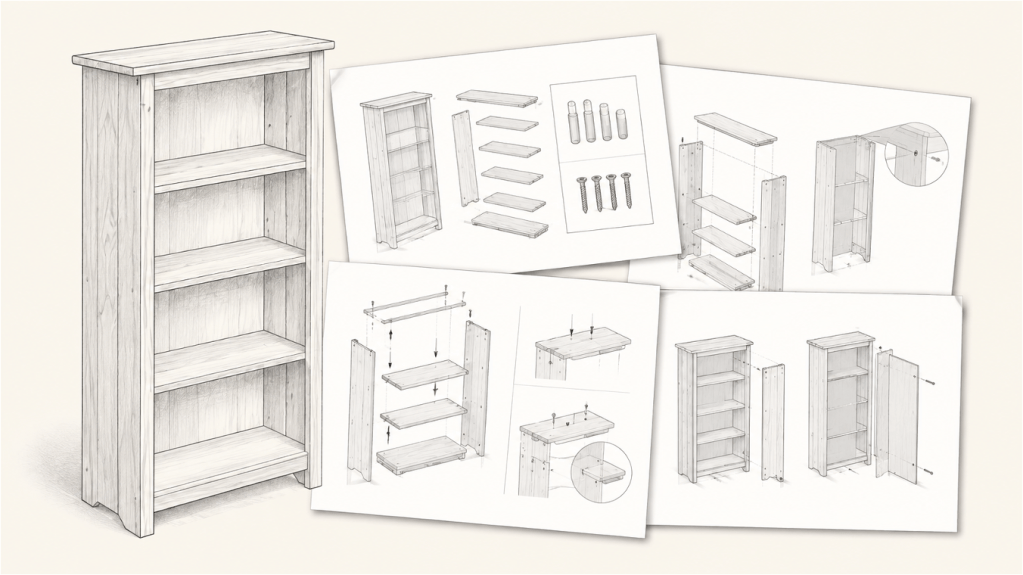
Those instructions—weren’t the bookshelves themselves. They were the plan that showed us how all those separate pieces were meant to fit together—and what they would become when we finished. When we come to Exodus 25 through 27, it can feel as though we’ve opened another set of assembly instructions. If you’ve ever done a read through the Bible, these are some of the chapters that it’s really tempting to skip!
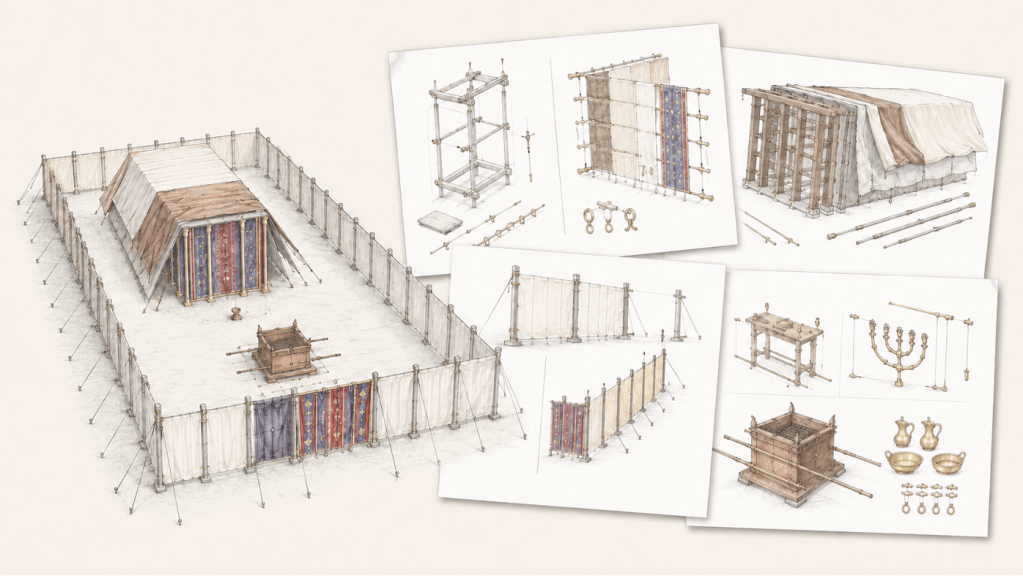
The details may feel like an old IKEA instruction manual: boring, repetitive, and irrelevant. Make the table this long. Put the rings here. Insert the poles there. Make fifty loops and fifty clasps. Use this kind of wood, this color of fabric, and this much gold. Just like any instruction manual, it can be tempting to skim through the details so we can get to the finished product! But Israel wasn’t assembling a bookshelf. They were preparing a dwelling place for God in the middle of their camp!
In the Old Covenant everything associated with worship had to partake of proper symbolism, so that the presence of God and the ways of salvation could be communicated with people—visually, and even tactilely.[1] The pieces are visual aids. God is teaching a group of former slaves—who have only known pagan Egyptian temples—how a Holy God relates to His people. These instructions showed them how wood, fabric, curtains, furniture, bread, oil, and fire would come together to create a place where the holy God would live among His people. Last week, we heard God say, “Have them make a sanctuary for me, and I will dwell among them.” We looked at the design of the tabernacle and the ark of the covenant, and discovered that:
God’s desire is to dwell among His people. We make room for His presence in our life together.
Today we’ll be covering some of the items surrounding and inside the tabernacle, and the elements that were a part of the space the people were preparing for Him. Because without God’s presence, it would have just been an elaborate tent in the wilderness. But when God chose to make His home there, wilderness ground became holy ground. The point of this information is not about the details of the Tabernacle, or the rituals that are set in place. The theme of the upcoming chapters is about God’s presence in the midst of his people.[2]
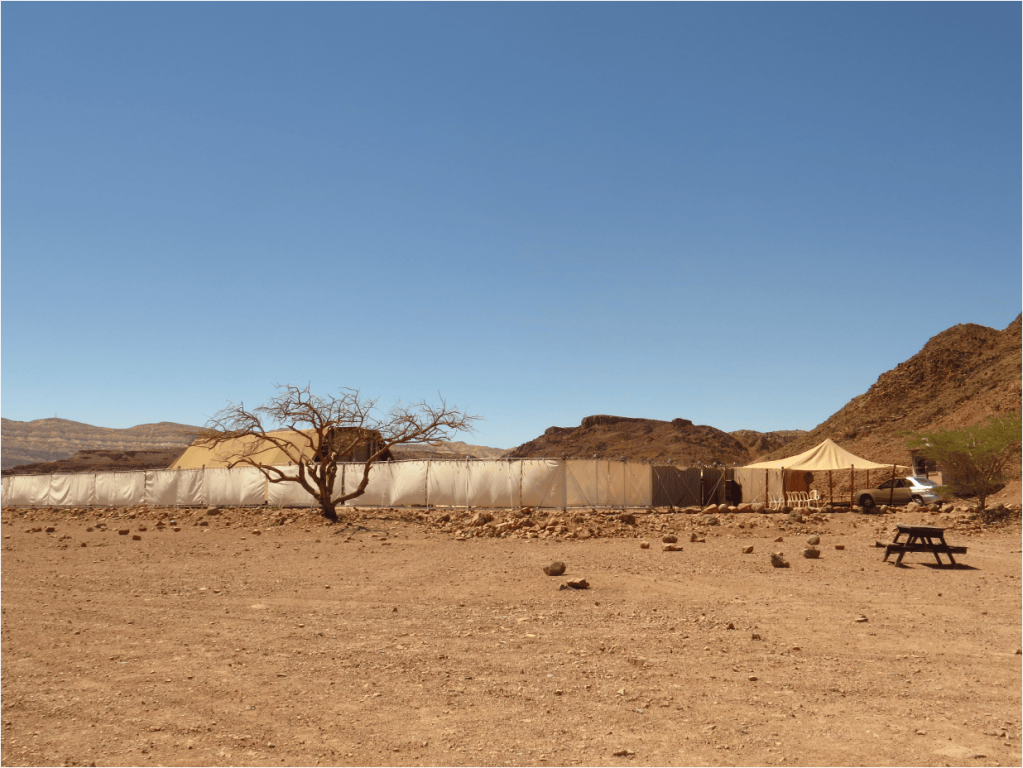
Here’s a picture that I took of a replica of the Tabernacle at Timnah Park in Israel. I’ll be showing a few pictures throughout this message of the contents to give you an idea of what was inside the courtyard and the tent. In the late 1960’s a Midianite tent was found at Timnah[3], woven of flax and wool and dyed red and yellow.[4] Keep in mind—there is no rendering, sketch or model of the Tabernacle that is absolutely correct, because the information we have is too incomplete and ambiguous. The reality is that we don’t know in what form it existed.[5] Whatever the Tabernacle may have looked like, and however it may have worked…[6] whether these items were an exact depiction, or symbolic material, all of it is based on the theological assertion that God is present with his people at every level.[7]
There are definite shadows of Jesus in the meaning of some of details, but not everything in these verses are about applying “this” to “that”. All of the materials involved are precious and suggest that anything, or anyone, must be better, the closer they get to the presence of God.[8] We’re going to highlight some of the things that are important, and why, as we look at The God who Comes Near to his people in Exodus. So, rather than getting lost in the measurements and materials, we are going to ask what all these details reveal about God. And beneath all of them is one central truth:
God’s presence transforms ordinary space into sacred space.
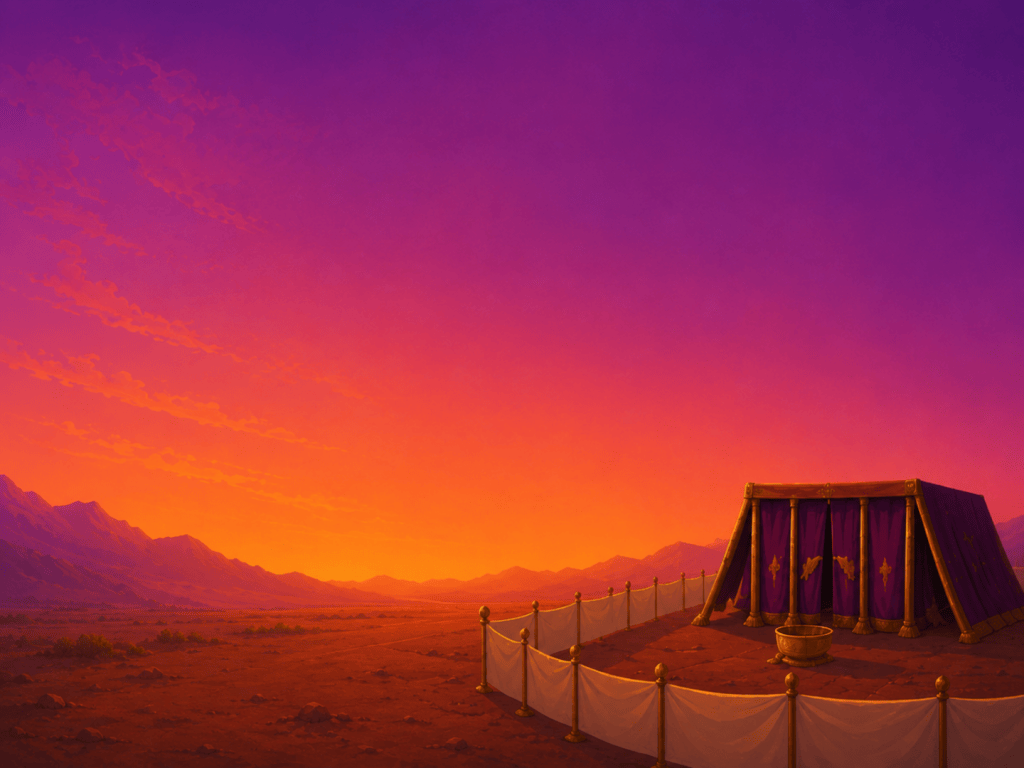
The tabernacle is the meeting place of heaven and earth.[9] The Hebrew word for tabernacle is mishkan, meaning “dwelling place.” This was God’s tent—God’s home—in the middle of Israel’s camp, with the people’s tents gathered around His.[10] That helps explain what we are about to see. God’s dwelling has rooms, curtains, a table, dishes, lamps, a courtyard, and a place where food is prepared. But it isn’t an ordinary home. It is the royal dwelling of Israel’s holy King. God said:
The Table
23 Make a table of acacia wood—two cubits long, a cubit wide and a cubit and a half high. 24 Overlay it with pure gold and make a gold molding around it. 25 Also make around it a rim a handbreadth wide and put a gold molding on the rim. 26 Make four gold rings for the table and fasten them to the four corners, where the four legs are. 27 The rings are to be close to the rim to hold the poles used in carrying the table. 28 Make the poles of acacia wood, overlay them with gold and carry the table with them. 29 And make its plates and dishes of pure gold, as well as its pitchers and bowls for the pouring out of offerings. 30 Put the bread of the Presence on this table to be before me at all times. Exodus 25:23-30 NIV
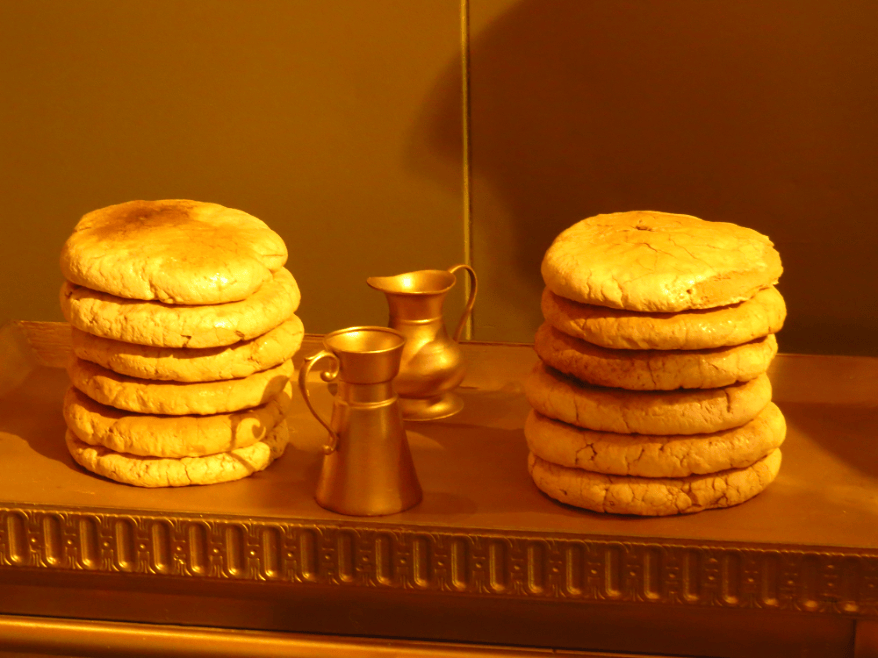
Tables are for food and drink. This table is made of wood and covered with gold, like the ark. And like the ark, it can only be moved by inserting poles through the rings attached to the Table.[11] The table was smaller than the ark, and had a molding around the top that protected items from accidentally slipping off the edges.[12] God lived in the ‘back room’ of the tabernacle, by means of the ark. In the front room were pieces of furniture. The table symbolizes that God inhabits his house—in much the same way that they lived in theirs.[13] But a king deserved to eat in style, and God required his dishes to be made out of pure gold.[14]
The table will hold large plates, small bowls, pitchers, bowls,[15] and bread. There was a plate on which the Bread of the Presence was placed, a small pan for frankincense, a pitcher for wine, and bowl into which the wine was poured out.[16] The Talmud understands the bowls to be the molds that the loaves were placed in after baking so that they would keep their shape.[17] Bread is a staple—a basic necessity. This bread symbolized the daily need for sustenance, and its presence on the table symbolizes the people’s dependance on God for providing it.[18] Leviticus tells us there were twelve loaves in all, possibly symbolizing the twelve tribes of Israel.[19]
It is called the Bread of the Presence, or ‘Face Bread’, cakes deposited to Yahweh’s face.[20] He is not present IN the bread…it is the bread who is placed before him.[21] And it is not offered directly in his presence, at the ark, but as a token, at the table.[22] In other cultures in the Ancient Near East, bread would be set out before the gods.[23] But they would do it daily—because the gods need to eat. Yahweh however—does not need to eat—and the bread for the table in the tabernacle, is only made once a week.[24]
God’s presence transforms ordinary space into sacred space.
A table, bread, dishes, and pitchers were ordinary parts of a household. But here they stood before the Holy King, in the dwelling place of God. There’s more. God said:
The Lampstand
31 Make a lampstand of pure gold. Hammer out its base and shaft, and make its flowerlike cups, buds and blossoms of one piece with them. 32 Six branches are to extend from the sides of the lampstand—three on one side and three on the other. 33 Three cups shaped like almond flowers with buds and blossoms are to be on one branch, three on the next branch, and the same for all six branches extending from the lampstand. 34 And on the lampstand there are to be four cups shaped like almond flowers with buds and blossoms. 35 One bud shall be under the first pair of branches extending from the lampstand, a second bud under the second pair, and a third bud under the third pair—six branches in all. 36 The buds and branches shall all be of one piece with the lampstand, hammered out of pure gold. 37 Then make its seven lamps and set them up on it so that they light the space in front of it. 38 Its wick trimmers and trays are to be of pure gold. 39 A talent of pure gold is to be used for the lampstand and all these accessories. 40 See that you make them according to the pattern shown you on the mountain. Exodus 25:31-40 NIV
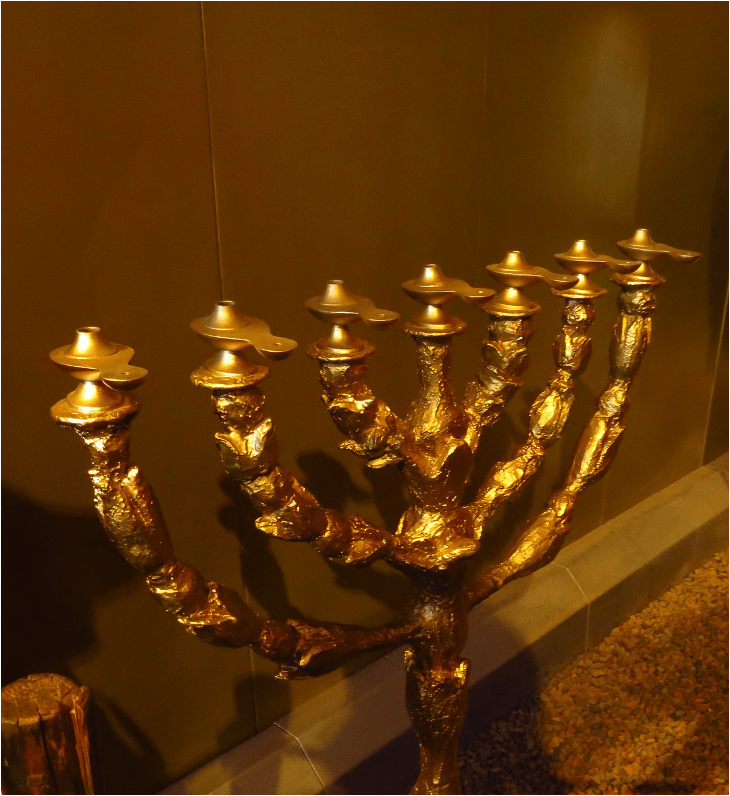
Every Israelite tent needed a lamp at night. But this lamp burned continually before the Lord—a living light within God’s dwelling. And everything is made out of pure gold. The word for lampstand in the Hebrew is ‘menorah.’[25] Holy flames and sacred trees have cosmic significance. The lampstand symbolized the tree of life, God’s gift of life to his people.[26] The pedestal was the tree trunk, and three branches came out from either side of it.[27] Seven lamps are at the end of the trunk and each branch—in a gold flower on a gold tree.[28] Olive trees and branches were often used to represent Israel, and miraculous divine deliverance. [29] The stem of the word for almond means to be watchful, wakeful, and vigilant, and the almond flower is a symbol of life renewed and sustained.[30] Eventually, Aaron’s almond wood staff that miraculously budded was eventually included in the contents of the ark.[31] So, this lampstand symbolizes God’s provision as he watches over his people, the nation of Israel. [32] Again,
God’s presence transforms ordinary space into sacred space.
The Lampstand was a reminder of God’s presence in their midst—always awake—a living fire.[33] Next we come to the tabernacle itself and the materials and structure. It’s a longer section, so bear with me, and I’ll summarize a few of the important things after that.
The Tabernacle
26 Make the tabernacle with ten curtains of finely twisted linen and blue, purple and scarlet yarn, with cherubim woven into them by a skilled worker. 2 All the curtains are to be the same size—twenty-eight cubits long and four cubits wide. 3 Join five of the curtains together, and do the same with the other five. 4 Make loops of blue material along the edge of the end curtain in one set, and do the same with the end curtain in the other set. 5 Make fifty loops on one curtain and fifty loops on the end curtain of the other set, with the loops opposite each other. 6 Then make fifty gold clasps and use them to fasten the curtains together so that the tabernacle is a unit. 7 Make curtains of goat hair for the tent over the tabernacle—eleven altogether. 8 All eleven curtains are to be the same size—thirty cubits long and four cubits wide. 9 Join five of the curtains together into one set and the other six into another set. Fold the sixth curtain double at the front of the tent. 10 Make fifty loops along the edge of the end curtain in one set and also along the edge of the end curtain in the other set. 11 Then make fifty bronze clasps and put them in the loops to fasten the tent together as a unit. 12 As for the additional length of the tent curtains, the half curtain that is left over is to hang down at the rear of the tabernacle. 13 The tent curtains will be a cubit longer on both sides; what is left will hang over the sides of the tabernacle so as to cover it. 14 Make for the tent a covering of ram skins dyed red, and over that a covering of the other durable leather. 15 Make upright frames of acacia wood for the tabernacle. 16 Each frame is to be ten cubits long and a cubit and a half wide, 17 with two projections set parallel to each other. Make all the frames of the tabernacle in this way. 18 Make twenty frames for the south side of the tabernacle 19 and make forty silver bases to go under them—two bases for each frame, one under each projection. 20 For the other side, the north side of the tabernacle, make twenty frames 21 and forty silver bases—two under each frame. 22 Make six frames for the far end, that is, the west end of the tabernacle, 23 and make two frames for the corners at the far end. 24 At these two corners they must be double from the bottom all the way to the top and fitted into a single ring; both shall be like that. 25 So there will be eight frames and sixteen silver bases—two under each frame. 26 Also make crossbars of acacia wood: five for the frames on one side of the tabernacle, 27 five for those on the other side, and five for the frames on the west, at the far end of the tabernacle. 28 The center crossbar is to extend from end to end at the middle of the frames. 29 Overlay the frames with gold and make gold rings to hold the crossbars. Also overlay the crossbars with gold. 30 Set up the tabernacle according to the plan shown you on the mountain. 31 Make a curtain of blue, purple and scarlet yarn and finely twisted linen, with cherubim woven into it by a skilled worker. 32 Hang it with gold hooks on four posts of acacia wood overlaid with gold and standing on four silver bases. 33 Hang the curtain from the clasps and place the ark of the covenant law behind the curtain. The curtain will separate the Holy Place from the Most Holy Place. 34 Put the atonement cover on the ark of the covenant law in the Most Holy Place. 35 Place the table outside the curtain on the north side of the tabernacle and put the lampstand opposite it on the south side. 36 For the entrance to the tent make a curtain of blue, purple and scarlet yarn and finely twisted linen—the work of an embroiderer. 37 Make gold hooks for this curtain and five posts of acacia wood overlaid with gold. And cast five bronze bases for them. Exodus 26:1-37 NIV
In case your eyes have started to glaze over, let me just highlight a couple of things about the structure. The frames for the tabernacle are made of acacia wood. When put together, the beams and fabric would weigh a lot! In Numbers, we learn that there are wagons and oxen that were used to transport all the stuff needed for the tabernacle.[34] The tabernacle structure has ten panels that are made out of linen and richly colored wool fabric,[35] which is joined by gold loops and clasps.[36] These curtains are expensive and beautifully fashioned.[37] Over those, another set of curtains are made to shelter and protect the Tabernacle.[38] Then there were tanned rams’ skins, and another layer of durable leather, made from the hides of sea sows that would protect from the sun, rain, snow, frost, dust, and sand.[39] Libyans had tough leather covers in the Early Iron Age, and Bedouin do it today to shield the tent from the elements…but it also makes the inside much darker.[40] All together—four layers—two of fabric and two of skins—comprise the portable shrine.[41]
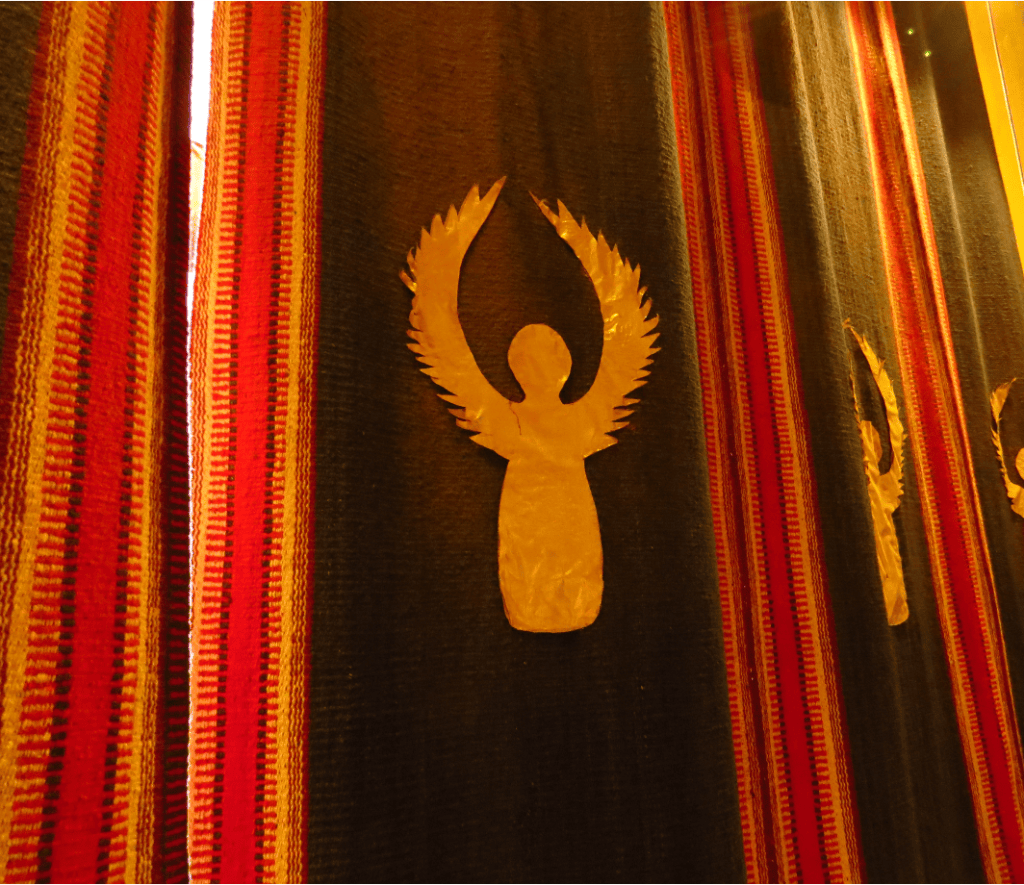
The Holy of Holies is God’s special residence.[42] There is a curtain at the entrance to the tent, and a veil that separates the holy place from the most holy place.[43] The curtains, or veils, are to be woven by skilled worker, and have cherubim woven into them, a reminder that the tabernacle is an earthly representation of the heavenly tabernacle.[44] Remember what we said last week about cherubim. They could be animals that were part lion, part bird, and probably part human. The ark of the covenant also has cherubim on it. It’s hard to imagine what these curtains would have looked like.
This Persion-era tapestra [45] was found frozen in Siberia with winged quadrupeds and other beasts.[46] It is the oldest surviving pile carpet. Look at all the amazing details and animals woven into it! The curtains of the tabernacle may have been woven with just as much intricacy and detail. Together, the curtains and veil establish the boundaries of holy space. Linen, wool, wood, leather—these were materials used in ordinary tents. But gathered around the presence of God, they marked out sacred space. Again, God says,
The Altar of Burnt Offering
27 Build an altar of acacia wood, three cubits high; it is to be square, five cubits long and five cubits wide. 2 Make a horn at each of the four corners, so that the horns and the altar are of one piece, and overlay the altar with bronze. 3 Make all its utensils of bronze—its pots to remove the ashes, and its shovels, sprinkling bowls, meat forks and firepans. 4 Make a grating for it, a bronze network, and make a bronze ring at each of the four corners of the network. 5 Put it under the ledge of the altar so that it is halfway up the altar. 6 Make poles of acacia wood for the altar and overlay them with bronze. 7 The poles are to be inserted into the rings so they will be on two sides of the altar when it is carried. 8 Make the altar hollow, out of boards. It is to be made just as you were shown on the mountain. Exodus 27:1-8 NIV
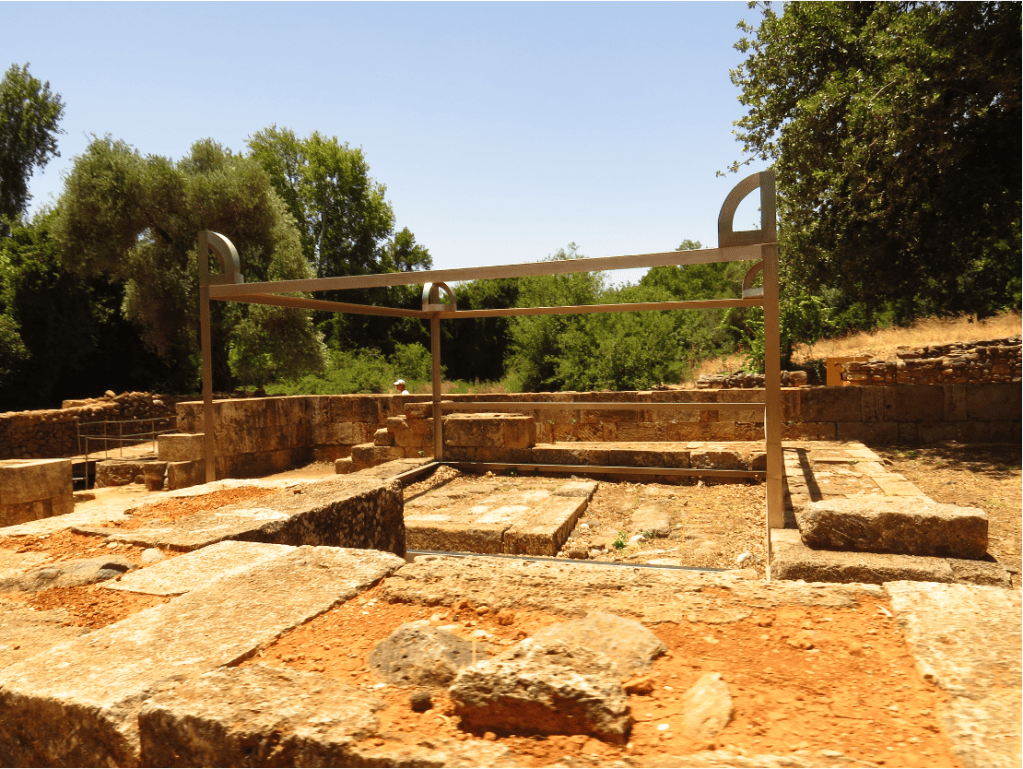
The altar of burnt offering, or Bronze Altar,[47] was 7 ½ feet square and 4 ½ feet high.[48] Here’s a picture of the framework of an altar that was at the Temple at Dan in Israel. That one was considerably larger, because it stayed in place. The one for the tabernacle was still high and the priests would use a ramp to get to the top, but it also had rings and poles to make it portable.[49]
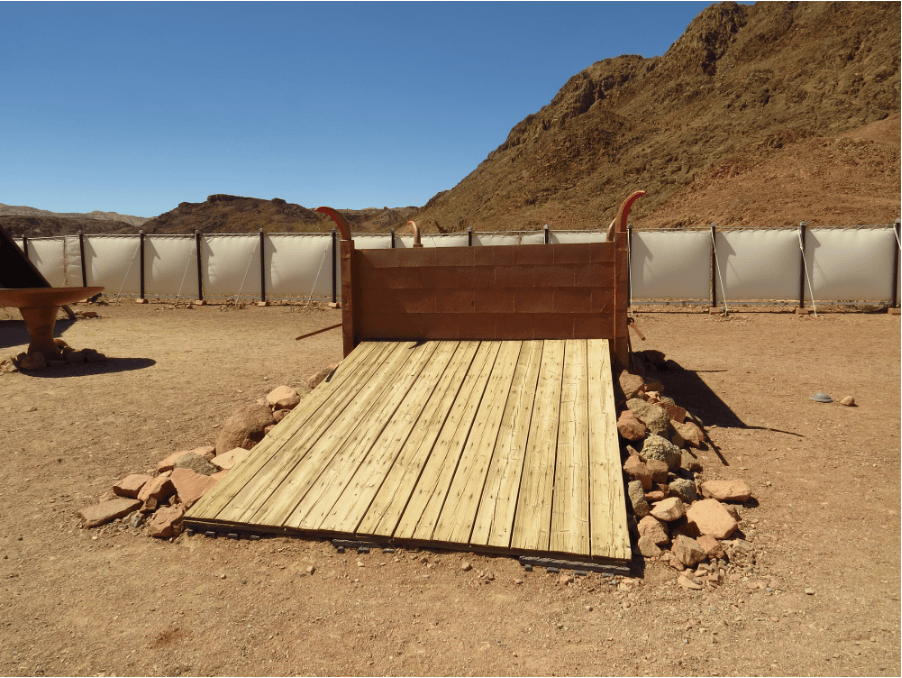
The horns are symbols of strength, power,[50] and fertility.[51] They make the altar look impressive, almost like a crown.[52] The horns could hold the sacrifice in place,[53] or be a refuge for a condemned individual.[54] Whatever they represented, they were the holiest part of the Altar.[55] A wooden one covered with metal is unlikely to have been functional—and may be a hypothetical structure.[56] It’s not practical to burn sacrifices on a wooden altar, even if it IS covered in copper![57] But apparently it is supposed to function as the main sacrificial altar for the Israelites.[58] It is basically God’s large outdoor grill, where He required that sacrifices be cooked, eaten in His presence, and shared in corporate worship.[59] There’s more:
The Courtyard
9 Make a courtyard for the tabernacle. The south side shall be a hundred cubits long and is to have curtains of finely twisted linen, 10 with twenty posts and twenty bronze bases and with silver hooks and bands on the posts. 11 The north side shall also be a hundred cubits long and is to have curtains, with twenty posts and twenty bronze bases and with silver hooks and bands on the posts. 12 The west end of the courtyard shall be fifty cubits wide and have curtains, with ten posts and ten bases. 13 On the east end, toward the sunrise, the courtyard shall also be fifty cubits wide. 14 Curtains fifteen cubits long are to be on one side of the entrance, with three posts and three bases, 15 and curtains fifteen cubits long are to be on the other side, with three posts and three bases. 16 For the entrance to the courtyard, provide a curtain twenty cubits long, of blue, purple and scarlet yarn and finely twisted linen—the work of an embroiderer—with four posts and four bases. 17 All the posts around the courtyard are to have silver bands and hooks, and bronze bases. 18 The courtyard shall be a hundred cubits long and fifty cubits wide, with curtains of finely twisted linen five cubits high, and with bronze bases. 19 All the other articles used in the service of the tabernacle, whatever their function, including all the tent pegs for it and those for the courtyard, are to be of bronze. Exodus 27:9-19 NIV
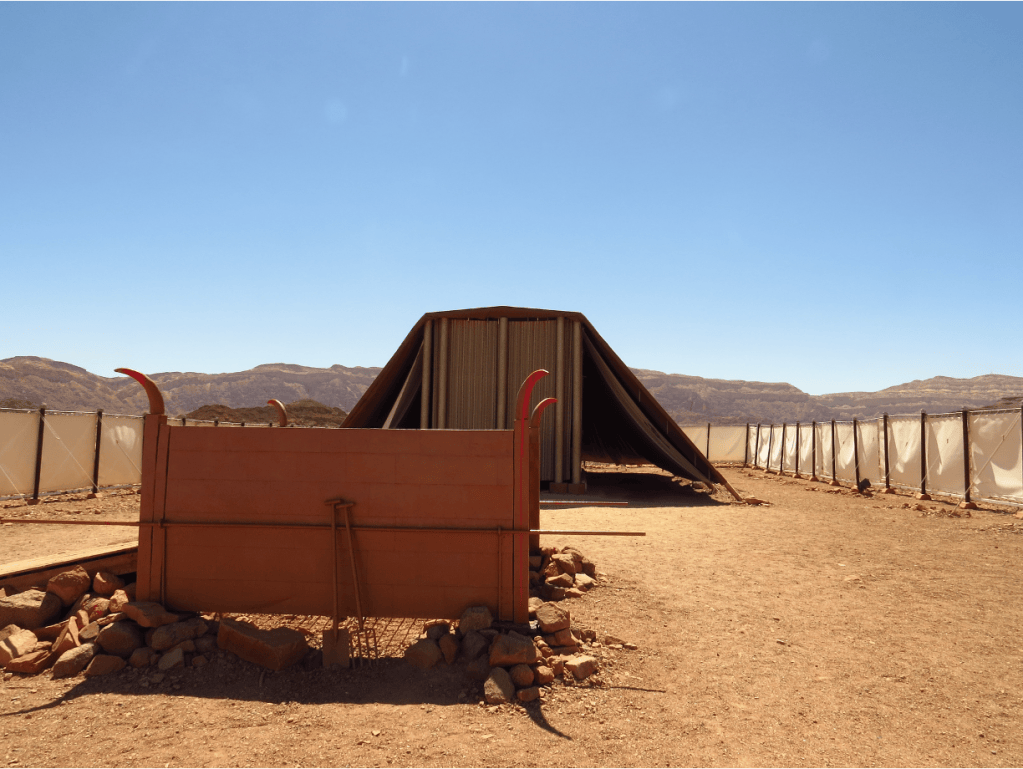
In the ancient Near East, from village houses to urban palaces—EVERYONE had a courtyard space. The warm, dry climate meant that people would use outdoor space to sit, to keep animals, or to roast large pieces of meat.[60] For people living in tents, the open space around their tents served much the same purpose—a place to sit, work, cook, and tend animals. The altar and courtyard are where the people gather at God’s house. Now, the ancient Israelites would worship AT God’s house, but not IN his house—the meat was cooked outside, and the meal was eaten outside.[61] His servants, the priests, enter his home and come and go, but everyone else met with him outdoors.[62] During times of sacrifice, there would be a constant stream of people entering the courtyard, watching their sacrifice prepared, receiving it from the priests, sitting and eating as households, and then departing for their own homes.[63] Walls around the outside set the boundary to protect space. For the tabernacle, the courtyard space was controlled—for the safety of the people. It was the dividing line between the sacred space and the world outside.[64]
God’s presence transforms ordinary space into sacred space.
Sacred space—was not ultimately about a particular set of coordinates. Wherever God made His dwelling among them, ordinary wilderness ground became holy ground. All of the pieces of the tabernacle are portable, and so is God’s Presence—so that the people have to follow to any place at a moment’s notice.[65] The poles and rings reveal that this house travels with them. One more note:
Oil for the Lampstand
20 Command the Israelites to bring you clear oil of pressed olives for the light so that the lamps may be kept burning. 21 In the tent of meeting, outside the curtain that shields the ark of the covenant law, Aaron and his sons are to keep the lamps burning before the Lord from evening till morning. This is to be a lasting ordinance among the Israelites for the generations to come. Exodus 27:20-21 NIV
The Israelites have lamps in their own tents at night, so, as Douglas Stuart notes, it would not have been polite for them—to have denied Yahweh the same courtesy.[66] Olives were a staple in the Mediterranean diet. The olive tree symbolized fertility in many biblical passages, and olive oil enhances the tree-of-life symbolic value already present in the lamp stand.[67] Olive oil is more valuable than oil that came from flax, sesame seed, or animal fats.[68] This oil had to be extracted and pounded by hand. Doing so would give off almost no smoke,[69] which could smudge the curtains.[70]
The lamps in the tabernacle were lit when the sun went down each day. God does not sleep—so his lamp should not go out.[71] The light is a welcome sign that someone is home.[72] “We’ll leave the light on for you.” Tending the lamps is the priests’ constant duty forever.[73] Later, Jesus will call Himself the world’s Menorah—[74], the Light of the World, and He will call His followers to keep their lamps burning— to live ready and faithful.
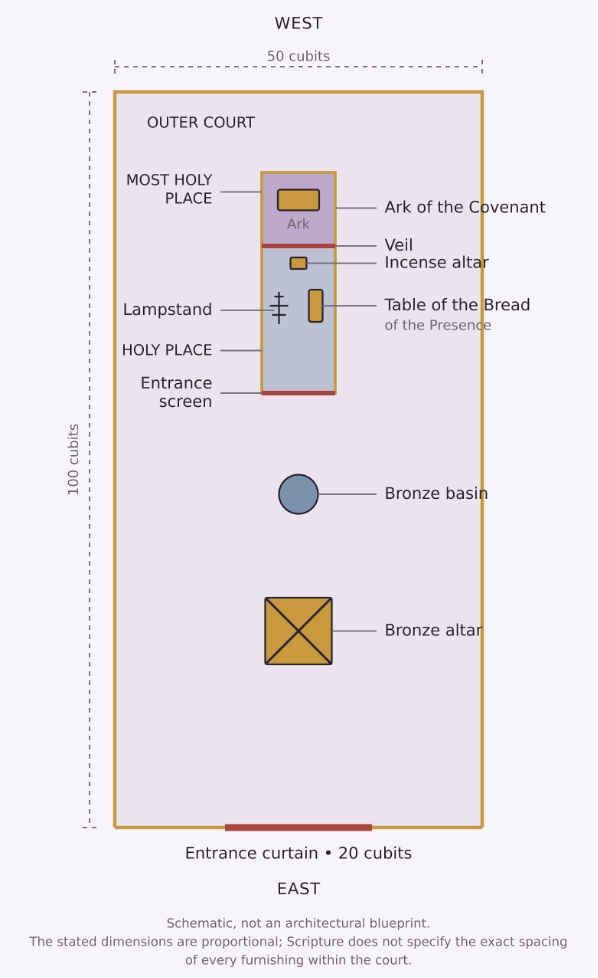
Let’s put it all together in summary now. God’s desire is to dwell among His people. He has a tent in the wilderness. It is his home among his people, and the Israelites pitch their tents around God’s tent. The rings and poles meant that whenever God moved, the people of Israel moved with him. His place faced east and had two rooms—the holy place, and the most holy place, divided by a curtain. Inside the main room, a table and a lampstand were set up, providing food and drink, and light.[75] The incense altar will also be a part of this room, and will get talked about later, in chapter 30. Curtains marked the holiness of the One who lived there. Outside, an altar and courtyard provided a place for the people to worship, and a big grill to sacrifice meat so the people would eat in His presence.[76] The tabernacle—was a microcosm of creation itself…order in the middle of chaos, an ideal world, a building project that is meant to return to the splendor before the Fall.[77] It was a tent in the wilderness—but because God made His home there, it became holy ground: a piece of Eden, a meeting place between heaven and earth. As Peter Enns writes, it is a piece of holy ground amid a world that has lost its way.[78] The gold did not make it sacred. The curtains did not make it sacred. The furniture did not make it sacred. God’s presence made it sacred.
God’s presence transforms ordinary space into sacred space.
All of these items are important symbols. But no one would walk away from the tabernacle and say, “Wow, what a bronze altar!”, or “What curtain flaps!”, or “Best incense I’ve ever smelled.!” What they would say, is, ‘What a God!’[79] But there was still a veil. God had come near, but access to His presence remained guarded. The Israelites could gather at God’s house, but most of them could not enter it. Only the priests entered the Holy Place, and only the high priest could pass through the veil into the Most Holy Place. But the veil would not have the final word. When Jesus died, the curtain in the temple was torn from top to bottom. Hebrews tells us that through Jesus, a new and living way has been opened. Through His body, Jesus made a way for US to draw near to God. Sacred space is no longer confined to a tent in the wilderness or a temple in Jerusalem. God makes His home among His people.
Even the room we meet in is ordinary space. It is a rented room in a building that was once a factory. There is nothing inherently sacred about these walls, this carpet, or this equipment. But when God’s people gather here to worship, to pray, to hear His Word, and to come to the table together, God meets us here. God’s presence transforms ordinary space into sacred space.
In a few minutes, we come to a table with ordinary bread and an ordinary cup. There is nothing impressive about them. But they point us to the body of Jesus, given for us, and the blood of Jesus, poured out for us. They remind us that the veil has been opened and that Jesus has made a way for us to come near. So as we come to the table today, we don’t have to remain at a distance. We draw near—not because we have made ourselves worthy, but because Jesus has made the way.
We come to remember the God who desired to dwell among His people. We come to remember the Savior who gave Himself to bring us near. And we come knowing that the God who made His home among Israel still makes His home among His people today.
PRAYER: Holy God, You have always desired to draw near to the humans you created, and You made Your home among Your people in the wilderness, Thank You that through Jesus, the veil has been opened and a new and living way has been made. As we prepare to come to the table, quiet our hearts. Help us bring You our sin, our sorrow, our gratitude, and our hope. Turn our attention away from the ordinary bread and cup to the extraordinary grace they proclaim: the body of Christ given for us and the blood of Christ poured out for us. Meet us here, Lord. Make Your presence known among us, and remind us that together as Your people—we have are welcomed, forgiven, and brought near through Jesus. Amen.
Bibliography
Books
Childs, Brevard S., The Book of Exodus: A Critical, Theological Commentary, Old Testament Library, Philadelphia: Westminster Press, 1974.
Durham, John I., Exodus, Word Biblical Commentary, Waco: Word Books, 1987.
Enns, Peter, Exodus, NIV Application Commentary, Grand Rapids: Zondervan, 2000.
Hamilton, Victor P., Exodus: An Exegetical Commentary, Grand Rapids: Baker Academic, 2011.
Meyers, Carol, Exodus, New Cambridge Bible Commentary, Cambridge: Cambridge University Press, 2005.
Propp, William H. C., Exodus 19–40: A New Translation with Introduction and Commentary, Anchor Bible 2A, New York: Doubleday, 2006.
Sarna, Nahum M., Exodus: The Traditional Hebrew Text with the New JPS Translation, JPS Torah Commentary, Philadelphia: The Jewish Publication Society, 1991.
Stuart, Douglas K., Exodus, New American Commentary, Volume 2, Nashville: B&H Publishing Group, 2006.
Articles and Online Sources
Gordon, Bonnie J., “Mining the Evidence,” Medium, April 12, 2024, accessed August 10, 2026, https://medium.com/@goshen2sinai/mining-the-evidence-70b678137061.
Ninara, “Y1A2617 Hermitage, St. Petersburg,” photograph, June 17, 2015, Wikimedia Commons, https://commons.wikimedia.org/wiki/File:Y1A2617_Hermitage,_St._Petersburg_(21409212769).jpg.
—
Small Group Questions
The God Who Comes Near. Week Three: Sacred Space
Exodus 25:23-27:21
Icebreaker
- Tell about something you assembled from instructions. Did you follow them carefully, improvise as you went, or ask someone else to take over? How did it turn out?
These chapters can feel like a long set of assembly instructions. Yet each detail helps Israel understand what it means for the holy God to live among His people. As you work through the different areas and objects of the tabernacle, consider what they reveal about God and about the people He was forming Israel to become.
The Table
Read Exodus 25:23–30 NIV
23 Make a table of acacia wood—two cubits long, a cubit wide and a cubit and a half high. 24 Overlay it with pure gold and make a gold molding around it. 25 Also make around it a rim a handbreadth wide and put a gold molding on the rim. 26 Make four gold rings for the table and fasten them to the four corners, where the four legs are. 27 The rings are to be close to the rim to hold the poles used in carrying the table. 28 Make the poles of acacia wood, overlay them with gold and carry the table with them. 29 And make its plates and dishes of pure gold, as well as its pitchers and bowls for the pouring out of offerings. 30 Put the bread of the Presence on this table to be before me at all times.
Discussion
- The bread was called the Bread of the Presence, or “Bread of the Face,” because it was continually placed before God. What does this language suggest about Israel living before the face of God?
- A table, dishes, pitchers, and bread were ordinary household objects. What else made them special?
- If your household table could tell the story of your relationship with God and others, what would it reveal about gratitude, provision, hospitality, or fellowship?
- The table held twelve loaves of bread, possibly representing the twelve tribes of Israel. What might the continual presence of this bread have communicated to the people about God’s provision and their dependence upon Him?
- In what area of life do you most need to trust that God sees your needs and will continue to provide?
The Lampstand
Read Exodus 25:31–40 NIV
Make a lampstand of pure gold. Hammer out its base and shaft, and make its flowerlike cups, buds and blossoms of one piece with them. 32 Six branches are to extend from the sides of the lampstand—three on one side and three on the other. 33 Three cups shaped like almond flowers with buds and blossoms are to be on one branch, three on the next branch, and the same for all six branches extending from the lampstand. 34 And on the lampstand there are to be four cups shaped like almond flowers with buds and blossoms. 35 One bud shall be under the first pair of branches extending from the lampstand, a second bud under the second pair, and a third bud under the third pair—six branches in all. 36 The buds and branches shall all be of one piece with the lampstand, hammered out of pure gold. 37 Then make its seven lamps and set them up on it so that they light the space in front of it. 38 Its wick trimmers and trays are to be of pure gold. 39 A talent of pure gold is to be used for the lampstand and all these accessories. 40 See that you make them according to the pattern shown you on the mountain.
Discussion
- What words and images from the description of the lampstand evoke the appearance of a living tree?
- How might the lampstand’s branches, flowers, buds, and blossoms have reminded Israel of Eden and the tree of life?
- The Hebrew word associated with the almond tree also carries the idea of being watchful or wakeful. What might a continually burning, almond-shaped lampstand communicate about God?
- Imagine entering the darkened Holy Place and seeing the golden lampstand burning. What feelings or thoughts might that sight awaken in you?
- Where do you presently need the reminder that God remains awake, attentive, and watchful over His people?
The Tabernacle
Read Exodus 26:1–6, 14–17, and 29–35 NIV
Make the tabernacle with ten curtains of finely twisted linen and blue, purple and scarlet yarn, with cherubim woven into them by a skilled worker. 2 All the curtains are to be the same size—twenty-eight cubits long and four cubits wide. 3 Join five of the curtains together, and do the same with the other five. 4 Make loops of blue material along the edge of the end curtain in one set, and do the same with the end curtain in the other set. 5 Make fifty loops on one curtain and fifty loops on the end curtain of the other set, with the loops opposite each other. 6 Then make fifty gold clasps and use them to fasten the curtains together so that the tabernacle is a unit.
Make for the tent a covering of ram skins dyed red, and over that a covering of the other durable leather. 15 “Make upright frames of acacia wood for the tabernacle. 16 Each frame is to be ten cubits long and a cubit and a half wide, 17 with two projections set parallel to each other. Make all the frames of the tabernacle in this way.
Overlay the frames with gold and make gold rings to hold the crossbars. Also overlay the crossbars with gold. 30 “Set up the tabernacle according to the plan shown you on the mountain. 31 “Make a curtain of blue, purple and scarlet yarn and finely twisted linen, with cherubim woven into it by a skilled worker. 32 Hang it with gold hooks on four posts of acacia wood overlaid with gold and standing on four silver bases. 33 Hang the curtain from the clasps and place the ark of the covenant law behind the curtain. The curtain will separate the Holy Place from the Most Holy Place. 34 Put the atonement cover on the ark of the covenant law in the Most Holy Place. 35 Place the table outside the curtain on the north side of the tabernacle and put the lampstand opposite it on the south side.
Discussion
- Linen, wool, wood, leather, clasps, loops, and curtains were ordinary materials. What made them part of sacred space?
- The innermost curtains were beautiful and intricately woven, even though very few people would ever see them. What does that suggest about offering God our best when no one else notices?
- The tabernacle included increasingly restricted areas: the courtyard, Holy Place, and Most Holy Place. What did these boundaries teach Israel about both God’s nearness and His holiness?
- The veil was decorated with cherubim, recalling the cherubim who guarded the way into Eden. What connections do you see between Eden and the tabernacle?
- If you could examine one feature of the tabernacle in person—the curtains, frames, veil, table, lampstand, or coverings—which would you choose, and why?
The Altar of Burnt Offering
Read Exodus 27:1–8 NIV
Build an altar of acacia wood, three cubits high; it is to be square, five cubits long and five cubits wide. 2 Make a horn at each of the four corners, so that the horns and the altar are of one piece, and overlay the altar with bronze. 3 Make all its utensils of bronze—its pots to remove the ashes, and its shovels, sprinkling bowls, meat forks and firepans. 4 Make a grating for it, a bronze network, and make a bronze ring at each of the four corners of the network. 5 Put it under the ledge of the altar so that it is halfway up the altar. 6 Make poles of acacia wood for the altar and overlay them with bronze. 7 The poles are to be inserted into the rings so they will be on two sides of the altar when it is carried. 8 Make the altar hollow, out of boards. It is to be made just as you were shown on the mountain.
Discussion
- The four horns gave the altar an appearance of strength, perhaps even resembling a crown. How might that imagery connect sacrifice with the power and kingship of God?
- The altar stood in the courtyard, before anyone could approach the tent itself. What did its location communicate about sacrifice and approaching a holy God?
- The sacrifices were prepared, eaten, and shared in corporate worship. How does this broaden the meaning of sacrifice beyond an individual’s private interaction with God?
- The altar would have been a place of smoke, heat, strong smells, and constant activity. How does that reality compare with the calm, clean images we sometimes associate with worship?
- What ordinary or messy aspects of life might God use as places of worship, surrender, or transformation?
The Courtyard
Read Exodus 27:9–11 NIV
Make a courtyard for the tabernacle. The south side shall be a hundred cubits long and is to have curtains of finely twisted linen, 10 with twenty posts and twenty bronze bases and with silver hooks and bands on the posts. 11 The north side shall also be a hundred cubits long and is to have curtains, with twenty posts and twenty bronze bases and with silver hooks and bands on the posts.
Discussion
- Why do you think God’s dwelling included a large open space where His people could gather? How were the boundaries both restrictive and protective?
- Most Israelites worshiped at God’s house without entering the tent itself. What do you imagine it would have been like to gather in the courtyard while knowing that God’s presence was just beyond the curtain?
- Imagine households entering the courtyard, worshiping, eating, and spending time together before returning to their tents. What sights, sounds, and conversations might have filled that space?
- The courtyard created a shared space rather than a collection of private places for worship. What do we miss when we treat faith mainly as a private relationship with God rather than something practiced among His gathered people?
- What makes a gathering place feel welcoming and help people become aware of God’s presence?
- How can our church create space—not only physically, but relationally—for people to gather, belong, worship, and draw near to God?
Oil for the Lampstand
Read Exodus 27:20–21 NIV
Command the Israelites to bring you clear oil of pressed olives for the light so that the lamps may be kept burning. 21 In the tent of meeting, outside the curtain that shields the ark of the covenant law, Aaron and his sons are to keep the lamps burning before the Lord from evening till morning. This is to be a lasting ordinance among the Israelites for the generations to come.
Discussion
- Why do you think the people were commanded to bring valuable, carefully prepared olive oil rather than whatever fuel was easiest to obtain?
- The light burning through the night was a visible sign that someone was home. When have you experienced God’s presence as a light in a dark time?
- What practices help keep your awareness of God’s presence from growing dim? Is there one practice that needs renewed attention in your life?
Putting It All Together
- The tabernacle was a portable dwelling. What does it reveal about God that He chose to travel with His people rather than requiring them to reach a permanent sacred location?
- Which object or area—the table, lampstand, curtains, veil, altar, courtyard, or continually burning light—most deepens your understanding of God? Why?
- The gold, curtains, and furnishings did not make the tabernacle sacred; God’s presence did. How does that challenge the way we sometimes think about “sacred” buildings, objects, activities, or moments?
God’s presence transforms ordinary space into sacred space.
- Where have you experienced ordinary space becoming sacred because you became aware that God was present there?
- How might recognizing God’s presence change the way you enter an ordinary room, share a meal, do your work, care for someone, or gather with the church?
Closing Prayer
God who comes near, thank You for making room for us in Your presence and giving us a place among Your people. Help us recognize You in the ordinary spaces of our lives, draw near to You through Jesus, and make room for others to gather, belong, and worship. Amen.
[1] Douglas K. Stuart, Exodus, Volume 2, Nashville: B&H Publishing Group, 2006, 562.
[2] Brevard S. Childs, The Book of Exodus: A Critical, Theological Commentary, Old Testament Library, Philadelphia: Westminster Press, 1974, 353.
[3] Bonnie J. Gordon, “Mining the Evidence”, Medium, April 12, 2024. Accessed August 10, 2026. https://medium.com/@goshen2sinai/mining-the-evidence-70b678137061
[4] William H.C. Propp, Exodus 19-40; New York: Doubleday, 2006, 405.
[5] John I Durham, Word Biblical Commentary: Exodus, Waco: Word Books, 1987, 372.
[6] John I Durham, Word Biblical Commentary: Exodus, Waco: Word Books, 1987, 371.
[7] Based on John I. Durham, 370.
[8] John I Durham, Word Biblical Commentary: Exodus, Waco: Word Books, 1987, 379.
[9] Carol Meyers, Exodus, Cambridge: Cambridge University Press, 2005, 232.
[10] Douglas K. Stuart, Exodus, Volume 2, Nashville: B&H Publishing Group, 2006, 583.
[11] John I Durham, Word Biblical Commentary: Exodus, Waco: Word Books, 1987, 361.
[12] Douglas K. Stuart, Exodus, Volume 2, Nashville: B&H Publishing Group, 2006, 573.
[13] Douglas K. Stuart, Exodus, Volume 2, Nashville: B&H Publishing Group, 2006, 572.
[14] Douglas K. Stuart, Exodus, Volume 2, Nashville: B&H Publishing Group, 2006, 574.
[15] Carol Meyers, Exodus, Cambridge: Cambridge University Press, 2005, 231.
[16] John I Durham, Word Biblical Commentary: Exodus, Waco: Word Books, 1987, 362.
[17] Nahum M. Sarna, Exodus, JPS Torah Commentary, Philadelphia: The Jewish Publication Society, 1991, 163.
[18] Carol Meyers, Exodus, Cambridge: Cambridge University Press, 2005, 23.
[19] Nahum M. Sarna, Exodus, JPS Torah Commentary, Philadelphia: The Jewish Publication Society, 1991, 163.
[20] William H.C. Propp, Exodus 19-40; New York: Doubleday, 2006, 397.
[21] Peter Enns, Exodus: The NIV Application Commentary, Grand Rapids: Zondervan, 2000, 514.
[22] Based on Douglas K. Stuart, 575, footnote 437.
[23] Victor P. Hamilton, Exodus: An Exegetical Commentary, Grand Rapids: Baker Academic, 2011, 462.
[24] Victor P. Hamilton, Exodus: An Exegetical Commentary, Grand Rapids: Baker Academic, 2011, 462.
[25] Accordance, H4501.
[26] Douglas K. Stuart, 577.
[27] John I Durham, Word Biblical Commentary: Exodus, Waco: Word Books, 1987, 364.
[28] Douglas K. Stuart, 578.
[29] Based on Douglas K. Stuart, 580.
[30] Nahum M. Sarna, Exodus, JPS Torah Commentary, Philadelphia: The Jewish Publication Society, 1991, 165.
[31] Based on Douglas K. Stuart, 580.
[32] Based on Douglas K. Stuart, 580.
[33] John I Durham, Word Biblical Commentary: Exodus, Waco: Word Books, 1987, 365.
[34] Numbers 3:36-37; 4:29-32; 7:8.
[35] Carol Meyers, Exodus, Cambridge: Cambridge University Press, 2005, 235.
[36] Carol Meyers, Exodus, Cambridge: Cambridge University Press, 2005, 235.
[37] John I Durham, Word Biblical Commentary: Exodus, Waco: Word Books, 1987, 371.
[38] John I Durham, Word Biblical Commentary: Exodus, Waco: Word Books, 1987, 371.
[39] Douglas K. Stuart, 586.
[40] William H.C. Propp, Exodus 19-40; New York: Doubleday, 2006, 409-410, footnote on 26:14.
[41] Carol Meyers, Exodus, Cambridge: Cambridge University Press, 2005, 236.
[42] Victor P. Hamilton, Exodus, Grand Rapids: Baker Academic, 2011, 472, footnote for vs 31.
[43] Victor P. Hamilton, Exodus: An Exegetical Commentary, Grand Rapids: Baker Academic, 2011, 473.
[44] Peter Enns, Exodus: The NIV Application Commentary, Grand Rapids: Zondervan, 2000, 519.
[45] https://commons.wikimedia.org/wiki/File:Y1A2617_Hermitage,_St._Petersburg_(21409212769).jpg
[46] William H.C. Propp, Exodus 19-40; New York: Doubleday, 2006, 405.
[47] William H.C. Propp, Exodus 19-40; New York: Doubleday, 2006, 421.
[48] Victor Hamiltyon, 477.
[49] Carol Meyers, Exodus, Cambridge: Cambridge University Press, 2005, 237.
[50] Victor P. Hamilton, Exodus: An Exegetical Commentary, Grand Rapids: Baker Academic, 2011, 477.
[51] Nahum M. Sarna, Exodus, JPS Torah Commentary, Philadelphia: The Jewish Publication Society, 1991, 172.
[52] William H.C. Propp, Exodus 19-40; New York: Doubleday, 2006, 421.
[53] Victor P. Hamilton, Exodus: An Exegetical Commentary, Grand Rapids: Baker Academic, 2011, 477.
[54] Victor P. Hamilton, Exodus: An Exegetical Commentary, Grand Rapids: Baker Academic, 2011, 477.
[55] John I Durham, Word Biblical Commentary: Exodus, Waco: Word Books, 1987, 375.
[56] Carol Meyers, Exodus, Cambridge: Cambridge University Press, 2005, 237.
[57] John I Durham, Word Biblical Commentary: Exodus, Waco: Word Books, 1987, 375.
[58] Carol Meyers, Exodus, Cambridge: Cambridge University Press, 2005, 238.
[59] Douglas K. Stuart, 595.
[60] Carol Meyers, Exodus, Cambridge: Cambridge University Press, 2005, 237.
[61] Douglas K. Stuart, Exodus, Volume 2, Nashville: B&H Publishing Group, 2006, 597.
[62] Douglas K. Stuart, 597.
[63] Douglas K. Stuart, 597.
[64] Carol Meyers, Exodus, Cambridge: Cambridge University Press, 2005, 238.
[65] John I Durham, Word Biblical Commentary: Exodus, Waco: Word Books, 1987, 373.
[66] Douglas K. Stuart, Exodus, Volume 2, Nashville: B&H Publishing Group, 2006, 600.
[67] Carol Meyers, Exodus, Cambridge: Cambridge University Press, 2005, 239.
[68] Victor P. Hamilton, Exodus: An Exegetical Commentary, Grand Rapids: Baker Academic, 2011, 481.
[69] John I Durham, Word Biblical Commentary: Exodus, Waco: Word Books, 1987, 380.
[70] William H.C. Propp, Exodus 19-40; New York: Doubleday, 2006, 427.
[71] Douglas K. Stuart, 600.
[72] Peter Enns, Exodus: The NIV Application Commentary, Grand Rapids: Zondervan, 2000, 515.
[73] William H.C. Propp, Exodus 19-40; New York: Doubleday, 2006, 429.
[74] Hamiton, 466.
[75] Carol Meyers, Exodus, Cambridge: Cambridge University Press, 2005, 231.
[76] Douglas K. Stuart, Exodus, Volume 2, Nashville: B&H Publishing Group, 2006, 583.
[77] Peter Enns, Exodus: The NIV Application Commentary, Grand Rapids: Zondervan, 2000, 521.
[78] Peter Enns, Exodus: The NIV Application Commentary, Grand Rapids: Zondervan, 2000, 522.
[79] Victor P. Hamilton, Exodus: An Exegetical Commentary, Grand Rapids: Baker Academic, 2011, 448.


.jpg)