
About these posts
These posts grow out of sermons I’ve written for my local church community. You’re welcome to use them—for teaching, small groups, preaching, or personal reflection. If you share them elsewhere, please include a simple attribution. If you’d ever like to share how they’re being used, you’re welcome to reach out through the Contact button.
We’re going to embark on an adventure through the final chapters of Exodus that go through building of the Tabernacle, the installation of the Priesthood, and some of the stories surrounding that tradition in the Old Testament. We’ll be considering the God who comes near to his people, and what that means for us today as well.
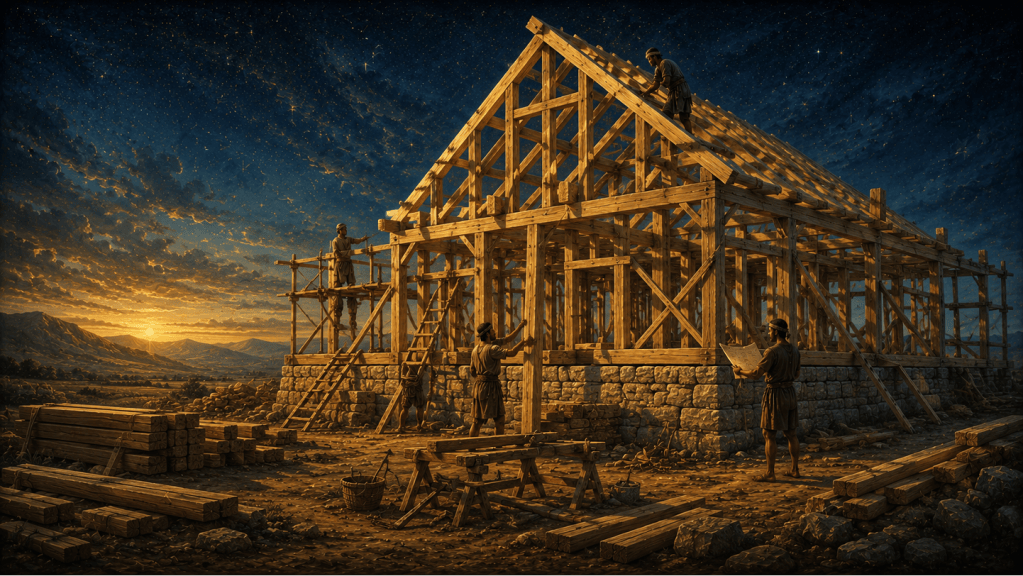
As we get started, imagine for a moment—walking through a house while it is still being built. You can see the walls going up. You can tell where the rooms will be. Maybe the lights are being installed and some of the furniture is beginning to arrive. But some of the choices might not make sense until you know who will live there. A house for a growing family will look different than someone who is aging and can’t use the stairs very well. A lake cottage might have large windows facing the water, and a screened porch. A musician’s home might include a soundproof room or studio. Once you know the people and the kind of life the house is designed to hold, the details begin to make sense. In Exodus, we’re going to walk through God’s building project—the tabernacle. We’ll look at curtains and lamps, tables and altars, clothing and priests. But before we examine the rooms and furnishings, we need to understand the purpose of the house.
Why does God ask Israel to prepare a dwelling place? And what will it mean for God to move in among them? To answer those questions, we need to go back to the first dwelling that God prepared—which takes us to the creation story in Genesis. That story is foundational for how we understand everything else.
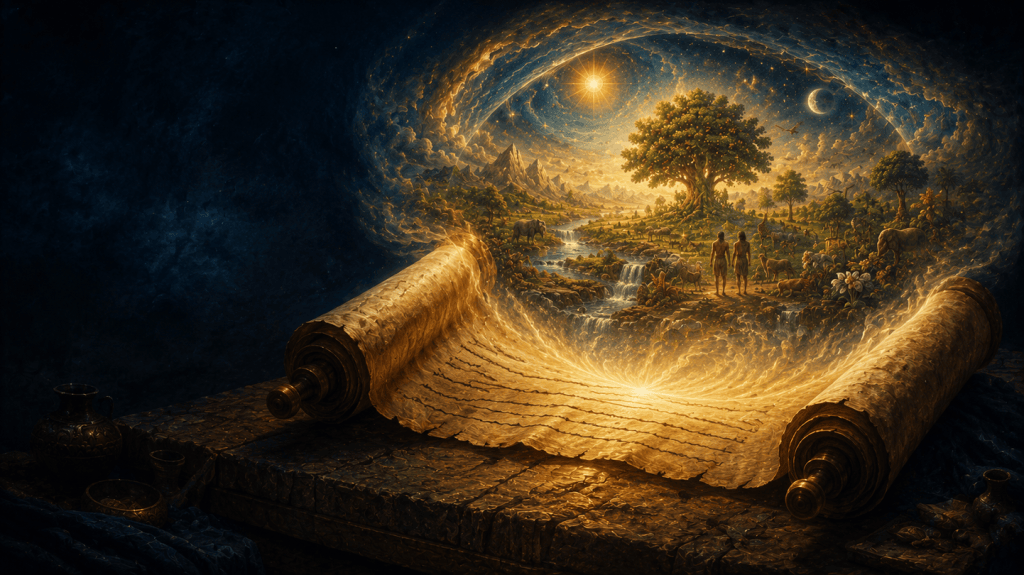
As we begin, keep in mind that Genesis is not a science text, and it’s not a history text in the way that WE understand history. The creation narrative is not meant to answer our 21st century Western questions—In fact, if we ask it the wrong questions, we will get ourselves into trouble. It may be a story, but it’s not just a story. There are things being said about God and who he is that are profoundly important, if we are going to say that we are his people and that he made us. Our number one goal in reading this story is to understand what God was trying to communicate to the ancient people—and then bring if forward to today. The actual writing of Genesis 1-3 may have happened long after the Exodus. It’s not going to be beneficial for us to argue about when or how the stories were written, but WHY? That’s what we need to dig into, because for people coming out of Egypt, who were engrained in the traditions and cultures there, the story of creation as told in Genesis will totally subvert the other pagan worldviews of how the world was created and why. The ancients understood their creation stories in the framework of what they believed about the world. In the Ancient Near East, every event was an act of God, or the gods. Each nation had its own creation story. So—we’re going to dig into some of those stories first, which will help us see why Genesis is so different, and so special.
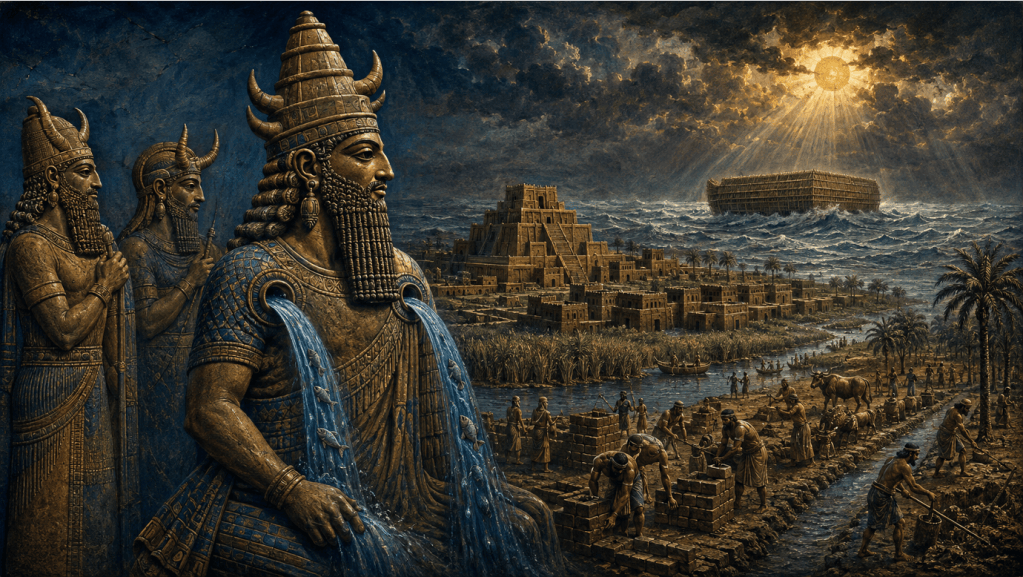
Long before Genesis was written, the peoples of ancient Mesopotamia told stories about how humanity began and how a great flood nearly destroyed it. The stories differed in their details, but the basic account went something like this: Long ago, the gods An, Enlil, Enki, and Ninhursaga fashioned human beings—“the black-headed people”—and filled the plains with animals. At first, the people wandered without settled homes. But Nintur, the mother goddess, looked upon her creatures and called them to build cities, temples, and canals. Kingship descended from heaven, and the first cities were established, beginning with Eridu. Humanity learned to cultivate the land, organize its life, and to perform the labor of the gods.
*Note that this story believes in progress. Things were not as good to begin with, and the gods created humans to do their work. But they have a change of heart.[1]
Eventually, the gods decided to destroy humanity with a great flood, because Enlil was tired of their noise. The goddesses mourned, but Enki secretly warned Ziusudra, a devout king and priest, speaking to him through a wall. Ziusudra built a great boat and preserved human and animal life. For seven days and seven nights, storms swept across the land and tossed the boat upon the waters. Then Utu, the sun god, appeared and filled the boat with light. Ziusudra opened the boat, bowed to the ground, and offered sacrifices. Because he had preserved “the seed of mankind” and the animals, the gods granted him eternal life and settled him in the distant land of Dilmun, where the sun rises. This is the creation story from ancient Mesopotamia.
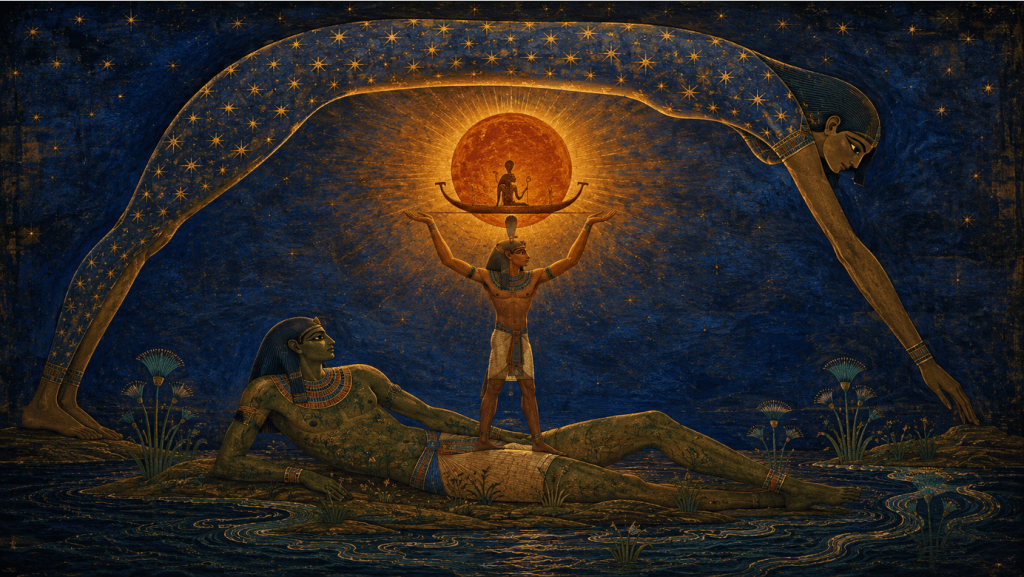
Ancient Egyptians told several overlapping stories about creation. Drawing together pieces from some of those traditions, the story went something like this: In the beginning, only the dark waters of Nun existed. From them rose the first mound of earth. Upon it appeared Atum-Ra, the self-created god, shining as the first sun. Now Ra was all-powerful, and he could take many forms. His power and the secret of it lay in his hidden name. When he spoke a name, that which he named came into being. “I am Khepera at the dawn, and Ra at noon, and Atum in the evening,” he said. And the sun rose and passed across the sky and set for the first time. Then he named Shu, and the first winds blew; he named Tefnut the spitter, and the first rain fell. Next, he named Geb, and the earth came into being; he named the goddess Nut, and she was the sky arched over the earth with her feet on one horizon and her hands on the other; he named Hapi, and the great River Nile flowed through Egypt and made it fruitful. Shu separated earth from sky, making room for the ordered world and all living things. Geb and Nut then produced Osiris, Isis, Seth, and Nephthys, and the ordered world of gods and nature began. The sun rose over creation, the Nile watered the earth, and life emerged from the darkness and waters of chaos. After this Ra named all things that are upon the earth, and they grew. Last of all he named mankind, and there were men and women in the land of Egypt. Ra then traveled across the sky each day in his solar boat, bringing light and sustaining creation. Each night he passed through the underworld, struggled against the forces of chaos—and rose again in the morning. These are the stories of ancient Egypt.
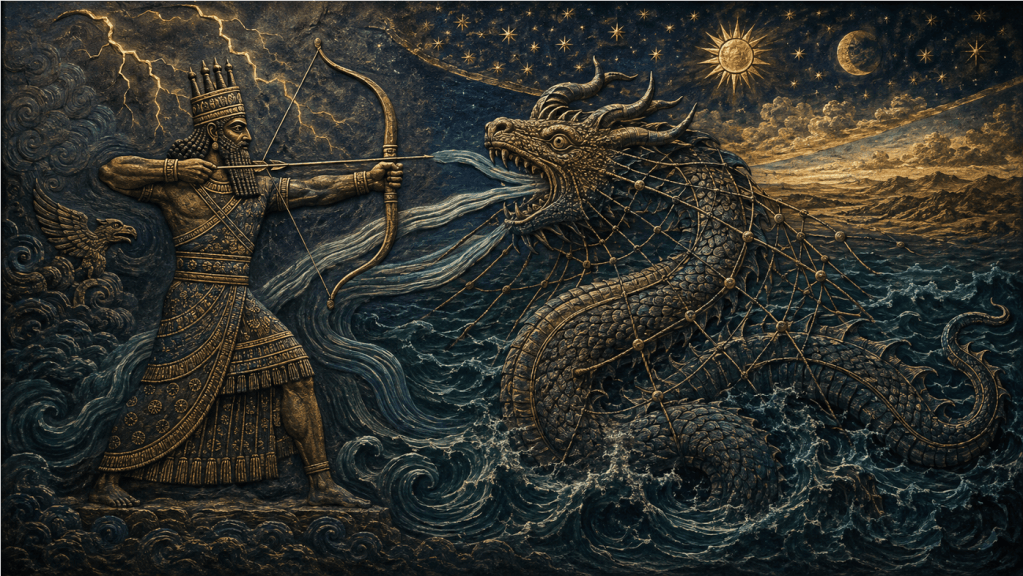
The Enuma Elish story is from ancient Babylon and talks of the birth of the divine assembly out of the chaos of water and darkness.[2]
*In the Sumerian version, the heroes were Enlil or Enki. In the Babylonian creation tale, the hero is Marduk.
In the beginning, neither heaven nor earth had names. Apsu, the god of fresh waters, and Tiamat, the goddess of the salt oceans, and Mummu, the god of the mist that rises from both of them, were still mingled as one. There were no mountains, there was no pastureland, and not even a reed-marsh could be found to break the surface of the waters. There were only two great bodies of water: Apsu, the fresh water, and Tiamat, the salt water. When their waters mingled, generations of younger gods were born. But the younger gods became so noisy that Apsu decided to destroy them. The god Ea, their great-grandson, discovered the plan and killed Apsu first. Tiamat was enraged, and she collected an army of dragons and monsters. Marduk, the son of Ea, offered to fight her—on the condition that if he won, he would be made king of all the gods. All the other gods agreed. Marduk armed himself with a bow and arrows, a club, and lightning. He attacked and she howled as they closed for battle. They struggled as Marduk caught her in his nets. When she opened her mouth to devour him, he filled it with the evil wind that served him. She could not close her mouth with his gale blasting in it, and he shot an arrow down her throat. It split her heart, and she was slain.[3] He split her body in two, making the heavens from one half and the earth from the other. He arranged the sun, moon, and stars and established the order of time. Finally, Marduk killed Kingu and used his blood to create human beings. Humanity’s purpose—was to perform the gods’ labor, provide their food and sacrifices, and free the lesser gods from work. In gratitude, the gods built Babylon and a great temple for Marduk, praising him as their supreme king.
These creation narratives were exciting, full of different characters, and told, embellished, retold, added to, and passed down from generation to generation. And they had a major impact on the Israelites. They heard these tales many times. But God had another story to tell them—one that would define who HE was, and who they were as human beings. And it is very different from the other stories. Listen.
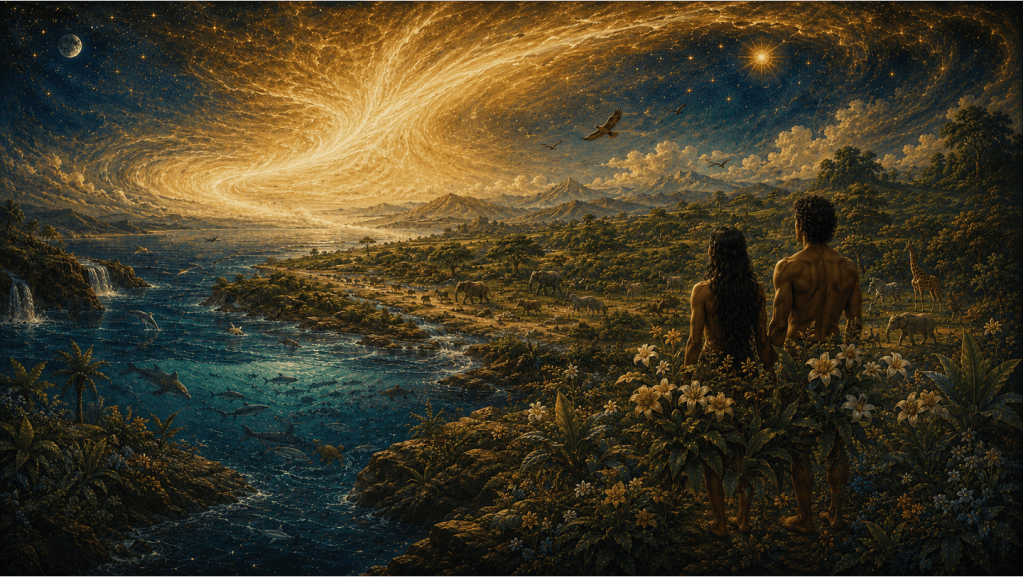
In the beginning, God created the heavens and the earth. The earth was formless and empty, darkness covered the deep waters, and the Spirit of God hovered over them. Then God spoke: “Let there be light,” and light appeared. God separated the light from the darkness, calling the light day and the darkness night. God formed the sky, gathered the waters into seas, and caused dry land to appear. The earth brought forth plants and trees bearing fruit and seed. God placed lights in the sky—the sun, moon, and stars—to mark days, seasons, and years. God filled the waters with living creatures and the sky with birds, blessing them and telling them to multiply. God then made the animals of the land. Finally, God created human beings, male and female, in God’s own image! God blessed them and entrusted them with the care of the earth and its creatures. God looked upon everything that had been made and declared it very good. With creation complete, God rested, blessed the seventh day, and made it holy.
In the ancient world, the seas had creatures that were threats to an ordered system. There are enemies that have to be checked and controlled. Our horror stories have to do with getting lost in the woods or being in the mountains…for the Ancient Near East people—the SEA was scary! It was the home of chaos, sea monsters, crocodiles, cosmic creatures, and the deep.[4] For Canaanites, Sumerians and Egyptians, their stories of creation are climactic, involving struggles with dragons, with other gods, with the sea, and of monsters. There is violence, bloodshed, rivalry and relationship tension, and the hero emerges to create a world order.
Genesis tells a radically different story. There IS chaos—an earth that is formless and void—and deep waters—But did you hear the names of any other gods? Did you hear any conflict? This writing has no one else worth mentioning. Only God creates, he speaks—and it happens. In Genesis, there is no struggle, and there is no slaying of dragons—in fact, in Genesis 1:21, where your Bible might read “God created the great creatures of the sea’, in the Hebrew it reads, ‘God created the great sea monsters’. He didn’t battle them. He created them. And it was GOOD! The Genesis creation story doesn’t just replace the other ancient stories with their version of God, it demythologizes the myth, the hero-god, the dragon, and the way that creation comes about.
In other religions, human beings are created to take over the work of the gods. The gods then protect their worshipers and provide for them.[5] But in Genesis, humanity is the climax of the creation account! The couple in Genesis are the models of what humanity’s role is on planet earth.[6] The people function—not like employees who work in a factory, but like employees who are in sales and marketing and get to represent God to the world. Being in the image of God was a political statement, attached to kings. In Genesis, the first people are functioning as images of the deity, and they are partners with God in ruling creation.[7] Ancient worshipers would put a statue of their god in the temple, but in Genesis, humans are placed in God’s cosmic temple as his image, or idol—an embodied physical image of the divine creator and king.[8]
Genesis 1 and 2 is a story—a theological counter story—designed to show that Yahweh is the God above all Gods—he has no competition. He speaks and puts things into place—for a reason! He is setting up a temple for himself to reside in.
God created the world as a home for His presence
In the ancient world, temple building was the final step of creation where a deity achieved sovereign rest and stability. When their god conquers the chaos, he has a house built for him. Each temple that is built to honor these gods becomes a mirror of the universe, the home of the god, a place of worship, a place of authority, a place of rule.[9]
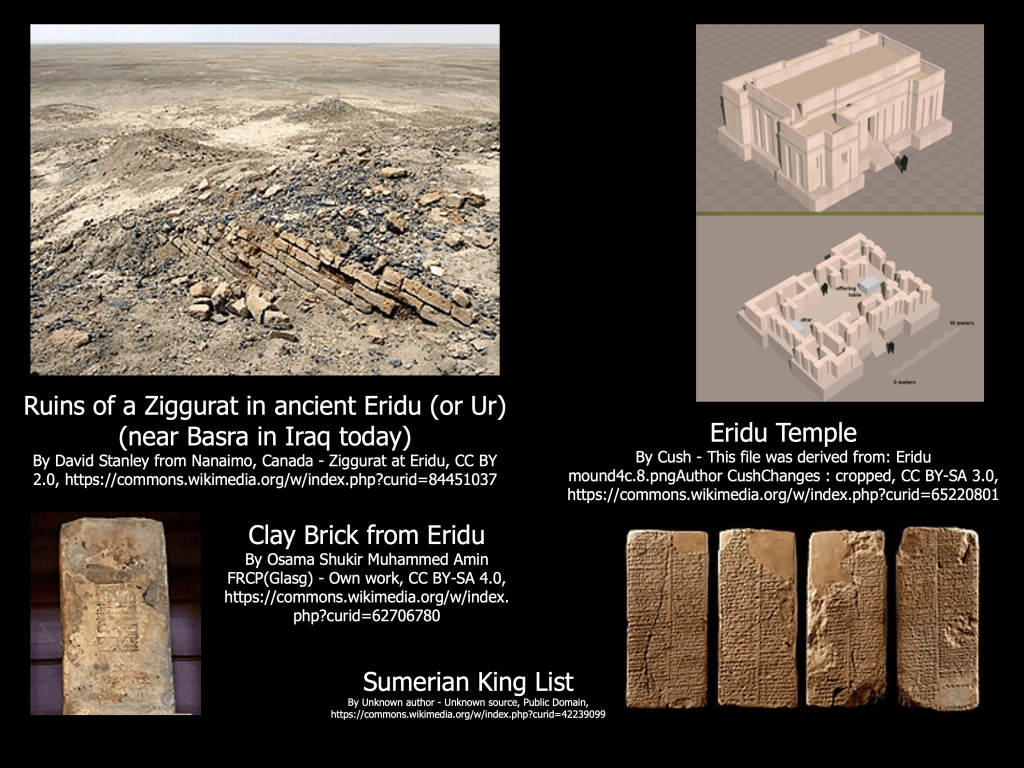
One of the Babylonian creation accounts say: “All lands were sea, then Eridu was made.”[10] Eridu was considered the oldest city in the world, created by the gods to establish order on earth. It was the sacred seat of Enki (the Sumerian god), or Ea,[11] the Babylonian god. The city is situated in Iraq today.
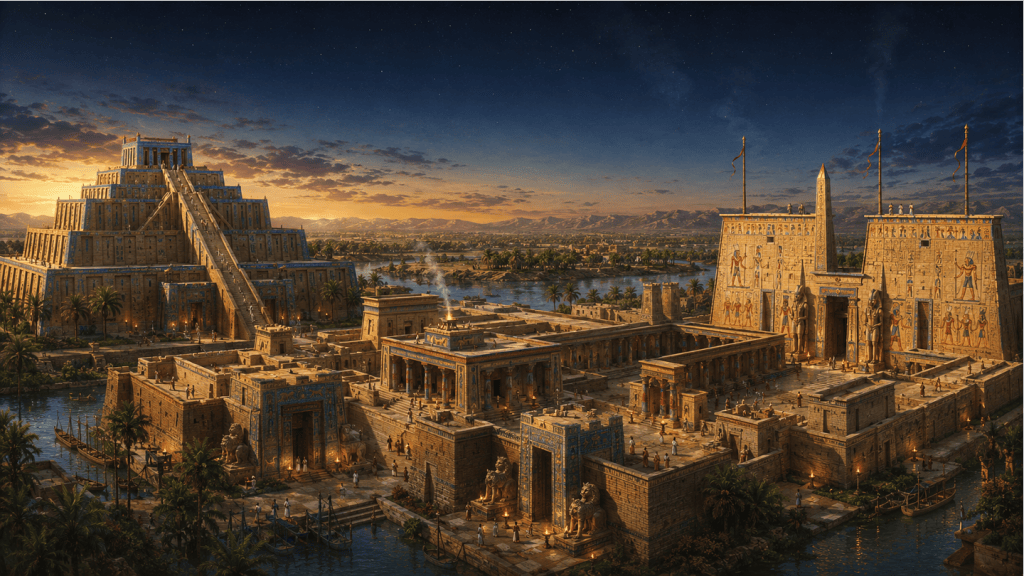
The Sumerians and Babylonians built temple complexes that included ziggurats. The ziggurat symbolized the connecting link between heaven and earth.[12] The gods would use it as a stairway.[13] The temples were the resting of the divine spirit.[14] Temples touch the heavens above, and the netherworld below, and are the bond that hold the cosmos together.[15] The floor is the earth, the ceiling represents the sky. The decorations have pictures that show the world of the gods…in a sense, the temple WAS the world of the gods.[16] Egyptians did not build ziggurats. For them, the mound of earth that rose from the waters in the beginning was a holy piece of creation that inspired the design of the Egyptian temples. The Egyptian temple was pictured as a microcosm of the world, the realm of the god.[17] Its pylons reach to the height of the heavens…it is like the horizon where Ra is born again every day…it is a reflection of the world. The ceiling was painted blue for the sky and studded with a multitude of golden stars.[18] The floor of the temple was the earth from which plants grow.[19]
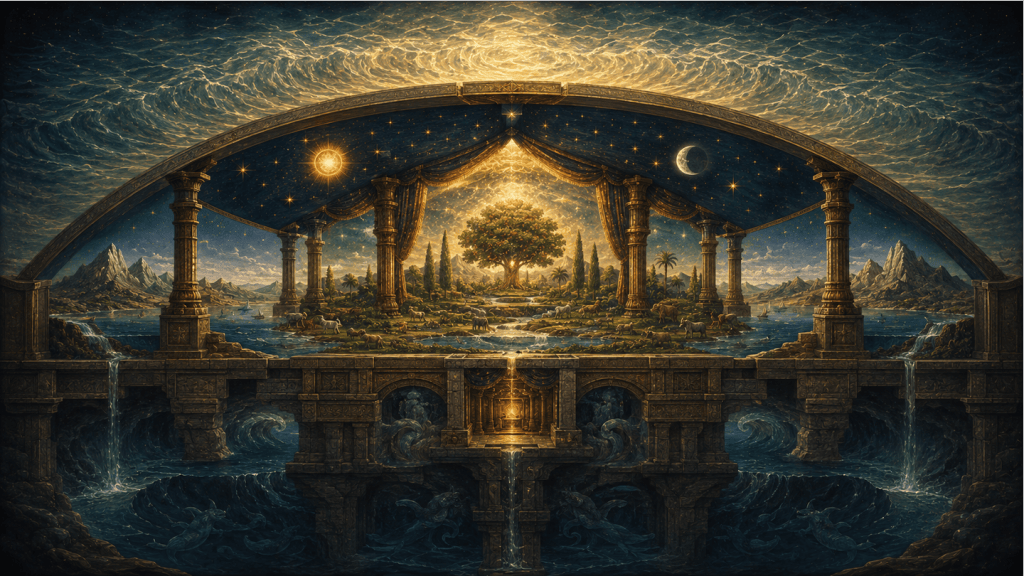
The story of the God of Israel has many similar characteristics. God’s creation was also a royal construction. He’s the master builder. The earth has a four-cornered floor. The sky was the canopy. There were beams and pillars to support it. The stars were the lamps hung under the canopy. They are just functionaries, though, not other gods with whom to battle. God appoints them to take their positions—to govern—to rule. And the word for ‘light’ that is hung here in the place that God is making as his temple—is the same word used for the ‘lighting’ in the tabernacle,[20] later. Hmmm. In the Genesis story, God claims the ENTIRE cosmos as sacred space, which doesn’t leave any room for any other gods to even HAVE temples. That’s pretty extreme![21]
God created the world as a home for His presence—and created humans to live with Him there.
In temples for other gods, people build images that resemble their idea of the god and place them in the temples to worship them. In Genesis, the image of God is reflected in living, breathing human beings, who do the things that God does, by naming, tending, creating, and loving.
By the end of Genesis 1, God, the owner, the builder, the maker—is going to move in. Think for a moment again about building a house. Not all of us have done that, but we know people who have, and we’ve seen the planning, preparation and work that goes into that process. The blueprints are made, the lights are installed, the doors are put on, the carpet is laid, and the furniture is put in place. The house by itself is just lumber, nails, fixtures and material items. Moving in entails so much more! The day that you most look forward to is moving day! And after you put everything in place and you inhabit the space, the house becomes a home. You now move into different activities than you had before. No longer are you getting it ready, you are inhabiting it and working from it, making meals in it, having people over, and it becomes part of your daily life. In the ancient world, the temple was the place from which the gods ruled.
It is the residence and palace. When we read the beginning of Genesis 2, that God completed his work and he “rested”, this is not God being tired and needing a break. This day is the most important day in the seven days. It’s the climax! This is God moving into his home— He is basking in the glory of his temple palace. He is taking his seat—taking his throne— taking up his rule over creation!
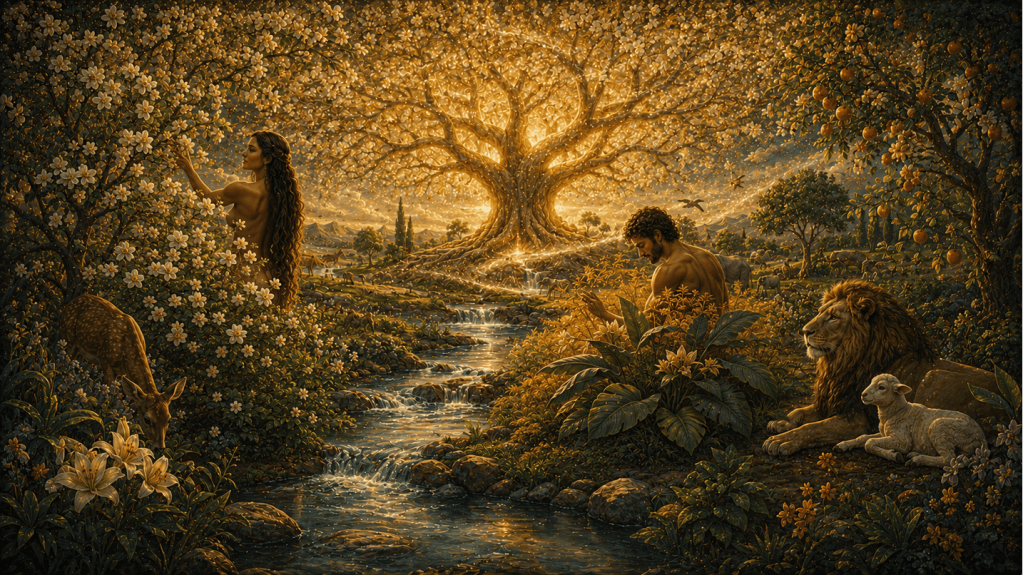
The rest of Genesis 2 will shift gears. In fact, if you’re looking to be a literalist, you will have to decide which version in Genesis you want to stick to. Genesis 1 and 2 are both different accounts. I challenge you to pick up your Bible and read them both this week. Take notes. In Genesis 1, it says that man was created last. In Genesis 2, it says that there were no plants or shrubs, and God created man, and THEN planted a garden. The two creation stories—yes, plural—stories, are meant to tell us what kind of God Yahweh is. Genesis 1 gives us the wide-angle view: God the sovereign King ordering his cosmic temple. Genesis 2 brings the camera close: God forming, breathing, planting, speaking, and placing humanity within the garden. One account emphasizes God’s transcendence—his majesty above creation. The other emphasizes God’s nearness—his immanence—his intimate presence within creation, as he gets his hands dirty.
In the ancient stories, humans are made to do the dirty work of the gods, because they are sick of it. From raising crops and animals, to digging ditches, the humans are imposed on as slave labor. Most stories about the gods were told in order to justify and solidify the rule of a king or emperor, so that they could maintain their power over the people.[22] Not so in the Genesis narrative. In the story of Israel, humans are made in the image of God. He doesn’t need human slaves to build him a house or bring him food. God is king over all creation, and he rules from the earth as his temple.
Now, in ancient cultures, the kings would create royal gardens that would be settings for religious rituals. By cultivating the land, and placing things in order, they were reenacting creation—and showing responsibility to care for people and maintain divine order. The garden was a mini representation of the king’s world and power. And access was controlled by the king-priest. [23]
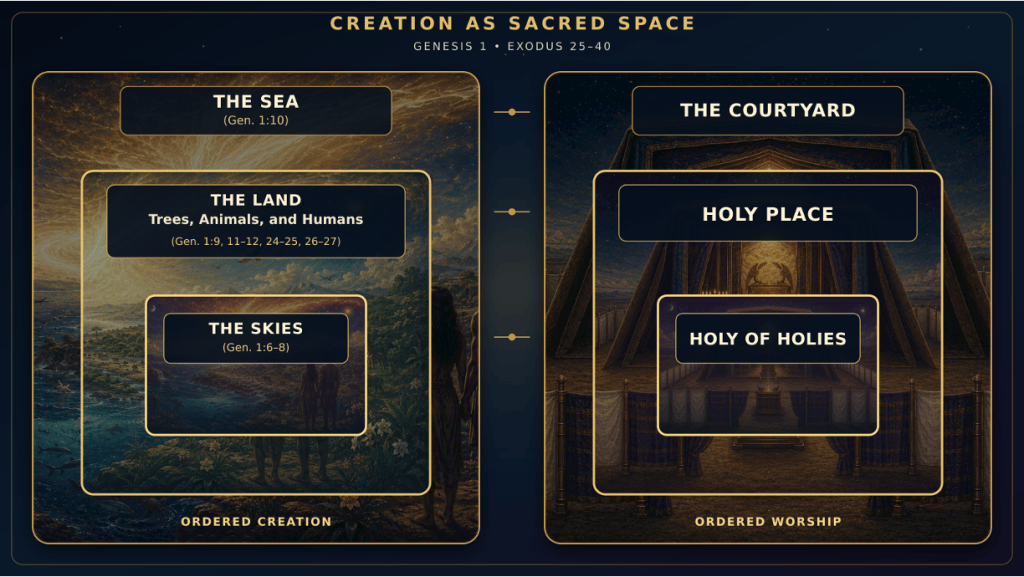
In Genesis, basically, the garden is another temple—a sacred space where God would meet with his people.[24] It has parallels to the tabernacle that will come later in Exodus 25, and the Temple structure that will be built much later. Adam and Eve will function as priests who are subordinate to the king of all the earth. And they are charged with guarding the sanctity of God’s kingdom.[25] Genesis 2:15 says: Then the Lord God took the man and put him into the garden of Eden to cultivate it and keep it. The NIV says, ‘to work it and to take care of it.’ The Hebrew states that the man is to work it and keep it.[26] These same words are used to describe the work of the priests in later texts.
God created the world as a home for His presence—and created humans to live with Him there.
Adam and Eve, in Ancient Near Eastern terms, were part of a kingdom and a covenant, where the great king of the earth is enthroned in his temple, and they worship him—by working, serving, and living life as his image bearers.
Just as the governing bodies of the sun, moon and stars are functioning under God’s commands, just as the birds of the air, the fish of the sea, and the beasts of the earth are to fulfill their functions to multiply and fill the earth, so man is given the gift of life, a relationship with his maker, and the job of obeying the instructions given to him. There’s only one listed. You must not eat from the tree of the knowledge of good and evil, for when you eat from it you will certainly die.
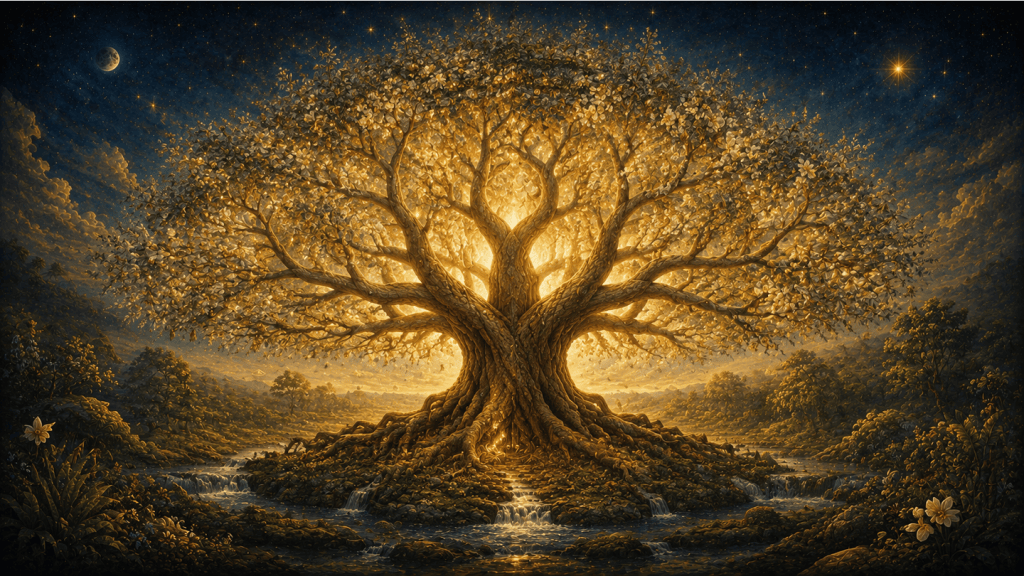
That seems like a reasonable request. One. One tree. Just don’t! Don’t do it. Now, the tree itself is not bad. The ‘knowledge of good and evil’ is a Hebraic expression which talks about the knowledge of the complexity of the things in life. The phrase may be a way of describing maturity, an age when one has had enough experience and has gained sufficient knowledge to make important decisions. And if we look ahead to the Tabernacle, the knowledge is somewhat like the tablets of the law that will be kept in the Holy of Holies, which is Israel’s “wisdom” (Deut. 4:4-6) and “life” (Deut. 32:46-47).[27] Adam and Eve have the choice to serve God, Yahweh-the king, by obeying his orders, or by deciding that they want to do things in their own way and in their own time.
For a while everything is good. Enter the serpent and the great sin. You know the story. The snake spins a different narrative—one in which God is being stingy and withholding things from them. When they listen to the serpent, they begin to have doubts about God’s motives and about his goodness. We might tend to ask the wrong questions here. The question should not be—why did God allow sin to happen?
The question should be—‘Why did humanity blow it?’ This also shows the difference between other creation stories. In Genesis, things began well—but grew steadily worse through man’s sinfulness.[28] Instead of exercising faithful rule over the creature, instead of embodying God’s image by subduing, Adam and Eve allowed the creature’s voice to rule them.
And now—now is where God grieves. Genesis 3 is not God yelling at Adam and Eve and throwing curses around. The only thing that God curses is the serpent. But Adam and Eve’s failure to obey HAS brought dire consequences. The relationship between God and his image bearers has changed. Their knowledge has given them things that bring pain and brokenness.
Then the Lord God said, “Behold, the man has become like one of Us, knowing good and evil; and now, he might stretch out his hand, and take also from the tree of life, and eat, and live forever”—Therefore the Lord God sent him out from the garden of Eden, to cultivate the ground from which he was taken. So He drove the man out; and at the east of the garden of Eden He stationed the cherubim and the flaming sword which turned every direction to guard the way to the tree of life. Genesis 3:22-24
God cleansed his temple—He sends out Adam and Eve—who were his priests—along with their false god—and the characteristics they now image. God built a home. God moved in. And God created human beings to live in his presence and represent him within his world. But the image-bearers listened to another voice. The priests failed to guard the sacred space entrusted to them. And now they stand OUTSIDE the garden.
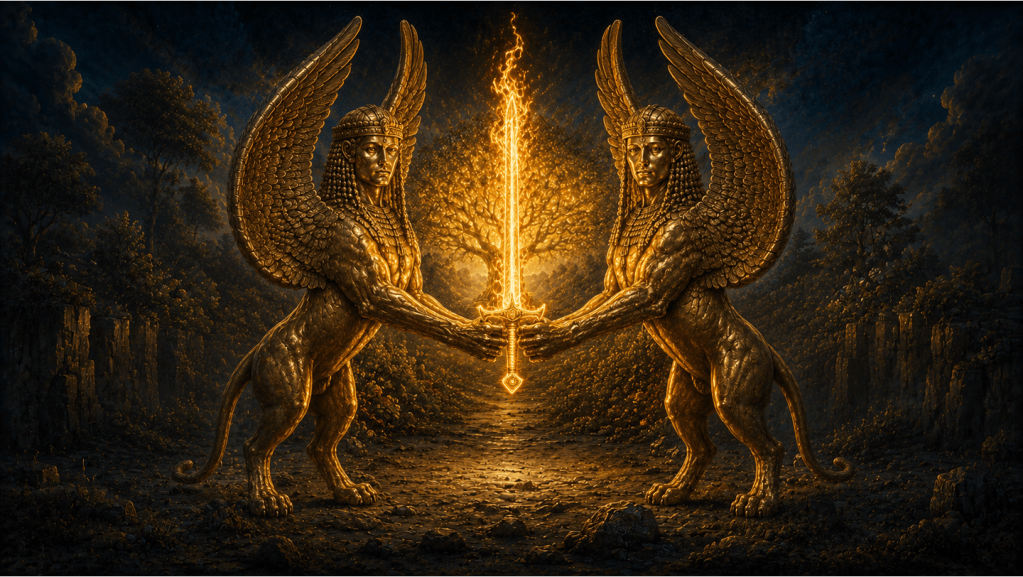
The cherubim are sent in now— to guard and keep—the tasks that Adam and Eve were supposed to do as priests. The cherubim take their place at the entrance—guarding the way to the tree of life, guarding the way into sacred space, guarding the way to the presence for which humanity was created. Humanity loses unrestricted access to God’s presence. The people are east of Eden. So HOW can a holy God ever dwell among human beings again? That is the question the tabernacle will begin to answer.
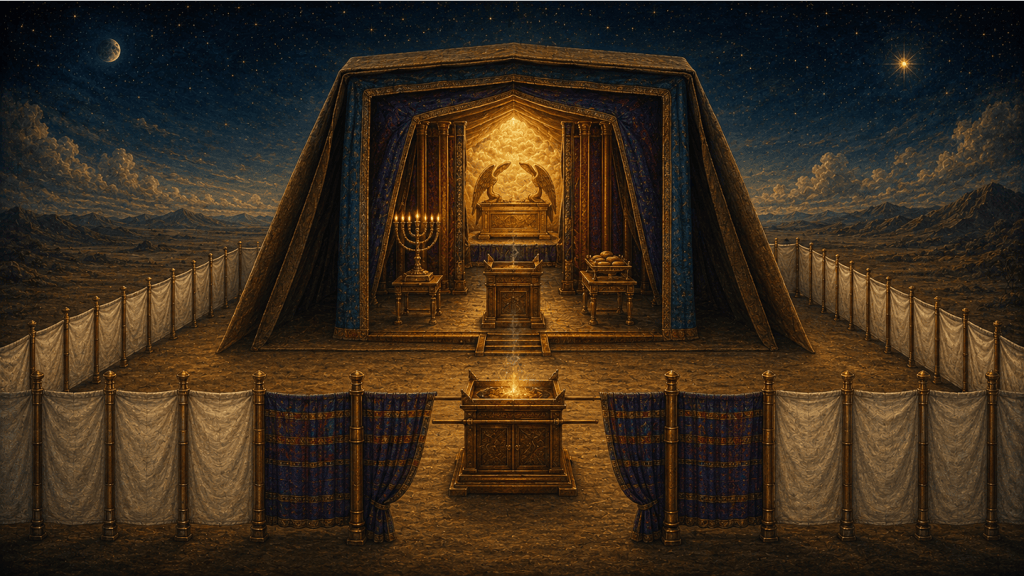
When we come to Exodus, God will do something astonishing. He doesn’t tell the people to find their own way back to Eden. He comes to them— in the wilderness! God says that he brought Israel out of Egypt so that he might dwell among them. In other words, God didn’t just rescue them FROM Pharaoh. He rescued them FOR his presence. And when God instructs them to build the Tabernacle, it will be filled with echoes of the garden: gold and precious stones, a lampstand shaped like a flowering almond tree, and cherubim woven into the curtains. Its entrance faces east, and the priest moves westward toward the presence of God—reversing the direction of humanity’s exile.
Now, God’s holiness still matters. Sin matters. Human beings can’t simply wander into God’s presence as if nothing has happened. And yet, at the very center of the Tabernacle, will be a place where God says to Moses, “I will meet with you.”
God created the world as a home for his presence—and created humans to live with him there.
The tabernacle tells us that exile will not have the last word. God doesn’t abandon his desire to dwell with his people. Even in the wilderness, He’s going to pitch his tent in the middle of their camp. Some of us know what it’s to feel east of Eden—to feel far from God, ashamed, displaced, or uncertain whether there is any way back. But the good news of Scripture isn’t that we have discovered how to get back to God. The good news is that God comes looking for us. We were created for God’s presence. We are rescued for God’s presence. And even in our wilderness, God is willing to pitch his tent among us. East of Eden is where exile begins. But it’s not where God intends the story to end. And THAT—is what we’ll pick back up next week.
Prayer: Creator God, You spoke light into darkness, brought order out of chaos, and filled the world with life. You created this world as a home for your presence, and you created us to live with you and reflect your goodness. Thank you for scholars, writers, theologians and people of God who labor and strive to dig deeply into the ancient texts to discover you and learn about you and share those ideas with us. Thank you for the ways that we can see you as awesome above all the other gods that have been portrayed through the ages. We are grateful today that you have set us apart as your people—called by your name—ambassadors to the world—Oh God, Your name is great and greatly to be praised! God, we feel so small in this earth sometimes—we look at the stars, the seas, the mountains, the creatures—and we feel inadequate to the task that you have given us. We confess that, just like Adam and Eve, that we still listen to other voices. We question your goodness, choose our own wisdom, and fail to care faithfully for what you’ve entrusted to us. We know what it is to feel east of Eden—ashamed, displaced, and far from you. And yet, you have not abandoned us. Thank you for being the God who comes near. Thank you for meeting your people in the wilderness and making a way to dwell among them. Thank you that in Jesus you came to dwell among us, and that through your Spirit you continue to make your home among your people. Teach us to recognize your presence. Help us to trust your voice, reflect your character, and care for the world and the people you have placed around us. Bring order into the chaotic places within us. Breathe new life into what has become weary, broken, or afraid. Make us a people among whom your presence can be seen and known. Help us to live each day in the assurance that you are near. In the name of Jesus, amen.

Bibliography
Books
Robert Altar, The Five Books of Moses, New York: W.W. Norton & Company, 2004.
T. Desmond Alexander & David W. Baker, Dictionary of the Old Testament: Pentateuch, Downers Grove: InterVarsity Press, 2003.
Bill T. Arnold, Brent A. Strawn, eds., The World Around the Old Testament: The People and Places of the Ancient Near East, Grand Rapids: Baker Academic, 2016.
James K. Bruckner, Exodus, Grand Rapids: Baker Books, 2008.
Umberto Cassuto, A Commentary on the Book of Exodus, Skokie: Varda Books, 2005.
Brevard Childs, The Book of Exodus, Louisville: The Westminster Press, 1974.
John Coffey, Exodus and Liberation: Deliverance Politics from John Calvin to Martin
Luther King Jr., New York: Oxford University Press, 2014.
Thomas B. Dozeman, Methods for Exodus, Cambridge: Cambridge University Press, 2010.
John I Durham, Word Biblical Commentary: Exodus, Waco: Word Books, 1987.
Peter Enns, Exodus: The NIV Application Commentary, Grand Rapids: Zondervan, 2000.
Peter Enns, Exodus for Normal People, Perkiomenville: The Bible for Normal People, 2021.
Rabbi David Fohrman, Exodus: A Parsha Companion, New Milford: Aleph Beta Press, 2020.
Terence E. Fretheim, Exodus, Interpretation Bible Commentary, Louisville: Westminster John Knox Press, 1991.
John Goldingay, Exodus & Leviticus for everyone, Louisville: John Knox Press, 2010.
John Goldingay, The First Testament, Downers Grove: InterVarsity Press, 2018.
Jonathan S. Greer, John W. Hilber, and John H. Walton, Behind the Scenes of the Old Testament: Cultural, Social, and Historical Contexts, Grand Rapids: Baker Academic, 2018.
Victor Hamilton, Exodus, Grand Rapids, Baker Academic, 2011.
Jacquetta Hawkes, Pharaohs of Egypt, New York, American Heritage Publishing, Co., 1965.
Philip J. King and Lawrence E. Stager, Life in Biblical Israel, Louisville: Westminster John Knox Press, 2001.
Jeff Manion, The Land Between, Grand Rapids: Zondervan, 2010.
Victor H. Matthews, Don C. Benjamin, Old Testament Parallels, New York: Paulist Press, 2006.
Tony Merida, Exodus, Nashville: B&H Publishing Group, 2014.
Carol Meyers, Exodus, Cambridge: Cambridge University Press, 2005.
Dr. David McDonald, ed., The Story Lectionary, Portland: Portland Seminary, 2017.
Watchman Nee, A Table in the Wilderness, Fort Washington: CLC Publications, 2007.
William H.C. Propp, Exodus 19-40; New York: Doubleday, 2006.
Nahum M. Sarna, Exodus, Philadelphia: The Jewish Publication Society, 1991.
Nahum M. Sarna, Exploring Exodus: The Origins of Biblical Israel, New York: Schocken Books, 1986.
Mark S. Smith, Exodus, Collegeville: Liturgical Press, 2011.
Douglas K. Stuart, Exodus, Nashville: B&H Publishing Group, 2006.
Charles R. Swindoll, Moses, Nashville: Word Publishing, 1999.
John H. Walton, Craig S. Keener, editors, Cultural Backgrounds Study Bible, Grand
Rapids: Zondervan, 2016.
Walton, John H., Genesis 1 as Ancient Cosmology, Winona Lake: Eisenbrauns, 2011.
John Walton, Victor H. Matthews, Mark W. Chavalas, The IVP Bible Background Commentary-Old Testament; Downers Grove: IVP Academic, 2000.
George J. Wenham, Exploring the Old Testament: A Guide to the Pentateuch, Volume One, Downers Grove: InverVarsity Press, 2003.
Articles
Jacobsen, Thorkild, “The Eridu Genesis”, Journal of Biblical Literature, 100 no 4 Dec 1981, 513-529.
Nelson, Harold Hayden, The significance of the temple in the ancient Near East Part I The Egyptian temple: with particular reference to the Theban temples of the Empire period, The Biblical Archaeologist, 7 no 3 Sep 1944, 44-53.
Patrick, Donald P., “The Imperial Gardens of Mesopotamia: Landscapes of Power” (major research paper, University of Guelph, 2016), 31–32, Accessed July 31, 2026. https://www.academia.edu/30542958/The_Imperial_Gardens_of_Mesopotamia_Landscapes_of_Power.
Walton, John H. “The Mesopotamian background of the Tower of Babel account and its implications”, Bulletin for Biblical Research, 5 1995, 155-175.
Small Group Questions
The God Who Comes Near.
Week One: Created for God’s Presence
Genesis 1-3
Icebreaker
- If you could design a house or one special room entirely around a particular person or purpose, who or what would it be designed for? What distinctive features would you include?
God Prepares a Home
Read Genesis 1:1–5, 26–31 and Genesis 2:1–3 NIV
In the beginning God created the heavens and the earth. 2 Now the earth was formless and empty, darkness was over the surface of the deep, and the Spirit of God was hovering over the waters. 3 And God said, “Let there be light,” and there was light. 4 God saw that the light was good, and he separated the light from the darkness. 5 God called the light “day,” and the darkness he called “night.” And there was evening, and there was morning—the first day.
26 Then God said, “Let us make mankind in our image, in our likeness, so that they may rule over the fish in the sea and the birds in the sky, over the livestock and all the wild animals, and over all the creatures that move along the ground.”
27 So God created mankind in his own image,
in the image of God he created them;
male and female he created them.
28 God blessed them and said to them, “Be fruitful and increase in number; fill the earth and subdue it. Rule over the fish in the sea and the birds in the sky and over every living creature that moves on the ground.” 29 Then God said, “I give you every seed-bearing plant on the face of the whole earth and every tree that has fruit with seed in it. They will be yours for food. 30 And to all the beasts of the earth and all the birds in the sky and all the creatures that move along the ground—everything that has the breath of life in it—I give every green plant for food.” And it was so.
31 God saw all that he had made, and it was very good. And there was evening, and there was morning—the sixth day.
Thus the heavens and the earth were completed in all their vast array.
2 By the seventh day God had finished the work he had been doing; so on the seventh day he rested from all his work. 3 Then God blessed the seventh day and made it holy, because on it he rested from all the work of creating that he had done.
Discussion
- What picture of God emerges from the opening verses? What does God do when faced with darkness, deep waters, and a world that is formless and empty?
- In many ancient creation stories, the gods must fight other gods or monsters before creating the world. What is different about the way God creates in Genesis?
- If you could safely stand and watch one moment of creation unfold, which moment would you choose? What would you most want to see?
- Why do you think the declaration changes from “good” to “very good” after human beings are created?
- Ancient creation stories often portrayed the world as emerging through conflict among the gods and human beings as laborers who served their needs. How is the God of Genesis different? How is the purpose given to humanity different?
- What does it mean for every human being—rather than only kings or especially important people—to be made in the image of God?
- God’s rest on the seventh day does not suggest that God was exhausted. What might it mean for God to “rest” within the world he has ordered? How does this connect with the idea of God taking up residence and ruling from his temple?
Life in the Garden
Read Genesis 2:7–9 and 15–18
Then the Lord God formed a man from the dust of the ground and breathed into his nostrils the breath of life, and the man became a living being. 8 Now the Lord God had planted a garden in the east, in Eden; and there he put the man he had formed. 9 The Lord God made all kinds of trees grow out of the ground—trees that were pleasing to the eye and good for food. In the middle of the garden were the tree of life and the tree of the knowledge of good and evil.
15 The Lord God took the man and put him in the Garden of Eden to work it and take care of it. 16 And the Lord God commanded the man, “You are free to eat from any tree in the garden; 17 but you must not eat from the tree of the knowledge of good and evil, for when you eat from it you will certainly die.” 18 The Lord God said, “It is not good for the man to be alone. I will make a helper suitable for him.”
Discussion
- Genesis 1 gives us a wide-angle view of God creating the cosmos. What do God’s actions in these verses in Genesis 2—forming, breathing, planting, placing, and speaking—reveal about his personal involvement with humanity?
- The garden contains beauty, abundant food, meaningful work, and God’s presence. What does this picture suggest about the kind of life God intended for human beings?
- Genesis 2:15 says that the man was placed in the garden to “work” and “keep” it. These same Hebrew words are later used together for priestly service in the tabernacle. How might this change the way we understand humanity’s calling in the garden?
- Work appears in the story before sin enters the world. How does that challenge the idea that work itself is a curse? What has God placed within your care to cultivate, protect, or help flourish? Where might your ordinary responsibilities become a form of sacred service?
- God gave the humans abundant freedom along with one clear boundary. What does that boundary suggest about trust, dependence, and the difference between receiving wisdom from God and taking it for ourselves?
Listening to Another Voice
Read Genesis 3:1–9 NIV
Now the serpent was more crafty than any of the wild animals the Lord God had made. He said to the woman, “Did God really say, ‘You must not eat from any tree in the garden’?” 2 The woman said to the serpent, “We may eat fruit from the trees in the garden, 3 but God did say, ‘You must not eat fruit from the tree that is in the middle of the garden, and you must not touch it, or you will die.’”
4 “You will not certainly die,” the serpent said to the woman. 5 “For God knows that when you eat from it your eyes will be opened, and you will be like God, knowing good and evil.” 6 When the woman saw that the fruit of the tree was good for food and pleasing to the eye, and also desirable for gaining wisdom, she took some and ate it. She also gave some to her husband, who was with her, and he ate it. 7 Then the eyes of both of them were opened, and they realized they were naked; so they sewed fig leaves together and made coverings for themselves. 8 Then the man and his wife heard the sound of the Lord God as he was walking in the garden in the cool of the day, and they hid from the Lord God among the trees of the garden. 9 But the Lord God called to the man, “Where are you?”
Discussion
- Compare the serpent’s words with God’s command in Genesis 2:16–17. How does the serpent alter God’s words and portray God’s motives?
- Notice the progression in verse 6: the woman saw, desired, took, and ate. What does this teach us about the way temptation develops? Are you ever tempted to believe that God is stingy and withholding something good?
- Instead of faithfully ruling over the creature, the humans allow a creature’s voice to rule them. What voices or desires are most likely to compete with God’s voice in our lives?
- God comes looking for the humans and asks, “Where are you?” Why do you think God asks questions when he already knows what has happened? What might that question invite Adam and Eve—or us—to do?
East of Eden
Read Genesis 3:21–24 NIV
21 The Lord God made garments of skin for Adam and his wife and clothed them. 22 And the Lord God said, “The man has now become like one of us, knowing good and evil. He must not be allowed to reach out his hand and take also from the tree of life and eat, and live forever.” 23 So the Lord God banished him from the Garden of Eden to work the ground from which he had been taken. 24 After he drove the man out, he placed on the east side of the Garden of Eden cherubim and a flaming sword flashing back and forth to guard the way to the tree of life.
Discussion
- What consequences of human rebellion do you see in this passage? How are relationships with God, one another, the earth, and ourselves affected?
- Where do you see signs of mercy even in the middle of judgment?
- Why might preventing the humans from eating from the tree of life and living forever in their broken condition be both judgment and mercy?
- What is lost when Adam and Eve are sent out of the garden? What does the presence of the cherubim communicate about God’s holiness and humanity’s access to sacred space?
- “East of Eden” can describe the experience of feeling ashamed, displaced, or far from God. When have you experienced that feeling? What helped you recognize that God had not abandoned you?
God created the world as a home for His presence—
and created humans to live with Him there.
God Comes Near
Read Exodus 25:8 and Exodus 29:45–46
“Have them make a sanctuary for me, and I will dwell among them.”
“Then I will dwell among the Israelites and be their God. They will know that I am the Lord their God, who brought them out of Egypt so that I might dwell among them.
I am the Lord their God.”
Discussion
- God says that he brought Israel out of Egypt so that he might dwell among them. How does that deepen the meaning of salvation? What were they rescued from—and what were they rescued for?
- The tabernacle will contain echoes of Eden: cherubim, gold and precious materials, and a lampstand shaped like a flowering tree. What does this suggest about what God is beginning to restore?
- God does not tell Israel to find its own way back to Eden; he comes to the people in the wilderness. What does this reveal about God’s response to people who are lost, displaced, or far from home?
Personal Application
- Where does your life feel most like a wilderness right now? What might it mean to trust that God is willing to meet you there?
- We were created not only to enjoy God’s presence but also to reflect God’s character within the world. What is one specific way you can make God’s goodness, creativity, justice, or care visible this week?
Prayer: Creator God, Thank you for making this world as a home for your presence and for creating us in your image. Forgive us for the times we listen to other voices, question your goodness, or hide from you. Help us trust your word, care faithfully for what you have entrusted to us, and reflect your character in the world. When we feel east of Eden, remind us that you are the God who comes near and meets your people in the wilderness. Make our lives and our community places where your presence can be known. In Jesus’ name, amen.
[1] Jacobsen, Thorkild, “The Eridu Genesis”, Journal of Biblical Literature, 100 no 4 Dec 1981, 513-529, 529.
[2] Victor H. Matthews, Don C. Benjamin, Old Testament Parallels, New York: Paulist Press, 2006, 11-12.
[3] Alexander Heidel, 1952, The Babylonian Genesis (2nd edn.): Chicago, University of Chicago Press, 153 p. (BS1236.H4 1963). Tikva Fryer-Kensky, (trans), Astrahasis, in O’Brien, Joan, and Major, Wilfred, 1982, In the Beginning: Creation Myths from Ancient Mesopotamia, Israel, and Greece: Chico, CA, Scholars Press, 211 p. (BL226.O27 1982)
[4] John H. Walton, Genesis 1 as Ancient Cosmology, Winona Lake: Eisenbrauns, 2011, 173.
[5] John H. Walton, Genesis 1 as Ancient Cosmology, Winona Lake: Eisenbrauns, 2011, 78.
[6] Walton, Cosmology, 176.
[7] Walton, Cosmology, 177.
[8] https://bibleproject.com/articles/were-adam-and-eve-priests-eden/
[9] https://www.ancient.eu/temple/
[10] A. Heidel, The Babylonian Genesis (Chicago: University of Chicago Press, 1951) 62:10-12. P172-Walton, The Mesopotamian background…
[11] https://en.wikipedia.org/wiki/Enki
[12] Walton, John H. “The Mesopotamian background of the Tower of Babel account and its implications”, Bulletin for Biblical Research, 5 1995, 155-175, 160.
[13] Walton, Mesopotamian background, 169.
[14] Walton, John H. “The Mesopotamian background of the Tower of Babel”, 158.
[15] Walton, Cosmology, 102.
[16] Walton, Cosmology, 107.
[17] Harold Hayden Nelson, 47.
[18] Harold Hayden Nelson, 47.
[19] Harold Hayden Nelson, 48.
[20] Exodus 25:6
[21] Walton, Cosmology, 110.
[22] https://www.joeledmundanderson.com/the-genre-historical-context-and-purpose-of-genesis-1-11/
[23] Donald P. Patrick, “The Imperial Gardens of Mesopotamia: Landscapes of Power” (major research paper, University of Guelph, 2016), 31–32, Accessed July 31, 2026. https://www.academia.edu/30542958/The_Imperial_Gardens_of_Mesopotamia_Landscapes_of_Power.
[24] https://bibleproject.com/articles/were-adam-and-eve-priests-eden/
[25] Kline, p51.
[26] When we look at the Genesis account of Eden, we find other instances of people portrayed as created for worship. Adam, for example, is told to “till” (from the root ‘bd) and “keep” (from the root šmr). When šmr and ‘bd occur together in the OT (Num. 3:7-8; 8:25-26; 18:5-6; 1 Chr. 23:32; Ezek. 44:14) they refer to keeping/guarding and serving God’s word and also they refer to priestly duties in the tabernacle. And, in fact, šmr and ‘bd only occur together again in the Pentateuch in the descriptions in Numbers for the Levites’ activities in the tabernacle.
[27] https://bibleproject.com/articles/were-adam-and-eve-priests-eden/
[28] Jacobsen, Thorkild, “The Eridu Genesis”, Journal of Biblical Literature, 100 no 4 Dec 1981, 513-529, 529.

