

About these posts
These posts grow out of sermons I’ve written for my local church community. You’re welcome to use them—for teaching, small groups, preaching, or personal reflection. If you share them elsewhere, please include a simple attribution. If you’d ever like to share how they’re being used, you’re welcome to reach out through the Contact button.

When my kids were in high school, they participated in marching band. Because it was also a very big interest for me, I signed up as a chaperone and eventually became the head chaperone. On the last day of my final band camp, I bawled. It was the end of an era, and I knew I was going to miss it. I passed on the baton, and although I still miss that season, God had other things for me to do. That chapter had ended, but He was already opening another one.
Life is full of chapters. Some chapters begin with excitement—a graduation, a wedding, a new baby, a new job. New beginnings are gifts from God. But sometimes new chapters begin with grief. Others begin with uncertainty. A diagnosis changes everything. Retirement arrives sooner than you expected. The kids move away. A loved one dies. A friendship changes. A door closes that you never wanted to see close.
Some chapters we choose. Others are chosen for us. Some come suddenly. Some are joyful. Others leave us wondering what comes next. We don’t always like every transition. We like familiarity. We like the people and routines we’ve come to depend on. But sooner or later, every one of us reaches the end of one chapter which leaves us standing on the first page of another. The question isn’t whether life will change.
The question is whether we will trust God when it does. That’s where we find Elijah and Elisha. Elijah’s chapter is coming to an end. Elisha’s is just beginning. Both of them know something is changing. But what neither of them can fully see yet is that God has been writing the next page of the story long before they arrived here. Depending on where you are in life, you’ll probably identify more with one than the other. Some of us are standing where Elijah is—looking back on years of God’s faithfulness and wondering what comes next. Others are standing where Elisha is—looking ahead at responsibilities that feel bigger than we are. This story has good news for both.
A life of faith trusts that God is already at work in the next chapter.
We’ve been talking about trusting God in every season. Over the last six weeks we’ve watched Elijah at the brook Cherith, on Mount Carmel, in the wilderness, on Mount Horeb, and in Naboth’s vineyard. We’ve watched him trust God through drought, confrontation, exhaustion, prayer, and injustice. But today we come to the final scene of Elijah’s life. And surprisingly, this story isn’t really about how Elijah finishes. It’s about how God continues. We’re going to be starting in 1 Kings 19:
So Elijah went from there and found Elisha son of Shaphat. He was plowing with twelve yoke of oxen, and he himself was driving the twelfth pair. Elijah went up to him and threw his cloak around him. 20 Elisha then left his oxen and ran after Elijah. “Let me kiss my father and mother goodbye,” he said, “and then I will come with you.” “Go back,” Elijah replied. “What have I done to you?” 1 Kings 19:19-20 NIV
Elisha is at home. His birthplace is identified as Abel-Meholah, not all that far from Elijah’s birthplace of Tishbe. Elisha is plowing with twelve yoke—or twelve pairs of oxen, meaning that he comes from some wealth.[1] When Elijah puts his mantle on Elisha, it means that he is placing a call on Elisha’s life and it’s up to him to accept it.
Behind the scenes, God may have been preparing him for years. He may not feel ready…but he is prepared. Those aren’t always the same thing. Elisha’s question about going to kiss his parents goodbye is met with a question that is a challenge. Will he go back to his parents, or is he going to go with Elijah?
So Elisha left him and went back. He took his yoke of oxen and slaughtered them. He burned the plowing equipment to cook the meat and gave it to the people, and they ate. Then he set out to follow Elijah and became his servant. 1 Kings 19:21 NIV
Elisha proves his acceptance of the call by not only saying goodbye to his parents, but slaughtering a pair of his oxen and having a sacrificial feast.[2] He offers the animals to Yahweh and uses the meat to host a meal for his family and friends[3], and takes on the call to follow Elijah. There’s no going back now. Elijah didn’t know it yet, but while God was preparing Elisha for what was next, He was also preparing Elijah to let go. God isn’t abandoning him. And his ministry isn’t ending because he failed. He’s finishing faithfully.
We don’t hear much about Elijah after that. He wanders in and out with the kings and their successors in the next few chapters, and we heard last week about his encounter with Ahab when Ahab wanted Naboth’s vineyard. While Elijah continued his ministry, God was also preparing Elisha. Years passed. Elisha served quietly. No miracles. No headlines. Just faithful obedience. Sometimes God’s preparation happens long before anyone notices. But the time finally comes for the new leg of the journey. The next major scene with Elijah is when he prepares to leave and Elisha is set up to take his place.
When the Lord was about to take Elijah up to heaven in a whirlwind, Elijah and Elisha were on their way FROM GILGAL. 2 Kings 2:1 NIV
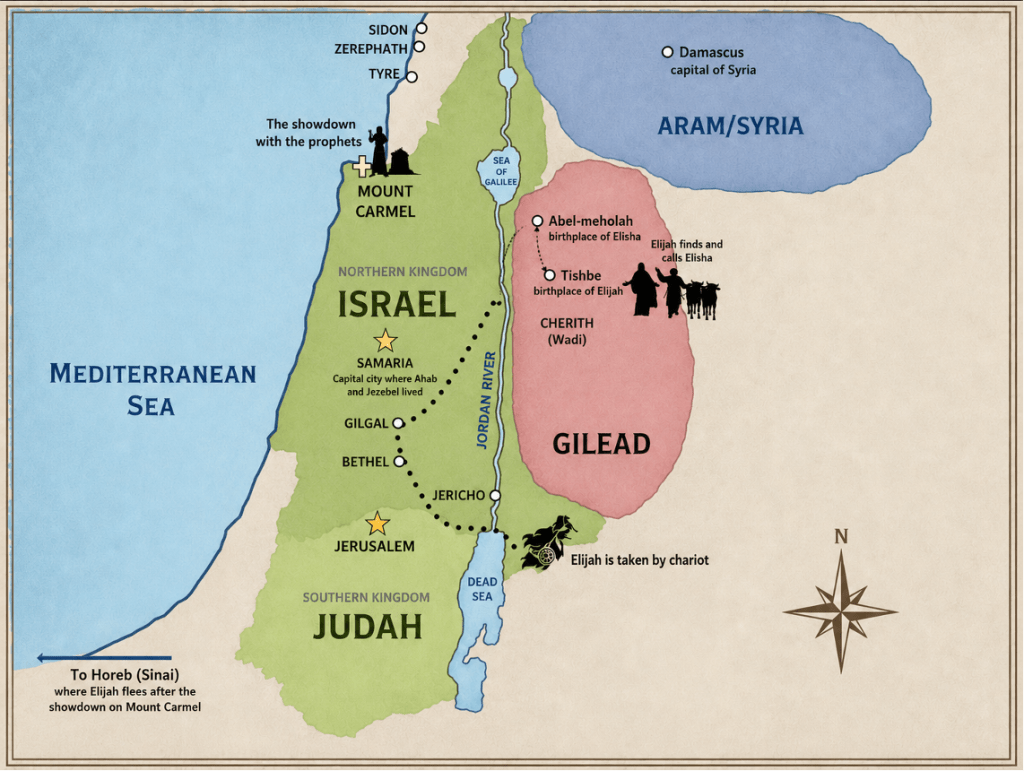
Gilgal was the first campsite of the Israelites after they crossed over the Jordan River into the Promised Land. It’s the place where their covenant with God was renewed, and the new generation celebrated Passover there. It’s the location of the 12 memorial stones, and a major center for worship and early royal history.[4] We find out that God is going to take Elijah by whirlwind. The phrase literally means “in the storm of the heavens”[5] Ba’al was the storm god. He was the one who was supposed to ride in the heavens, bringing thunder, lightning, and rain. But when the prophets on Mount Carmel called for Ba’al to cash in and bring rain, there was no answer. Yahweh proved himself to be the ultimate deity, by bringing fire from heaven to light the bull on the altar on fire, and he brought the much-needed rain to the people, too. This next scene will once again prove that Yahweh rules the storms instead of the supposed storm god Ba’al.[6]
I can only imagine that there may be a sense of nervousness on Elisha’s part. Can you imagine being the one called to take over for the ministry of Elijah? Elijah—who went alone before king Ahab and told him that there would be no rain. Elijah—who stood on Mount Carmel and was a prophet alone in the middle of over 900 prophets of other gods. Elijah—who got death threats from the queen, —who heard God’s voice in the desert, —-who calls Ahab on the carpet for his sin. Those are very big shoes to fill!
On April 12, 1945, Harry Truman received a message asking him to come to the White House “as quickly and as quietly as you can.” This was in the middle of World War II. When he arrived, he was taken into Mrs. Roosevelt’s sitting room and she said, “Harry, the president is dead.” Truman was stunned and said, “Is there anything I can do for you?” “No Harry,” she said. “Is there anything we can do for YOU?”[7]
Elijah knows his ministry is ending. Elisha knows his is about to begin. Imagine what their emotions might be. One is wondering how to finish well. The other is wondering whether he’s really ready. As they head out, Elijah will test Elisha to make sure he’s up for the job.
Elijah said to Elisha, “Stay here; the Lord has sent me TO BETHEL.” But Elisha said, “As surely as the Lord lives and as you live, I will not leave you.” So they went down to Bethel. 2 Kings 2:2 NIV
Bethel was the place where Abraham pitched his tent and built an altar to the Lord after God had called him to leave his country and had promised him that he would be a great nation, and his name would be great.[8] Jacob had a dream at Bethel with the stairway reaching to heaven.[9] He returned to Bethel years later, and God changed his name to Israel there, too.[10] Bethel is 7 and a half miles from Gilgal. In Bethel is a group of prophets. Did you know there was such a thing as a professional guild of prophets? It’s a place where people are trained to become prophets—or are assistants to the prophets. These groups were located in various places in the region, and may have been part of the 7,000 Israelites who had not bowed down to Baal, mentioned in 1 Kings 19.[11]
The company of the prophets AT BETHEL came out to Elisha and asked, “Do you know that the Lord is going to take your master from you today?” “Yes, I know,” Elisha replied, “so be quiet.” Then Elijah said to him, “Stay here, Elisha; the Lord has sent me TO JERICHO.” And he replied, “As surely as the Lord lives and as you live, I will not leave you.” So they went to Jericho. 2 Kings 2:3-4 NIV
From Bethel to Jericho is 11 and a half miles. Jericho is the site of the first city that was conquered miraculously as the Israelites entered the Promised Land. It was there that they walked around the city seven times and the walls came tumbling down.[12] At Jericho they encounter another group from the sons of the prophets.
The company of the prophets AT JERICHO went up to Elisha and asked him, “Do you know that the Lord is going to take your master from you today?” “Yes, I know,” he replied, “so be quiet.” Then Elijah said to him, “Stay here; the Lord has sent me TO THE JORDAN.” And he replied, “As surely as the Lord lives and as you live, I will not leave you.” So the two of them walked on. 2 Kings 2:5-6 NIV
It’s almost 6 miles from Jericho to the Jordan river.[13] A typical traveler can walk 15-20 miles a day. This is about 25 miles. It’s a serious bit of travel for one days’ journey. This isn’t random travel though. They’re retracing some of the most significant places in Israel’s history as they entered the Promised Land[14]—as though God is reminding them that He has been writing His people’s story for generations.
Fifty men from the company of the prophets went and stood at a distance, facing the place where Elijah and Elisha had stopped at the Jordan. Elijah took his cloak, rolled it up and struck the water with it. The water divided to the right and to the left, and the two of them crossed over on dry ground. 2 Kings 2:7-8 NIV
When Elijah takes his cloak, which is a symbol of his power, and struck the waters, think of the story of Moses when he used his staff, which was his sign of power, and struck the waters of the Sea of Reeds, the waters parted, and the people pass over on dry ground. The prophets see all of this happen. That’s important. They stay on one side of the Jordan, and Elijah and Elisha cross and move on—to the other side of the Jordan—outside of Israel.[15]
When they had crossed, Elijah said to Elisha, “Tell me, what can I do for you before I am taken from you?” “Let me inherit a double portion of your spirit,” Elisha replied. “You have asked a difficult thing,” Elijah said, “yet if you see me when I am taken from you, it will be yours—otherwise, it will not.” 2 Kings 2:9-10 NIV
The meaning of the ‘double portion’ is just a Hebrew idiom. It doesn’t mean that Elisha is asking for twice as much as Elijah had.[16] This is a custom of inheritance for the firstborn, found in Deuteronomy 21:15-17. It means that Elisha is asking to be appointed—as Elijah’s legitimate heir.[17] Elijah knows that God is at work. And he’s learning to let go. He doesn’t cling to the mantle. He lets it fall.
A life of faith trusts that God is already at work in the next chapter.
It’s a good reminder for us. How do we become people who recognize where God is already at work? Elisha may have questions about what it will look like after Elijah is gone. But he needs to have enough faith to step into the chapter that God had prepared for him.
As they were walking along and talking together, suddenly a chariot of fire and horses of fire appeared and separated the two of them, and Elijah went up to heaven in a whirlwind. 2 Kings 2:11 NIV

WOW! Without warning, Elijah is taken to heaven. The spiritual realm is visible in the physical realm and the meaning is significant. Fire is a typical sign of the divine, as we noted in the story of Elijah on Mount Carmel—and in the wilderness at Mount Horeb.
And a chariot—is the driving force behind an army. It’s like the army tank. The king of Israel would lead the nation into battle in his chariot.[18] The storm god Ba’al was said to rule the storms and rode in HIS chariot in the sky. But Yahweh is stronger than Ba’al. He rules over the whirlwind and is stronger than death.[19] God alone rides the heavens and controls the storm. And now he comes to take Elijah to himself.
Elisha saw this and cried out, “My father! My father! The chariots and horsemen of Israel!” And Elisha saw him no more. Then he took hold of his garment and tore it in two. Elisha then picked up Elijah’s cloak that had fallen from him and went back and stood on the bank of the Jordan. He took the cloak that had fallen from Elijah and struck the water with it. “Where now is the Lord, the God of Elijah?” he asked. When he struck the water, it divided to the right and to the left, and he crossed over. 2 Kings 2:12-14 NIV
A new chapter is beginning. And Elisha is looking up. He’s not staring at what he’s losing. He’s watching what God is doing.
A life of faith trusts that God is already at work in the next chapter.
Elisha passes the test. He sees Elijah being taken and the mantle is passed to him. He receives the power from God to carry on the next leg of prophetic ministry. Elijah trusted God enough to let go of the term God had given him. Elisha trusted God enough to step into the new era that God had prepared for him. Both required faith.
There is no substitute for a great leader. God doesn’t recycle the past. But when God’s leader is removed, everything of God still remains. HE is unchanging. Elijah was an amazing prophet, but Elisha will have his own distinctive ministry.[20] We are all going to leave some kind of legacy behind. Maybe today you feel more like Elijah. You’re handing something off. A career. A ministry. A season of life. A dream. Trust God enough to let go. He isn’t finished writing His story. Or maybe you’re feeling more like Elisha. You’re stepping into something new. A marriage. College. Retirement. A new responsibility. You don’t feel ready. But remember…God had been preparing Elisha long before this day ever arrived, and he has been preparing the way for you, too.
Over the last six weeks, we’ve walked with Elijah through some of the most significant seasons of his journey. At the brook Cherith, we learned that: When our resources run dry, God’s provision remains faithful
On Mount Carmel, we saw that When hearts are divided God calls people back to Himself. God is worthy of our wholehearted trust, even when the world pulls us in other directions.
In the wilderness, we discovered that When we’re running on empty, God doesn’t abandon us. He still restores weary bodies. He still restores discouraged hearts. He still restores purpose.
We were encouraged by Elijah’s prayer on the mountain. Faith keeps looking up when everything else is looking down. So, we can pray one more time. Because God hears and responds to the prayers of His people, even when they seem small.
In Naboth’s vineyard, we found that When life isn’t fair, faith relies on the God who sees. God sees every injustice and will one day make all things right.
And now, beside the Jordan River, we discover one more truth: A life of faith trusts that God is already at work in the next chapter.
The God who provided at Cherith… The God who answered on Carmel… The God who restored Elijah in the wilderness… The God who heard his prayers… The God who confronted injustice… Is the same God who was already preparing what came next before Elijah’s story came to an end.
The same God who was faithful in every season of Elijah’s life is already at work in the next chapter of yours. We started today by saying this story isn’t really about how Elijah finishes. It’s about how God continues. That’s true of Elijah. It’s true of Elisha. And it’s true of us. Chapters end. Seasons change. People come and go. But God continues. None of us knows what the next leg of the journey holds. Some of us will celebrate. Some of us will grieve. Some of us will wait. Some of us will step into something we’ve never done before. But our hope has never been that we know what comes next. Our hope is in God—the one who holds all things—and who works things together for His glory and our good.
Prayer: God, we thank You that You are the Author of our lives. Long before we see a new chapter unfolding, You are already at work. You go before us, preparing the way, shaping us, and accomplishing Your purposes even when we cannot yet see them. Today, some of us are standing where Elijah stood. We are learning to let go of a season that has been familiar. We carry both gratitude for what has been and uncertainty about what comes next. Give us the faith to place our future in Your hands.
Others of us are standing where Elisha stood. A new responsibility, a new opportunity, or a new season lies before us, and we wonder whether we are enough for what You’ve called us to do. Remind us that You have been preparing us long before we realized it.
Help us to trust not in ourselves, but in Your presence and Your Spirit. Teach us to keep our eyes on You instead of focusing on our fears. When the future feels uncertain, remind us that nothing surprises You. When life changes, remind us that You do not. Thank You for those who have gone before us—for parents and grandparents, teachers and mentors, pastors and friends—who have pointed us toward You. Help us to live in such a way that we leave behind a legacy of faith for those who will follow after us. And as we begin whatever chapter lies ahead, may we do so with confidence—not because we know what tomorrow holds, but because we know the One who holds tomorrow. We place our lives, our families, our church, and our future into Your faithful hands. In the name of Jesus we pray, Amen.
Bibliography
- Alter, Robert, Ancient Israel: The Former Prophets: Joshua, Judges, Samuel, and Kings, New York: W.W. Norton & Company, 2013.
- Beal, Lissa M. Wray, Apollos Old Testament Commentary, 1 & 2 Kings, Downers Grove: InterVarsity Press, 2014.
- DeVries, Simon J., Word Biblical Commentary, 1 Kings, Second Edition, Nashville: Thomas Nelson, Inc, 2003.
- Fritz, Volkmar, 1 & 2 Kings, Minneapolis: Fortress Press, 2003.
- Gunkel, Hermann, Elijah, Yahweh and Baal, Eugene: Cascade Books, 2014.
- House, Paul R., The New American Commentary, An Exegetical and Theological Exposition of Holy Scripture, 1,2 Kings, Broadman and Holman Publishers, 1995.
- Inrig, Gary, Holman Old Testament Commentary, 1&II Kings, Nashville: B&H Publishing Group, 2003, 177.
- Walsh, Jerome T., Berit Olam: Studies in Hebrew Narrative & Poetry, 1 Kings, Collegeville, Minnesota: The Liturgical Press, 1996.
Websites
https://www.gotquestions.org/school-of-prophets.html. Accessed July 23, 2026.
https://ask.metafilter.com/66998/Walking-Distance-In-a-Day Accessed July 23, 2026.
https://www.gotquestions.org/Gilgal-in-the-Bible.html Accessed July 27, 2026.
—
Small Group Questions
Elijah: A Life of Faith
Week 5—When God Opens a New Chapter
1 Kings 19:19–21; 2 Kings 2:1–14
*Leader’s Guide available on request
Icebreaker
- If you could skip one transition in life entirely, what would it be? (Moving, job changes, learning new technology, kids leaving home, retirement, other?)
Read 1 Kings 19:19-21 NIV
9 So Elijah went from there and found Elisha son of Shaphat. He was plowing with twelve yoke of oxen, and he himself was driving the twelfth pair. Elijah went up to him and threw his cloak around him. 20 Elisha then left his oxen and ran after Elijah. “Let me kiss my father and mother goodbye,” he said, “and then I will come with you.” “Go back,” Elijah replied. “What have I done to you?” 21 So Elisha left him and went back. He took his yoke of oxen and slaughtered them. He burned the plowing equipment to cook the meat and gave it to the people, and they ate. Then he set out to follow Elijah and became his servant.
Discussion
- After Elijah places his cloak on Elisha, Elisha immediately leaves his oxen and runs after him. What does that tell you about Elisha’s response to God’s call?
- Elisha slaughtered his oxen and burned his plowing equipment before following Elijah. Why do you think he did that instead of simply leaving home?
What does this act communicate about his commitment?
- What “plows” or “safety nets” do people today sometimes hold onto that make it difficult to fully follow God’s leading?
- Notice that God called Elisha while he was faithfully working in the field. What does this suggest about where and when God often calls people?
- Between 1 Kings 19 and 2 Kings 2, many years pass while Elisha serves Elijah quietly. Why do you think Scripture says so little about those years?
What might that teach us about seasons of preparation?
- Before Elijah’s ministry came to an end, God was preparing Elisha behind the scenes. Can you think of a time when you later realized God had been preparing you for something long before you recognized it?
Read 2 Kings 2:1-8 NIV
When the Lord was about to take Elijah up to heaven in a whirlwind, Elijah and Elisha were on their way from Gilgal. 2 Elijah said to Elisha, “Stay here; the Lord has sent me to Bethel.” But Elisha said, “As surely as the Lord lives and as you live, I will not leave you.” So they went down to Bethel. 3 The company of the prophets at Bethel came out to Elisha and asked, “Do you know that the Lord is going to take your master from you today?” “Yes, I know,” Elisha replied, “so be quiet.”
4 Then Elijah said to him, “Stay here, Elisha; the Lord has sent me to Jericho.” And he replied, “As surely as the Lord lives and as you live, I will not leave you.” So they went to Jericho. 5 The company of the prophets at Jericho went up to Elisha and asked him, “Do you know that the Lord is going to take your master from you today?” “Yes, I know,” he replied, “so be quiet.” 6 Then Elijah said to him, “Stay here; the Lord has sent me to the Jordan.” And he replied, “As surely as the Lord lives and as you live, I will not leave you.” So the two of them walked on. 7 Fifty men from the company of the prophets went and stood at a distance, facing the place where Elijah and Elisha had stopped at the Jordan. 8 Elijah took his cloak, rolled it up and struck the water with it. The water divided to the right and to the left, and the two of them crossed over on dry ground.
Discussion
- Why do you think the writer tells us several times that “the Lord was about to take Elijah up to heaven in a whirlwind”? What effect does this repetition have as you read the story?
- Elijah tells Elisha three different times to stay behind, yet Elisha refuses each time. Why do you think Elijah kept asking him to stay?
What do Elisha’s repeated responses reveal about his character?
- The journey takes Elijah and Elisha through Gilgal, Bethel, Jericho, and finally to the Jordan. Why do you think the author records each stop? What might the journey itself be teaching us?
- Each time the prophets mention Elijah’s departure, Elisha replies, “I know. Be quiet.” Why do you think Elisha responded that way? What emotions do you imagine he was experiencing?
- Can you think of a time when you knew a significant change was coming but couldn’t stop it? How did you handle the waiting?
- This passage is filled with endings, anticipation, and uncertainty. Elijah was learning to let go while Elisha was learning to step in. Which people do you identify with most right now?
- Elijah, preparing to let go.
- Elisha, stepping into new responsibilities.
- The prophets watching from the sidelines.
- Someone grieving a significant change.
What makes you identify with that person?
Read 2 Kings 2:9-14 NIV
When they had crossed, Elijah said to Elisha, “Tell me, what can I do for you before I am taken from you?” “Let me inherit a double portion of your spirit,” Elisha replied. 10 “You have asked a difficult thing,” Elijah said, “yet if you see me when I am taken from you, it will be yours—otherwise, it will not.” 11 As they were walking along and talking together, suddenly a chariot of fire and horses of fire appeared and separated the two of them, and Elijah went up to heaven in a whirlwind. 12 Elisha saw this and cried out, “My father! My father! The chariots and horsemen of Israel!” And Elisha saw him no more. Then he took hold of his garment and tore it in two. 13 Elisha then picked up Elijah’s cloak that had fallen from him and went back and stood on the bank of the Jordan. 14 He took the cloak that had fallen from Elijah and struck the water with it. “Where now is the Lord, the God of Elijah?” he asked. When he struck the water, it divided to the right and to the left, and he crossed over.
Discussion
- Elijah asks Elisha, “Tell me, what can I do for you before I am taken from you? If someone you deeply respected asked you that question today, how do you think you would answer?
- Elisha asked for a “double portion” of Elijah’s spirit (2 Kings 2:9). This wasn’t about wanting twice as much power, but about becoming Elijah’s rightful spiritual heir. Who has been a spiritual influence or mentor in your life?
How did they help shape your faith?
- Elijah tells Elisha, “If you see me when I am taken from you, it will be yours.” Why do you think Elijah connected the promise to Elisha’s attentiveness and perseverance? What does this teach us about remaining faithful?
- What responsibilities do you think came with the cloak that Elisha picked up? What “cloak” has someone else passed on to you—a responsibility, ministry, opportunity, or example of faith? How have you responded?
A life of faith trusts that God is already at work in the next chapter
- What do you think faithful obedience looks like when God hasn’t yet revealed what the “next chapter” will be?
- Think back over the Elijah series. Which story has spoken to you most personally?
- God’s provision at Cherith
- Mount Carmel
- Elijah’s burnout
- The small cloud and persistent prayer
- Naboth’s vineyard
- Elijah passing the mantle to Elisha
Why has that particular story stayed with you?
Personal Application
- What is one area of your life where God may be inviting you to leave something familiar in order to follow Him more fully?
- What are some ways you can intentionally prepare and encourage those who will come after you?
Closing
Invite each person to briefly share one “next chapter” they would appreciate prayer for—a decision, transition, relationship, opportunity, loss, or uncertainty. Pray that each person would trust that God is already at work before they can see what comes next.
Prayer
Gracious God, thank You for Your faithfulness in every season of life. Give us courage to let go when You call us to release something, and faith to step forward when You open a new chapter. Help us to trust that You are already at work in the future we cannot yet see. In Jesus’ name, Amen.
[1] Jerome T. Walsh, Berit Olam: Studies in Hebrew Narrative & Poetry, 1 Kings, Collegeville, Minnesota: The Liturgical Press, 1996., 279.
[2] Simon J. DeVries, Word Biblical Commentary, 1 Kings, Nashville: Thomas Nelson, Inc, 2003., 239.
[3] Jerome T. Walsh, 280.
[4] https://www.gotquestions.org/Gilgal-in-the-Bible.html
[5] Paul R. House, The New American Commentary: 1&2 Kings; Nashville: B&H Publishing Group, 1995, 257.
[6] House, 259.
[7] Gary Inrig, Holman Old Testament Commentary, 1&II Kings, Nashville: B&H Publishing Group, 2003, 177, 203.
[8] Genesis 12:1-9.
[9] Genesis 8:10-22.
[10] Genesis 35:1-4
[11] https://www.gotquestions.org/school-of-prophets.html
[12] Joshua 6:1-27.
[13] https://ask.metafilter.com/66998/Walking-Distance-In-a-Day
[14] Lissa M. Wray Beal, Apollos Old Testament Commentary, 1 & 2 Kings, Downers Grove: InterVarsity Press, 2014., 303.
[15] Robert Alter, Ancient Israel: The Former Prophets: Joshua, Judges, Samuel, and Kings, New York: W.W. Norton & Company, 2013, 736.
[16] Gary Inrig, 205.
[17] Beal, 304.
[18] Volkmar Fritz, 1 & 2 Kings, Minneapolis: Fortress Press, 2003, 236.
[19] Paul R. House, 259.
[20] Gary Inrig, Holman OT Commentary, I&II Kings, Nashville: B&H Publishing, 2003, 203.

