
About these posts
These posts grow out of sermons I’ve written for my local church community. You’re welcome to use them—for teaching, small groups, preaching, or personal reflection. If you share them elsewhere, please include a simple attribution. If you’d ever like to share how they’re being used, you’re welcome to reach out through the Contact button.
Over the last few weeks, we’ve been following Elijah’s journey of faith, and if there’s one thing we’ve learned, it’s that trusting God looks different in every season. Sometimes faith means trusting God for daily provision, like food from ravens and flour that never runs out. Sometimes it means standing with courage on Mount Carmel,
believing that God will show up in power. And sometimes faith means sitting in the silence, listening for the gentle whisper of God’s voice when you’re exhausted and running on empty. Today we come to another season of faith—one that most of us know very well. What do we do when our prayers feel small?
We tend to remember the spectacular prayers in the Bible: Moses raises his staff and the Red Sea parts. Joshua says, ‘Sun, stand still’ and the sun never sets. Hannah prays for a child and gets Samuel the prophet. Peter says, “In the name of Jesus Christ of Nazareth, walk,” and a lame man is healed. We remember the prayers that changed history. When the cancer is healed, the money is provided, and revival happens. The big prayer requests are also the ones that we put in the church newsletters and in the emails, too: ‘God, let the test results come back clear!’ ‘End the war!’ ‘Save my loved one!’ But then there are the small prayers. Most of our prayers aren’t asking God to stop the sun. They’re asking Him to help us get through Monday. ‘Help me make it through this shift.’ ‘Keep my kids safe.’ ‘Help me forgive.’ ‘I need patience, please!’ ‘Help me be faithful today.’ ‘Help me find my keys!’ ‘Give me wisdom in this conversation.’ ‘Lord…I’m tired.’ ‘I don’t know what to do.’ I wonder…What if THOSE are the prayers God delights to answer?
Elijah prayed one of those prayers. It wasn’t the dramatic prayer that called down fire from heaven. It’s the quiet prayer that came afterward…when the sky was still empty. We’re going to pick up Elijah’s story near the end of his ministry on Mount Carmel, and then we’ll see why James points to this particular moment as an example of faithful prayer.
Three years earlier, Elijah had received a word from the Lord and boldly stood before King Ahab, declaring that there would be no rain on the land. The drought that followed wasn’t just a weather event—it was God’s judgment against Baal, the supposed storm god of Canaan. Over the past few weeks, we’ve watched God provide for Elijah by the brook and through the widow of Zarephath. We’ve watched God answer with fire on Mount Carmel. But this is what we often forget…Sure, the fire fell. Yes, the people confessed, “The LORD—He is God!” Elijah is a man of faith, and he’s acted on the word of the Lord. But now what? Because it still hadn’t rained. The fields are still brown. There is still a drought happening. And there are no clouds in the sky.
Have you ever had that? Is there a time where you stepped out in faith, but you haven’t seen the fulfillment? You’ve finished college, or grad school, but you don’t have a job yet, and you can’t even get interviews. You’ve been planning on starting a business, but nothing is happening. You’ve got bills to pay and are paying them but hanging on by the skin of your teeth in this economy. You may have parents and neighbors that you’ve stepped up to help, but you don’t know what things will look like in a month or two. And what do you do after God has already done something amazing, but the thing you’ve been waiting for still hasn’t happened? God had told Elijah:
“Go and present yourself to Ahab, and I will send rain on the land.” 1 Kings 18:1b.
After the miracle on Mount Carmel, Elijah finds himself in the in-between. God has answered with fire, but there is still no sign of rain. The sky is empty. Yet Elijah is a man of faith. He trusts the word God has already spoken, even though he has not yet seen it fulfilled. So, he takes a bold step.
Elijah said to Ahab, “Go up, eat and drink; for there is the sound of the roar of rain.” 1 Kings 18:41
That phrase –“the sound of rain”, could be associated with a panicked military camp[1], an uproar[2], or torrents of conjured water[3]’. The word equates God’s voice—with the sound of water.[4]
So Ahab went UP to eat and drink. But Elijah went UP to the top of Carmel; and he crouched down on the earth and put his face between his knees. He said to his servant, “Go UP now, look toward the sea.” So he went UP and looked and said, “There is nothing.” And he said, “Go back” seven times. 1 Kings 18:42-43
This whole section is framed by the words ‘Go up’! Remember, the whole group is at the bottom of the mountain at the brook Kishon, where they have just killed all of the prophets of Baal. “Climb up that mountain, Ahab—after you’ve watched your prophets—the prophets of Baal die—Go up that mountain and stand before God—and eat and drink—go up and make a sacrifice as a representative of the people and see if God will renew his covenant with us.”
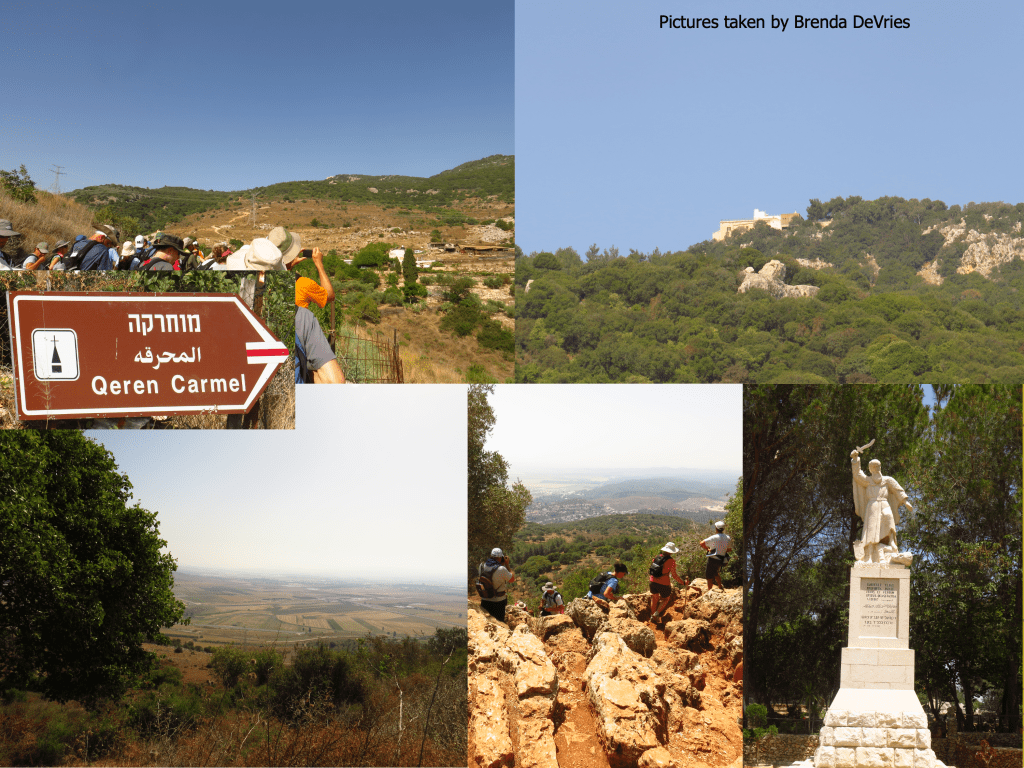
It’s not a short climb. It took our group about 2 hours to climb to the spot where the monastery sits on Mount Carmel. It’s a tall ask. But Ahab has been humiliated, and he needs to make things right with God. And so he goes up…
Meanwhile, Elijah also went to the top of Mount Carmel. Did they climb together? While Ahab is making an altar and sacrifice, Elijah is somewhere nearby with his face between his knees—knees that have NOT bowed in worship to Baal. Other versions say that Elijah crouched down (NASB), bowed low to the ground (NLT), or cast himself down upon the earth (KJV). His expression is of special concentration, and a posture of humility, mourning and prayer.[5] But what does he pray? The earlier text gives us his dramatic prayer at the showdown scene:
“O LORD, the God of Abraham, Isaac and Israel, today let it be known that You are God in Israel and that I am Your servant and I have done all these things at Your word. 37 “Answer me, O LORD, answer me, that this people may know that You, O LORD, are God, and that You have turned their heart back again.” 1 Kings 18:36b-37.
God answers that prayer in a powerful show of fire from heaven. But what does Elijah pray when his head is between his knees? ‘Help!’ ‘God, please.’ ‘Answer my prayer.’ ‘Send what you promised.’ ‘Show your people that you truly care.’ ‘Prove that YOU are the God of rain.’ ‘God?’ …’Where is the rain?’ SEVEN TIMES he tells his servant to look toward the sea. Is there a cloud? Do you see anything? How about now?

We may often say, ‘things are looking up.’ It means that things are getting better. But in this story, things have not been going well. A three-year drought is followed by a show of power from God, but that feels like the opposite of what is needed. God brought fire? We need rain. The ground is dry. There is no cloud in the sky. And all Elijah can do is pray.
Faith keeps looking up when everything else is looking down
That’s exactly what Elijah does. Before anything changes around him, he chooses to turn his heart toward God. Before the rain comes down, Elijah goes up. In the Old Testament, ‘going up’ wasn’t simply about climbing a mountain. It was the language of worship. The language of approaching God. The language of sacrifice. Before the rain ever comes down—Elijah goes up. He looks to God. And he prays. THAT prayer is the basis for the last part of James’ letter. When James comes to the end of his letter in the New Testament, he tells the church to pray. When you’re suffering—pray! When you’re happy—pray! When you’re sick, discouraged, and tired—call out—and we will pray FOR you! We must pray, pray, pray—even when…and especially when—it seems as if ALL we can do is pray. God is faithful—and he is our only hope for sustenance, for healing, and for justice. And then James writes:
The prayer of a righteous person is powerful and effective. 17 Elijah was a human being, even as we are. He prayed earnestly that it would not rain, and it did not rain on the land for three and a half years. 18 Again he prayed, and the heavens gave rain, and the earth produced its crops. James 5:16b-18
James makes a reference to Elijah’s prayer. The prayer that no one hears. The prayer that no one wrote down. Everybody remembers the fire. But James remembers the rain. The prayer he highlights isn’t the spectacular one. It’s the persistent one. It’s the one where Elijah is just kneeling, waiting, looking, and sending the servant to see if anything had changed. It’s interesting that James would choose THIS prayer to remember. Early church historian Eusebius tells us that James himself became known for his life of prayer. He wrote that James’ knees grew hard like a camel’s because he spent so much time kneeling in worship and praying for the forgiveness of the people.[6]
Maybe that’s why James noticed that Elijah put his face between his knees. He knew something about waiting before God. We don’t know a single word Elijah prayed that afternoon. We know where he prayed. We know how he prayed. But we don’t know the words. Apparently, God wasn’t listening for eloquence. He was looking for faith.
Sometimes faith is expressed in just a few simple words. Maybe this week your prayer doesn’t need to be a long prayer. Maybe it can be a small, simple breath prayer. A breath prayer is prayed in one slow breath. As you breathe in, you remember God’s truth. As you breathe out, you respond in faith. Let’s practice a couple of these together:
(breathe in) I cast my cares on you…(breathe out) because you care for me.
(breathe in) When I am afraid…(breathe out) I put my trust in You.
(breathe in) The Lord is my Shepherd…(breathe out) I have everything I need.
(breathe in) Your Word comes true in time…(breathe out) I can wait with hope.
Those may seem like small prayers. But they are prayed to a very big God: a God who delights to answer his children. At the end of the story in 1 Kings 18, we read:
44 The seventh time the servant reported, “A cloud as small as a man’s hand is rising from the sea.” So Elijah said, “Go and tell Ahab, ‘Hitch up your chariot and go down before the rain stops you.’” 45 Meanwhile, the sky grew black with clouds, the wind rose, a heavy rain started falling and Ahab rode off to Jezreel. 46 The power of the Lord came on Elijah and, tucking his cloak into his belt, he ran ahead of Ahab all the way to Jezreel. 1 Kings 18:44-46 NIV
The seventh time is the kicker. The rain finally comes. The crops are saved. The people know that the Lord is God. I think many of us spend time living in the first six times that the servant went back.
It’s when we are scanning the skies, and we keep saying, ‘there’s nothing yet.’ But faith isn’t measured by what we can see. It’s measured by whether we keep looking toward the One who made the promise. That’s where faith is formed—not after the cloud appears, but while the sky is still empty. If that’s where you are, you’re in good company today. James says Elijah was a person just like us. Elijah got discouraged.
He got tired. He doubted. He hid. He ran. He prayed. Just like us. Which means you don’t have to be a prophet. You don’t have to stand on Mount Carmel. You don’t have to pray for fire from heaven, or have the most eloquent words. Sometimes faith looks like getting on your knees…believing God’s promise…and deciding to pray one—more—time. Church, this week, remember this:
Faith keeps looking up when everything else is looking down
This story is a reminder, not only for Elijah, but for us, that rather than relying on noise and action, or seeking to find God in the dazzling displays…perhaps we should also remember God is at work even when the sky still looks empty. Sometimes God’s first answer doesn’t look like much. God answered Elijah with a small cloud—a cloud the size of a man’s hand. But a small answer from a faithful God is still enough.
So, what do you do when your prayers feel small? Remember the story of Elijah. Keep looking up. Pray one more time. Elijah’s life is an example of faithfulness. Like Elijah, we can trust God’s promises, and we pray yet again. Because, as James writes, “The prayer of a righteous person is powerful and effective.”[7] So, let’s pray:
PRAYER: Our good and gracious God, Thank You for hearing every prayer we bring to You—not just the dramatic ones, but the quiet ones whispered in the middle of ordinary days. Forgive us for the times we grow impatient or discouraged when we can’t yet see what You’re doing. Teach us to trust Your promises, even when the sky still looks empty. Give us the faith to keep looking up, to keep coming to You, and to pray one more time. When we are afraid, remind us that You are with us. When we are tired, renew our strength. When we are waiting, fill us with hope. And Lord, for those among us who are living in the first six times—for those waiting for healing, for answers, for reconciliation, for work, for direction, or for relief—meet them today with Your presence. Help them know that even when they cannot yet see the answer, You are still faithful and You are still at work. May our lives reflect the quiet, persistent faith of Elijah. And may we remember that a small prayer offered to a great God is never wasted. We ask all of this in the name of Jesus, our Savior and our hope. Amen.
Bibliography
- Beal, Lissa M. Wray, 1 & 2 Kings. Apollos Old Testament Commentary, Downers Grove, IL: InterVarsity Press, 2014.
- Holladay, William L., A Concise Hebrew and Aramaic Lexicon of the Old Testament. Grand Rapids, MI: William B. Eerdmans Publishing Company, 1988.
- Long, Burke O, 1 Kings, The Forms of the Old Testament Literature, Grand Rapids, MI: William B. Eerdmans Publishing Company, 1984.
- McKnight, Scot, The Letter of James, New International Commentary on the New Testament, Grand Rapids, MI: William B. Eerdmans Publishing Company, 2011.
- Wiseman, Donald J., 1 & 2 Kings, Downers Grove: InterVarsity Press, 1993.
—
Small Group Discussion Guide
Elijah: A Life of Faith
Week 4 – When Your Prayers Feel Small
1 Kings 18:41-46; James 5:16b-18
*Leader’s Guide available on request
Icebreaker
- If you had to wait for something that felt like forever (a package, test results, a vacation, a proposal, a baby, etc.), what was it? Were you patient…or did you check every five minutes?
- We often celebrate dramatic answers to prayer. What are some “small prayers” you find yourself praying most often?
Examples: Wisdom, Patience, Strength, Direction, Peace, Daily provision
Read 1 Kings 18:41-42 NASB
41 Now Elijah said to Ahab, “Go up, eat and drink; for there is the sound of the roar of a heavy shower.” 42 So Ahab went up to eat and drink. But Elijah went up to the top of Carmel; and he crouched down on the earth and put his face between his knees.
Discussion
- Elijah tells Ahab, “There is the sound of the roar of a heavy shower”, even though there isn’t a cloud in the sky. What do you think gave Elijah the confidence to say that?
- Compare Ahab’s response with Elijah’s response. What does Ahab do? What does Elijah do?
- Putting his face between his knees is a posture of humility and prayer. Elijah already knew God’s promise from 1 Kings 18:1: “I will send rain.” If God had already promised it, why pray? What does that teach us about the relationship between God’s promises and our prayers?
- Which required more faith: Standing before 450 prophets of Baal, or waiting quietly for rain after the victory? Why?
Read 1 Kings 18:43
43 “Go up now, and look toward the sea,” he told his servant. And he went up and looked. “There is nothing there,” he said. Seven times Elijah said, “Go back.”
Discussion
- If you were watching this scene unfold, what emotions do you think each character was experiencing?
-Elijah
-The servant
-Ahab
- This section repeats the phrase “Go up.” Why do you think worship and prayer often require us to “go up” before we see anything change?
- Imagine being the servant. After the fourth or fifth trip up the mountain, what do you think was going through his mind? How do you think he felt when Elijah simply said, “Go back.”
- Why do you think God didn’t send the rain immediately? What might God have been teaching Elijah?
- The servant reports only what he sees. Elijah responds based on what he believes. What is the difference between living by sight and living by faith in this passage?
- What does persistence look like without becoming demanding or trying to manipulate God?
- What details stood out to you in this passage that you’ve never noticed before?
Read James 5:16b-18 NIV
The prayer of a righteous person is powerful and effective.
17 Elijah was a human being, even as we are. He prayed earnestly that it would not rain, and it did not rain on the land for three and a half years. 18 Again he prayed, and the heavens gave rain, and the earth produced its crops.
Discussion
- James says Elijah was “a person just like us.”Why is that important? How does remembering Elijah’s humanity encourage your own prayer life?
- James doesn’t point us to Elijah calling down fire. He points us to Elijah praying for rain. Why do you think James chose that moment instead? What does that teach us about faithful prayer?
Read 1 Kings 18:44-46 NIV
44 The seventh time the servant reported, “A cloud as small as a man’s hand is rising from the sea.” So Elijah said, “Go and tell Ahab, ‘Hitch up your chariot and go down before the rain stops you.’” 45 Meanwhile, the sky grew black with clouds, the wind rose, a heavy rain started falling and Ahab rode off to Jezreel. 46 The power of the Lord came on Elijah and, tucking his cloak into his belt, he ran ahead of Ahab all the way to Jezreel.
Discussion
- Why do you think God chose to begin with a tiny cloud instead of sending an immediate downpour? Have you ever seen God answer a prayer with a “small cloud” before the full answer came?
- What keeps people from praying “one more time”? Discouragement? Disappointment? Busyness? Fear? Something else?
- Which is harder for you: Praying boldly? Waiting patiently? Trusting silently? Why?
Faith keeps looking up when everything else is looking down
- At the beginning of this passage there was no rain, no clouds, no visible evidence. By the end there is abundant rain. Where in your life are you praying for a “small cloud” right now? How can this group encourage you to keep looking up?
- How can we keep praying faithfully when God’s answers seem delayed?
Personal Application
- Take one minute of silence. Think of one area where you’re currently “living in the first six times.” Write one sentence that begins: “Lord, while I’m waiting…”
- This week, every time you’re tempted to think, “There’s nothing yet…” pause and pray one more time.
Breath Prayers
Here are some breath prayers that you can practice. Say the first phrase while breathing in, and the second one while breathing out.
When I am afraid… I put my trust in You.
The Lord is my Shepherd… I have everything I need.
Your Word comes true in time… I can wait with hope.
Closing
- Invite each person (if they’re comfortable) to share one word or one short phrase describing what they’re waiting for (examples: healing, wisdom, family, work, peace, direction). After each person shares, the group simply responds together: “Lord, help us keep looking up.” Then close in prayer, asking God to give everyone the faith to trust His promises—even when they’re living in “the first six times.”
Prayer: Thank You for hearing every prayer we bring to You, whether it feels big or small. Help us to trust Your promises even when the sky still looks empty. Give us the faith to keep looking up, to pray one more time, and to recognize even the smallest signs of Your work. As we go into this week, remind us that You are faithful, and that a small answer from a great God is enough. We ask this in Jesus’ name. Amen.
[1] Beal, Lissa M. Wray: Apollos Old Testament Commentary: 1 & 2 Kings; Downers Grove, InterVarsity Press, 2014, 245. 1 Samuel 14:19
[2] William L. Holladay, A Concise Hebrew and Aramaic Lexicon of the Old Testament, Grand Rapids: William B. Eerdmans Publishing Company, 1988, 81.
[3] Long, Burke O., The Forms of the Old Testament Literature: 1 Kings., Grand Rapids: William B. Eerdmans Publishing Company, 1984. 194.
[4] Jeremiah 10:12
[5] Donald J. Wiseman, 1 & 2 Kings, Downers Grove: InterVarsity Press, 1993, 171.
[6] Scot McKnight, NICNT: The Letter of James, Grand Rapids: Eerdmans Publishing Company, 2011, 21.
[7] James 5:16

