

About these posts
These posts grow out of sermons I’ve written for my local church community. You’re welcome to use them—for teaching, small groups, preaching, or personal reflection. If you share them elsewhere, please include a simple attribution. If you’d ever like to share how they’re being used, you’re welcome to reach out through the Contact button.

Have you ever noticed that sometimes the hardest things aren’t the big events in life, but how we feel afterwards? Maybe you’ve experienced that yourself. You poured yourself into caring for someone you love. You finished a huge project at work. You finally got through a difficult period with your family. You led an event that went really well. But afterwards, you feel completely drained. We might think, “If I can just make it through this busy season…” “If I can just finish the project…” “If I can just get through the wedding…” “If I can just get through the school year…” Then life will settle down. Sometimes we even take a vacation, expecting to come home refreshed. But before long, we’re doing laundry, answering emails, catching up on everything that piled up while we were gone, and we realize…we’re still tired.
Burnout affects people in all walks of life. Statistics say that burnout today isn’t just from the workplace. It also comes from being constantly connected, constantly processing information, constantly juggling responsibilities, and often carrying burdens that no one else sees. It’s a recipe for exhaustion.[1] Running on empty doesn’t always mean we’ve failed. Sometimes it means we’ve poured ourselves out for really good things! The good news is:
When we’re running on empty, God doesn’t abandon us.
We’re going to see that truth in the life of Elijah today. When we left him last, God had just answered with fire from heaven. The prophets of Ba’al had been defeated. It was one of the greatest spiritual victories in all of Scripture. You would think that Elijah would be on cloud nine, exulting in the power of God, and confident in his position. But the next chapter begins with a collapse.
Now Ahab told Jezebel all that Elijah had done, and all about how he had killed all the prophets with the sword. 1 Kings 19:1 NIV
As the text stresses, Ahab gave Jezebel ALL the details. But…Ahab doesn’t say one thing about Yahweh. He only talks about what Elijah had done. ALL the credit AND…all the blame goes to Elijah. It makes sense. It’s much easier to blame someone you can physically see and touch, and Ahab doesn’t need another showdown with Yahweh. And he doesn’t want one with his wife, either. Jezebel was a Phoenician princess. The god of her people was Ba’al, and he’s just been discredited in front of the priests and people gathered on that mountain. Not only that, but ALL of the prophets who were there…HER prophets—450 of Ba’al, and 400 of the Asherah—prophets who had been wined and dined at her table…ALL of them are dead…because Elijah commanded it. Jezebel is pretty ticked.
Then Jezebel sent a messenger to Elijah, saying, “So may the gods do to me and even more, if I do not make your life as the life of one of them by tomorrow about this time.” 1 Kings 19:2 NIV
Jezebel has killed Yahweh’s prophets before,[2] so Elijah has no reason to doubt her.[3] This is not an idle threat. But Elijah said, ‘Yahweh is God. You’ve heard for yourself what happened on the mountain. Ahab saw it with his own eyes. I am God’s prophet, Jezebel. Repent and worship him. I will even come and pray with you.” Nope.
And he was afraid and arose and ran for his life and came to Beersheba, which belongs to Judah, and left his servant there. But he himself went a day’s journey into the wilderness, and came and sat down under a juniper tree; and he requested for himself that he might die, and said, “It is enough; now, O Lord, take my life, for I am not better than my fathers.” 1 Kings 19:3-4 NIV
In chapter 17-18, Elijah is strong. Here—he is weak…he cowers before Jezebel, he flees into the desert, and he seems to abandon life itself.[4]
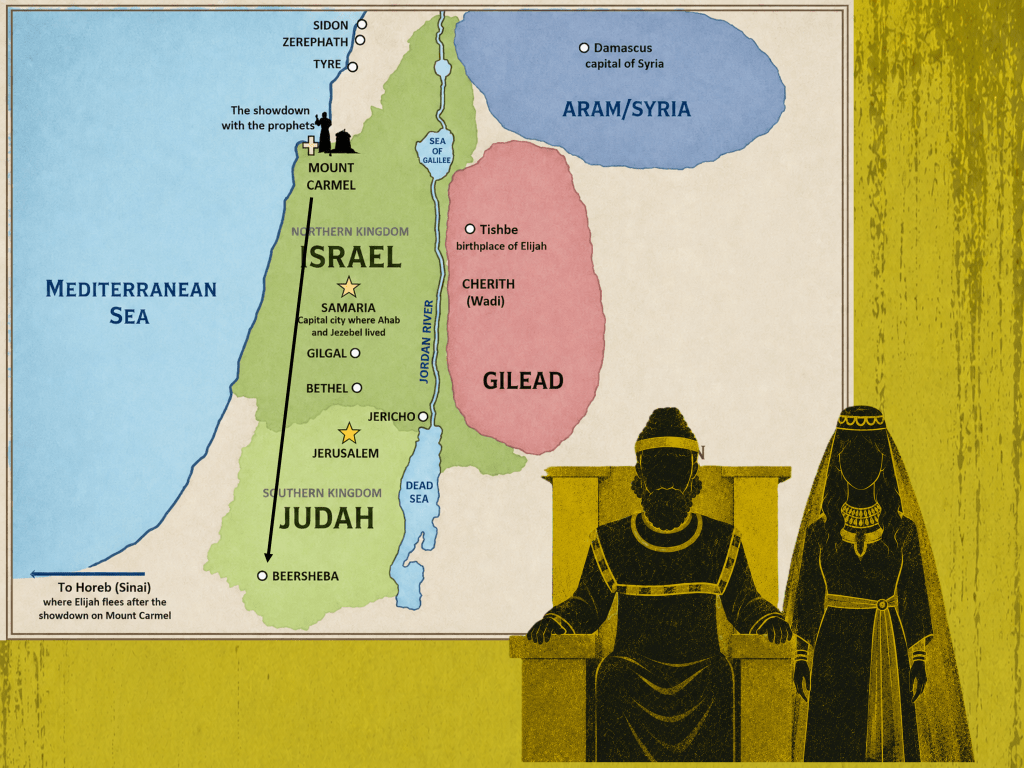
Elijah was just up on Mount Carmel by the Sea, and in the jurisdiction of Ahab and Jezebel near Jezreel. Now, Elijah heads to Beersheba, which is WAY out of the reach of Jezebel. He’s on foot! And he runs like Forrest Gump—about 100 miles away from this crazy, angry woman.[5] And when he came to Beersheba in Judah, he leaves his servant there and keeps going. After he is out of sight of his servant, he goes another day’s journey into the desert. No one can survive in that harsh of a climate for long. The desert is dry and dangerous. This is a suicide mission.[6]
Before we get too hard on Elijah, let’s look at how this sometimes plays out in our own lives. We’re more connected than we’ve ever been. Our phones buzz all day long with texts, emails, news alerts, and social media. And yet many people have never felt more emotionally drained or more alone. Maybe you’re raising young children, and there are days when you think, “Lord, I don’t know if I can do this one more time.” Maybe you’re caring for aging parents, juggling doctor’s appointments, medications, and difficult decisions, and you wonder how much longer you can carry the weight. Maybe it’s your job. You keep showing up, working hard, doing what’s expected of you, and then one more meeting, one more criticism, or one more impossible deadline is enough to break the camel’s back. Maybe you’ve poured yourself into caring for other people for so long that you’ve developed compassion fatigue. You’ve listened, encouraged, served, and helped until there’s just nothing left in the tank. I’ve discovered that sometimes even ministry can become a wilderness.
When we are tired, discouraged and vulnerable, our problems become big, and our God looks small. Elijah wasn’t running from a lack of faith. He was exhausted. He had spent himself in faithful service—and now fear and fatigue distorted everything he could see.
“I’ve had enough Lord. Take me now! My life seems meaningless! I haven’t made a difference at all!” Sometimes we run to the desert—and sometimes the desert is thrust upon us. But God is still present in the wilderness.
When we’re running on empty, God doesn’t abandon us.
Most experts agree that recovering from burnout means caring for your body, creating healthy boundaries, seeking support from others, and making changes that restore balance to your life.[7] Interestingly, that’s not far from what God does for Elijah.
(Elijah) He lay down and slept under a juniper tree; and behold, there was an angel touching him, and he said to him, “Arise, eat.” Then he looked and behold, there was at his head a bread cake baked on hot stones, and a jar of water. So he ate and drank and lay down again. The angel of the Lord came again a second time and touched him and said, “Arise, eat, because the journey is too great for you.” So he arose and ate and drank, and went in the strength of that food forty days and forty nights to Horeb, the mountain of God. 1 Kings 19:5-8 NIV
God restored Elijah’s BODY
In this moment, the first thing God does is to restore Elijah’s body—through food and sleep. Maybe you’ve seen the meme that says: This one time in the Bible, Elijah was like, “God, I’m so mad! I want to die! So, God said, “Here’s some food. Why don’t you have a nap?”…Never underestimate the power of a nap and a snack,[8] it says. I like that…But Elijah wasn’t just tired. Dr. Henry Cloud talked about this once. He said that most of us are not tired. If you were just tired, you could take a nap, and that would solve your problem. Physical rest is a reality. And we all need rest for the body at times.
But even after that, what is really needed—is an encounter with the very real and very holy presence of God. What is needed is an intimate moment where you experience the grace, the goodness, the loving kindness, and the mercy of the presence of God.
Elijah ate, but then he went on a journey. Maybe after an encounter with the angel he’s thinking, “I need to find God. I need to have another powerful moment. I need God to show up again so that I can feel his presence in my life…and I’m going to go far away to do that.
We might sometimes be tempted to think, “If I could just get away… if I could just get to camp… if I could just get to that worship concert… if I could just experience another spiritual high…” Those experiences are gifts from God on occasion. But they aren’t where our faith is sustained. Eventually the conference ends. Eventually we all come home. Eventually we’re back in ordinary life. God isn’t only present in spectacular moments. He’s present in the quiet ones too. Here’s what happens to Elijah.
Then he came there to a cave and lodged there; and behold, the word of the Lord came to him, and He said to him, “What are you doing here, Elijah?” 1 Kings 19:9 NIV
God is direct and to the point, isn’t he? “What are you doing here?” That’s an interesting question. Maybe YOU are in the wilderness right now because you’re running away from something. Maybe you’re afraid, and so you’ve run away from community, from fellowship, and from living the life that God has called you to. Or maybe you’re in the wilderness because you were driven there. Things happened, and the rug was pulled out from under you, and you’re not living in abundance or good times. All of a sudden you look around and you’re alone. You didn’t choose that—it just happened. Think about that question for a minute. “What are you doing here?” What would you say to God? Elijah says,
“I have been very zealous for the Lord, the God of hosts; for the sons of Israel have forsaken Your covenant, torn down Your altars and killed Your prophets with the sword. And I alone am left; and they seek my life, to take it away.” 1 Kings 19:10 NIV
Elijah whines a little. He wants God to know that he’s tried hard, but that he feels alone and wants to die. He says that the sons of Israel have torn down the altars of Yahweh, and yet…. they were JUST on top of Mount Carmel where they rebuilt one of the altars and God showed up in a big way. He also seems to forget about the other prophets that are faithful to Yahweh, and sobs that he is alone. He isn’t doing well emotionally, and he spills his guts out. But I love how Elijah just tells it like it is. We can’t be afraid to tell God how we see it, either…even if our perspective is wrong, even if we are just tired and hurt…we are allowed to tell God how we feel. But God’s response is even better. He doesn’t argue with Elijah. He doesn’t send him packing and make him go right back. He meets with him. And the meeting with God is unexpected—because of its subtlety.
So He said, “Go forth and stand on the mountain before the Lord.” And behold, the Lord was passing by! And a great and strong wind was rending the mountains and breaking in pieces the rocks before but the Lord was not in the wind. And after the wind an earthquake, but the Lord was not in the earthquake. After the earthquake a fire, but the Lord was not in the fire; 1 Kings 19:12-13 NIV
Yahweh is God. He is powerful, he is awesome, he is the Creator of the earth, the defender of his people, and the Lord over all! When God shows up, it should be in a way that only God could show up in. Elijah had just seen God show up in fire on Mount Carmel. God’s presence is supposed to be seen in big manifestations, right?
And wind, earthquake, and fire are the most familiar symbols.[9] Elijah is expecting to see something BIG as he waits. GOD is passing by! A great wind comes…but God is not in the wind. An earthquake comes…but God is not in the earthquake. A fire comes…but God is not in the fire. God was not….. in the Earth…Wind…and Fire…(some of you got that) God wasn’t present in all the big stuff. He didn’t shout. He didn’t yell. He didn’t show off his power.
In what ways do WE expect to hear God? I think we tend to align our assumptions with what is awe-inspiring and impressive. We want God to zoom in and save the day with great shows of power. We expect God to show up in the bright lights and loud music of a concert. We want the glitz and glamour; we want the thunder when it comes to God. But God doesn’t always show up in the grandiose. Dan Tiessen writes: even if we encounter God on the mountaintop, we can’t live in the world of divine apparitions and spiritual ecstasy.[10] God doesn’t always show up that way. He is not limited to the grand and glorious, as Elijah is about to find out.
…and after the fire a sound of a gentle blowing. When Elijah heard it, he wrapped his face in his mantle and went out and stood in the entrance of the cave. 1 Kings 19:13 NIV
God shows up. But it is in the sound of a gentle blowing, a thin silence, a whisper that is barely audible. But Elijah recognizes the presence of Yahweh in the hardly audible murmur.[11] This is a new image of God. Why does God whisper? Sometimes God speaks softly—so that we must pay attention. Did you know that a close whisper is 100 times more intense than a sound at the threshold of hearing?[12] I once watched a father-in an online video. He was saying that he went in to talk to his daughter. She was on her tablet, so she didn’t even want to acknowledge him. Rather than using his former method of raising his voice to try and get her attention, he got close, leaned in, and said ‘hey’. She turned, curious, and he whispered, ‘can you please get ready for practice?’ And she did.[13] If you’re looking for a new practice with your kids, that might be one to try. I love doing that with our grandbabies. They lean in close when I whisper in their ear so that they can hear more.
God whispers because he wants to get your attention. And in the wilderness, there’s space to hear a whisper. In the clamor of work, kids, grandkids, basketball games, rehearsals, meetings and other events…it’s hard to hear sometimes. But in the wilderness—when everything is stripped away—Whether by choice or thrust upon you—God doesn’t abandon you. Here:
God restored Elijah’s PERSPECTIVE
Elijah needed a word from the Lord. He expected another Mount Carmel. But God gave him Horeb. He expected spectacular. God chose personal. He did not get his answer in the expected format, and he didn’t get shouted at, either. God came to him in a whisper. Again…God asks him a question:
And behold, a voice came to him and said, “What are you doing here, Elijah?” Then he said, “I have been very zealous for the Lord, the God of hosts; for the sons of Israel have forsaken Your covenant, torn down Your altars and killed Your prophets with the sword. And I alone am left; and they seek my life, to take it away.” 1 Kings 19:13-14 NIV
Elijah’s response to God is the same as before. He laments that he has been doing the work of the Lord, but everyone has abandoned God and only he is left. He is miserable. God is aware of what Elijah needs, but he does not release him from his mission. Elijah must go back.
The Lord said to him, “Go, return on your way to the wilderness of Damascus, and when you have arrived, you shall anoint Hazael king over Aram; and Jehu the son of Nimshi you shall anoint king over Israel; and Elisha the son of Shaphat of Abel-meholah you shall anoint as prophet in your place. It shall come about, the one who escapes from the sword of Hazael, Jehu shall put to death, and the one who escapes from the sword of Jehu, Elisha shall put to death. Yet I will leave 7,000 in Israel, all the knees that have not bowed to Ba’al and every mouth that has not kissed him.” 1 Kings 19:15-18
God did not abandon Elijah when he was running on empty. He restored Elijah’s BODY with food and rest, He restored Elijah’s PERSPECTIVE through the whisper and his presence, and now:
God restored Elijah’s PURPOSE
Elijah needs to go back to anoint two new kings…one over Aram, or Syria, and one over Israel, even though Ahab is not quite finished with his term yet. God asks Elijah to continue his ministry as God’s prophet. But the ministry is not going to depend on Elijah alone. He also gets to anoint another prophet who will take his place when he is finished: someone who will carry the torch after he is gone. But God still has things for Elijah to do. God also reminds him that there are people who are still loyal to Yahweh.
There are seven thousand people who have not worshipped Ba’al. This isn’t 7000 exact people, but it represents a complete number—a substantial number of people who are faithful to Yahweh. As Dan Epp-Tiessen notes, “Elijah doesn’t need to be so discouraged, or take himself so seriously because he is far from being the only person committed to the divine cause.”[14]
And perhaps Elijah is given the realization that lasting transformation for the people of Israel would not come through a spectacular performance either, but rather through soft, one-on-one encounters with people.[15] And that means he has to go back and be with them. God doesn’t allow Elijah to stay in the cave. He restores Elijah by giving him purpose again.
When we’re running on empty, God doesn’t abandon us. God wants to restore our bodies, our perspective, and our purpose.
The same God who met Elijah in the wilderness still meets His people today. He still restores weary bodies. He still restores discouraged hearts. He still restores purpose.
Maybe today what you need most is rest. Like Elijah, you’ve been running hard for a long time, and your body is telling you it’s time to stop and take a break. Receive that as God’s gift, not as a sign of weakness. Maybe what you need is a new perspective. You’ve been listening to the voices of fear, failure, or discouragement for so long that they’ve begun to sound like the truth. Spend time in God’s presence and let His voice become louder than the others. Don’t run away from God. Run to him! Or maybe what you need is renewed purpose. You’ve been tempted to quit, to believe your work doesn’t matter, or that you’re all alone. But God isn’t finished with you yet. We might think, “When I feel better, THEN I’ll serve.” But sometimes God restores us through faithful obedience.
He still has people to love, people to encourage, and a purpose for your life. If you’re running on empty today, remember this: God meets you in the wilderness. And He hasn’t abandoned you. He is still at work—restoring your body, renewing your perspective, and calling you forward with purpose.
Prayer: Almighty and powerful God, today you come to us, not in the great wind, not in the roar of the earthquake, and not in the raging fire…but in the sound of a silent whisper. Help us to listen for your still, small voice. We are a wordy people, God, prone to fill all the crooks and crevices of our life with noise. We expect something loud and flashy from you, too. But sometimes you simply sit with us—and are quiet. So this morning we want to be silent before you, too, and so we come to you in a time of silent prayer, being still, and acknowledging that you are God.
Time of Silent Prayer
God, in your whispers give us strength and offer us hope. Give us the courage for the mission that you have for us, trusting that you will prepare the way, and that you will journey with us. We offer you our lives, in the name of Jesus the Christ…Amen.
—————————-
Bibliography
- Alter, Robert; Ancient Israel: The Former Prophets: Joshua, Judges, Samuel, and Kings; New York: W.W. Norton & Company, 2013.
- Anders, Max, Gary Inrig, Holman Old Testament Commentary: 1&2 Kings, Nashville: B&H Publishing, 2003.
- Beal, Lissa M. Wray, 1&2Kings, Downers Grove: InterVarsity Press, 2014.
- DeVries, Simon J.; Word Biblical Commentary: 1 Kings, 2nd Edition; Nashville: Thomas Nelson, 2003.
- Fritz, Volkmar; 1 & 2 Kings, a Continental Commentary; Minneapolis: Fortress Press, 2003.
- House, Paul R., 1,2 Kings, The New American Commentary, Vol.8; Nashville: B&H Publishing Group, 1995.
- Long, Burke O.; 1 Kings: with an Introduction to Historical Literature, Volume IX, Grand Rapids: William B. Eerdmans Publishing Company, 1984.
- Online book: Julie Baretz, The Bible on Location: Off the Beaten Path in Ancient and Modern Israel, University of Nebraska Press, 2015. https://books.google.com/books?id=0q4eCAAAQBAJ&pg=PT123&dq=fire+in+1+Kings+19&hl=en&sa=X&ved=0ahUKEwja2fm2kbHUAhXGNiYKHSKJCZoQ6AEIKjAB#v=onepage&q=fire%20in%201%20Kings%2019&f=false
Articles:
- Dan Epp-Tiessen, “1 Kings 19-The Renewal of Elijah”, Direction 35/1, 2006.
—-
Small Group Discussion Guide
A Life of Faith: Trusting God in Every Season
Week 2-When God Shows up Powerfully
1 Kings 18:1-2, 17-40
*Leader’s Guide available on request
Icebreaker
If you had to choose only one convenience, hobby, or possession to keep for a year (besides basic necessities), what would it be—and why?
Read 1 Kings 18:1-2, 17-21 NIV
After a long time, in the third year, the word of the Lord came to Elijah: “Go and present yourself to Ahab, and I will send rain on the land.” 2 So Elijah went to present himself to Ahab. 17 When he saw Elijah, he said to him, “Is that you, you troubler of Israel?” 18 “I have not made trouble for Israel,” Elijah replied. “But you and your father’s family have. You have abandoned the Lord’s commands and have followed the Baals. 19 Now summon the people from all over Israel to meet me on Mount Carmel. And bring the four hundred and fifty prophets of Baal and the four hundred prophets of Asherah, who eat at Jezebel’s table.” 20 So Ahab sent word throughout all Israel and assembled the prophets on Mount Carmel. 21 Elijah went before the people and said, “How long will you waver between two opinions? If the Lord is God, follow him; but if Baal is God, follow him.” But the people said nothing.
Discussion
- God waited three years before sending Elijah back. What might God have been accomplishing during those three years—in Elijah? In Ahab? In Israel?
- Ahab blames Elijah instead of recognizing his own unfaithfulness. Why is it often easier to blame the messenger than face the real problem?
- This seems to be a private confrontation between Elijah and Ahab. Why do you think Elijah wanted “all Israel” present?
- Elijah asks, “How long will you waver between two opinions?” The Hebrew word suggests limping or hobbling between two paths. What picture does that create in your mind? Why is “limping” a powerful image for divided loyalty?
- Ahab and Israel were trying to keep Yahweh and Baal. Can you think of examples today where Christians are tempted to treat Jesus as “one voice among many” rather than the supreme authority in their lives?
Read 1 Kings 18:22-29 NIV
Then Elijah said to them, “I am the only one of the Lord’s prophets left, but Baal has four hundred and fifty prophets. 23 Get two bulls for us. Let Baal’s prophets choose one for themselves, and let them cut it into pieces and put it on the wood but not set fire to it. I will prepare the other bull and put it on the wood but not set fire to it. 24 Then you call on the name of your god, and I will call on the name of the Lord. The god who answers by fire—he is God.” Then all the people said, “What you say is good.” 25 Elijah said to the prophets of Baal, “Choose one of the bulls and prepare it first, since there are so many of you. Call on the name of your god, but do not light the fire.” 26 So they took the bull given them and prepared it. Then they called on the name of Baal from morning till noon. “Baal, answer us!” they shouted. But there was no response; no one answered. And they danced around the altar they had made. 27 At noon Elijah began to taunt them. “Shout louder!” he said. “Surely he is a god! Perhaps he is deep in thought, or busy, or traveling. Maybe he is sleeping and must be awakened.” 28 So they shouted louder and slashed themselves with swords and spears, as was their custom, until their blood flowed. 29 Midday passed, and they continued their frantic prophesying until the time for the evening sacrifice. But there was no response, no one answered, no one paid attention.
Discussion
- Why do you think fire instead of rain was the test?
- Why do you think Elijah lets the prophets of Baal go first?
- The prophets of Baal begin early in the morning and call on Baal for hours. What are some things people pursue today that promise fulfillment but ultimately leave them empty?
- Can you think of modern examples where people exhaust themselves trying to gain acceptance, success, or security?
- Elijah suggests Baal may be deep in thought, busy, traveling, or asleep. What does each possibility imply about the limitations of Baal? How is Yahweh different?
- Imagine you were standing somewhere on Mount Carmel watching this unfold.
At what point do you think you would have started wondering whether Baal was ever going to answer? After an hour? By noon? After Elijah started mocking them? When they began cutting themselves? At evening sacrifice? Why?
Read 1 Kings 18:30-37 NIV
30 Then Elijah said to all the people, “Come here to me.” They came to him, and he repaired the altar of the Lord, which had been torn down. 31 Elijah took twelve stones, one for each of the tribes descended from Jacob, to whom the word of the Lord had come, saying, “Your name shall be Israel.” 32 With the stones he built an altar in the name of the Lord, and he dug a trench around it large enough to hold two seahsof seed. 33 He arranged the wood, cut the bull into pieces and laid it on the wood. Then he said to them, “Fill four large jars with water and pour it on the offering and on the wood.” 34 “Do it again,” he said, and they did it again. “Do it a third time,” he ordered, and they did it the third time. 35 The water ran down around the altar and even filled the trench. 36 At the time of sacrifice, the prophet Elijah stepped forward and prayed: “Lord, the God of Abraham, Isaac and Israel, let it be known today that you are God in Israel and that I am your servant and have done all these things at your command. 37 Answer me, Lord, answer me, so these people will know that you, Lord, are God, and that you are turning their hearts back again.”
Discussion
- Elijah uses twelve stones, one for each tribe of Israel. Why was it important to include all twelve tribes, even though the kingdom had been divided?
- Why do you think Elijah wanted them not only to watch, but to participate in this process?
- Elijah has the sacrifice drenched with water three times. What misconceptions or objections does it eliminate? What emotions do you think the people experienced as they kept pouring more and more water over the altar during a severe drought?
- Read Elijah’s prayer carefully. What are the main requests he makes?
What does he not pray for?
- Notice how simple Elijah’s prayer is compared with everything the prophets of Baal had done. What does this teach us about the difference between praying and trying to manipulate God?
Read 1 Kings 18:38-40
38 Then the fire of the Lord fell and burned up the sacrifice, the wood, the stones and the soil, and also licked up the water in the trench. 39 When all the people saw this, they fell prostrate and cried, “The Lord—he is God! The Lord—he is God!” 40 Then Elijah commanded them, “Seize the prophets of Baal. Don’t let anyone get away!” They seized them, and Elijah had them brought down to the Kishon Valley and slaughtered there.
Discussion
- The fire consumed not only the sacrifice, but also the wood, stones, dust, and water. What does this communicate about God’s power?
- In the end, the people finally confess, “The LORD—He is God!” Why is this confession the climax of the story rather than the fire itself?
- Verse 40 is difficult for many readers. What questions does it raise for you?
What does it teach us about the seriousness of idolatry?
- In the first two stories, God sent Elijah, God provided for Elijah, God answered by fire, God turned hearts back to Himself. Why is it important to remember that God moves toward us before we fully return to Him? How does that encourage you today?
When our hearts are divided, God calls us back to Himself
- If you could have been one person in this story (other than Elijah), who would you have wanted to be—and why?
Personal Application
- Israel didn’t completely reject Yahweh. They simply refused to trust Him alone.
Why do you think it’s easier to divide our loyalties than to reject God outright?
- Which of these is most likely to compete with wholehearted trust in Christ?
Comfort, Security, Success, Approval, Control, Money, Politics, Something else?
How have you seen that compete for your loyalty?
- Have you ever experienced a “Mount Carmel moment”—a time when God made His faithfulness unmistakably clear? How did it affect your faith?
- Have you ever experienced a season where God graciously drew you back after your heart had drifted? What happened?
This Week’s Challenge
Take five quiet minutes sometime this week and ask God one simple question:
“Lord, is there anything competing with You for first place in my heart?”
Write down an area where your heart has begun to drift or become divided.
Pray and ask God for the courage to trust Him more fully in that area.
Time of Silence
Spend a few moments in silent reflection before the final prayer. Ask God to reveal any competing loyalties that have quietly taken hold of your heart.
Prayer: Lord, thank You for being the living God who graciously reveals Yourself and calls us back when our hearts begin to drift. Show us anything that is competing for first place in our lives. Thank You that You don’t abandon us when our hearts are divided, and that you continue to call us back to Yourself. Give us ears to hear Your voice and courage to follow You follow You with wholehearted devotion. In Jesus’ name, Amen.
[1] https://www.pathways-ky.org/burnout-in-2026/ Burnout in 2026
Pathways, Apr 20, 2026, accessed July 8, 2026.
[2] 1 Kings 18:4,13
[3] Paul R. House, 1,2 Kings, The New American Commentary, Vol.8; Nashville: B&H Publishing Group, 1995, 221.
[4] Simon J. DeVries, Word Biblical Commentary: 1 Kings, 2nd Edition; Nashville: Thomas Nelson, 2003, 236.
[5] revamped from Craig Groeschel’s sermon
[6] Dan Epp-Tiessen, “1 Kings 19-The Renewal of Elijah”, Direction 35/1, 2006, 35.
[7] https://www.pathways-ky.org/burnout-in-2026/
[8] https://www.facebook.com/MINDFULCHRISTIANITY/photos/a.1657258524556329/2957982511150584/?type=3&source=48&paipv=0&eav=AfbEsXP996rINHbPD8G-SxtoteEegijnA2he9VA5eLX1jno-xJzE-9asSOjiHfjJJ4M&_rdr
[9] DeVries, Word, 236. “Wind, earthquake and fire are familiar symbols of the theophanic presence as potential manifestations of Yahweh’s power.”
[10] Epp-Tiessen, 47.
[11] Volkmar Fritz, 1 & 2 Kings, a Continental Commentary; Minneapolis: Fortress Press, 2003, 198.
[12] https://www.bartleby.com/solution-answer/chapter-26-problem-34a-conceptual-physics-the-high-school-physics-program-9th-edition/9780133647495/how-much-more-intense-is-a-close-whisper-than-a-sound-at-the-threshold-of-hearing/f85479d8-e914-4555-91a0-d1bf84d74be1
[13] https://www.facebook.com/reel/503434545190216?fs=e&s=aEkTS0&mibextid=z9DgKg
[14] Epp-Tiessen, 39.
[15] Julie Baretz, The Bible on Location: Off the Beaten Path in Ancient and Modern Israel, University of Nebraska Press, 2015. https://books.google.com/books?id=0q4eCAAAQBAJ&pg=PT123&dq=fire+in+1+Kings+19&hl=en&sa=X&ved=0ahUKEwja2fm2kbHUAhXGNiYKHSKJCZoQ6AEIKjAB#v=onepage&q=fire%20in%201%20Kings%2019&f=false

