

About these posts
These posts grow out of sermons I’ve written for my local church community. You’re welcome to use them—for teaching, small groups, preaching, or personal reflection. If you share them elsewhere, please include a simple attribution. If you’d ever like to share how they’re being used, you’re welcome to reach out through the Contact button.

Have you ever accidentally committed to be in two places at the same time? One time I did that—I was supposed to go on a weekend retreat—as a leader—and I had committed to playing in an alumni band performance. A few days before the event, my daughter noticed that I had inadvertently mixed up the days, and to my horror, they were both on the same day! I experienced the reality of having to make a choice between the two. I had to make a phone call, and an apology, because I couldn’t be in two places at the same time. Thankfully, in the end, I was able to just be a few hours late to the retreat, and made a memory with my classmates and kids that is a treasure.
Almost every choice in life eventually asks for your full commitment. You can date for a while, but eventually someone asks, ‘Will you marry me?’ You can explore different careers, but eventually you have to choose one. You can stand at a fork in the trail for a few minutes, but if you’re ever going to get anywhere, you have to pick a path. Eventually, every commitment reveals what matters most. That’s exactly where Israel finds itself in 1 Kings 18. For years they’ve tried to keep one foot with Yahweh and one foot with Baal. They were trying to keep Yahweh…AND Baal, just in case.
Last week we met Elijah for the first time. The Word of God brought Elijah to King Ahab’s palace and announced a drought. After that, God led him to the Cherith Ravine. Through ravens, a brook, and a widow, God showed Elijah that He could be trusted. We learned that when our resources run dry, God’s provision remains faithful. But while God was caring for Elijah, the nation was growing more desperate. Three years have passed. The drought wasn’t just exposing empty reservoirs—it’s exposing where Israel has placed its trust. Today, we’re going to see what happens when Elijah confronts Israel with a choice: Who will they trust? Who will they worship? It’s one of the most famous stories of Elijah. Like every biblical narrative, this story is more than history. It is history told with a purpose. The writer wants us to see something about God’s character. It isn’t just a story telling us that a contest happened. It’s inviting us to answer the same question Israel had to answer: Who is really God?
After a long time, in the third year, the word of the Lord came to Elijah: “Go and present yourself to Ahab, and I will send rain on the land.” 2 So Elijah went to present himself to Ahab. 1 Kings 18:1-2 NIV
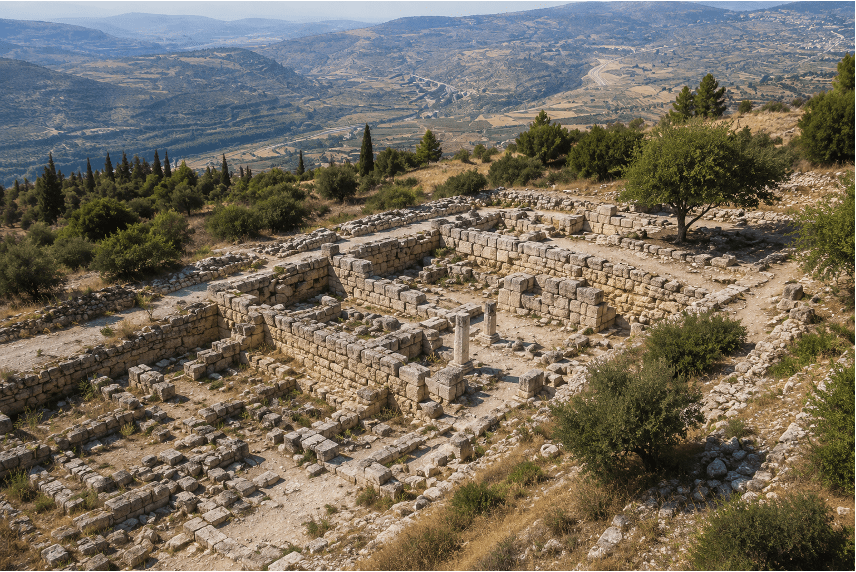
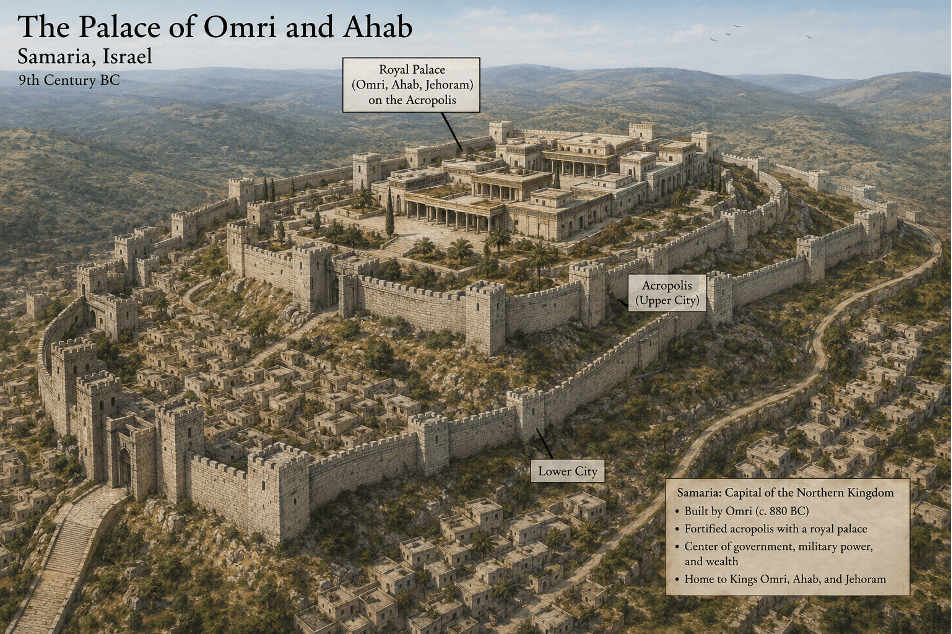
Ahab is king of Northern Israel, and the capital is in Samaria. His father Omri had built a palace there,[2] and it was a political hub.[3] The location was intentional. There were wine and oil presses there, but it also had cisterns—that contained so much water, that it would cover a single person’s water needs today for almost 1,500 years.[4] King Ahab was not hurting for water. The hill was also on the main trade route, and from the palace, you could see a panorama of the Coastal plain[5] and the Mediterranean Sea.[6]
17 When he saw Elijah, he said to him, “Is that you, you troubler of Israel?” 18 “I have not made trouble for Israel,” Elijah replied. “But you and your father’s family have. You have abandoned the Lord’s commands and have followed the Baals. 19 Now summon the people from all over Israel to meet me on Mount Carmel. And bring the four hundred and fifty prophets of Baal and the four hundred prophets of Asherah, who eat at Jezebel’s table.” 1 Kings 18:17-19 NIV
Ahab blames the drought on Elijah, and Elijah reminds him that it is the worship of the Baals that has brought this calamity on the nation.[7] Baal was the storm deity—the rider of the clouds. He was often portrayed with a lightning bolt in one hand, and thunder was identified as his voice.[8] But Baal simply means, ‘lord’, and there were different Baals: Baal Melqart of Tyre, Baal-Shamem, or Baal Carmel.[9] Elijah lumps them all together—‘Ahab, you have followed the Baals.’
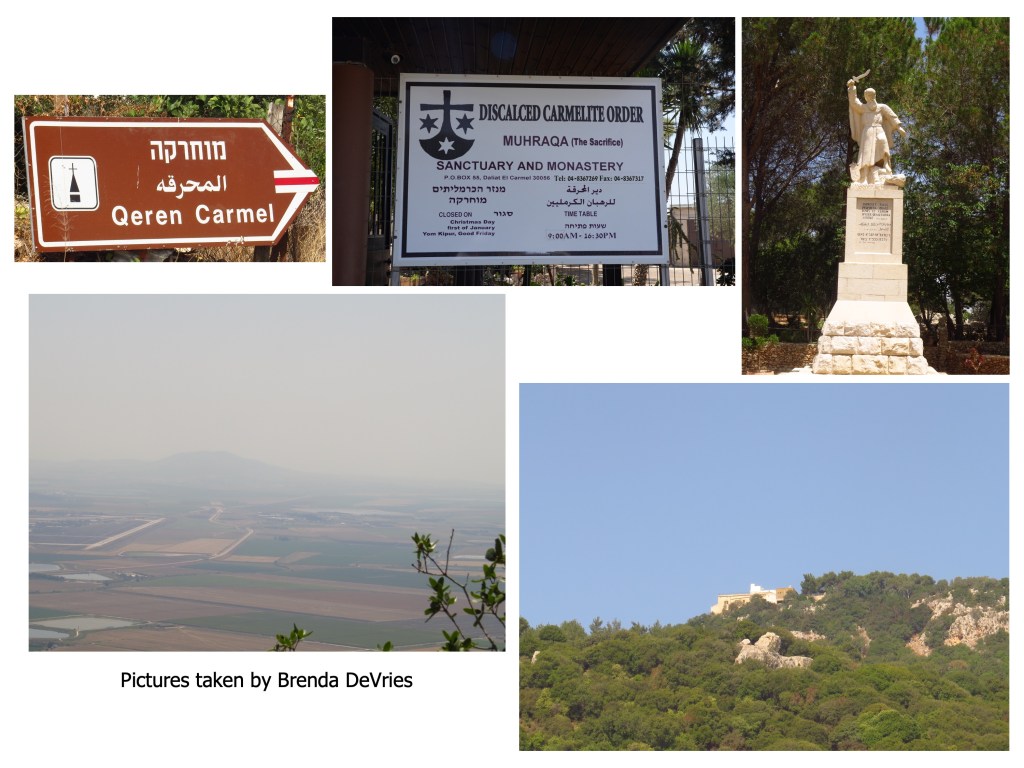
I have hiked up a spot on the South-eastern peak of Mount Carmel, overlooking the valley, and seen the place where they have built a monument and a monastery, at the site where some believe this event to have taken place.
Now summon the people from all over Israel to meet me ON Mount Carmel. NIV Now then send and gather to me all Israel AT Mount Carmel. HEBREW (and CSB, CEB, ESV, MSG, NASB, etc.) 1 Kings 18:17
It’s interesting when reading a text for the umpteenth time, that certain things pop out at you. In the NIV, the translation seems to say that they met ON Mount Carmel—at the top. Which has always been my natural assumption. Until I read a commentary and checked some sources. It turns out that the Hebrew preposition in front of the mountain in 1 Kings 18 means ‘at’ and not ‘on.’
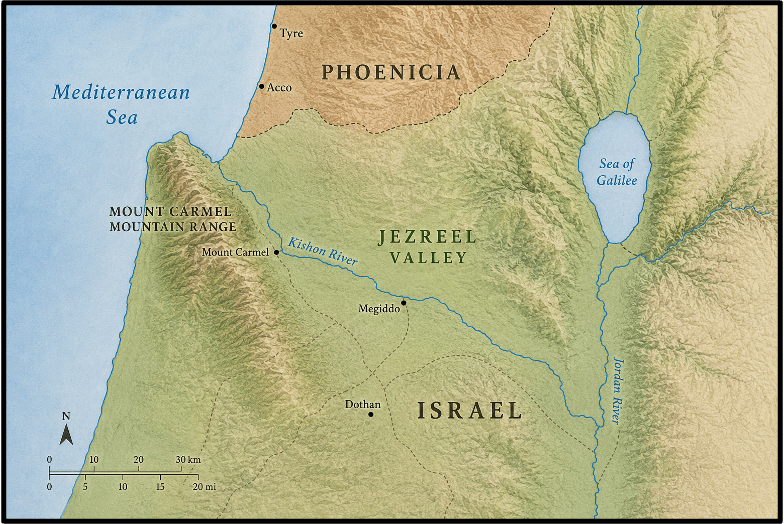
It also turns out Mount Carmel is a many miles long mountain range[10], not a specific point. The mountain is basically a limestone ridge that bisects the coastal plain of the land of Israel branching off from the mountains of Samaria west towards the Mediterranean coast.[11] Carmel means garden land,[12] and the Canaanites believed that Mount Carmel was the special dwelling place of the gods.[13] Even the lower mountains of Carmel were idolized and considered the seat of a deity.[14] Whoever controlled the worship that took place on Carmel controlled the nation spiritually.[15] Both Ahab and Elijah know the specific place to meet. And more importantly than pinpointing an exact location, this battle will take place in the border territory between Israel and Phoenicia.[16] It’s the dividing line between two nations, and two gods.
20 So Ahab sent word throughout all Israel and assembled the prophets on/at Mount Carmel. 21 Elijah went before the people and said, “How long will you waver between two opinions? If the Lord is God, follow him; but if Baal is God, follow him.” But the people said nothing. 1 Kings 18:20-21 NIV
The idea of walking with God—is about a way of life that is ordered around God’s presence. It’s the picture of someone living every step before the face of God—conscious that God sees, leads, and judges. It’s a life of covenant faithfulness, obedience, and loving God. The people of Israel have been called to walk in God’s ways. Elijah says to them…’how long with you limp, or hobble, between two opinions?’[17] The allusion is to wobbling—between two sticks or crutches,[18] where the people are not walking one way or the other.[19] Israel needs to make a decision.
Now, in the ancient world, people were very open to worshiping whichever god was appropriate. They were not exclusivistic. They could very easily revere both deities, as long as they didn’t become rivals for the same sphere of influence. The people are not willing to choose.[20] They can’t answer Elijah at this moment. Yahweh was the god of their forefathers, but the appeal of Baal was strong.[21] They are a divided people. But…
When hearts are divided, God calls people back to Himself.
Because the people do not see the two gods as rivals, Elijah proposes a contest that will pit them against one another.[22]
22 Then Elijah said to them, “I am the only one of the Lord’s prophets left, but Baal has four hundred and fifty prophets. 23 Get two bulls for us. Let Baal’s prophets choose one for themselves, and let them cut it into pieces and put it on the wood but not set fire to it. I will prepare the other bull and put it on the wood but not set fire to it. 24 Then you call on the name of your god, and I will call on the name of the Lord. The god who answers by fire—he is God.” Then all the people said, “What you say is good.” 1 Kings 18:22-24 NIV
The prophets of Baal are allowed to choose the sacrificial bulls. This gives them an advantage, because they could choose a good one, and give an imperfect one to Elijah[23] if they wanted. An interesting observation: Jerome Walsh notes that Elijah changes pronouns here. Instead of talking about the Baal prophets, “THEY will call on the name of their god,” he says to the people themselves, ‘YOU call on the name of your god.”[24] The people are caught.
Like many people do, early Israel believed in a practical monotheism…the only god who counts as real—is the one who acts, who has power to help his people.[25] They agree to the terms. They will choose the g(G)od who acts. Elijah will now turn to the prophets and command them to do the actual physical shouting. But because of the pronoun shift in verse 24, the entire audience now knows that the prophets are crying out—on behalf of the people’s choice.

25 Elijah said to the prophets of Baal, “Choose one of the bulls and prepare it first, since there are so many of you. Call on the name of your god, but do not light the fire.” 26 So they took the bull given them and prepared it. Then they called on the name of Baal from morning till noon. “Baal, answer us!” they shouted. But there was no response; no one answered. And they danced around the altar they had made. 1 Kings 18:25-26 NIV
They dance, or leap, which is probably a form of ceremonial dancing;[26] or limping! In this story, it is a pun that is ridiculing their behavior, calling back to the way that the people have ‘limped’ along without conviction.[27]
27 At noon Elijah began to taunt them. “Shout louder!” he said. “Surely he is a god! Perhaps he is deep in thought, or busy, or traveling. Maybe he is sleeping and must be awakened.” 28 So they shouted louder and slashed themselves with swords and spears, as was their custom, until their blood flowed. 29 Midday passed, and they continued their frantic prophesying until the time for the evening sacrifice. But there was no response, no one answered, no one paid attention. 1 Kings 18:27-29 NIV
The prophets of Baal make a good effort. They have the home-court advantage.[28] They call out and slash themselves, and get into frenzied prophesying, which may have looked a lot like ancient methods of self-hypnosis.[29] Elijah goads them: perhaps he is busy or sleeping! (Which is another mockery, because these prophets believed that gods are similar to humans.[30]) Maybe he’s ‘turned aside’, which in the Hebrew may be a taunt that Baal is busy in the bathroom.[31] Jerome Walsh writes this loose paraphrase: Cry louder! After all, he’s a god: he’s busy, in a tizzy, he’s off on the road! Or perhaps he’s asleep, and you can wake him![32]
These prophets get a lot of time to try to get the attention of Baal. They start at morning, around 9am, to noon, and then midday passes. By the time of the evening sacrifice, it is about 3pm, and they have spent six hours of frantic effort.[33] But there is no sound. The gods are silent. This is a theological statement. Baal has no voice,[34] because there IS no one to answer.[35]
30 Then Elijah said to all the people, “Come here to me.” They came to him, and he repaired the altar of the Lord, which had been torn down. 31 Elijah took twelve stones, one for each of the tribes descended from Jacob, to whom the word of the Lord had come, saying, “Your name shall be Israel.” 32 With the stones he built an altar in the name of the Lord, and he dug a trench around it large enough to hold two seahs of seed. 1 Kings 18:30-32 NIV
According to the text, ALL the people are asked to participate in this process. Elijah refuses to let them remain spectators. He invites the people to rebuild the altar. They carry the stones. They haul the water. They’re no longer watching from the sidelines. Elijah draws them in—to the work God is about to do. He uses 12 stones, which represents the 12 tribes, but it also shows that the connection with Yahweh. He built the altar in the name of the Lord. And Israel is GOD’s people. All twelve tribes—even though the nation is currently divided—in more ways than one. Just as the prophets of Baal have been calling on their god, Israel must now proclaim Yahweh’s name.[36] And they are going to need to choose sides.
33 He arranged the wood, cut the bull into pieces and laid it on the wood. Then he said to them, “Fill four large jars with water and pour it on the offering and on the wood.” 34 “Do it again,” he said, and they did it again. “Do it a third time,” he ordered, and they did it the third time. 35 The water ran down around the altar and even filled the trench. 1 Kings 18:33-35 NIV
The trench was big enough to hold about five gallons of seed,[37] but it doesn’t give us a really good idea of how big that was.[38] 12 jars of water is no small offering, though. And remember 12 stones, 12 tribes, and now 12 jars. If they are on top of the mountain, they would need access to a well, or a way to go down the mountain and carry the water back up, which would be quite a long and difficult task. Regardless, water is precious in a time of drought. Elijah’s request is like the one he made to the widow when she was at the end of her flour and oil. It took some amount of trust to use precious water on this so called ‘experiment.’
36 At the time of sacrifice, the prophet Elijah stepped forward and prayed: “Lord, the God of Abraham, Isaac and Israel, let it be known today that you are God in Israel and that I am your servant and have done all these things at your command. 37 Answer me, Lord, answer me, so these people will know that you, Lord, are God, and that you are turning their hearts back again.” 1 Kings 18:36-37 NIV
The prophets of Baal have taken up a lot of time. Elijah pleads, let it be known today, Lord! If God does not respond, all is lost.[39] He iuses the covenantal formula in his prayer, but instead of the familiar patriarchal formula, he says Abraham, Isaac, and ISRAEL—Jacob’s new name, but also the identity of the people of God. He invokes God’s covenant relationship with his people.[40]
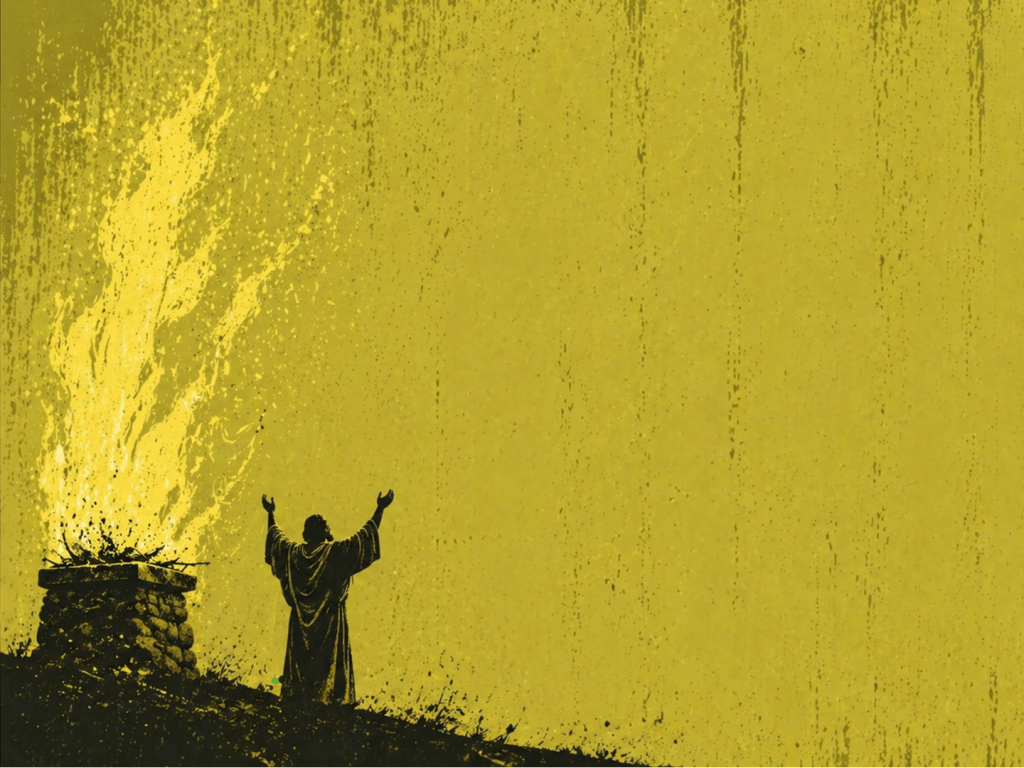
38 Then the fire of the Lord fell and burned up the sacrifice, the wood, the stones and the soil, and also licked up the water in the trench. 39 When all the people saw this, they fell prostrate and cried, “The Lord—he is God! The Lord—he is God!” 40 Then Elijah commanded them, “Seize the prophets of Baal. Don’t let anyone get away!” They seized them, and Elijah had them brought down to the Kishon Valley and slaughtered there. 1 Kings 18:38-40
The fire of God was an impressive display of divine power,[41] especially at the end of the day, close to sunset.[42] This is one of the most dramatic acts in the whole history of Israel.[43] It may have been lightning,[44] which would be a strike against the storm god, Baal, but that is debatable and unknown.[45]
It brings to mind the fire that fell from heaven to consume the offering in the ordination of Aaron and his sons, which was an inauguration of Israel’s priesthood and worship in Leviticus 9.[46] In this story, Elijah functions almost like a priest. He repairs the altar, prepares the sacrifice, intercedes, and blesses the people through prayer. He’s restoring proper worship when the priesthood has failed. The irony is that the fire has to ‘fall’ before the people will ‘fall’ in worship.[47]
The end result of this story is not that Baal fails, or even that Yahweh comes through. It’s that the people who have been limping between two opinions finally worship and confess, “The Lord is God! He is God!”[48] Yes, the God who answers by fire—he is God![49]
Now, the slaughtering of the prophets is a difficult one. But it’s a powerful reminder that there was no middle ground between Yahweh and Baal. In this ancient culture, it was a way of purging moral and spiritual evil,[50] and a parallel with the prophets of God who were also ‘cut off’ by Queen Jezebel earlier in the chapter.[51] It is a sacrificial act,[52] as they sacrifice the prophets instead of a bull,[53] and a sign that they are looking to God alone for their sustenance—and there is no connection between them and Baal anymore.
In this story, the fire is spectacular. The miracle is unforgettable. But Elijah’s deepest desire isn’t that people would be impressed by God’s power. It’s that the people who had spent years wavering in their hearts would be turned back to worship and love God. This story is about God, not Elijah.[54] GOD is doing the initiative. In the last story, GOD sends Elijah. GOD provides the water and food before Elijah had the next step figured out. Here, GOD answered Israel before they deserved restoration. That’s grace. God didn’t wait until they were faithful before revealing Himself. He revealed Himself in order to bring them back. And the God who revealed Himself on Carmel is still in the business of turning divided hearts back to Himself.
Ancient Israel was a theocracy, where God was the head of state. Without God there was no Israel.[55] And without God there is no church. We live in an era where God has established his church, not as a state, but as a community of believers, not defined by nationality, ethnicity, social class, or gender, but by our supreme loyalty to Christ[56] and his kingdom. As followers of Jesus, we are inclusive—the gospel is for all people in all places. But the gospel is also exclusive—Jesus is not A way, but THE Way.[57] We can’t “dance around the issues”—like the people of Israel were doing in this story.
Israel never rejected Yahweh. They simply refused to trust Him alone. They didn’t worship Baal instead. They were like: “We’ll worship Yahweh…and Baal, just in case.” That’s uncomfortable, because it sounds much more like us. Most of us don’t bow down to Baal. But we do know what it’s like to have divided loyalties. The greatest threat to faith isn’t always outright rejection of God. Sometimes it’s trying to give Him only part of our trust. But just as in the time of Elijah,
When our hearts are divided, God calls us back to Himself.
The question Elijah asked Israel is the same question the Holy Spirit asks every generation: ‘How long will you waver?’ In verse 21, the people say nothing to Elijah. After the fire—they finally confess. Some of us have been silent for a long time. We’re not hostile, or opposed, just…undecided. Comfortably in the middle. When your deepest convictions are challenged, whose word wins? Is it the culture? Your political tribe? Your emotions? Your friends? Your fears? Or is it Jesus? The truth is, most of us don’t wake up one morning and decide to abandon Jesus. We still come to church. We still pray. We still believe Jesus is Lord. But somewhere along the way, another voice begins to shape us more than His voice. It might not be a conscious decision. It’s usually a slow drift: one compromise at a time, one priority at a time, or one excuse at a time.
Elijah’s question is so powerful, because he invites the people to decide. A divided heart will never experience the peace of wholehearted trust. And maybe that’s why this story still speaks today. Not because we’re tempted to worship Baal, but because every one of us knows what it feels like to have something else quietly compete for first place in our hearts. We say Jesus is Lord…but we trust money more than God’s provision. We say Jesus is Lord…but our political tribe shapes our thinking more than Scripture. We say Jesus is Lord…but we protect our comfort more than we pursue obedience. We say Jesus is Lord…but we value acceptance more than faithfulness. These are examples of divided allegiance.
The people on Mount Carmel finally fell on their faces and confessed, “The LORD—He is God!” They didn’t just witness a miracle. They made a confession. Every generation has to make that confession for itself. Not just with our lips. But with our loyalties. So today, the question isn’t whether God is worthy. Mount Carmel has already answered that. The question is whether there is anything in our lives competing with Him for first place. The beauty of grace is that when our hearts are divided, God doesn’t push us away. He calls us back to Himself. May we hear His voice above every other voice, trust Him above every other hope, and confess with our lives, “The LORD—He is God!”
PRAYER: O LORD, God of Abraham, Isaac, and Israel, let it be known among us today that You are God. There is no rival to Your power, no equal to Your glory, and no one more worthy of our love and worship. We confess that our hearts are often divided. We know what it is like to trust You with part of our lives while holding tightly to comfort, security, success, or the approval of others. Thank You that You are a God who takes the initiative. Thank You for pursuing Elijah, for calling Israel back to Yourself, and for revealing Your faithfulness even when Your people had wandered. Lord, reveal anything that is competing for first place in our hearts. Forgive us. Help us to hear Your voice above every other voice, to trust Your Word above every other claim, and to follow You with wholehearted devotion. May our confession be more than words. May our lives declare, “The LORD—He is God.” Shape us into a people whose loyalty belongs to Christ alone. We pray this in the name of Jesus, our Savior and King. Amen.
Bibliography
- Beal, Lissa M. Wray, Apollos Old Testament Commentary, 1&2 Kings, Downers Grove: InterVarsity Press, 2014.
- DeVries, Simon J., Word Biblical Commentary, 1 Kings, Second Edition, Nashville: Thomas Nelson, Inc., 2003.
- Fritz, Volkmar, 1 & 2 Kings, A Continental Commentary, Minneapolis: Fortress Press, 2003.
- House, Paul R., 1,2, Kings, Vol. 8, The New American Commentary, Nashville: B&H Publishing Group, 1995.
- Inrig, Gary, Max Anders, general editor, Holman Old Testament Commentary, I&II Kings, Nashville: B&H Publishing Group, 2003.
- Walsh, Jerome T., Berit Olam, I Kings, Collegeville: The Liturgical Press, 1996.
Articles
- Baukal, Charles E., “Pyrotechnics on Mount Carmel”, Bibliotheca sacra, 171 no 683 Jul – Sep 2014, p289-306.
- Tromp, Nicholas J., “Water and fire on Mount Carmel: a conciliatory suggestion”, Biblica, 56 no 4 1975, p480-502.
- Windle, Bryan, “King Omri: An Archaeological Biography”, Biblical Archaeology Report, March 6, 2020.
- Malone, Seth, “Uncovering the Bible’s Buried Cities: Samaria”, Armstrong Institute of Biblical Archaeology, From the July-August 2022 Let the Stones Speak Magazine Issue,
- https://armstronginstitute.org/748-uncovering-the-bibles-buried-cities-samaria
- Accessed June 25, 2026.
—
Small Group Discussion Guide (*Leader’s Guide available on request) A Life of Faith: Trusting God in Every Season Week 2-When God Shows up Powerfully 1 Kings 18:1-2, 17-40
Icebreaker
If you had to choose only one convenience, hobby, or possession to keep for a year (besides basic necessities), what would it be—and why?
Read 1 Kings 18:1-2, 17-21 NIV After a long time, in the third year, the word of the Lord came to Elijah: “Go and present yourself to Ahab, and I will send rain on the land.” 2 So Elijah went to present himself to Ahab. 17 When he saw Elijah, he said to him, “Is that you, you troubler of Israel?” 18 “I have not made trouble for Israel,” Elijah replied. “But you and your father’s family have. You have abandoned the Lord’s commands and have followed the Baals. 19 Now summon the people from all over Israel to meet me on Mount Carmel. And bring the four hundred and fifty prophets of Baal and the four hundred prophets of Asherah, who eat at Jezebel’s table.” 20 So Ahab sent word throughout all Israel and assembled the prophets on Mount Carmel. 21 Elijah went before the people and said, “How long will you waver between two opinions? If the Lord is God, follow him; but if Baal is God, follow him.” But the people said nothing.
Discussion
- God waited three years before sending Elijah back. What might God have been accomplishing during those three years—in Elijah? In Ahab? In Israel?
- Ahab blames Elijah instead of recognizing his own unfaithfulness. Why is it often easier to blame the messenger than face the real problem?
- This seems to be a private confrontation between Elijah and Ahab. Why do you think Elijah wanted “all Israel” present?
- Elijah asks, “How long will you waver between two opinions?” The Hebrew word suggests limping or hobbling between two paths. What picture does that create in your mind? Why is “limping” a powerful image for divided loyalty?
- Ahab and Israel were trying to keep Yahweh and Baal. Can you think of examples today where Christians are tempted to treat Jesus as “one voice among many” rather than the supreme authority in their lives?
Read 1 Kings 18:22-29 NIV Then Elijah said to them, “I am the only one of the Lord’s prophets left, but Baal has four hundred and fifty prophets. 23 Get two bulls for us. Let Baal’s prophets choose one for themselves, and let them cut it into pieces and put it on the wood but not set fire to it. I will prepare the other bull and put it on the wood but not set fire to it. 24 Then you call on the name of your god, and I will call on the name of the Lord. The god who answers by fire—he is God.” Then all the people said, “What you say is good.” 25 Elijah said to the prophets of Baal, “Choose one of the bulls and prepare it first, since there are so many of you. Call on the name of your god, but do not light the fire.” 26 So they took the bull given them and prepared it. Then they called on the name of Baal from morning till noon. “Baal, answer us!” they shouted. But there was no response; no one answered. And they danced around the altar they had made. 27 At noon Elijah began to taunt them. “Shout louder!” he said. “Surely he is a god! Perhaps he is deep in thought, or busy, or traveling. Maybe he is sleeping and must be awakened.” 28 So they shouted louder and slashed themselves with swords and spears, as was their custom, until their blood flowed. 29 Midday passed, and they continued their frantic prophesying until the time for the evening sacrifice. But there was no response, no one answered, no one paid attention.
Discussion
- Why do you think fire instead of rain was the test?
- Why do you think Elijah lets the prophets of Baal go first?
- The prophets of Baal begin early in the morning and call on Baal for hours. What are some things people pursue today that promise fulfillment but ultimately leave them empty?
- Can you think of modern examples where people exhaust themselves trying to gain acceptance, success, or security?
- Elijah suggests Baal may be deep in thought, busy, traveling, or asleep. What does each possibility imply about the limitations of Baal? How is Yahweh different?
- Imagine you were standing somewhere on Mount Carmel watching this unfold.
At what point do you think you would have started wondering whether Baal was ever going to answer? After an hour? By noon? After Elijah started mocking them? When they began cutting themselves? At evening sacrifice? Why?
Read 1 Kings 18:30-37 NIV 30 Then Elijah said to all the people, “Come here to me.” They came to him, and he repaired the altar of the Lord, which had been torn down. 31 Elijah took twelve stones, one for each of the tribes descended from Jacob, to whom the word of the Lord had come, saying, “Your name shall be Israel.” 32 With the stones he built an altar in the name of the Lord, and he dug a trench around it large enough to hold two seahsof seed. 33 He arranged the wood, cut the bull into pieces and laid it on the wood. Then he said to them, “Fill four large jars with water and pour it on the offering and on the wood.” 34 “Do it again,” he said, and they did it again. “Do it a third time,” he ordered, and they did it the third time. 35 The water ran down around the altar and even filled the trench. 36 At the time of sacrifice, the prophet Elijah stepped forward and prayed: “Lord, the God of Abraham, Isaac and Israel, let it be known today that you are God in Israel and that I am your servant and have done all these things at your command. 37 Answer me, Lord, answer me, so these people will know that you, Lord, are God, and that you are turning their hearts back again.”
Discussion
- Elijah uses twelve stones, one for each tribe of Israel. Why was it important to include all twelve tribes, even though the kingdom had been divided?
- Why do you think Elijah wanted them not only to watch, but to participate in this process?
- Elijah has the sacrifice drenched with water three times. What misconceptions or objections does it eliminate? What emotions do you think the people experienced as they kept pouring more and more water over the altar during a severe drought?
- Read Elijah’s prayer carefully. What are the main requests he makes?
What does he not pray for?
- Notice how simple Elijah’s prayer is compared with everything the prophets of Baal had done. What does this teach us about the difference between praying and trying to manipulate God?
Read 1 Kings 18:38-40 38 Then the fire of the Lord fell and burned up the sacrifice, the wood, the stones and the soil, and also licked up the water in the trench. 39 When all the people saw this, they fell prostrate and cried, “The Lord—he is God! The Lord—he is God!” 40 Then Elijah commanded them, “Seize the prophets of Baal. Don’t let anyone get away!” They seized them, and Elijah had them brought down to the Kishon Valley and slaughtered there.
Discussion
- The fire consumed not only the sacrifice, but also the wood, stones, dust, and water. What does this communicate about God’s power?
- In the end, the people finally confess, “The LORD—He is God!” Why is this confession the climax of the story rather than the fire itself?
- Verse 40 is difficult for many readers. What questions does it raise for you? What does it teach us about the seriousness of idolatry?
- In the first two stories, God sent Elijah, God provided for Elijah, God answered by fire, God turned hearts back to Himself. Why is it important to remember that God moves toward us before we fully return to Him? How does that encourage you today?
When our hearts are divided, God calls us back to Himself
- If you could have been one person in this story (other than Elijah), who would you have wanted to be—and why?
Personal Application
- Israel didn’t completely reject Yahweh. They simply refused to trust Him alone.Why do you think it’s easier to divide our loyalties than to reject God outright?
- Which of these is most likely to compete with wholehearted trust in Christ? Comfort, Security, Success, Approval, Control, Money, Politics, Something else? How have you seen that compete for your loyalty?
- Have you ever experienced a “Mount Carmel moment”—a time when God made His faithfulness unmistakably clear? How did it affect your faith?
- Have you ever experienced a season where God graciously drew you back after your heart had drifted? What happened?
This Week’s Challenge
Take five quiet minutes sometime this week and ask God one simple question: “Lord, is there anything competing with You for first place in my heart?” Write down an area where your heart has begun to drift or become divided. Pray and ask God for the courage to trust Him more fully in that area.
Time of Silence
Spend a few moments in silent reflection before the final prayer. Ask God to reveal any competing loyalties that have quietly taken hold of your heart.
Prayer
Lord, thank You for being the living God who graciously reveals Yourself and calls us back when our hearts begin to drift. Show us anything that is competing for first place in our lives. Thank You that You don’t abandon us when our hearts are divided, and that you continue to call us back to Yourself. Give us ears to hear Your voice and courage to follow You follow You with wholehearted devotion. In Jesus’ name, Amen.
[1] Created with AI, based on other pics and resources.
[2] 1 Kings 16:24.
[3] https://biblearchaeologyreport.com/2020/03/06/king-omri-an-archaeological-biography/
[4] https://armstronginstitute.org/748-uncovering-the-bibles-buried-cities-samaria
[5] https://www.youtube.com/shorts/QvWLTneEtzQ
[6] Fritz, Volkmar, 1 & 2 Kings, A Continental Commentary, Minneapolis: Fortress Press, 2003, 188.
[7] Paul R. House, 1,2, Kings, Vol. 8, The New American Commentary, Nashville: B&H Publishing Group, 1995, 218.
[8] Baukal, Charles E., “Pyrotechnics on Mount Carmel”, 294.
[9] Baukal, Charles, 294.
[10] https://en.wikipedia.org/wiki/Mount_Carmel
[11] https://cbnisrael.org/2025/02/25/biblical-israel-mount-carmel-5/
[12] Accordance definition
[13] Baukal, Charles E., Pyrotechnics on Mount Carmel”, 291.
[14] Fritz, Volkmar, 1 & 2 Kings, A Continental Commentary, Minneapolis: Fortress Press, 2003, 190.
[15] Baukal, Charles E., Pyrotechnics on Mount Carmel”, Bibliotheca sacra, 171 no 683 Jul – Sep 2014, p289-306, 290.
[16] Beal, Lissa M. Wray, Apollos Old Testament Commentary, 1&2 Kings, Downers Grove: InterVarsity Press, 2014, 243.
[17] Simon J. DeVries, Word Biblical Commentary, 1 Kings, Second Edition, Nashville: Thomas Nelson, 2003, 228.
[18] Inrig, Gary, Max Anders, general editor, Holman Old Testament Commentary, I&II Kings, Nashville: B&H Publishing Group, 2003, 147.
[19] Simon J. DeVries, Word Biblical Commentary, 1 Kings, Second Edition, Nashville: Thomas Nelson, 2003, 228.
[20] Jerome T. Walsh, Berit Olam, I Kings, Collegeville: The Liturgical Press, 1996, 245.
[21] DeVries, 230.
[22] Jerome T. Walsh, Berit Olam, I Kings, Collegeville: The Liturgical Press, 1996, 246.
[23] Jerome T. Walsh, Berit Olam, I Kings, Collegeville: The Liturgical Press, 1996, 246.
[24] Walsh, 246.
[25] Simon J. DeVries, Word Biblical Commentary, 1 Kings, Second Edition, Nashville: Thomas Nelson, 2003, 228.
[26] Paul R. House, 1,2, Kings, Vol. 8, The New American Commentary, Nashville: B&H Publishing Group, 1995, 219.
[27] House, 219, see footnote 22.
[28] Lissa M. Wray Beal, 1&2 Kings, 244.
[29] House, 220, see footnote 26.
[30] Fritz, Volkmar, 1 & 2 Kings, A Continental Commentary, Minneapolis: Fortress Press, 2003, 191.
[31] Lissa M. Wray Beal, 1&2 Kings, 244.
[32] Walsh, 249.
[33] Inrig, Gary, Max Anders, general editor, Holman Old Testament Commentary, I&II Kings, Nashville: B&H Publishing Group, 2003, 148.
[34] Beal, Lissa M. Wray, Apollos Old Testament Commentary, 1&2 Kings, Downers Grove: InterVarsity Press, 2014, 244.
[35] Walsh, 248.
[36] Walsh, 250-251.
[37] Inrig, Gary, Max Anders, general editor, Holman Old Testament Commentary, I&II Kings, Nashville: B&H Publishing Group, 2003, 149.
[38] Walsh, 251, see footnotes 6.
[39] DeVries, 230.
[40] Lissa M. Wray Beal, 1&2 Kings, 245.
[41] Walsh, 253.
[42] Baukal, Charles E., Pyrotechnics on Mount Carmel”, 292.
[43] Baukal, Charles E., Pyrotechnics on Mount Carmel”, Bibliotheca sacra, 171 no 683 Jul – Sep 2014, p289-306, 289, quoting A.W. Pink.
[44] Walsh, 253.
[45] Baukal, Charles, 301.
[46] Leviticus 9:23-24.
[47] Walsh, 253.
[48] DeVries 231, based on the LXX translation.
[49] Walsh, 253.
[50] Inrig, 150.
[51] 1 Kings 18:4.
[52] Lissa M. Wray Beal, 1&2 Kings, 245.
[53] Baukal, Charles, 304.
[54] Baukal, Charles, 305.
[55] House, 220.
[56] Inrig, 152.
[57] Inrig, 152.

