

About these posts
These posts grow out of sermons I’ve written for my local church community. You’re welcome to use them—for teaching, small groups, preaching, or personal reflection. If you share them elsewhere, please include a simple attribution. If you’d ever like to share how they’re being used, you’re welcome to reach out through the Contact button.

When my grandkids build or make something, they say, ‘come and see’! If Jim and I find something catches our attention, we might say, ‘come and see this’! We do this all the time—“You’ve got to check out this restaurant.” “You’ve got to come and see our new remodel.” “Come and look at this view!” For six weeks we have heard different invitations to “Come and see.” Come and see: who Jesus is. Come and see: where we hurt. Come and see: the empty tomb. Come and see: what God is doing. But today, something changes. Today we’re going to look at a little section of a letter from the apostle Paul. On his second missionary journey, Paul traveled to Philippi. There he met Lydia, and it’s there where Paul and Silas were imprisoned, and sang their songs in the middle of the night. The jailer converted, and a church was planted.
Let’s look at the ancient city for a few moments before we read Paul’s words.
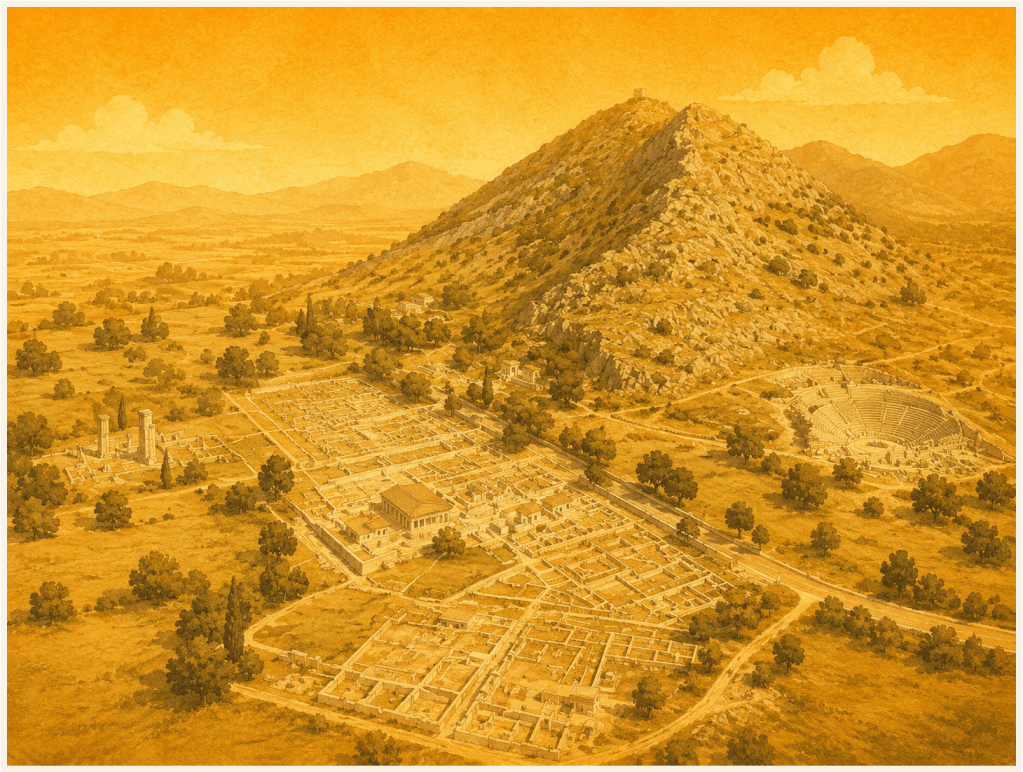
Ancient Philippi was located in eastern Macedonia between mountain ranges. It sits about 10 miles from the Aegean sea.[1] Philip of Macedon was the one who changed its name after taking control of the city.[2] Augustus had made Philippi a Roman colony. Even so, it was a fairly small city, with around 10,000 inhabitants.[3] During reign of Claudius, (41-54AD) foreigners could join the auxiliary forces[4], like light cavalry, archers and scouts, and receive citizenship when they retired.[5] Over time, the city became filled with Roman soldiers, veterans and military families. As colonists, they were to live by the rules of the mother city. [6] They were expected to extend Roman culture, Roman values, and Roman influence. Philippi became a little piece of Rome far from Rome itself.
By Paul’s time, Philippi had become a diverse city filled with descendants of veterans, wealthy Roman citizens, native Macedonians, Greeks, merchants, and travelers. But the city remained deeply proud of its Roman identity, their citizenship, and culture, as well as their military heritage, their loyalty to Caesar, and their status as a Roman colony.[7]There were some who happened to be former soldiers or descendants of soldiers, and the city had been shaped by military culture. They knew what it meant to stand firm, obey commands, and defend the empire, and they would identify themselves first as Romans, not as Philippians. “Citizenship” and “colony” were emotionally loaded concepts in Philippi. For some people, Rome’s presence represented opportunity; for others, it represented loss. Paul is going to take that familiar colonial language and redirect it toward a kingdom whose King reigns through self-giving love rather than domination.
Paul writes this letter to the Philippians while in one of his many prison stints. He could have been in jail in Rome, or Caesarea, or more likely, Ephesus at this time.[8] It’s been 10 years since the church in Philippi was planted. In his letter, Paul uses the same words we’ve been looking at—”come and see”—but this time it’s not a direct invitation. The question is, what Paul would find—if he came and saw the church in Philippi? A divided church or a united church? A fearful church or a courageous church? A church living for itself or striving side by side for the gospel? Paul’s hope is for something good. He writes:
27 Whatever happens, conduct yourselves in a manner worthy of the gospel of Christ. Then, whether I come and see you or only hear about you in my absence, I will know that you stand firm in the one Spirit, striving together as one for the faith of the gospel 28 without being frightened in any way by those who oppose you. This is a sign to them that they will be destroyed, but that you will be saved—and that by God. 29 For it has been granted to you on behalf of Christ not only to believe in him, but also to suffer for him, 30 since you are going through the same struggle you saw I had, and now hear that I still have. Philippians 1:27-30 NIV
The people who were a part of the Philippian church were experiencing rejection from other relatives, neighbors, and community members.[9]
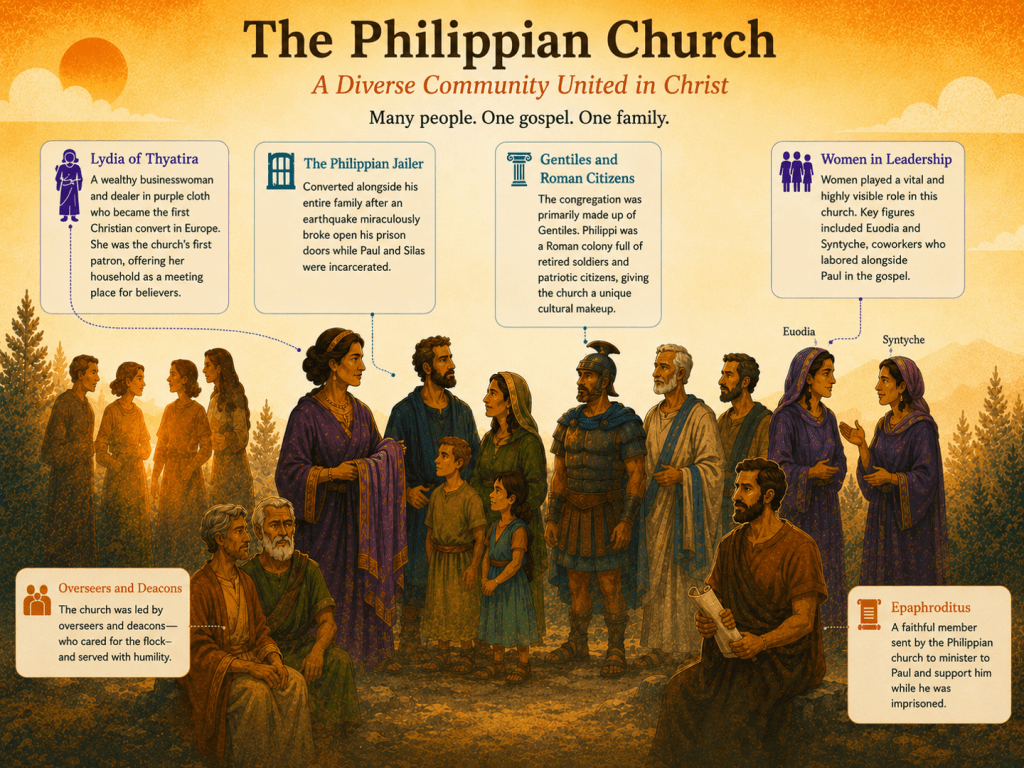
When we picture the church at Philippi, we might imagine a large congregation. But scholars estimate there may have been only about thirty believers by the end of the first century. Think of Lydia, the wealthy businesswoman and dealer in purple cloth who offered her household as a meeting place for the early believers. There was the jailer and his family, Overseers and deacons, Epaphroditus, and Euodia and Syntyche.[11] As these believers faced opposition and rejection, the church became more than a weekly gathering—it became a family. Brothers and sisters in Christ stood together, encouraged one another, and shared in both the suffering and the mission of the gospel. Paul writes to them not simply as fellow believers, but as brothers and sisters who are participating together in the work of Christ and he tells them that his imprisonment has turned out to help spread the gospel.[12]
In this letter, he also addresses some signs of disunity because of the persecution they were experiencing.[13] In chapter 4, he urges Euodia and Syntyche to serve the Lord together, with one mind. These two women have a position consistent with that of women in the free cities of the Roman empire,[14] and especially in Philippi.[15] They were important figures[16] in the Philippian church, and possibly even house church leaders.[17] The leaders need to get along, and the whole community is called to peace and corporate harmony,[18] because they are part of God’s new family. Paul refers to this church numerous times as brothers and sisters in Christ.[19]
The face of the family in the public had a sense of collective honor.[20] In the New Testament world, people were always trying to enhance their honor: in politics, sports, literary contests, dinner invitations or even arranging a marriage.[21] Families…competed with one another. But inside a family, they were expected to defer to one another in honor, to present a united front to the outside world.[22] When siblings don’t hold up the ideals of the family and instead, fight and bicker with one another, the honor of the family unit can be seriously compromised.[23] This presented an interesting dynamic for the church. When people began to follow Jesus, they were supposed to view loyalty to their natural families—as secondary to loyalty to their newfound family of surrogate siblings in Christ.[24] They now profess allegiance to a NEW family where, according to their own social values, they would be expected to defer in honor to their brothers and sisters in Christ[25] and other children of God.[26]
As citizens of heaven, the church is called to represent the kingdom of Christ on earth.
Paul hopes that he can COME AND SEE a church that is living uniquely in this world. His desire for the church is that they work together, stand firm in the Spirit, and are striving together. He uses language veterans would understand. The language of co-struggling or striving together echoes the military imagery of a legion, or cohort fighting together in tight formation—for success or even for survival.[27] Stand firm, one spirit, strive side by side, do not be frightened by opponents…this is what unity, loyalty and courage look like. Paul says:
Whatever happens, conduct yourselves in a manner worthy of the gospel of Christ. Philippians 1:27
The word for conduct is poly two’ es they (πολιτεύεσθε). It comes from the verb which can be broadly understood as a communal entity from which one derives a sense of social or political identity.[28] It means to live as citizens, to conduct oneself as a citizen, or to behave as a commonwealth.
Many of the inscriptions in Philippi urged residents to live worthily of a monarch or a city-state.[29] The Philippians knew what a Roman colony looked like. But Rome’s colonies often spread Roman power through military victory, political privilege, land redistribution, and social status. It looked like veterans, citizenship, and power.
In that day, many people tried to acquire Roman citizenship. In Acts 22, just as Paul was being stretched out for a massive scourging, he told the centurion that he was a Roman citizen. The centurion hastily brought him before the chief officer, Claudius Lysias[30], who asks him if he is really a Roman citizen. Paul says that he is, and Claudius says, “I had to pay a lot of money for my citizenship.” To which Paul says, But I was born a citizen.”[31] Citizenship was not a given. The veterans, who earned their citizenship through service, knew what it meant to live as a Roman citizen. But Peter Oakes’s work in Philippians reveals that less than half of Paul’s audience could have possessed Roman citizenship.[32] Maybe only 30 percent.
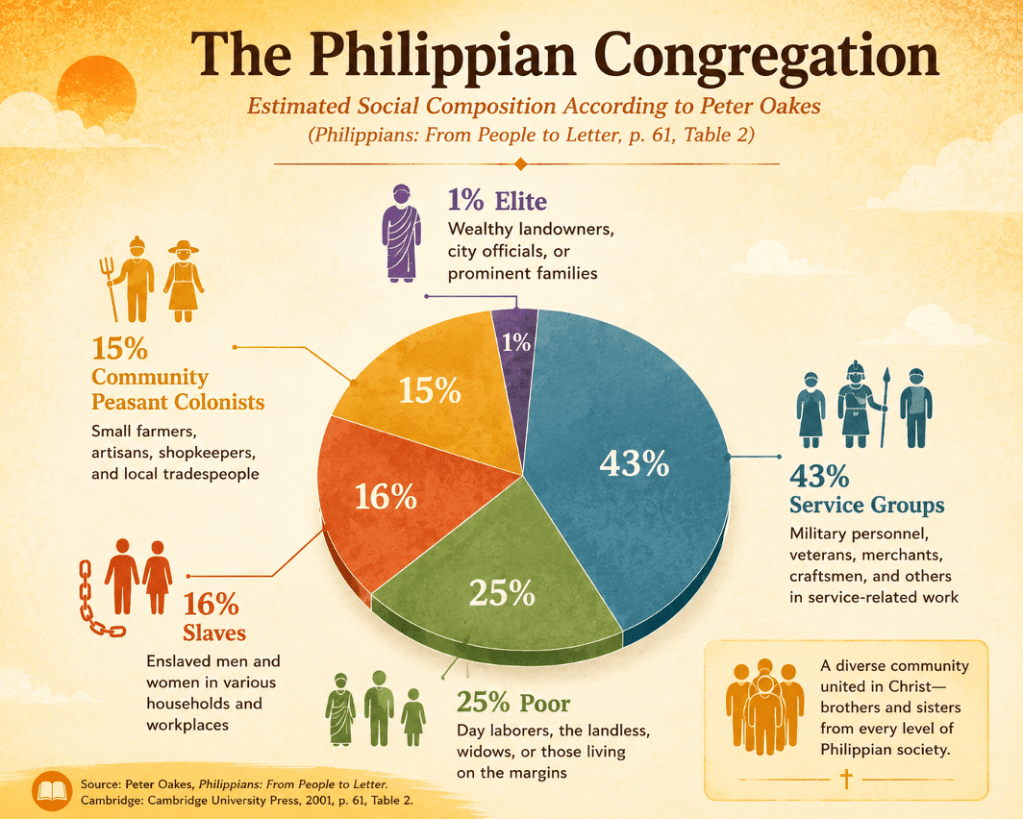
In fact, the Philippian congregation was largely comprised of Greek-speaking noncitizens.[34] Most of them belonged to the “working classes.”[35] Oakes estimates the congregation as 1% elite, 15% community peasant colonists, 43% service groups, 25% poor, 16% slaves.[36] The Greek Christians in Philippi most likely envied those who had the title of “citizen”, which could have included their Roman brothers in the church.[37] Many of these believers would never enjoy the privileges of Roman citizenship. But Paul consoles them with the knowledge that they are participants in a divine commonwealth that far surpasses the glories and benefits of its imperial counterpart.[38]
He says, conduct yourselves in a manner worthy of the gospel…Live as citizensworthy of the gospel. Walk worthy of the gospel of Christ. You know what it means to live as good Roman citizens. Now live as citizens of Christ’s kingdom! Fulfill your civic responsibilities! The Philippians would have heard that immediately.
The Christians in Philippi lived in a culture that constantly told them who deserved their loyalty. Everywhere they looked, the emperor was honored and celebrated. In that environment, it would have been easy to compromise or blend in. Paul reminds them to stand firm and remember who their true King is. Above every ruler, title, and authority stands Jesus Christ, the Lord of all.[39] They need to remember who they belong to. They can be good neighbors, responsible citizens, and faithful members of their community, but their ultimate loyalty belongs to Jesus, not Caesar. They may live in a Roman colony, but they are part of a greater kingdom. So when pressure comes, Paul says: stand firm, don’t compromise, and remember that Jesus is your true Lord and Savior.[40]
In Rome, a colony represented the culture, values, and authority of the homeland. Rome planted Philippi as a colony to make Macedonia look like Rome. But Paul says the church is a colony of heaven, planted in Philippi to make Philippi look more like heaven. That’s why he later says: Our citizenship is in heaven.[41] Our ‘commonwealth.[42]’ When we modern Christians hear “our citizenship is in heaven,” we often think: “Heaven is our home, and one day we’ll leave earth and go there.” But that’s not how a Roman colonist in Philippi would have heard it. A Roman citizen living in Philippi wasn’t thinking, “I wish I could move back to Rome.” Rome wanted them right where they were. Their job was to live by Roman values, practice Roman customs, enforce Roman law, represent Roman culture, and extend Roman influence. Philippi was supposed to look like Rome because Romans lived there. That’s why the colony existed.
When Paul says: “Conduct yourselves as citizens worthy of the gospel” and later: “Our citizenship is in heaven” he’s saying something much more radical than “we’re going to heaven someday.” He’s saying: “You are citizens of another kingdom, and your job is to make Philippi look more like the kingdom of Christ.” The church is not an escape pod waiting for heaven. The church is a colony of heaven planted on earth.
As citizens of heaven, the church is called to represent the kingdom of Christ on earth.
The church becomes a visible outpost of God’s kingdom. A colony of heaven. A gospel community people can see. Come and See: The Church of Christ. And when Paul talks about Christ’s kingdom, he’s not describing another empire that advances by taking land or imposing itself through force. In Philippians 2, Paul contrasts the two ways of exercising power using Christ’s example. Jesus did not grasp for status. He emptied himself. He became a servant. That’s the exact opposite of how empires normally work. Instead of soldiers conquering neighbors, the colony of heaven looks like people standing firm together, striving side by side, sharing life, serving one another, imitating Christ. The church becomes a very different kind of colony. It spreads Christ’s reign through sacrifice, witness, love, hospitality…and suffering. That’s a striking contrast.
Paul wants to come and see the church. But ultimately every church lives before the Lord who truly sees. Again, Paul wrote to the church in Philippi 10 or so years after it was planted. Estimates are that the church would have had about thirty people in it by the end of the first century.[43] That’s not hard to imagine for our church.
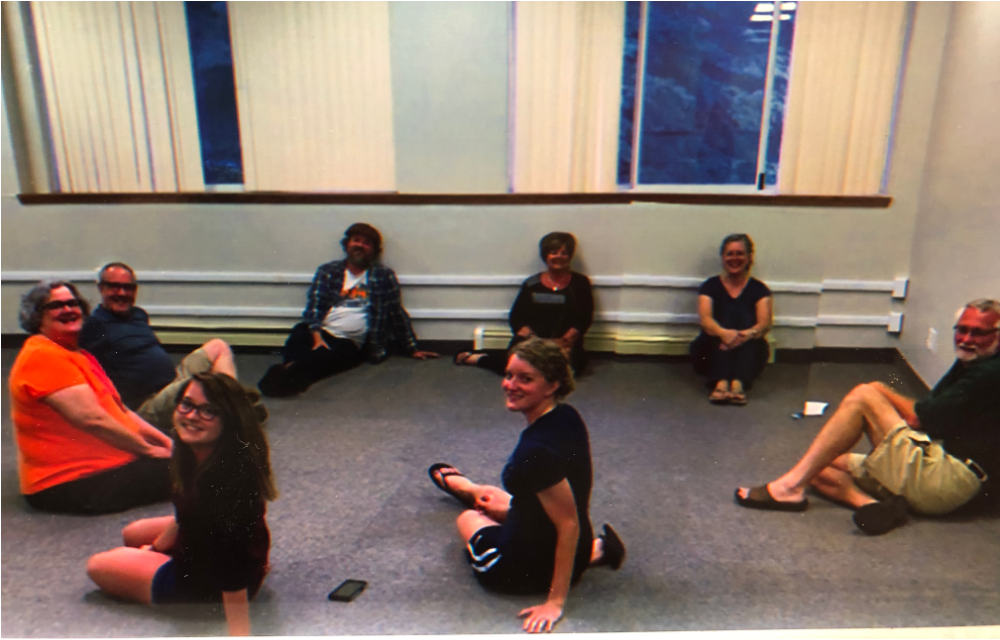
Ten years ago we prayed and dreamed about what God might do. Ten years ago we launched a new church. This picture exactly ten years ago—on a Tuesday night, as the prayer team sat down on the floor of our first location and egan the official process, which we’ll be celebrating over the next few months and into the Fall. And now? What would someone see? What would Paul see? What would Christ see? What would some of the people who were at the preview services that summer, or the launch service say about us now? And perhaps there’s another question. If there is someone in your life who doesn’t know Christ…would you feel comfortable saying, “Come and see!” Not because our church is perfect, or because we have everything figured out, or because we have the biggest programs or the best music. But because you’ve seen people love one another. Because you’ve seen people pray for one another. Because you’ve seen people stand together through hard times. Because you’ve seen people grow in their faith. You have seen the church of Christ.
As we look back over the last ten years, I suspect that people are not going to be remembering sermons, budgets, or ministries. They WILL remember who welcomed them, who sat with them, who encouraged them, and who made room at the table. Ordinary faithfulness matters.
When Paul says, “whether I come and see you or only hear about you…” he doesn’t say: I hope your budget is balanced, I hope you’ve expanded the building, I hope your programs are thriving. No. He says I want to hear that you are standing firm in one spirit, with one mind striving together for the faith of the gospel.
Paul did not see his mission as one which had as its goal to convert every individual.[44] And we can also give up hoping to Christianize the world.[45] That’s not Paul’s point. ‘If we’re to understand the language Paul uses for the mission of the church’, writes Brian Peterson, ‘it means letting go of trying to fill the seats with more converts, or to measure the faithfulness of the mission by the size of buildings or the strength of offerings. It is the cross lived out through the community that is the truer evangelical mission. The communal life stands against the death dealt by empire.’ He continues, ‘the church is the beginning of God’s new creation in concrete ways by gathering, by sharing meals, by breaking down ethnic-social barriers that keep empire stable, and by doing good for all, because that is God’s intent for the whole cosmos. The church’s success in mission, or better its faithfulness in mission, is not determined by the number of members held or gained, but by the clarity of its cruciform life together.’[46]
Paul isn’t asking “What have you accomplished?” He’s asking: “Who have you become?” And that may be the most powerful question for our church. The church Paul loved wasn’t a perfect church. It was a church learning to stand firm together despite disagreements, social differences, and competing loyalties. Which sounds remarkably contemporary. What should people find when they come and see the church?
As citizens of heaven, the church is called to represent the kingdom of Christ on earth.
They should see a little bit of heaven. Not perfection. Not sinlessness. But a community shaped by the reign of King Jesus. A visible gospel community. A community where people aren’t controlled by fear, who love one another, and who embody the values of their true homeland.
The picnic we’re having today isn’t just lunch. It’s citizens of the kingdom sharing life together. The baptism isn’t just a personal testimony. It’s a public declaration of allegiance: Jesus is Lord. Caesar is not. Or, in today’s terms: My primary identity is no longer found in the kingdoms of this world. I belong to Christ. God has formed us as a body of people who are called to stand firm together, to strive side by side, to keep loving in fearful times, to share life together, to gather at tables, to bear one another’s burdens, and to rejoice at baptisms. So, today we will come and see a life given to Christ. Today we will come and see a family of faith. Today we will come and see the gospel made visible. And the world will come and see us. Come and See: The Church of Christ. Let’s pray:
PRAYER; Heavenly Father, we thank you for calling us into your kingdom and making us citizens of heaven through your grace. Thank you for the church—for brothers and sisters who stand with us, pray for us, encourage us, and walk beside us through every season of life. Thank you for gathering us into a family that is larger than ourselves and for teaching us what it means to live under your reign. Forgive us for the times when we have been more concerned with our own preferences than with your purposes. Forgive us for the times we have forgotten who we belong to. By your Spirit, help us to stand firm together. Help us to strive side by side for the message of the gospel. Help us to love one another well, to make room at the table, to bear one another’s burdens, and to encourage one another in Christ. May our life together reflect your kingdom. May those who encounter this church see not our accomplishments, but your grace at work among us. Shape us into a community that points to Jesus—a people marked by faith, hope, love, humility, courage, and joy. Remind us again that our deepest identity is found in you. We belong to Christ. We live under the reign of King Jesus. May your kingdom come and your will be done in us and through us, for your glory. In the name of Jesus we pray, Amen.

Bibliography
- Bird, Michael F., Nijay K. Gupta, Philippians, Cambridge: Cambridge University Press, 2020.
- Oakes, Peter. Philippians: From People to Letter. Society for New Testament Studies Monograph Series 110. Cambridge: Cambridge University Press, 2001.
- Articles
Brewer, Raymond Rush, “The meaning of politeuesthe in Philippians 1:27”, Journal of Biblical Literature, 73 no 2 Jun 1954, 76-83. - Guy, Samuel, “A Politeuma Worth Pursuing: Philippians 3:20 in Light of Philippi’s Sociological Composition”, Stone-Campbell Journal, 22 no 1 Spr 2019, 89-100.
- Hellerman, Joseph H., “Brothers and friends in Philippi: family honor in the Roman world and in Paul’s Letter to the Philippians”, Biblical Theology Bulletin, 39 no 1 Feb 2009, 15-25.
- Maclean, Jennifer. Review of Philippians: From People to Letter, by Peter Oakes. Bryn Mawr Classical Review 2001.12.02 (2001). Accessed on 6/12/26: https://bmcr.brynmawr.edu/2001/2001.12.02/
- Peterson, Brian K., “Being the church in Philippi”, Horizons in Biblical Theology, 30 no 2 2008, 163-178.
- Reese, Chris. “Practical Insights from the Greek of Philippians 1:27.” Kregel Academic Blog, April 23, 2020. Accessed June 12, 2026. https://kregelacademicblog.com/biblical-studies/practical-insights-from-the-greek-of-philippians-127/
- Stenschke, Christoph W., “Philippians 1:1-2:18”, Neotestamentica, 56 no 1 2022, 198-201.
- Tan, Melissa C. M., “How Might Positionality Be Used in Biblical Studies?: Philippians 1:27-2:4 as an Example”, Religions, 15 no 6 Jun 2024, 1-17.
- “Kingdom Affirmations and Commitments.” Transformation 11, no. 3 (1994): 2–7. http://www.jstor.org/stable/43052433.
- Verhoef, Eduard, “Syncretism in the church of Philippi”, HTS Theological Studies, 64 no 2 Jun 2008, 697-714.
Other Websites
- Nyaita / Didaktika Pedagogia: Journal of Education and Religion Vol 2 No. 1 – 2026.
- Concannon, Cavan W., “Military Veterans and Philippi,” Bible Odyssey, June 20, 2017, accessed May 28, 2026, https://www.bibleodyssey.org/articles/military-veterans-and-philippi/
- Mowczko, Marg, “Euodia and Syntyche: Women Church Leaders at Philippi.” August 4, 2011. Accessed May 28, 2026. https://margmowczko.com/euodia-and-syntyche-church-leaders-at-philippi/
- https://en.wikipedia.org/wiki/Philippi, accessed June 12, 2026.
- https://thracians.net/2025/05/10/auxiliaries-in-the-roman-army/, accessed June 12, 2026.
Week Six: Come and See: The Church of Christ
Small Group Questions
Philippians 1:27-30
Icebreaker Question
- What is one thing that immediately tells people where you’re from? (A phrase you use, a sports team, a food, an accent, a habit, etc.)
Background Info
Philippi was a Roman colony where citizenship, loyalty, and identity mattered deeply. Many residents lived under the influence of Roman culture and took pride in their connection to the empire. About ten years after helping plant the church in Philippi, Paul writes to the believers in Philippi from prison. He does not know what the future holds for him, and the Philippians themselves are experiencing opposition because of their faith in Christ. Yet Paul’s focus is not on fear or circumstances. Instead, he urges the church to live as citizens worthy of the gospel—to stand firm together, strive side by side, and represent the kingdom of Christ in the world.
Read Philippians 1:27-30.
Whatever happens, conduct yourselves in a manner worthy of the gospel of Christ. Then, whether I come and see you or only hear about you in my absence, I will know that you stand firm in the one Spirit, striving together as one for the faith of the gospel 28 without being frightened in any way by those who oppose you. This is a sign to them that they will be destroyed, but that you will be saved—and that by God. 29 For it has been granted to you on behalf of Christ not only to believe in him, but also to suffer for him, 30 since you are going through the same struggle you saw I had, and now hear that I still have.
Discussion
- Verse 27 begins with the words, “Whatever happens…” Why do you think Paul starts this section that way? What circumstances was he facing, and what circumstances might the Philippians have been facing?
- What does Paul say he hopes to find if he comes and sees the church? What specific qualities does he mention?
- What do you think it looks like to stand firm? What do you think it means to strive together?
- What are some practical ways Christians can strive together rather than simply pursuing their faith as individuals?
- Paul says he wants to hear that the church is “standing firm in one Spirit.” What do you think unity in the Spirit looks like? How is it different from simply agreeing on everything?
- Paul tells the Philippians to “conduct yourselves in a manner worthy of the gospel of Christ.”The Greek word for ‘conduct’ carries the idea of living as citizens. What do you think it means to live as a citizen of Christ’s kingdom?
- Philippi was a Roman colony whose citizens took great pride in their Roman identity. What identities, loyalties, or affiliations compete for our allegiance today? How can we remain faithful to Christ while still being good citizens, neighbors, and community members?
- The church in Philippi likely included wealthy patrons, former soldiers, working-class people, slaves, women leaders, and families. What challenges and opportunities come with building unity among people who are very different from one another?
- Paul encourages believers not to be frightened by opposition or suffering. What kinds of pressures do Christians face today that tempt them to compromise, stay silent, or blend in? How can we encourage one another to stand firm?
- Paul says that suffering for Christ has been “granted” to believers (v. 29). Why might this have been surprising for the Philippians to hear? What does this teach us about following Jesus?
- In verse 30, Paul reminds the Philippians that they are sharing in the same struggle he is experiencing. How might knowing that Paul suffered for the gospel encourage the church? How can shared struggles strengthen Christian community today?
- If someone came and visited our church for the first time, what evidence would they see that Christ is our King? What would you hope they notice?
As citizens of heaven, the church is called to represent the kingdom of Christ on earth
- Looking at verses 27-30 as a whole, what picture of the church emerges? What characteristics seem most important to Paul?
- Paul wrote Philippians about ten years after the church was planted. Imagine Paul visited our church ten years from now. What would you hope he would “come and see” in us?
Closing Prayer: Heavenly Father, thank you for calling us into your kingdom and making us citizens of heaven. Help us to stand firm in one Spirit, strive together for the gospel, and faithfully represent your reign in the world around us. May our lives and our church reflect your love, grace, and truth so that others may see you through us. In Jesus’ name we pray, Amen.
[1] https://en.wikipedia.org/wiki/Philippi
[2] Michael F. Bird, Nijay K. Gupta, Philippians, Cambridge: Cambridge University Press, 2020, 2.
[3] Michael F. Bird, Nijay K. Gupta, Philippians, Cambridge: Cambridge University Press, 2020, 3.
[4] https://thracians.net/2025/05/10/auxiliaries-in-the-roman-army/
[5] Samuel Guy, “A Politeuma Worth Pursuing: Philippians 3:20 in Light of Philippi’s Sociological Composition”, Stone-Campbell Journal, 22 no 1 Spr 2019, 89-100, 95.
[6] Peterson, Brian K., “Being the church in Philippi”, Horizons in Biblical Theology, 30 no 2 2008, 163-178, 173.
[7] Cavan W. Concannon, “Military Veterans and Philippi,” Bible Odyssey, June 20, 2017, accessed May 28, 2026, https://www.bibleodyssey.org/articles/military-veterans-and-philippi/
[8] Michael F. Bird, Nijay K. Gupta, Philippians, Cambridge: Cambridge University Press, 2020, 20-21.
[9] Bird, Gupta, 20.
[10] Illustration created by Brenda DeVries with AI assistance, 2026.
[11] Lydia: Acts 16:13–15 (Details her meeting Paul by the river, her conversion, and hosting the church).The Roman Jailer: Acts 16:22–34 (Details the earthquake, his attempted suicide, Paul stopping him, and his family’s subsequent baptism).Overseers and Deacons: Philippians 1:1 (Paul explicitly addresses the leadership structure of this specific church in his opening greeting).Epaphroditus: Philippians 2:25–30 and Philippians 4:18 (Paul praises his dedication, mentions his near-fatal illness, and thanks the church for the financial gift he delivered).Euodia and Syntyche: Philippians 4:2–3 (Paul pleads with them to settle their disagreement and validates their work as co-laborers).
[12] Philippians 1:12-18.
[13] Bird, Gupta, 20.
[14] Brewer, 81.
[15] Bird, Gupta, 171.
[16] Bird, Gupta, 173.
[17] Marg Mowczko, “Euodia and Syntyche: Women Church Leaders at Philippi,” August 4, 2011, accessed May 28, 2026, https://margmowczko.com/euodia-and-syntyche-church-leaders-at-philippi/
[18] Bird, Gupta, 175.
[19] Philippians 1:12, 3:1,13,174:1,8.
[20] Joseph H. Hellerman, “Brothers and friends in Philippi: family honor in the Roman world and in Paul’s Letter to the Philippians”, Biblical Theology Bulletin, 39 no 1 Feb 2009, 15-25, 21.
[21] Joseph H. Hellerman, 16.
[22] Joseph H. Hellerman, 16.
[23] Joseph H. Hellerman, 21.
[24] Joseph H. Hellerman, 16.
[25] Joseph H. Hellerman, 20.
[26] Philippians 2:15.
[27] Bird, Gupta, 61.
[28] Samuel Guy, 90.
[29] Bird, Gupta, 59.
[30] https://www.biblegateway.com/resources/encyclopedia-of-the-bible/Claudius-Lysias
[31] Acts 22:23-29.
[32] Samuel Guy, 90.
[33] Infographic created based on data from Peter Oakes.
[34] Samuel Guy, 91.
[35] Bird, Gupta, 24.
[36] Maclean, Jennifer. Review of Philippians: From People to Letter, by Peter Oakes. Bryn Mawr Classical Review 2001.12.02 (2001). Accessed on 6/12/26: https://bmcr.brynmawr.edu/2001/2001.12.02/
[37] Guy Samuel, 96.
[38] Guy Samuel, 100.
[39] Based on Brewer, 82.
[40] Brewer, 83.
[41] Philippians 3:20.
[42] Accordance definition.
[43] Michael F. Bird, Nijay K. Gupta, Philippians, Cambridge: Cambridge University Press, 2020, 24.
[44] Peterson, 177.
[45] Peterson, 177.
[46] Brian K. Peterson, “Being the church in Philippi”, Horizons in Biblical Theology, 30 no 2 2008, 163-178, 178.

