
About these posts
These posts grow out of sermons I’ve written for my local church community. You’re welcome to use them—for teaching, small groups, preaching, or personal reflection. If you share them elsewhere, please include a simple attribution. If you’d ever like to share how they’re being used, you’re welcome to reach out through the Contact button.
I’m not a big fan of storms. There was one time when lightning struck VERY close to our street, and I screamed out loud. When there’s thunder, lightning and wind,
…I want to go to the basement and bury my head in a pillow. Some of you LIKE storms, so this doesn’t compute. BUT… it doesn’t take much nowadays to feel a sense of doom and gloom in the air. Think about your level of tension and anxiety about what’s going on in the world today: Another alert. Another outrage. Another crisis. Another prediction of collapse. Add to that list—the things that are going on in your job, your family, your body…and we’re off to a great start for the morning, aren’t we? Take a minute and notice how your body has been reacting to these things. Did your shoulders just tense up a bit? Are your hands clenched? Is your jaw set on edge?
Into all that noise, the Psalmist says: “Come and see what God is doing.”
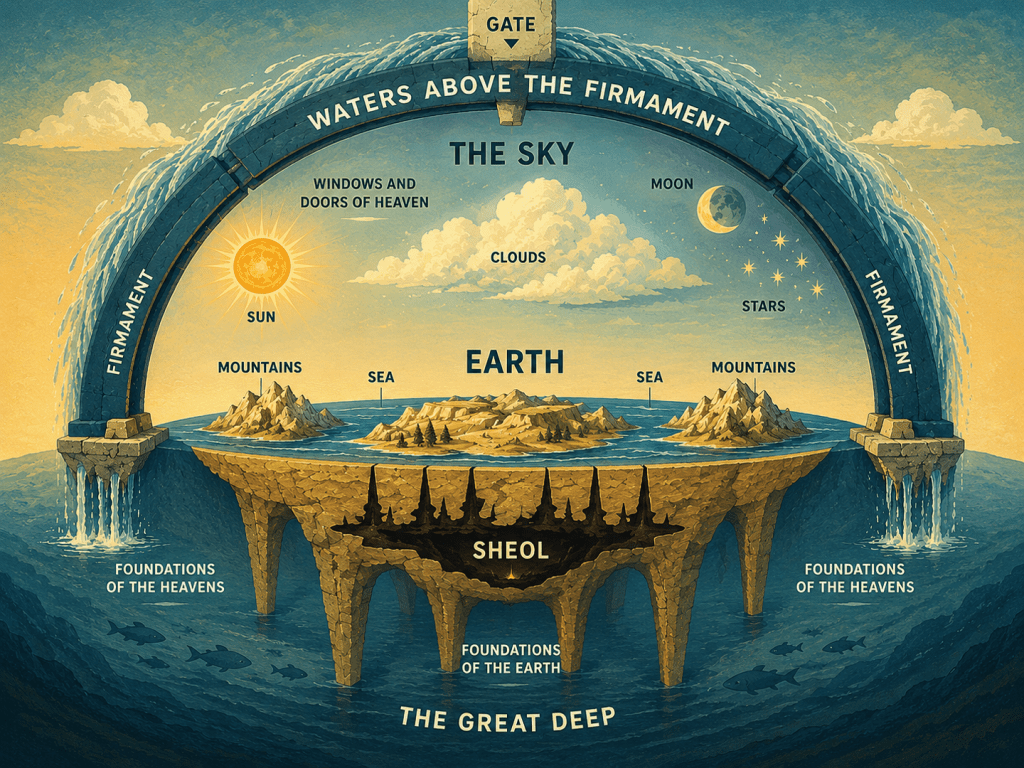
The ancients thought the earth was set on pillars that reached to the bottom of the ocean, and the mountains were rooted there as well. This was based on poetic theology— and literal observations of the physical world. Mountains were the tallest, most immovable things humans could see, so the ancients thought that they had to have anchors that held the world steady against the chaotic, shifting seas. They thought the world was enveloped by a cosmic ocean, which existed before the creation of the earth. There was water above the firmament where the gods lived, and windows that allowed the rain to come down, and there was a netherworld below the land, below the lower waters. To the people in the ancient world, if you were facing the most catastrophic disaster imaginable, it would feel like the undoing of creation—the separation of land and sea.[1] I think we can relate.
Where is our safe place? Where can we go when the storms of life are raging? Where do we find the strength to hold our heads up, when the world is crashing in around us, and we feel powerless to do anything? [2] The writer of our Psalm today paints a very clear picture of that. The Psalm opens with the voice of man and closes—with the voice of God.[3] There are two sections of this psalm: one that may focus on natural disasters, and one that emphasizes political disasters.[4] Things we can resonate with, too. Today we’ll learn that:
God is still working, even when we may not see it.
Before we get to the Psalm, let’s set up the possible back story. Psalm 46 may represent the international uproar and clash of arms that threatened the city of Jerusalem and was hushed by the voice of God.[5] Some scholars believe that this Psalm was written about the occasion when the Assyrian king Sennacherib headed into town with the express desire to conquer Israel. In the Ancient Near East, the thought was that if you win in war, it’s because of the god you serve. For Israel, that God is Yahweh. There are no other gods that they call on—or pray to—or pledge their allegiance to. Sennacherib shows up in Israel, looks around—and wants to conquer them in the name of HIS god. Not just to collect tribute, but to gain this territory completely. Land, bodies, minds…and Assyria has done a good job of that during this time period.
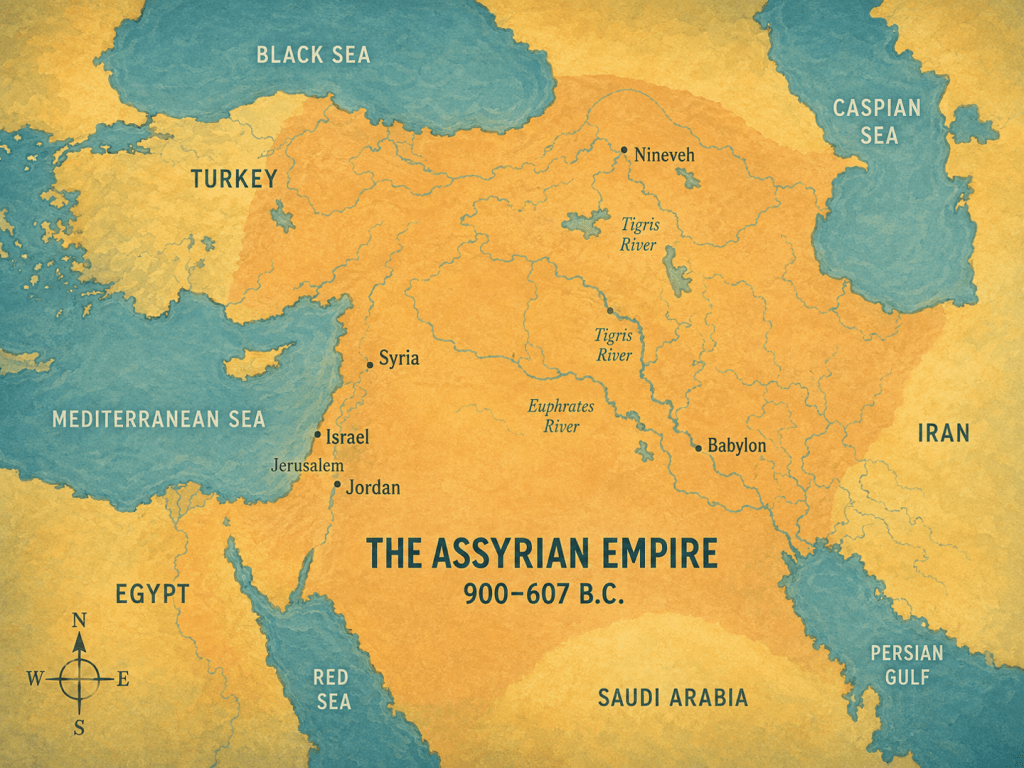
Look at the map of how they annihilated the countries around them from 900-600 BC. Assyria has massive troops, constantly ready for war. They have chariots and horses and are known for their ruthless war tactics. Sennacherib is coming for the little tribe of Judah, and the capital city, Jerusalem. And Israel has got some training and tactics by this point in their history as a nation, but they are no match for what is coming.
Using the strategies of the day, Sennacherib is going to come, lay siege to the city by putting troops around it and then waiting it out. If you are in the city and decide not to give in, they will use schemes to threaten, harm and cause fear and trembling. First, your homes and crops are destroyed while you watch from inside the city walls. Then, any unfortunate people that weren’t able to get into the city—are tortured outside the city walls, while you watch. Eventually, you’ll run out of food and water, and soon, the complete takeover will happen. Sennacherib has done this all over the countryside. But king Hezekiah, reigning over the small area of Judah, has put his trust in Yahweh. He’s the little guy, and things look bad. But he does what he can to protect his city. One of the things he does is build a tunnel under the city so that the people can get water. It’s an ingenious plan and buys some time. Hezekiah struggles with who and what to put his trust in, but eventually, he prays this to God:
“It is true, Lord, that the Assyrian kings have laid waste these nations and their lands. They have thrown their gods into the fire and destroyed them, for they were not gods but only wood and stone, fashioned by human hands. Now, Lord our God, deliver us from his hand, so that all the kingdoms of the earth may know that you alone, Lord, are God.” 2 Kings 19:15-18
Now, put yourself in the ancient city of Jerusalem for just a moment. War is coming. Food shortages are inevitable. Some of your friends or family may have died recently. Your world feels shaky, as if the bottom is going to fall out from under you. You have no control over the outcome. How might you be feeling? What might you be thinking? How might your body be dealing with the stress of what is happening right before your eyes? Into all this…The Psalmist writes:
1 God is our refuge and strength, an ever-present help in trouble. 2 Therefore we will not fear, though the earth give way and the mountains fall into the heart of the sea, 3 though its waters roar and foam and the mountains quake with their surging. 4 There is a river whose streams make glad the city of God, the holy place where the Most High dwells. 5 God is within her, she will not fall; God will help her at break of day. 6 Nations are in uproar, kingdoms fall; he lifts his voice, the earth melts. 7 The Lord Almighty is with us; the God of Jacob is our fortress. 8 Come and see what the Lord has done, the desolations he has brought on the earth. 9 He makes wars cease to the ends of the earth. He breaks the bow and shatters the spear; he burns the chariots with fire. 10 He says, “Be still, and know that I am God; I will be exalted among the nations, I will be exalted in the earth.” The Lord Almighty is with us; the God of Jacob is our fortress. Psalm 46 NIV
GOD is our strength. GOD is our help.
God is still working, even when we may not see it.
God is still working, even when the waters roar, even when kingdoms fall, even when mountains crumble. The land and the sea are subject to the One who created them.[6] In fact—there is A river—There is one river. At creation, Yahweh subdued the watery chaos, transformed it into life-giving waters, and established his temple—his place to rule.[7] To the eyes that are untrained to see what God is doing—everything seems threatening and turbulent—it’s all in an uproar.[8] But there is one river. And it is running its course—all ordered by the hand of God—and in the end, it does HIS will.[9] The threats that are faced in the nations, in politics, in history—No worries. When people think chaos is ultimate reality, the Psalmist says: Look closer. The river is calm enough to be qualified as a stream in the eyes of God.[10] Why?
God is within her, she will not fall; God will help her at break of day. Psalm 46:5
A quick pause here. You can find this verse on t-shirts, mugs, throw pillows, and enough social media graphics to fill the internet. It’s often used as a personal promise to women: God is within her she will not fall. But that’s not actually what the Psalm is talking about. While the verse certainly tells us something true about God’s presence and faithfulness, we need to be careful not to lift it out of its setting and make it say something the Psalmist never intended. In context, the “her” is not an individual woman. The “her” is the city of Jerusalem—the place where God had chosen to dwell among his people. It is the hope that Jerusalem, God’s city—will not fall. As long as God lives in his temple—[11] as long as God is on his throne—The city will not fail. God will help her at break of day. In the story of the southern kingdom of Judah, and the armies of Assyria, after a long night of siege, God intervenes at daybreak to rescue his people.[12]
Have you ever been in a room that is full of voices arguing—It could be kids playing, teenagers clamoring over a task, a meeting where tensions are high—but when the parent, or the chaperone, or the boss speaks—everything is quiet. In this scene, everything is loud—everyone is clamoring—and God raises his voice—and, as if in real time, …’why look, it’s melting!’[13] God has the power to end violence and bring peace.[14]
In the Hezekiah and Sennacherib story, The troops of Assyria are gathered around the city of Jerusalem—God’s city—Where HIS people are fearful, panicky, intimidated and expectant—waiting to see what God will do. The chariots, the wagons[15]—the martial[16] vehicles that hold and bring the supplies for the Assyrians are all there. The weapons are sharp and ready. The troops are chomping at the bit. And then night falls. Nighttime can be scary. We can’t see what’s happening. Dark is often used as a metaphor for evil. But when darkness was covering the earth, God said ‘let there be light.’ God does some of his best work in the dark. I hope you hear that today—even if it’s the one thing you remember: God does some of his best work in the dark.
That night the angel of the Lord went out and put to death a hundred and eighty-five thousand in the Assyrian camp. When the people got up the next morning—there were all the dead bodies! So Sennacherib king of Assyria broke camp and withdrew. He returned to Nineveh and stayed there. One day, while he was worshiping in the temple of his god Nisrok, his sons Adrammelek and Sharezer killed him with the sword, and they escaped to the land of Ararat. And Esarhaddon his son succeeded him as king. 2 Kings 19:35-37[17]
No one in the city lifted a finger. Not one person hurled a rock or a spear from Jerusalem’s city wall. Not one soldier had strapped on his gear or stepped into the fray. Not one combat plan had been executed. In the stillness of the night—the enemy had been defeated. The battle belongs to the Lord.
While the story of the deliverance from Assyria happened, and was a great moment in history for the people of God, Jerusalem was decimated many years later.[18] Word of that had come from God—through the prophets, and yet he was on the move, doing something more. There was a greater victory that was to come—not just in one country, not just in a city—but something that would reverberate around the world, in the furthest regions of the universe, in the heavenly realms, and even in the hearts of men and women and children.
Even when the ground falls out from underneath us, and when we cannot see the evidence that God is on the throne, this psalm dares us to believe anyway.[19] We can trust that God is on the move. God says:
“Be still, and know that I am God; I will be exalted among the nations, I will be exalted in the earth.” Psalm 46:10
Silence is reverence—and the ability to rest in God’s power alone.[20]
God is still working, even when we may not see it.
We don’t have to think long and hard to realize that we are faced with similar situations as the people behind the ancient wall of Jerusalem in Hezekiah’s day. Wars are raging. Food insecurity affects millions. Some of your friends or family may have died recently. The nations are in uproar. The headlines never seem to stop. The world feels shaky, as if the bottom is going to fall out from under you. People are hurting, grieving, and afraid. You have no control over the outcome. So, how are you feeling? What might you be thinking recently? How is your body dealing with the stress of what is happening right before your eyes? You don’t have to defend yourself. You don’t have to protect yourself. Be still. Relax. Put down your arms. Let God be God. Let HIM wipe out the weapons of war.[21] Cease and desist, unclench your fist,[22] surrender to God and let him build his kingdom.[23] The God of creation, who separated the waters and caused land and mountains to emerge, can handle it when the world seems to go in reverse, and our world seems to be dissolving back into disorder and chaos.[24] The Psalmist reminds us:
The Lord Almighty is with us; the God of Jacob is our fortress. Psalm 46:11
A mighty fortress is our God, a bulwark never failing; our helper he, amid the flood of mortal ills prevailing. For still our ancient foe does seek to work us woe; his craft and power are great, and armed with cruel hate, on earth is not his equal.
Did we in our own strength confide, our striving would be losing, were not the right Man on our side, the Man of God’s own choosing. You ask who that may be? Christ Jesus, it is he; Lord Sabaoth his name, from age to age the same; and he must win the battle.
And though this world, with devils filled, should threaten to undo us, we will not fear, for God has willed HIS truth to triumph through us. The prince of darkness grim, we tremble not for him; his rage we can endure, for lo! his doom is sure; one little word shall fell him.
That Word above all earthly powers no thanks to them abideth; the Spirit and the gifts are OURS through him who with us sideth. Let goods and kindred go, this mortal life also; the body they may kill: God’s truth abideth still; HIS KINGDOM is forever![25]
There’s a time to act. There are moments when we need to be faithful and courageous and do what we have been called to do. But we are not in command. God is. The Psalmist invites us to Come and See what God is doing.
God is still working, even when we may not see it.
God is still working, even when nations rage, even when life unravels, even when we’re afraid, even when prayers feel unanswered, even when the world shakes, even when the morning has not yet come. So, loosen your shoulders, unclench your fists, open your hands, close your eyes, and we’re going to pray. Please repeat these lines after me
PRAYER
O God— You are our refuge— You are our strength— You are present among us— In our trouble— We wait on you— In our anxiety— We wait on you— We will be still—and know that you are God—Amen.
Bibliography
Robert Alter, Psalms, New York: W.W. Norton & Company, 2007.
Craig C. Broyles, Psalms: Understanding the Bible Commentary Series, Grand Rapids: BakerBooks, 1999.
C. Hassell Bullock, Psalms, Volume 1: Psalms 1-72, Grand Rapids: BakerBooks, 2015.
John W. Hilber, Psalms: Zondervan Illustrated Bible Backgrounds Commentary, Grand Rapids: Zondervan, 2009, 2013.
Alec Motyer, Psalms by the Day: A New Devotional Translation, Scotland: Christian Focus Publications Ltd, 2016.
Going Deeper Questions
—In what ways does it feel like our world is coming apart or turned upside down?
—How do you normally cope when you’re overwhelmed?
Read Psalm 46:1-3 NIV
God is our refuge and strength, an ever-present help in trouble.
2 Therefore we will not fear, though the earth give way
and the mountains fall into the heart of the sea,
3 though its waters roar and foam and the mountains quake with their surging.
—Which description of God in verse one—refuge, strength, or ever-present help—stands out most to you? Why?
—What does it look like when another person becomes your “refuge,” and then your “strength,” and then your “help”? What are some of the things you have sometimes wrongly taken refuge in other than God?
—Why do you think the Psalmist chooses such extreme images (the earth giving way, mountains falling into the sea, roaring waters)?
—What situations in our world today feel similar to that kind of upheaval?
—If the mountains represent the things we think will never move, what are the “mountains” in your life? What happens when they begin to shake or fall?
—Have you ever experienced a season when it felt like the “earth gave way” beneath you? What happened?
—The Psalm does not deny the reality of chaos but calls God’s people not to fear in the midst of it. What fears tend to surface when life feels uncertain? What is the difference between denying fear and trusting God in the midst of fear?
—Which is more difficult for you: trusting God in personal struggles or trusting God in larger world events? Why?
Read Psalm 46:4-7 NIV
4 There is a river whose streams make glad the city of God,
the holy place where the Most High dwells.
5 God is within her, she will not fall; God will help her at break of day.
6 Nations are in uproar, kingdoms fall; he lifts his voice, the earth melts.
7 The Lord Almighty is with us; the God of Jacob is our fortress.
—The Temple was in Jerusalem, the place where God had agreed to dwell among his people. Why is God’s presence more important than the city’s walls, army, or defenses?
—How does this Psalm challenge our tendency to place ultimate hope in political, economic, or military power?
—Why might the Psalm specifically mention “break of day”? What is difficult about waiting through the night before the morning comes?
—How does God’s presence change the way we face difficult circumstances?
Read Psalm 46:8-11 NIV
8 Come and see what the Lord has done, the desolations he has brought on the earth.
9 He makes wars cease to the ends of the earth. He breaks the bow and shatters the spear; he burns the shields with fire. 10 He says, “Be still, and know that I am God;
I will be exalted among the nations, I will be exalted in the earth.”
11 The Lord Almighty is with us; the God of Jacob is our fortress.
*Psalm 46 may have been written about the occasion when Sennacherib tried to take Jerusalem. You can read the entire story in 2 Kings 18:9-19:37.
—The people of Jerusalem were focused on the army outside their walls. What larger reality does the Psalm invite them to see?
—Verse 8 invites us to “Come and see what the Lord has done.” Why do you think the Psalm invites us to “come and see” rather than simply “believe”?
—Why do you think we sometimes struggle to see God’s activity?
—What helps you pay attention to God’s presence when life feels uncertain?
—Where have you seen God at work in your life during a season when it wasn’t obvious at first?
—What does this passage teach us about God’s desire for peace?
—What comes to mind when you hear the phrase “Be still”?
—Some translations suggest the meaning “cease striving,” “let go,” or “stop fighting.” Why is being still often harder than taking action?
—What is one area of your life where you find yourself striving instead of trusting?
—Why do you think the Psalm repeats, “The Lord Almighty is with us; the God of Jacob is our fortress”? (verse 7, 11) In what ways does that phrase give comfort and encouragement to the people of Israel? To you?
God is still working, even when we may not see it.
—Where do you most need to believe that right now?
—Why is it important to remember that God’s story is bigger than our personal stories?
Personal Application
—What would it look like to look for evidence of God’s work rather than focusing only on the chaos around you?
—What is one situation you will entrust to God this week?
—What are you trying to control right now? What would it look like for you to “be still and know that I am God” this week?
—The Psalm invites us to “come and see what the Lord has done.” If someone were to ask you where you have seen God at work recently, what would you point to?
Prayer: Lord God, You are our refuge and our strength. When life feels chaotic and our hearts are afraid, help us to be still and know that you are God. Open our eyes to see what you are doing and give us faith to trust you when we cannot. In Jesus’ name, Amen.
[1] John W. Hilber, Psalms: Zondervan Illustrated Bible Backgrounds Commentary, Grand Rapids: Zondervan, 2009, 2013, 46.
[2] Motyer, 121. Refuge—shields us in danger; Strength—empowers us in weakness
[3] Motyer, 121.
[4] C. Hassell Bullock, Psalms, Volume 1: Psalms 1-72, Grand Rapids: BakerBooks, 2015, 346.
[5] Alec Motyer, Psalms by the Day: A New Devotional Translation, Scotland: Christian Focus Publications Ltd, 2016, 121.
[6] Motyer, 121. Mountains-depict creation in its passive solidity; Waters-are creation in its destructive powers.
Both are subject to the Creator.
[7] Broyles, 209.
[8] Motyer, 121.
[9] Motyer, 121.
[10] Hilber, 46.
[11] Hilber, 46.
[12] Robert Alter, Psalms, New York: W.W. Norton & Company, 2007, 163.
[13] Motyer, 122.
[14] Alter, 164.
[15] Motyer, 123.
[16] Alter, 164. ‘though the Hebrew noun usually means ‘wagons,’ the parallelism with ‘bow’ and ‘spear’ suggests a more martial vehicle.
[17] See also Isaiah 37:36
[18] Broyles, 211.
[19] Craig C. Broyles, Psalms: Understanding the Bible Commentary Series, Grand Rapids: BakerBooks, 1999, 208.
[20] Hilber, 47.
[21] Broyles, 210.
[22] Alter, 165.
[23] Bullock, 350.
[24] Bullock, 349.
[25] https://hymnary.org/text/a_mighty_fortress_is_our_god_a_bulwark

