

About these posts
These posts grow out of sermons I’ve written for my local church community. You’re welcome to use them—for teaching, small groups, preaching, or personal reflection. If you share them elsewhere, please include a simple attribution. If you’d ever like to share how they’re being used, you’re welcome to reach out through the Contact button.
I have many things that I want certainty about. I want evidence before I believe a news story. I’ll track a package to make sure it’s really going to arrive. I still ask for receipts at the restaurant. I like confirmation before assuming that plans are real. I definitely check to see whether the door is locked—more than once, and I double check the alarms I set before going to bed. We tend to trust what we can predict, what we can measure, what we can verify with our eyes and experience. We trust patterns, evidence and outcomes. We trust what we have experienced over and over again.
But the resurrection of Jesus does not fit neatly into any of those categories. And his resurrection does not allow us to remain spectators for very long, because the New Testament writers are not only asking us to observe something, but they ask us to step inside the story, to trust beyond what we can fully explain, and to live differently because of what we have been told.
That all feels easier to do that in the moment, doesn’t it? Easter is easier to believe on Easter: when the sanctuary is full, when the music swells, when the flowers are everywhere, and when people are dressed up and hopeful. But eventually the Easter lilies die, and somewhere about now…resurrection can start to feel far away. We’re going to read from Matthew 28 today, to set our focus, as we look at the Easter story again.
After the Sabbath, at dawn on the first day of the week, Mary Magdalene and the other Mary went to look at the tomb. 2 There was a violent earthquake, for an angel of the Lord came down from heaven and, going to the tomb, rolled back the stone and sat on it. 3 His appearance was like lightning, and his clothes were white as snow. 4 The guards were so afraid of him that they shook and became like dead men. 5 The angel said to the women, “Do not be afraid, for I know that you are looking for Jesus, who was crucified. 6 He is not here; he has risen, just as he said. COME AND SEE the place where he lay. 7 Then go quickly and tell his disciples: ‘He has risen from the dead and is going ahead of you into Galilee. There you will see him.’ Now I have told you.” 8 So the women hurried away from the tomb, afraid yet filled with joy, and ran to tell his disciples. 9 Suddenly Jesus met them. “Greetings,” he said. They came to him, clasped his feet and worshiped him. 10 Then Jesus said to them, “Do not be afraid. Go and tell my brothers to go to Galilee; there they will see me.” Matthew 28:1-10 NIV
This text in Matthew is the same one that we read on Easter, just eight short weeks ago. The section often has the heading, “The Resurrection.” I went and looked in a few of my Bibles. Sure enough. But Matthew does not give us information about the physical resurrection of Jesus. Did you ever think about that? In fact, NONE of the four Gospels offer an actual account of Jesus’ resurrection.[1] The only references we have, talk about a future event where Jesus ‘will be raised’, or a past event in which Jesus ‘has been raised.’[2]
In this account, we learn about the earthquake and the angel rolling back the stone, and the guards that shook. But we have nothing about the moment of resurrection. There were no hidden cameras, and Jesus didn’t talk about what happened with his disciples, or else they didn’t think it was important enough to write down later. No one was present when it happened. The other gospel accounts are all different from each other in their tellings as well. One women, two women, three women, multiple women? One angel, or two? Or were they just men? Is the angel outside the tomb? Sitting on the stone? Inside the tomb? It’s all very confusing, especially if you want to be able to analyze and fact check and have proof of what happened that day.
We are uncomfortable trusting what we cannot fully verify. We want evidence before we build our lives around something, right? We are people who look for proof. Dorothy Weaver writes: “Matthew’s narrative reticence on this issue is an implicit confession that the unprecedented act by which God raised Jesus from the dead is neither susceptible to human analysis nor reducible to human language.”[3] In other words, Matthew is not trying to satisfy our curiosity as much as he is trying to invite us into faith.
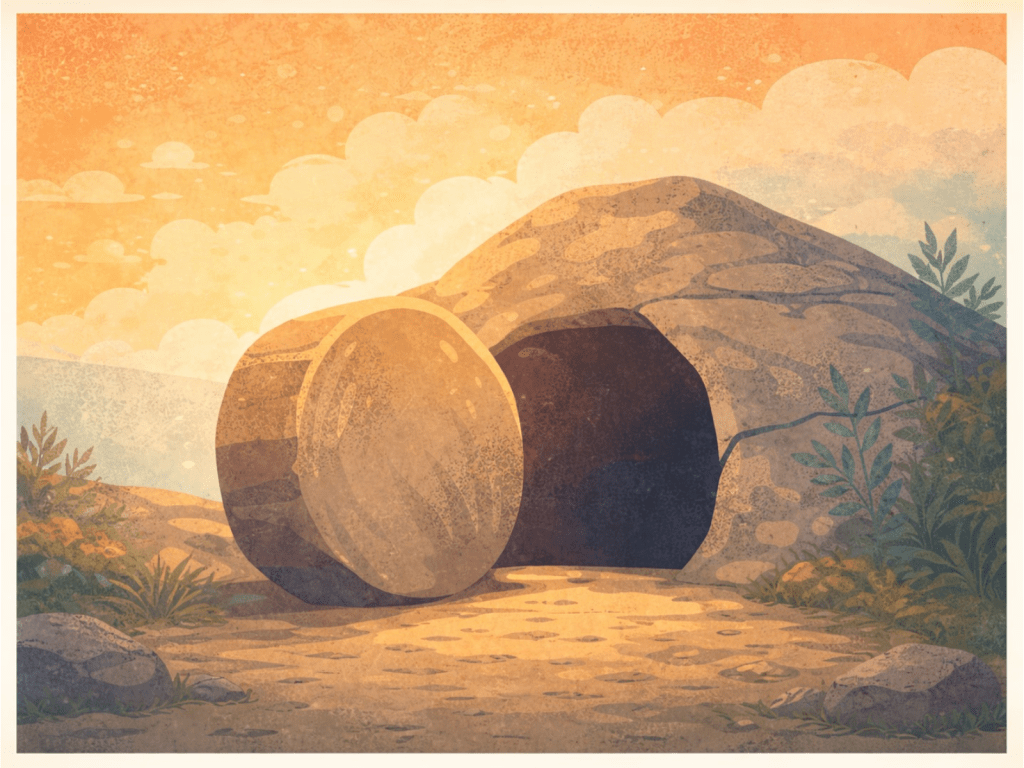
We have no knowledge that anyone actually saw the resurrection happen. Nobody watched Jesus walk out of the tomb. Nobody describes the moment. Instead, Matthew gives us an empty burial site, frightened women, a moved stone, and an invitation: “Come and see.”
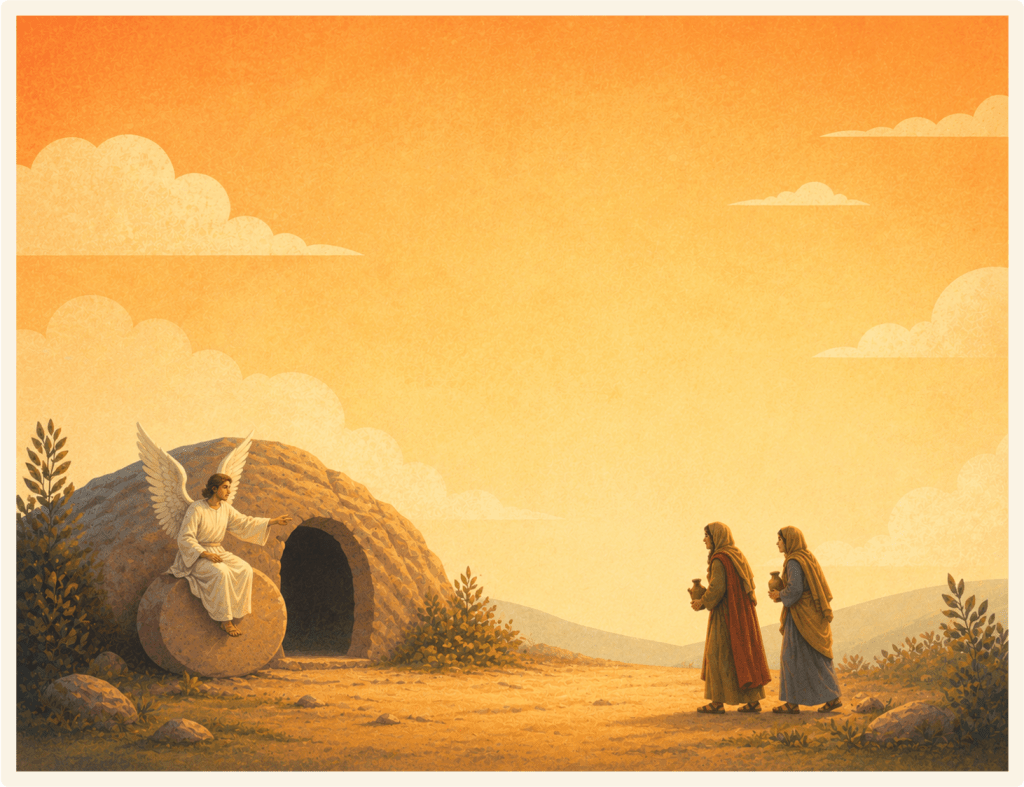
The women that arrive that morning, are not expecting resurrection. They come carrying grief, memory, confusion, and the ordinary assumptions people make about death. Now, I found out that according to the Mishnah, it WAS permissible to anoint a body on the Sabbath, it was just that the purchase of the necessary materials would not have been allowed.[4] The other writers note that the women brought spices and preparations to anoint Jesus with. But Matthew only tells us that Mary Magdalene and the other Mary went to ‘look’ at the tomb.
Friends or relatives often watched at the tomb in case the apparently dead person should revive.[5] In the last sermon on Lazarus, we learned that there was a belief that the spirit of a person hovered over the body for three days. After that, they were truly dead. There couldn’t have been too much debate about if Jesus was dead. Many of Jesus’ disciples watched from a distance. They watched the spitting and mocking and horrific beatings. They saw Jesus take his last breath and the soldiers take him down from the cross. A person does not survive that. But there was perhaps a little glimmer of hope. After all, he was Jesus, the one who had raised Lazarus, right?
The chief priests and the Pharisees knew that—and asked to have the tomb sealed and guards placed at the entrance to ensure that no one could enter[6]—obstacles for anyone who could potentially want to check the body and see if Jesus might possibly be alive.[7]
The women in Matthew’s text are heading to the tomb after the Sabbath. Jewish days begin at sundown, so the morning is the earliest that the women dared arrive. And they may have come, as the law requires, for the final inspection, to ensure that Jesus was really dead.[8] They come to confirm what they already know beyond a doubt is true —so that they can make the final preparations and honor his body on the third day, when he would be truly dead. And that makes sense. But what they get, is something that no one was expecting. What happened changed the meaning of all language, including such basic terms as death and life.[9] The women are not met by the silence and stillness of death, but by … the world itself being transformed from the grave outward.[10]
Everything in this scene in Matthew feels unstable: the rocks, the guards, and the women are shaken,[11] and the assumptions people have carried about death and power begin to crack apart, too. The resurrection is not just good news for Jesus. It is the beginning of God remaking the world! The angel invites these grieving women to look directly into the place where death was supposed to win. “Come and See the place where he lay.” The invitation directs them toward the living Christ.
The tomb—is the turning point of the story! It is important precisely because it was empty. It wasn’t opened to allow Jesus to come out, but to allow the women to come IN! Before this invitation, their minds are drawn back to what they remember, and they are pretty sure of what they’ve learned in the last few days: Rome always wins, Death is final, crosses end stories, and Jesus is gone. After coming and seeing the place where Jesus was, though, they are able to view reality differently. In that moment, their whole world begins to shift! Jesus’ resurrection changes what suffering means, what power means, what death means, what hope means, what the future means.
Resurrection is not just an abstract doctrine. The angel doesn’t invite the women to receive information so that they can explain the resurrection to others. He invites them to enter in. “Come and see” is not an invitation to solve a mystery. It is an invitation to step into a new reality. The women physically move into the empty tomb, and when they turn around and exit, they are commissioned to go and tell. That encounter moves them to witness, and as they head out to do just that, they meet Jesus. They encounter the risen Christ!
Over the centuries, people have tried to explain away the resurrection in all kinds of ways. Some have said that Mary Magdalene was just a hallucinating witness. Her love for Jesus made her imagine that Jesus was risen and her testimony convinced the other disciples.[12] But later, Jesus also appeared to his disciples in Galilee. He ate with them. He taught them. And what he gave them was so real, that there was no other proof needed. These men—and women—were so convinced that Jesus had risen—that they were willing to be—and even were—persecuted, mistreated, and killed for that belief. No one does that for a hallucination. One person maybe—but not that many.
The angel’s invitation to ‘Come and See’ is not just for the women. It’s for the readers of Matthew’s gospel. It’s an invitation to the church—to us—to you!
The empty tomb is not proof to master. It is a doorway into resurrection life.
Come and See—the empty tomb, the risen Christ, the new reality God has begun! And then? Go and live differently. Our job is not to present a logical proof that Jesus was raised from the dead. But it is our task to bear witness to the resurrection.[13]
And there is where it gets difficult. We KNOW how to live in a Good Friday world where innocent people get killed and the weak get stepped on…[14] We know how to live in grief, disappointment, cynicism, fear, scarcity, self-protection. The world trains us in all of those things. We know how to live in a world where: people disappoint us, where violence keeps happening, bodies fail, grief lingers, and injustice wins. We understand THAT world. But resurrection? Resurrection is harder to live inside of. Because resurrection requires trust beyond what we can see, and what we can prove.
The women who came to the tomb were preoccupied with everything they thought they knew. They understood tombs. They understood burial. They understood loss. And they thought they were at the end of the story. Like the women, we tend to be convinced by what we think we know, too. People die. Wars happen. Relationships fracture. Prayers are unanswered sometimes. And we will keep thinking like that if we don’t understand resurrection.
The temptation for us, post Easter, is to swing between two extremes. Either we despair in our circumstances, or we try to pretend that everything is fine. But resurrection does neither of those things. Resurrection faith actually means living in tension: The tomb is empty… and yet the world is not fully healed. Death IS real…but it is no longer sovereign. Resurrection people are called to live differently before everything is fixed. Resurrection life—means living according to God’s future in the middle of the present world. That’s difficult. But it’s also what makes Christian witness distinct.
If Christ is risen, then: we forgive before wounds are fully healed, we love enemies before the world becomes safe, we keep hoping before outcomes are visible, we keep serving before justice is complete, we keep witnessing before everyone believes. Our objective is not to prove the resurrection. The question before us is not, ‘what happened?’ It’s ‘NOW how will you live?’ The women were not invited to look so that they could say, “Interesting. The tomb is empty.” No! They were invited into witness, worship, and mission. The empty tomb changes them. And after they ‘Come and See’, they leave with ‘fear and great joy’—Because resurrection destabilized their old way of understanding reality. That’s often what stepping forward in faith feels like. There is excitement, uncertainty, questions, AND there is hope.
The empty tomb is not the end of the story. It is the beginning of a new way of living. It is not proof to master. It is a doorway into resurrection life. It cannot be reduced to detached observation. It must be entered into. Will we only visit the empty tomb once a year…or will we LIVE as resurrection people? Resurrection asks us to live as though: death is not ultimate, forgiveness is stronger than revenge, hope is reasonable, love is not wasted, suffering is not the end of the story, and God is still at work even when we cannot yet see it.
The resurrection is a crossroads. We can follow Jesus to the cross and the empty tomb, but then we must decide if we want to keep following Jesus into the implications of this new resurrection reality—to stay on the road—and to follow him to the end.[15] We do not walk into a future where everything is figured out and perfectly clear. But because Jesus lives, we can all move into the future with courage—even when we cannot yet see the whole road. Resurrection does not remove uncertainty from life. But it does mean that we do not face the future alone. The risen Christ goes ahead of us. Come and See the Empty Tomb.
PRAYER: Gracious and living God, you meet us in places where we expect only grief, silence, and endings. Thank you for the empty tomb, for the hope of resurrection, and for the promise that death does not have the final word. Teach us to live as resurrection people, too: to forgive when bitterness is easier, to hope when the future feels uncertain, to love even when the world feels divided, and to trust that you are still at work, even when we cannot yet see the whole road ahead. Give us courage as we step into new places and new seasons. Go before us, guide us, and remind us that we never walk alone. And when fear rises within us, meet us as you met the women on the road—with your presence, your peace, and your invitation to keep following you. We pray all of this in the name of the risen Christ, who lives and reigns with you and the Holy Spirit, one God, now and forever. Amen.
Bibliography
Articles
- Brisson, E. Carson, “Matthew 28:1-10”, Interpretation, 65 no 1 Jan 2011, 72-74.
- Harvard, Joseph S., “Preaching the Easter texts: can I get a witness?”, Journal for Preachers, 37 no 3 Easter 2014, 3-12.
- Jarvis, Cynthia A., “Matthew 28:1-10”, Interpretation, 42 no 1 Jan 1988, 63-68.
- Longstaff, Thomas R. W., “The women at the tomb: Matthew 28:1 Re-examined”, New Testament Studies, 27 no 2 Jan 1981, 277-282.
- Maier, Harry O., “Come and see: the promise of visual exegesis”, Colloquium, 47 no 1 May 2015, 152-157.
- Mazurek, Tomasz,” The Formula ‘come, see’ in the Palestinian Targums”, Verbum Vitae, 42 no 4 Oct – Dec 2024, 1017-1038.
- Minear, Paul Sevier, “Matthew 28:1-10”, Interpretation, 38 no 1 Jan 1984, 59-63.
- O’Collins, Gerald, “Mary Magdalene as major witness to Jesus’ resurrection”, Theological Studies, 48 no 4 Dec 1987, 631-646.
- Senior, Donald, “The death of Jesus and the birth of a new world: Matthew’s theology of history in the passion narrative”, Currents in Theology and Mission, 19 no 6 Dec 1992, 416-423.
- Weaver, Dorothy Jean, “Matthew 28:1-10”, Interpretation, 46 no 4 Oct 1992, 398-402.
Week Four: Come and See: The Empty Tomb
Small Group Questions
Matthew 28:1-10
Icebreaker Questions
- Are you more likely to trust quickly, or to want proof and certainty first?
- What’s one “ordinary” thing that helps you feel safe or in control?
Read Matthew 28:1 NIV
After the Sabbath, at dawn on the first day of the week, Mary Magdalene and the other Mary went to look at the tomb.
Discussion
- Matthew says the women went “to look at the tomb.” What do you think they expected to find there? What emotions do you imagine the women carrying as they walked?
- Why do you think resurrection was so difficult for them to imagine—even after hearing Jesus’ promises?
Read Matthew 28:2-4 NIV
2 There was a violent earthquake, for an angel of the Lord came down from heaven and, going to the tomb, rolled back the stone and sat on it. 3 His appearance was like lightning, and his clothes were white as snow. 4 The guards were so afraid of him that they shook and became like dead men.
Discussion
- Why do you think Matthew includes the earthquake, angel, stone, and terrified guards instead of simply saying, “Jesus rose from the dead”?
- If you had been standing there watching the earthquake and angel, how do you think you would have reacted?
- The guards are physically present at the tomb, yet they do not become witnesses in the same way the women do. What might that teach us about seeing versus believing?
Read Matthew 28:5–7 NIV
The angel said to the women, “Do not be afraid, for I know that you are looking for Jesus, who was crucified. 6 He is not here; he has risen, just as he said. Come and see the place where he lay. 7 Then go quickly and tell his disciples: ‘He has risen from the dead and is going ahead of you into Galilee. There you will see him.’ Now I have told you.”
Discussion
- The angel begins with the words: “Do not be afraid.” Why do you think that is often one of the first things said when people encounter God’s power or presence in Scripture?
- Why is it important that the angel notes that Jesus was crucified?
- Why do you think the angel invites the women to “Come and see the place where he lay”?
Read Matthew 28:8-10 NIV
8 So the women hurried away from the tomb, afraid yet filled with joy, and ran to tell his disciples. 9 Suddenly Jesus met them. “Greetings,” he said. They came to him, clasped his feet and worshiped him. 10 Then Jesus said to them, “Do not be afraid. Go and tell my brothers to go to Galilee; there they will see me.”
Discussion
- Why might it matter that the women are invited to see before they are sent to tell?
- Matthew says the women left the tomb with “fear and great joy.” Why do you think both emotions existed together?
- Why do you think Jesus repeats: “Do not be afraid”? What fears might the women still have been carrying, even after hearing the angel’s message?
- In these verses, the women move from: grief → fear → joy → worship → witness. Which part of that movement stands out most to you right now?
The empty tomb is not proof to master. It is a doorway into resurrection life.
We naturally look for certainty, proof, and predictable outcomes. Where do you most notice that tendency in your own life?
- What do you think it means to move from simply believing in the resurrection to actually living a resurrection-shaped life?
Personal Application
- Which of these resurrection practices feels hardest for you right now? Why?
forgiving before wounds fully heal
hoping before outcomes are visible
loving enemies before the world feels safe
serving before justice feels complete
trusting God when the future feels uncertain
- If the empty tomb truly is a “doorway into resurrection life,” what areas of your life might God be inviting you to step into differently right now?
- What might it look like for you to respond like the women: to come and see and then go and tell?
(“Go and tell” may include verbal witness, but also living differently through hope, compassion, forgiveness, courage, and faithfulness in everyday life.)
Prayer
Spend a few moments praying for courage, hope, perseverance, and deeper trust in the risen Christ.
[1] E. Carson Brisson, “Matthew 28:1-10”, Interpretation, 65 no 1 Jan 2011, 72-74, 73.
[2] Dorothy Jean Weaver, “Matthew 28:1-10”, Interpretation, 46 no 4 Oct 1992, 398-402, 399.
[3] Dorothy Jean Weaver, “Matthew 28:1-10”, Interpretation, 46 no 4 Oct 1992, 398-402, 399.
[4] Sabbath 23:5 https://www.sefaria.org/Mishnah_Shabbat.23.5?lang=bi
[5] Sherman E. Johnson, ‘The Gospel According to St. Matthew: Introduction and Exegesis’, The Interpreter’s Bible, vii, Nashville: Abingdon Press, 1951, 613.
[6] Matthew 27:62-66.
[7] Thomas R. W. Longstaff, “The women at the tomb: Matthew 28:1 Re-examined”, New Testament Studies, 27 no 2 Jan 1981, 277-282, 281.
[8] Longstaff, 278.
[9] Paul Sevier Minear, “Matthew 28:1-10”, Interpretation, 38 no 1 Jan 1984, 59-63, 60.
[10] E. Carson Brisson, “Matthew 28:1-10”, Interpretation, 65 no 1 Jan 2011, 72-74, 72.
[11] Minear, 60.
[12] Gerald O’Collins, “Mary Magdalene as major witness to Jesus’ resurrection”, Theological Studies, 48 no 4 Dec 1987, 631-646, 632.
[13] Joseph S. Harvard, “Preaching the Easter texts: can I get a witness?”, Journal for Preachers, 37 no 3 Easter 2014, 3-12, 3.
[14] Joseph S. Harvard, “Preaching the Easter texts: can I get a witness?”, Journal for Preachers, 37 no 3 Easter 2014, 3-12, 4.
[15] Harvard, Joseph S., “Preaching the Easter texts: can I get a witness?”, Journal for Preachers, 37 no 3 Easter 2014, 3-12, 5.

