

About these posts
These posts grow out of sermons I’ve written for my local church community. You’re welcome to use them—for teaching, small groups, preaching, or personal reflection. If you share them elsewhere, please include a simple attribution. If you’d ever like to share how they’re being used, you’re welcome to reach out through the Contact button.

Some people like road trips. I’m one of them. I enjoy seeing the road—and visiting places along the way. But sometimes I do enjoy getting to the destination, settling in, and just enjoying the view or the adventures at a specific location. A few weeks ago, at our tenth-anniversary celebration, someone won a plaque that said: “Life is a journey, not a destination.” I’ve been thinking about that phrase this week. Is that really true? Isn’t the destination important, too?” I think the journey AND the destination are both important. But as I was thinking, I realized that the biggest enjoyment in the trips I take—is being with people I love.
There’s a difference between someone telling you about a place to visit—and having someone go WITH you! I think that the best of the journey isn’t always where we’re going—it’s WHO we’re going with! And I think that’s true of life, too. We spend a lot of time thinking about where we’re going, what we’re hoping to accomplish, and what the future might hold. Sometimes we get SO focused on reaching the destination that we forget to consider who we’re traveling with. So, what happens when the destination is guaranteed, but the companionship isn’t? That’s the issue Moses is facing in Exodus 33.
To recap, Moses had just seen the people performing rituals and religious ceremony—in front of a golden calf that Aaron had crafted for them while Moses had been up on the mountain with God. The Ten Commandments forbade the construction of a graven image. The calf…was an earthly creature. Even though the calf may have been viewed as a vacant throne for God, it was a tangible symbol of God’s presence and would represent something that the people understood: creatures like the bull are strong, and fertile, and the temptation—would be to worship the CALF as a god,[1] not just a vehicle for Him.
God’s direction to build cherubim in the tabernacle was different. Cherubim were beings that were not seen on earth. They were not common or visible beings. They were only images. No one would think they were actually divine.[2] When Aaron made the calf, the people saw it and immediately fell down and worshipped it—a HUGE error![3] God had every intention to be among them in the tabernacle, but that came with responsibility! If they won’t accept his new teachings—but will keep hanging on to the old concepts of worship, the danger is that God will consume them in his anger![4] After this incident:
Then the Lord said to Moses, “Leave this place, you and the people you brought up out of Egypt, and go up to the land I promised on oath to Abraham, Isaac and Jacob, saying, ‘I will give it to your descendants.’ 2 I will send an angel before you and drive out the Canaanites, Amorites, Hittites, Perizzites, Hivites and Jebusites. 3 Go up to the land flowing with milk and honey. But I will not go with you, because you are a stiff-necked people and I might destroy you on the way.” Exodus 33:1-3 NIV
Whoa. Whoa. Whoa! What is God saying? The whole point of Exodus was for God and his people to be together![5] God will send AN angel to go before them? What happened to MY angel in the previous chapter?[6] This is a punishment worse than death.[7] So,
4 When the people heard these distressing words, they began to mourn and no one put on any ornaments. 5 For the Lord had said to Moses, “Tell the Israelites, ‘You are a stiff-necked people. If I were to go with you even for a moment, I might destroy you. Now take off your ornaments and I will decide what to do with you.’” 6 So the Israelites stripped off their ornaments at Mount Horeb. Exodus 33:4-6 NIV
The people had built a golden calf instead of a tabernacle, and they tried to worship God on their terms.[8] When they are called on the carpet, it’s not just Moses’ words to God that convince God to follow through. Notice what the people do. Months before, when they came out of Egypt, Exodus tells us that they ‘plundered’ or despoiled the Egyptians.[9] This was part of God’s promise to ABRAHAM way back in Genesis 15! He says, I will punish the nation they serve as slaves, and afterward they will come out with great possessions.[10] That jewelry was a witness—a testimony to God’s promises and the covenant between them and God.[11] But then they took part of that plunder—the gold earrings that they were wearing—and Aaron used it all to fashion the golden calf.[12] When God utters the dreadful words that he will not go with them, The Israelites do the same thing to themselves that they did to the Egyptians—they despoil themselves of their ornaments. They were no longer worthy to wear the symbol of the voided contract.[13] And they take them off—and LEAVE them off![14] Other versions say: ‘The Israelites remained stripped of the finery from Mount Horeb on.”[15] This act, along with their mourning, as at a funeral, were both signs of their repentance.[16]
God’s promise of safe passage to the land is not good enough. God’s promises, his blessings, his presence—are things that need to be experienced and lived! They had a destination. They had a promise. But:
God’s presence is the point of the journey.
Even if God doesn’t come to the tabernacle in their midst, the Israelites need to be able to go to him—or have someone who can intercede. Even if it’s just Moses who does that after this, they do not want to go on without God.
7 Now Moses used to take a tent and pitch it outside the camp some distance away, calling it the “tent of meeting.” Anyone inquiring of the Lord would go to the tent of meeting outside the camp. 8 And whenever Moses went out to the tent, all the people rose and stood at the entrances to their tents, watching Moses until he entered the tent. 9 As Moses went into the tent, the pillar of cloud would come down and stay at the entrance, while the Lord spoke with Moses. 10 Whenever the people saw the pillar of cloud standing at the entrance to the tent, they all stood and worshiped, each at the entrance to their tent. 11 The Lord would speak to Moses face to face, as one speaks to a friend. Then Moses would return to the camp, but his young aide Joshua son of Nun did not leave the tent. Exodus 33:7-11 NIV
At this point in the narrative, the tabernacle has not yet been completed, and it won’t be until the END of Exodus! That’s something you may not have realized. We’ve been reading all about the instructions FOR the tabernacle that God gave up on the mountain. But the people do not have any access to God right now, other than through Moses. The Tent of meeting that Moses uses is a precursor to the tabernacle. But right now—? It is outside the camp. The image shows the alienation of Israel from God.[17]
But at this point, we can also see a transformation in the people’s attitude. When Moses goes to the tent, the people stand at the entrances to their tents—giving their proper respect to God’s presence[18]—Watching, standing, worshipping—or bowing—falling prostrate on the ground.[19] Some scholars think that they remained in those positions as long as the cloud was in place.[20] THEY don’t know what God and Moses have to say in those cases, but we get to be privy to this next conversation:
Moses said to the Lord, “You have been telling me, ‘Lead these people,’ but you have not let me know whom you will send with me. You have said, ‘I know you by name and you have found favor with me.’ If you are pleased with me, teach me your ways so I may know you and continue to find favor with you. Remember that this nation is your people.” The Lord replied, “My Presence will go with YOU, and I will give you rest.” Then Moses said to him, “If your Presence does not go with US, do not send us up from here. How will anyone know that you are pleased with me and with your people unless you go with us? What else will distinguish me and your people from all the other people on the face of the earth?” Exodus 33:12-16 NIV
Let’s look at this conversation a little more closely. Moses both underquotes and over-quotes the Lord in v. 12.
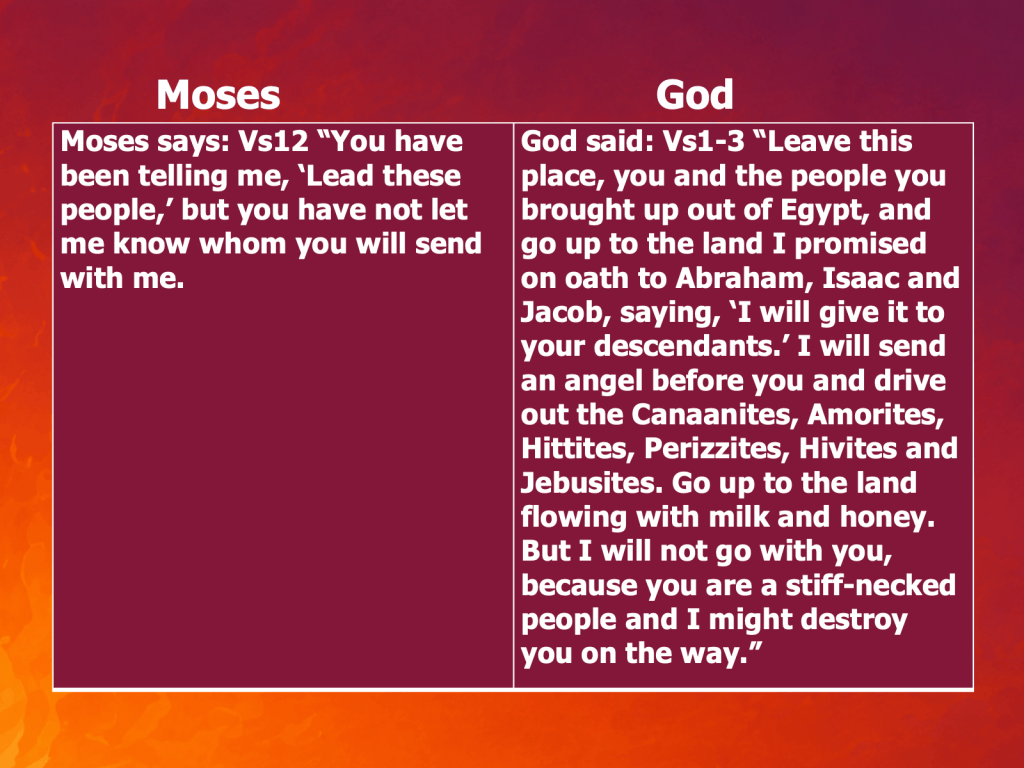
First, he quotes only a tiny portion of what the Lord has said in vv1-3, 5: “You have been telling me to lead these people,” but he omits any repeat of what the Lord said earlier about the angel, or his own absence, or the stubbornness of the people.[21]
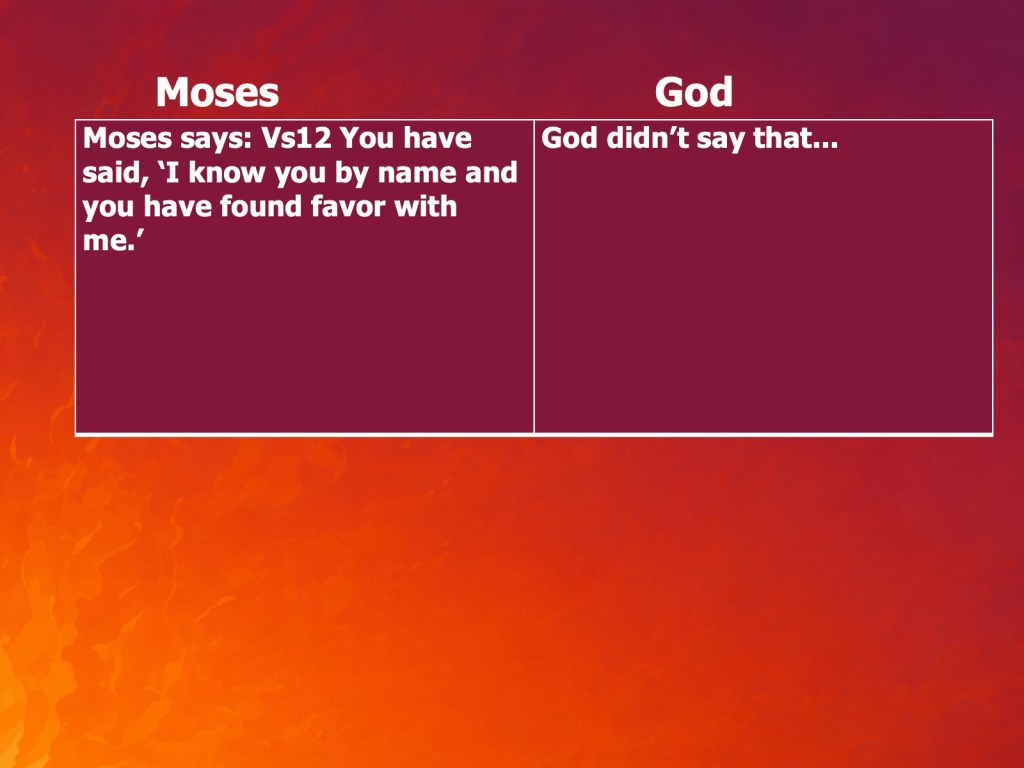
Then Moses seems to over-quote God when he says, “You have said, ‘I know you by name and you have found favor with me.’” But interestingly, nowhere in the narrative up to this point has God actually said those words! Moses subtracts from what God has said and adds words we haven’t heard before.
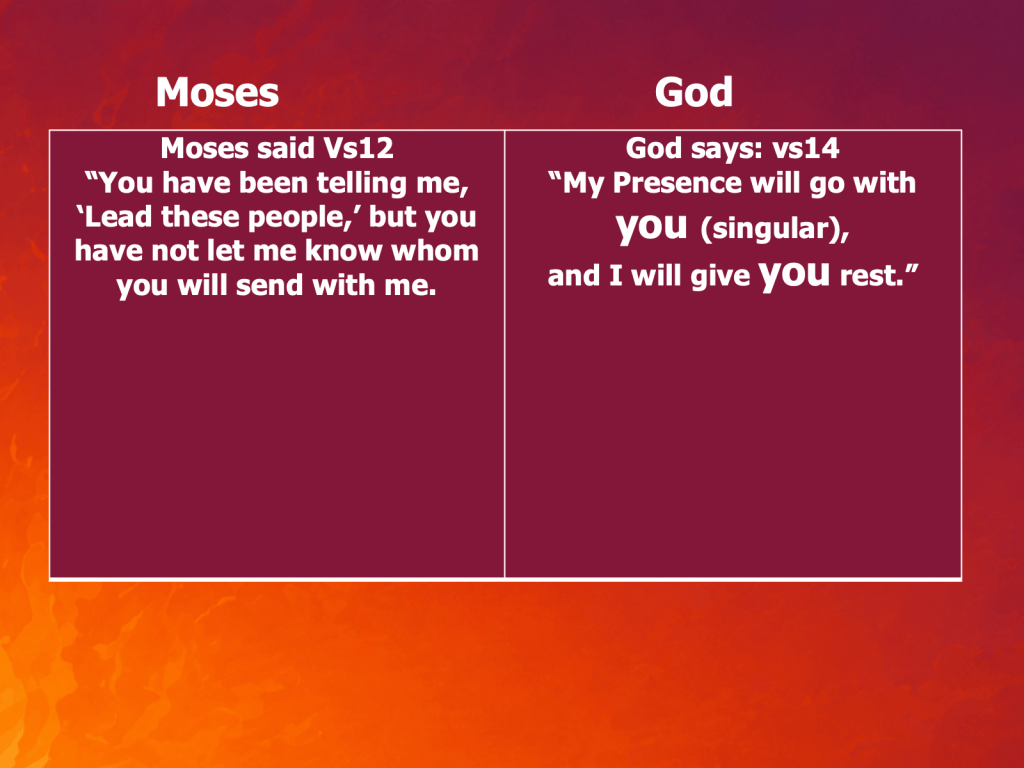
The Lord responds only to what Moses has said in v12a by saying, “My presence will go with you” (v14), but it’s in the singular. He ignores everything Moses has said about sending people with him. In the last chapter, God had said to Moses, ‘…leave me alone and let my anger flare against them and I will utterly destroy them, and I will make YOU into a great nation. In the word, ‘leave me alone’ in the Hebrew, is Noah’s name. It’s as if God was saying—Noah left me alone when I told him I was going to destroy the world. Why don’t you just be a Noah to me![22] But Moses won’t. And God changed his mind.
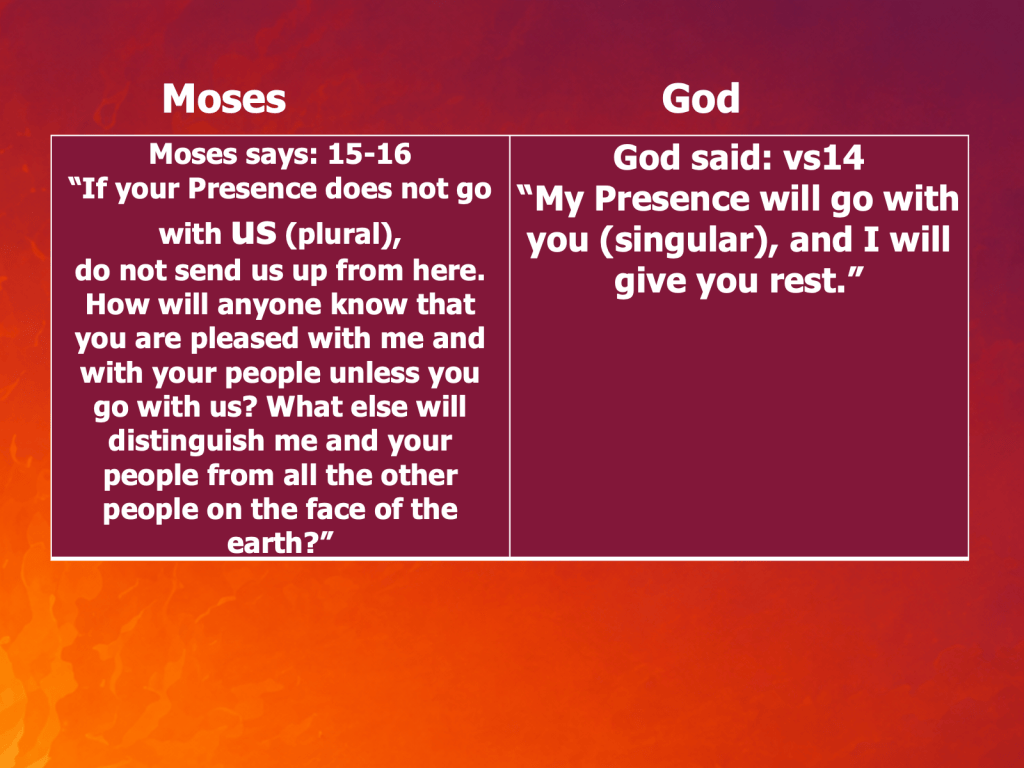
So, Moses ignores the Lord’s ignoring his words and presses God—almost demanding Him to include the people in the further journey. It is as if Moses says, “If you’re just going to go with me, forget it, but if your delivering grace includes your people, then count me in.”
John Durham notes: ‘without God’s presence there would be no kingdom of priests, no holy nation, no Yahweh being their God, no covenant, no Ark, no Tabernacle, no Altar, no cloud of glory.’[23] Moses thinks it’s better that they should drop dead in the desert, than go across the wilderness and inhabit Canaan without God’s presence.[24] John Goldingay rephrases it this way: “If you won’t have them God, you can’t have me at all.”[25]
According to the text, were it not for Moses, God would have wiped out Israel. Were it not for Moses, God would have been content with the deliverance of a solitary individual, Moses.[26] But Moses is not interested in getting to the Promised Land without the people of God. He is not interested in the good life if it does not include the Lord’s presence. God has committed to be known—to Israel, to the nations! He has indicated a desire for a relationship with these people—and Moses holds him to it.[27]
And the Lord said to Moses, “I will do the very thing you have asked, because I am pleased with you and I know you by name.” Exodus 33:17 NIV
This image is that of a royal court. A great king has many, many servants. It is a sign of his dignity NOT to know their names, except for his favorites! When God says to Moses, ‘I know you by name’, it means ‘you have found favor in my eyes.’[28]
Moses has the assurance that God will go with them, now. But he asks for more. In verses 12-17, Moses does more of the talking and God does more of the listening. Now, in verses 18-23, God does more of the talking, and Moses does more of the listening.[29]
18 Then Moses said, “Now show me your glory.” 19 And the Lord said, “I will cause all my goodness to pass in front of you, and I will proclaim my name, the Lord, in your presence. I will have mercy on whom I will have mercy, and I will have compassion on whom I will have compassion. 20 But,” he said, “you cannot see my face, for no one may see me and live.” 21 Then the Lord said, “There is a place near me where you may stand on a rock. 22 When my glory passes by, I will put you in a cleft in the rock and cover you with my hand until I have passed by. 23 Then I will remove my hand and you will see my back; but my face must not be seen.” Exodus 33:18-23
Yes, God comes to Moses, but the sight of his face is denied. What he does give Moses is a description—not of how he looks, but of how he is.[30] In Exodus 3, God said from the burning bush, ‘I AM WHO I AM.’ This same repetition expands on his name: I will have mercy on whom I will have mercy, and I will have compassion on whom I will have compassion.[31] Moses doesn’t just discover that God will accompany Israel. He begins to discover what kind of God will accompany them. If anything, Exodus 32-34 highlights God’s willingness to forgive a sinful people and accompany them on their trek.[32]
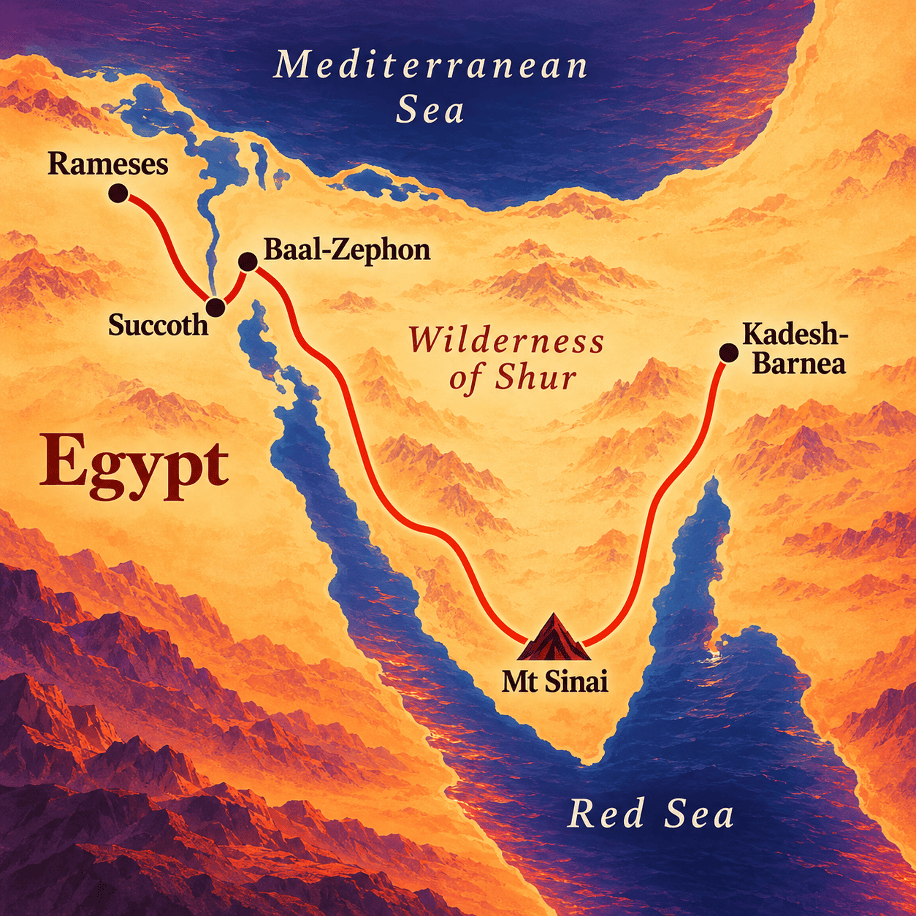
The people of Israel do NOT pick up and leave this place for quite some time. It took them three months to get to the foot of the Mountain, and they stayed there for almost a full year. To get from Egypt to Canaan originally should have only taken a couple of weeks.[33] Seriously! I mean, ‘let’s go!’ Why didn’t God just take them to Canaan right away? Get ‘em out of Egypt and deliver them to the Promised Land! But…
God’s presence is the point of the journey.
First, the fastest route would have brought them up against the Philistines. There would have been war, and none of them were prepared to face that directly after coming out of Egypt. They would have given up and gone back. So, God brings them deeper into the desert.
Second, God made a covenant with them, gave them the commandments, and transitioned them from a disorganized group of slaves into an organized nation.
They had to get rid of their slave mentality! They needed the structures for organizing their social and political life. And they needed to understand what it would mean to be in a relationship with God in this new life of freedom.[34] After the tabernacle finally gets built, and they pack up camp, they will have about 20 stops through difficult terrain before arriving on the border oasis of Kadesh Barnea…(Where they would get scared and refuse to enter…and get sent on a 40 year stint before FINALLY getting to the Promised Land. But that’s for another day.)
God’s presence doesn’t necessarily make the journey easier. But God’s presence is what makes Israel GOD’S people! And that’s still true for God’s people today. When Paul writes to the Corinthians, he draws on this very story of Moses and the glory of God. He explains that through Jesus Christ, something remarkable has happened. The relationship with God that Moses longed for has been opened to us through Christ! We don’t need to go outside the camp to a tent of meeting. We don’t have to wait for Moses to speak with God on our behalf. Through Jesus Christ and the gift of the Holy Spirit, we have access to the presence of God! And Paul tells us that as we behold the glory of the Lord, we’re being transformed into his image, with ever-increasing glory. (2 Corinthians 3:18)
God’s presence doesn’t just get us through life. His presence transforms us as we go. God’s presence is the point of the journey. At the beginning of this chapter, God promises to get the people to the Promised land, but he says he’s not going with them. Would that be okay with you? To get benefits and blessings from God but not have God himself? It’s easy to treat God like an insurance policy[35] instead of a King to whom we pledge our allegiance. We may have bought into the idea that you can just pray a prayer once, so you can be forgiven and go to heaven when you die. Exodus reminds us that God desires to dwell with his people! Now, we can’t treat him like a genie, or blessing dispenser. He wants a relationship, where He is present with us. He wants to show us what abundant life looks like, as we learn how to walk in the Way OF eternal life.
We spend so much of our lives asking God for directions. Where should I go? What should I do? Which path should I take? But perhaps the more important question isn’t, “God, where are you sending me?” It’s, “God, am I walking with you?” The invitation isn’t simply to ask God to accompany us wherever we’ve decided to go. It’s to learn to walk with him. To know his ways. To trust his goodness. To be changed by his presence! We may not be able to see a visible manifestation of God’s presence—most people never do.[36] But we have a privilege that even Moses didn’t have in Exodus!
We don’t have to pitch a tent. We can communicate with God constantly through worship and prayer. Access has been granted through Jesus Christ![37] We can know God by spending time with him, and as we are obedient to his lordship, we are led by his Spirit, becoming closer to him as time goes by.[38]
The God whose presence Moses longed for is the God who has come near to us in Jesus. And through the Holy Spirit, he continues to dwell with his people. This story assures us that God’s presence also goes with us—and so do God’s goodness, compassion, and grace.[39] Let’s journey with him together!
PRAYER: Gracious and merciful God, Thank you for being a God who draws near to your people. Thank you that you have not left us to find our own way—but have made yourself known through Jesus Christ and given us your Holy Spirit. Forgive us for the times we’ve been more interested in your blessings than in knowing you. For the times we’ve sought our own way instead of following yours, have mercy. Teach us to recognize your presence in the ordinary moments of life, in the joys and the struggles, in the familiar places and the unknown paths ahead. Shape us into the people you’ve called us to be. May your presence transform us, your goodness sustain us, and your mercy guide us. Like Moses, may we never be content to go forward without you. In the name of Jesus Christ, our Lord, we pray. Amen.

Bibliography
James K. Bruckner, Exodus, Grand Rapids: Baker Books, 2008.
Umberto Cassuto, A Commentary on the Book of Exodus, Skokie: Varda Books, 2005.
Brevard Childs, The Book of Exodus, Louisville: The Westminster Press, 1974.
John I. Durham, Word Biblical Commentary: Exodus, Waco: Word Books, 1987.
Peter Enns, Exodus: The NIV Application Commentary, Grand Rapids: Zondervan, 2000.
Rabbi David Fohrman, Exodus: A Parsha Companion, New Milford: Aleph Beta Press, 2020.
Terence E. Fretheim, Exodus, Interpretation Bible Commentary, Louisville: Westminster John Knox Press, 1991.
John Goldingay, Exodus & Leviticus for everyone, Louisville: John Knox Press, 2010.
Victor Hamilton, Exodus, Grand Rapids, Baker Academic, 2011.
Tony Merida, Exodus, Nashville: B&H Publishing Group, 2014.
Carol Meyers, Exodus, Cambridge: Cambridge University Press, 2005.
William H.C. Propp, Exodus 19-40; New York: Doubleday, 2006.
Nahum M. Sarna, Exodus, Philadelphia: The Jewish Publication Society, 1991.
Douglas K. Stuart, Exodus, Nashville: B&H Publishing Group, 2006.
Going Deeper Questions
—
Small Group Questions
The God Who Comes Near.
Week Five: If Your Presence will not go with us
Exodus 33:1-17
*Leader’s Guide and Helps available on request
Icebreaker
- Have you ever taken a memorable road trip or vacation? What made it special—the destination, the experiences along the way, or the people who went with you? Share a funny or unexpected memory from the trip!
The Destination Without God’s Presence
Read Exodus 33:1–6 NIV
Then the Lord said to Moses, “Leave this place, you and the people you brought up out of Egypt, and go up to the land I promised on oath to Abraham, Isaac and Jacob, saying, ‘I will give it to your descendants.’ 2 I will send an angel before you and drive out the Canaanites, Amorites, Hittites, Perizzites, Hivites and Jebusites. 3 Go up to the land flowing with milk and honey. But I will not go with you, because you are a stiff-necked people and I might destroy you on the way.”
4 When the people heard these distressing words, they began to mourn and no one put on any ornaments. 5 For the Lord had said to Moses, “Tell the Israelites, ‘You are a stiff-necked people. If I were to go with you even for a moment, I might destroy you. Now take off your ornaments and I will decide what to do with you.’” 6 So the Israelites stripped off their ornaments at Mount Horeb.
Discussion
- God promises to give the Israelites the land flowing with milk and honey and to send an angel ahead of them. But what is missing from that promise? Why would this news be so distressing to the people?
- God describes the Israelites as a “stiff-necked people.” What does that expression suggest about their relationship with God? What might stubbornness toward God look like in our lives today?
- The Israelites respond to God’s announcement by mourning and removing their ornaments. Why do you think removing their jewelry was significant, especially considering what happened with the golden calf?
- Imagine being offered everything you’ve ever wanted—financial security, success, comfort, answered prayers—but without a close relationship with God. What would be appealing about that offer? What would be missing?
God’s presence is the point of the journey.
- How might embracing that truth change the way we define success, pursue goals, or respond when life doesn’t go as planned?
The Tent Outside the Camp
Read Exodus 33:7–11 NIV
7 Now Moses used to take a tent and pitch it outside the camp some distance away, calling it the “tent of meeting.” Anyone inquiring of the Lord would go to the tent of meeting outside the camp. 8 And whenever Moses went out to the tent, all the people rose and stood at the entrances to their tents, watching Moses until he entered the tent. 9 As Moses went into the tent, the pillar of cloud would come down and stay at the entrance, while the Lord spoke with Moses. 10 Whenever the people saw the pillar of cloud standing at the entrance to the tent, they all stood and worshiped, each at the entrance to their tent. 11 The Lord would speak to Moses face to face, as one speaks to a friend. Then Moses would return to the camp, but his young aide Joshua son of Nun did not leave the tent.
Discussion
- Moses pitches the tent of meeting outside the camp rather than in the middle of the people. What does its location communicate about Israel’s relationship with God following the golden calf incident?
- Notice what happens whenever Moses goes to meet with God. What do the people’s actions reveal about their changing attitude toward God’s presence?
- Verse 11 says the Lord spoke to Moses “face to face, as one speaks to a friend.” What does this description tell us about the relationship between Moses and God? How does it challenge or deepen your understanding of prayer?
- Imagine you could sit down and have a conversation with God over coffee. What would you most want to ask him? What might you hope he would say to you?
- The Israelites could see the pillar of cloud and knew when Moses was meeting with God. Today, we don’t ordinarily experience such visible manifestations of God’s presence. What helps you become aware of God’s presence in everyday life? Are there times when recognizing his presence is particularly difficult?
If Your Presence Does Not Go with Us
Read Exodus 33:12–17 NIV
12 Moses said to the Lord, “You have been telling me, ‘Lead these people,’ but you have not let me know whom you will send with me. You have said, ‘I know you by name and you have found favor with me.’ 13 If you are pleased with me, teach me your ways so I may know you and continue to find favor with you. Remember that this nation is your people.”
14 The Lord replied, “My Presence will go with you, and I will give you rest.”
15 Then Moses said to him, “If your Presence does not go with us, do not send us up from here. 16 How will anyone know that you are pleased with me and with your people unless you go with us? What else will distinguish me and your people from all the other people on the face of the earth?” 17 And the Lord said to Moses, “I will do the very thing you have asked, because I am pleased with you and I know you by name.”
Discussion
- In verse 12, Moses reminds God that he has been called to lead the people. What does Moses ask God to teach him in verse 13? Why is knowing God’s ways different from simply knowing what God wants us to do?
- Compare God’s response in verse 14 with Moses’ reply in verses 15–16. Notice the movement from “you” to “us.” What does Moses’ insistence reveal about his character and his commitment to the Israelites?
- Moses asks, “What else will distinguish me and your people from all the other people on the face of the earth?” According to Moses, what makes God’s people distinctive? How might that shape our understanding of what it means to be the church today?
- Put yourself in Moses’ sandals. You’ve led a difficult, complaining, rebellious group of people through the wilderness. God offers you his favor and promises you rest. Would you be tempted to accept that promise for yourself and leave the others behind? What makes Moses’ response so remarkable?
- After receiving God’s assurance that he will go with them, Moses asks, “Now show me your glory.” Why do you think Moses wants more? What does this reveal about the difference between knowing about God and actually knowing God?
Living in God’s Presence
Read 2 Corinthians 3:12–18 NIV
12 Therefore, since we have such a hope, we are very bold. 13 We are not like Moses, who would put a veil over his face to prevent the Israelites from seeing the end of what was passing away. 14 But their minds were made dull, for to this day the same veil remains when the old covenant is read. It has not been removed, because only in Christ is it taken away. 15 Even to this day when Moses is read, a veil covers their hearts.
16 But whenever anyone turns to the Lord, the veil is taken away. 17 Now the Lord is the Spirit, and where the Spirit of the Lord is, there is freedom. 18 And we all, who with unveiled faces contemplate the Lord’s glory, are being transformed into his image with ever-increasing glory, which comes from the Lord, who is the Spirit.
Discussion
- Paul describes believers being transformed into the image of Christ with ever-increasing glory. How is this different from thinking of faith primarily as a way to receive God’s blessings or secure a future in heaven?
- Consider the question: “God, where are you sending me?” versus “God, am I walking with you?” How might those questions lead to different choices or priorities?
- What are some practical ways we can cultivate an awareness of God’s presence—not only individually, but together as a church family?
- Think back over the past year. Can you identify an ordinary moment, an unexpected blessing, or even a difficult experience in which you can now recognize God’s presence or faithfulness? Share with the group if you’re comfortable.
Personal Reflection
As you think about the days and weeks ahead, where might God be inviting you to pay less attention to reaching a particular destination and more attention to walking with him?
Prayer/All: Gracious God, deepen our awareness of Your presence, transform us through Your Spirit, and teach us to walk faithfully with You—together. Amen.
[1] Based on Umberto Cassuto, A Commentary on the Book of Exodus, Skokie: Varda Books, 2005, 408.
[2] Based on Umberto Cassuto, A Commentary on the Book of Exodus, Skokie: Varda Books, 2005, 407-408.
[3] Based on Umberto Cassuto, A Commentary on the Book of Exodus, Skokie: Varda Books, 2005, 408.
[4] Based on Umberto Cassuto, A Commentary on the Book of Exodus, Skokie: Varda Books, 2005, 426.
[5] Peter Enns, Exodus: The NIV Application Commentary, Grand Rapids: Zondervan, 2000, 578.
[6] Nahum M. Sarna, Exodus, Philadelphia: The Jewish Publication Society, 1991, 211.
[7] John I. Durham, Word Biblical Commentary: Exodus, Waco: Word Books, 1987, 437.
[8] Terence E. Fretheim, Exodus, Louisville: Westminster John Knox Press, 1991, 293.
[9] Exodus 3:21-22 I will make the Egyptians favorably disposed toward this people, so that when you leave you will not go empty-handed. Every woman is to ask her neighbor and any woman living in her house for articles of silver and gold and for clothing, which you will put on your sons and daughters. And so you will plunder the Egyptians.”
Exodus 12:36 The Lord had made the Egyptians favorably disposed toward the people, and they gave them what they asked for; so they plundered the Egyptians.
[10] Genesis 15:14.
[11] Umberto Cassuto, A Commentary on the Book of Exodus, Skokie: Varda Books, 2005, 428.
[12] Exodus 32:1-4
[13] Umberto Cassuto, A Commentary on the Book of Exodus, Skokie: Varda Books, 2005, 428.
[14] Terence E. Fretheim, Exodus, Louisville: Westminster John Knox Press, 1991, 295.
[15] Nahum M. Sarna, Exodus, Philadelphia: The Jewish Publication Society, 1991, 211.
See also: ASV, AMPC, CSB, ESV, GNT, HCSB, LEB, TLB, NASB, RSV, TLV, WYC.
[16] James K. Bruckner, Exodus, Grand Rapids: Baker Books, 2008, 294.
[17] Nahum M. Sarna, Exodus, Philadelphia: The Jewish Publication Society, 1991, 212.
[18] Douglas K. Stuart, Exodus, Nashville: B&H Publishing Group, 2006, 698.
[19] Umberto Cassuto, A Commentary on the Book of Exodus, Skokie: Varda Books, 2005, 431.
[20] John I. Durham, Word Biblical Commentary: Exodus, Waco: Word Books, 1987, 443.
[21] Victor Hamilton, Exodus, Grand Rapids, Baker Academic, 2011, 566.
[22] Forhman, 194
[23] John I. Durham, Word Biblical Commentary: Exodus, Waco: Word Books, 1987, 437.
[24] William H.C. Propp, Exodus 19-40; New York: Doubleday, 2006, 605.
[25] John Goldingay, Exodus & Leviticus for everyone, Louisville: John Knox Press, 2010.,119.
[26] Victor P. Hamilton, Exodus, Grand Rapids: Baker Academic, 2011, 566.
[27] W. Ross Blackburn, The God who makes himself known: the Missionary Heart of the book of Exodus; Downers Grove: Illinois, 2012, 178.
[28] William H.C. Propp, Exodus 19-40; New York: Doubleday, 2006, 602.
[29] Victor Hamilton, Exodus, Grand Rapids, Baker Academic, 2011, 568.
[30] John I. Durham, Word Biblical Commentary: Exodus, Waco: Word Books, 1987, 452.
[31] James K. Bruckner, Exodus, Grand Rapids: Baker Books, 2008, 298, footnote on vs19.
[32] Victor Hamilton, Exodus, Grand Rapids, Baker Academic, 2011, 571.
[33] https://thebibleisinmyblood.wordpress.com/2021/08/14/exodus-the-necessary-long-journey/
[34] https://thebibleisinmyblood.wordpress.com/2021/08/14/exodus-the-necessary-long-journey/
[35] Tony Merida, Exodus, Nashville: B&H Publishing Group, 2014, 207.
[36] Douglas K. Stuart, Exodus, Nashville: B&H Publishing Group, 2006, 707.
[37] Tony Merida, Exodus, Nashville: B&H Publishing Group, 2014, 208.
[38] Douglas K. Stuart, Exodus, Nashville: B&H Publishing Group, 2006, 707, footnote 135.
[39] Goldingay, 122.

