
About these posts
These posts grow out of sermons I’ve written for my local church community. You’re welcome to use them—for teaching, small groups, preaching, or personal reflection. If you share them elsewhere, please include a simple attribution. If you’d ever like to share how they’re being used, you’re welcome to reach out through the Contact button.
Let’s start out with a little experiment. How many of you know the story of Aladdin? Now, suppose YOU found a lamp, and rubbed it, and a Genie appeared that offered you three wishes. Don’t say them out loud—but take a moment to think. What would you wish for? (pause) Maybe you would wish for healing for someone you love. Financial security? A repaired relationship? An end to violence! A long and healthy life for you and your family. Most of our wishes would probably involve good things. And there is nothing wrong with wanting those things. Those are the kinds of things we pray about.
But notice what happened: The moment extraordinary power became available, our minds immediately went to what that power could do for us. Very few of us probably wondered: Who is this genie? What is he like? What does he want? That’s not a criticism—it’s how genies work. A genie isn’t someone you need to know or follow. A genie—is power at your disposal. In Disney’s Aladdin, the Genie describes his situation perfectly: “Phenomenal cosmic power! Itty-bitty living space!”
The appeal of the lamp is that it takes phenomenal power and makes it possessable. You can hold the lamp in your hands. Carry it wherever you want. And when you need something, you rub the lamp and make your request. You don’t have to rearrange your life around the Genie. The Genie rearranges reality around you. We’ll come back to that.
We’re in a series in Exodus that is focusing on God’s presence with his people by means of the Tabernacle. When we last left Moses, he was up on the mountain with God. In fact, everything that we have studied so far has just been the instructions that God was giving to Moses: Make a tabernacle, make an ark, make an altar, make a lampstand, a courtyard, consecrate the priests, make them special clothes and an ephod, and then, oh yes, don’t forget to observe the Sabbath. We would expect that the building is about to commence. Instead, we are going to be confronted with a story of what happened in Moses’ absence.[1] We start in Exodus 32, beginning at verse 1:
When the people saw that Moses was so long in coming down from the mountain, they gathered around Aaron and said, “Come, make us gods who will go before us. As for this fellow Moses who brought us up out of Egypt, we don’t know what has happened to him.” 2 Aaron answered them, “Take off the gold earrings that your wives, your sons and your daughters are wearing, and bring them to me.” 3 So all the people took off their earrings and brought them to Aaron. 4 He took what they handed him and made it into an idol cast in the shape of a calf, fashioning it with a tool. Then they said, “These are your gods, Israel, who brought you up out of Egypt.” 5 When Aaron saw this, he built an altar in front of the calf and announced, “Tomorrow there will be a festival to the Lord.” 6 So the next day the people rose early and sacrificed burnt offerings and presented fellowship offerings. Afterward they sat down to eat and drink and got up to indulge in revelry. Exodus 32:1-6
At the bottom of the mountain, the people have been waiting a long time—40 days and 40 nights. Now, in our fast paced world, that doesn’t seem like a long time, but they had come from Egypt—in the middle of the night, after a bunch of plagues, and had a miraculous escape through the Sea. Exodus 19 notes that: On the first day of the third month after the Israelites left Egypt—on that very day—they came to the Desert of Sinai…and Israel camped there in the desert in front of the mountain. (Exodus 19:1,2) God tells them that he will be their God and they will be his people, and they are exuberant in their response, and say that they will do whatever God tells them to do. After all, God had just rescued them! It was all so fresh and new and amazing!
Moses and the elders go up and have a big dinner with God, and Moses brings another message back down. Marvelous! And then God says, ‘Moses, come up on the mountain, and I will give you the tablets of stone with everything for their instruction’. Moses goes up, disappears into the cloud—And it’s been 40 days. So yes, they have come out of Egypt, but Egypt still needs to come out of them.[2] Old habits die hard. After centuries of being enslaved, they are very insecure in who they are. These people are learning to trust in Yahweh. It’s all new. First, they needed food. They complained about it…God provided manna from heaven. Then they needed water. They complained. God provided water from a rock. But now Moses is up on the mountain, and they don’t know what that means for their future. How will they survive in the desert? How will they make a living? How will they continue to be provided for without a god they can see, or something that makes sense to them. There may be an element of panic on the part of the people who fear that they have lost contact with God.[3] They want something tangible to take hold of!
Let’s talk about livestock for a minute. Egyptians revered their livestock.[4] Abraham was rich in livestock.[5] Jacob got wealthy in the livestock he obtained by working for his uncle Laban. When he and his sons first came to Egypt, Joseph tells them to mention to Pharaoh that they were keepers of livestock.[6] And THAT Pharaoh gave the land of Goshen to Jacob and his sons, and then turned over the care of HIS livestock to them, in Genesis 47.[7] When all the food ran out in Egypt and there was a famine in the land, Joseph was second in command. The people brought their livestock to him and traded it for food.[8] Livestock was a symbol of wealth. Livestock is currency. It was your bank account, your 401k, your future, and your security. And livestock are not just cattle, but cattle WERE very important in this ancient society.[9] The bull was a symbol of divine strength, energy, fertility, and even leadership in the biblical world.[10]
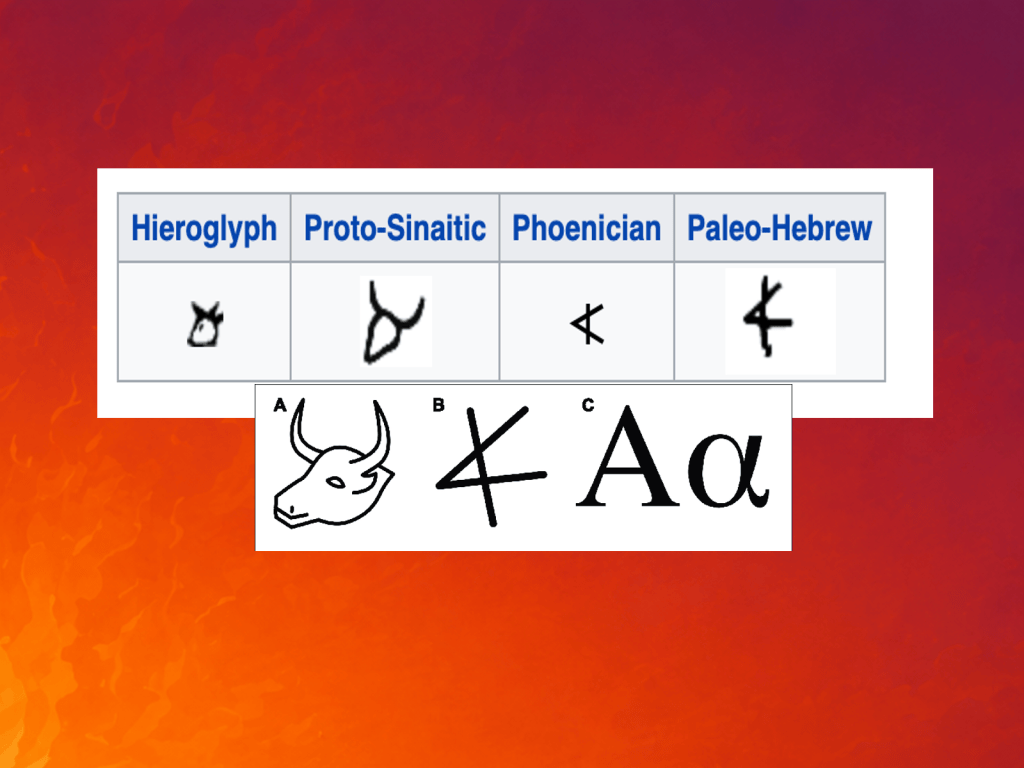
The first letter of the Hebrew alphabet that gets developed after this, is ‘aleph’, which came from the West Semitic word for ox, or bull. The hieroglyph looks like an ox head, and you can also see the Phoenician and Paleo Hebrew symbols that represent an ox head.[11]
Throughout the Ancient Near East, various gods and goddesses are called “bulls”, “cows” and “calves.[12] The Egyptians also had many sacred cows,[13] and livestock was connected to Egyptian worship. Hathor, Isis, Nut (Newt), and Bat (Baht) were goddesses who were often depicted as cows, with the horns of cows or with the ears of cows. The cow came to symbolize the mother of the pharaoh, and also was a solar icon, as the sun was carried across the sky when Nut or Hathor was in cow form.[14]
Apis (Ah’-peace) was a bull god, a fertility figure,[15] and was thought to be the actual embodiment of the god,[16] Osiris.[17] This bull was identified by specific sacred markings. It was highly revered and lived in luxury until it died, when it was buried with full honors[18] in its own sarcophagus.[19] As early as 3100 BC the pharaoh was also depicted in the form of a bull. [20]
So, livestock is currency—it is connected to worship—and it is power. During the plagues, Yahweh attacked the nation where it hurts. “Egyptian livestock died all over the place.”[21] It was an attack on their entire way of life, and their essence. Losing their livestock, while the Israelites kept theirs was a nationwide humiliation.[22] And NOT-EVEN-ONE of the livestock of Israel was dead. No donkeys, no goats, no sheep, and NO CATTLE. When they finally leave Egypt, they come out with a VERY large number of livestock.[23] One of the reasons that Moses told Pharaoh is that they were going to offer up sacrifices to Yahweh in the desert right?
In the wilderness God eventually gives Moses instructions for HOW the people are to worship—what the tabernacle is supposed to look like, and what the priests will do. In some of the chapters that we recently skipped over, God gave more specific instructions on HOW to offer up livestock to the Lord—for bulls, rams, lambs in Exodus 29-30. Yahweh is laying the foundation for worship. One of the 10 commandments, that the people have already given their assent to by Exodus 24, is ‘You shall have no other gods before me.’ Now, Israelites assume that other gods exist! That’s the theology of Exodus! There is a cosmic battle—between the gods of Egypt, with Pharaoh as their representative, and Yahweh—the god of slaves, who is represented by Moses.[24] Which God are they going to trust? The people declared in the desert: “In God we trust”. But now—Moses takes too long coming back from his pow wow with God, and they get a bit impatient, and so they have Aaron build something for them—a what? A GOLDEN CALF. A calf is livestock—it’s a young bull.
Now, the golden calf COULD represent another god other than Yahweh.[25] This may have been how you’ve always thought about it. The calf could also represent Yahweh himself[26]… Aaron says, ‘these are your gods—or even, this is your god, who brought you up out of Egypt.’ But—it is more likely that the calves are just supposed to be servants of God—being represented as bulls that God rides on—[27] like we noted a couple of weeks ago with the cherubim.
Making a calf, or young bull, was like making a seat or pedestal that the god can ride on top of. In ancient Near Eastern art, gods sometimes are depicted standing on bulls.[28] It didn’t necessarily represent the god.[29] Now, the animal may be suggestive of the attributes ascribed to the god who was mounted upon it…The young bull then—would have been the pedestal upon which the invisible God of Israel was popularly believed to be standing.[30] It’s basically like offering Yahweh a new car to ride on—a Cadillac with bull horns… And this creation of a young bull is fashioned from their gold rings. This is similar to Gideon who also requested gold earrings and made them into an ephod, which was wrongly worshiped.[31]
These people were not naively thinking that the image was a god. They would have felt that the object was a symbol that they could invoke the Deity through.[32] So, in essence, the bull is a pedestal for God. This could have also been what the bulls that Jeroboam built at Dan and Bethel were meant to represent.[33] Aaron is giving them a visible symbol—an empty throne. But it was putting God back INTO nature…instead of recognizing Him as the one who created everything.[34]
The Psalmist writes: They made a calf in Horeb and worshiped a molten image. Thus they exchanged their glory for the image of an ox that eats grass. They forgot God their Savior, who had done great things in Egypt…Psalm 106:19-21
God HAD done great things. He demonstrated his power over all of the gods of Egypt, and then he brings out his people. But right now, there is no priesthood, no temple, no worship practices, or things that join this population together. The only things these people know about right now—and for the past 400 years—are the pagan practices of Egypt. So, they are going to practice the things they know, which is in fact what they do when they create a golden calf. Israel wasn’t necessarily abandoning God. They were trying to remake Yahweh into something familiar. They keep God’s name. They keep God’s story: “This is the god who brought you up out of Egypt.” But they remake that God into a form they recognize and can manage. The calf is a pagan representation of the true God.[35] They don’t make Yahweh disappear. They make Yahweh small. And that’s what idolatry is.
Idolatry is not always replacing God; sometimes it is reducing God to something we can manage.
Idolatry replaces an unpredictable, holy Creator with a physical object or manageable concept that can be placed where humans want. See, God wasn’t just offering Israel protection or provision, or directions through the wilderness. God was preparing to dwell among them! God offered Israel his presence as a gift. They settled for something they could possess. Trust versus guaranteed access. A dwelling God versus a vehicle they design. Israel fashioned the form. Israel chose the symbol. Israel put it where they wanted it and expected it to go before them. THAT’S the problem.
They weren’t necessarily rejecting Yahweh. They were trying to make Yahweh more manageable. It’s like the genie’s lamp. The lamp isn’t just portable; it makes the Genie’s power possessable. Whoever holds the lamp decides when he appears and what he is asked to do. The calf offers the same illusion: power great enough to help us, but small enough for us to hold.
Now, the ark of the covenant would also be built out of gold, and would serve as the footstool of God, but the ark was designed by God—and would be something only the priests could see. The tabernacle was portable, the ark was portable—but God is not. Carrying the tabernacle or the ark did not mean possessing God. The cloud would move, and Israel would have to follow. GOD determined the journey! The calf reversed the relationship. The tabernacle represented a God they had to follow. The calf represented a god they believed they could manage.
7 Then the Lord said to Moses, “Go down, because YOUR people, whom YOU brought up out of Egypt, have become corrupt. 8 They have been quick to turn away from what I commanded them and have made themselves an idol cast in the shape of a calf. They have bowed down to it and sacrificed to it and have said, ‘These are your gods, Israel, who brought you up out of Egypt.’ 9 “I have seen these people,” the Lord said to Moses, “and they are a stiff-necked people. 10 Now leave me alone so that my anger may burn against them and that I may destroy them. Then I will make you into a great nation.” 11 But Moses sought the favor of the Lord his God. “Lord,” he said, “why should your anger burn against your people, whom you brought out of Egypt with great power and a mighty hand? 12 Why should the Egyptians say, ‘It was with evil intent that he brought them out, to kill them in the mountains and to wipe them off the face of the earth’? Turn from your fierce anger; relent and do not bring disaster on your people. 13 Remember your servants Abraham, Isaac and Israel, to whom you swore by your own self: ‘I will make your descendants as numerous as the stars in the sky and I will give your descendants all this land I promised them, and it will be their inheritance forever.’” 14 Then the Lord relented and did not bring on his people the disaster he had threatened. Exodus 32:7-14
God says that Israel has turned away from his commands and he is going to destroy them. And Moses bluntly asks God to turn away from his fierce anger and change his mind…and remarkably…God does![36] But Moses has only HEARD what has been going on…to SEE it—is another thing.
15 Moses turned and went down the mountain with the two tablets of the covenant law in his hands. They were inscribed on both sides, front and back. 16 The tablets were the work of God; the writing was the writing of God, engraved on the tablets. 17 When Joshua heard the noise of the people shouting, he said to Moses, “There is the sound of war in the camp.” 18 Moses replied: “It is not the sound of victory, it is not the sound of defeat; it is the sound of singing that I hear.” Exodus 32:15-18
Unlike the raucous party we might imagine is happening, some scholars think that the scene in front of the calf was an orderly ritual with practices that were well known, like a banquet, followed by sports, miming, and singing to honor the gods.[37] It may have been the same kind of singing that they did at the victory at the Sea![38] Again, the problem is eating in the context of idolatry—meat offered to idols—which is also a problem in the first century church.[39]
19 When Moses approached the camp and saw the calf and the dancing, his anger burned and he threw the tablets out of his hands, breaking them to pieces at the foot of the mountain. 20 And he took the calf the people had made and burned it in the fire; then he ground it to powder, scattered it on the water and made the Israelites drink it. Exodus 32:19-20
When Moses throws the tablets, he is committing a legal act. In legal terminology, he is ‘breaking the tablet’, which means to invalidate or repudiate a document or agreement.[40] The calf would have been made as a wooden model, and then overlayed with gold, which is why Moses could burn it and then ground it to powder.[41] Some scholars think that Moses ground the tablets to powder and made them drink it.[42] That may have been to prove their guilt or innocence.[43] It may be away of removing something that is improper. In 2 Kings 23, Josiah destroys idolatrous objects and throws their dust into the brook Kidron. Jesus threw items around and rearranged the furniture in the temple.[44] Get it out of here!
21 He (Moses) said to Aaron, “What did these people do to you, that you led them into such great sin?” 22 “Do not be angry, my lord,” Aaron answered. “You know how prone these people are to evil. 23 They said to me, ‘Make us gods who will go before us. As for this fellow Moses who brought us up out of Egypt, we don’t know what has happened to him.’ 24 So I told them, ‘Whoever has any gold jewelry, take it off.’ Then they gave me the gold, and I threw it into the fire, and out came this calf!”
(Don’t look at me![45] Blame it on the fire![46])
25 Moses saw that the people were running wild and that Aaron had let them get out of control and so become a laughingstock to their enemies. 26 So he stood at the entrance to the camp and said, “Whoever is for the Lord, come to me.” And all the Levites rallied to him. 27 Then he said to them, “This is what the Lord, the God of Israel, says: ‘Each man strap a sword to his side. Go back and forth through the camp from one end to the other, each killing his brother and friend and neighbor.’” 28 The Levites did as Moses commanded, and that day about three thousand of the people died. 29 Then Moses said, “You have been set apart to the Lord today, for you were against your own sons and brothers, and he has blessed you this day.” 30 The next day Moses said to the people, “You have committed a great sin. But now I will go up to the Lord; perhaps I can make atonement for your sin.” 31 So Moses went back to the Lord and said, “Oh, what a great sin these people have committed! They have made themselves gods of gold. 32 But now, please forgive their sin—but if not, then blot me out of the book you have written.” 33 The Lord replied to Moses, “Whoever has sinned against me I will blot out of my book. 34 Now go, lead the people to the place I spoke of, and my angel will go before you. However, when the time comes for me to punish, I will punish them for their sin.” 35 And the Lord struck the people with a plague because of what they did with the calf Aaron had made. Exodus 32:21-35
This is a terrible and difficult scene. The text does not allow us to treat Israel’s idolatry as a harmless religious experiment. Their attempt to control God tears through the covenant and through the community. Sin that promises security produces chaos and death. Terence Fretheim writes: “Radical sin calls for radical measures.”[47] Moses’ invitation is parallel to the one that Elijah makes at Mount Carmel…If Yahweh is God, follow him, but if Ba’al, then follow him.[48] Some of them come to Moses, but the silence of the majority is deafening.[49] God brings a plague—there must be individual accountability, but also collective responsibility. The water ordeal may have identified the guilty ones—as it did in cases of suspected adultery.[50]
You might be thinking, ‘How could God do this?’ It’s a tough pill to swallow. But the death penalty is not extreme in the context of Exodus.[51] And God had just relented from killing them all. Shocking as it may seem, the men who do what Moses commands are given a blessing and the rights to the priesthood.[52] Now, the writer of Exodus often uses hyperbole, so here, we can look at the faithfulness in the middle of rebellion. The fact that ALL the Levites come forward tells us that God’s house is still in order. The rebellion is serious, but it is not the final word.[53]
It’s easy to point fingers at the people in this story. And why not? We can see the problem, plain as day. And they lived a long time ago, so they are easy to pick on. And it’s also easy to critique someone else’s problem with idolatry. We critique the OTHER political party. We point out the failures of OTHER churches and denominations. We use Scripture as a spiritually convenient magnifying glass when it comes to OTHER people’s problems with power. Doing so might make us feel perceptive or righteous. But this is not just something that THEY do. If the people coming out of Egypt lacked faith, after seeing the parting of the Sea, while Moses is still alive, and with God’s presence close by, how much harder it is for later Israelites, and for us!—to believe and obey![54]
Idolatry is not always replacing God; sometimes it is reducing God to something we can manage.
We still do what the people in the desert did, when we make God too small. We may believe God has phenomenal cosmic power. But we want that power in a form we can carry, summon, understand, and use. We want a God powerful enough to solve our problems—but small enough not to interfere with our plans. Here are a few possible examples of how we settle for a God too small:
God offers relationship; we settle for a role.
We do things for God, accomplish things for God, and carry responsibility for God—while rarely enjoying or receiving God. We can spend our whole lives working in God’s house without ever sitting at his table. Oh God! Help us not to settle!
God gives us Scripture; we settle for information about God.
We can know the stories, defend the Bible, master the correct interpretation—and never allow the living God to address or change us through his Word. It’s like sitting across the table from someone you love while scrolling through their social-media profile. You study their photographs, read their words, and argue with others about what they meant—while ignoring the actual person sitting in front of you. We can become experts in what we know about God, while missing his presence completely. What would it look like if we didn’t settle for reading words on a page—but instead—we let God read US—and change us from the inside out?
God joins us to a body; we settle for attending an institution.
We can attend services, support programs, protect traditions, and defend the church while keeping people at a safe distance—living people through whom Christ is actually present! It’s not enough to say, “It’s just me and God.” To belong to Christ is to be joined to Christ’s body—to actual people whom we are called to know, need, forgive, serve, and love. It’s messy. It’s hard. But the church is Christ’s body! What would happen if we didn’t settle for just going to a service—but we practiced belonging to one another?
God offers to accompany us; we settle for directions, certainty and control.
We would rather have a clear five-year plan than walk through the wilderness with a God who gives enough light for only the next step. The temptation is to want to know the future. But if we know the One who holds the future, then the journey will be mysterious, and painful, and wonderful—and the destination is glorious, because the God of the universe walks with us!
The wonder is not merely that God has phenomenal cosmic power. Sure he does! The wonder is that this uncontainable God chooses to come near and dwell with us. But the living God will not be reduced to an institution, a role, a plan—a lamp, or a calf. God gives us himself—and calls us to know him, trust him, and follow him.
Idolatry is not always replacing God; sometimes it is reducing God to something we can manage.
Where have you made God small enough to manage? Let’s sit with that question—in a A Moment of Silence
PRAYER: Holy and uncontainable God, You are greater than every image we make, every explanation we defend, every institution we preserve, and every plan we construct. Forgive us for reducing you to what is familiar, useful, and manageable. You have given us your Word. Do more than inform us through it—address us, confront us, and change us. You have joined us to a body. Teach us to know one another, need one another, forgive one another, serve one another, and love one another. You invite us into relationship. Free us from finding our worth only in the roles we perform—and teach us how to enjoy you and receive your love. You promise to accompany us. So then, loosen our grip on certainty and give us the courage to follow wherever you lead. We do not want merely your gifts, your directions, or the outward signs of your presence. We want you. Through Jesus Christ, the true image of the invisible God, draw us away from every smaller substitute and make your home among us. Amen.

Bibliography
- Cassuto, Umberto. A Commentary on the Book of Exodus. Translated by Israel Abrahams. Skokie, IL: Varda Books, 2005.
- Clements, Ron, and John Musker, directors. Aladdin. Walt Disney Pictures, 1992.
- Enns, Peter. Exodus. The NIV Application Commentary. Grand Rapids, MI: Zondervan, 2000.
- Enns, Peter. Exodus for Normal People: A Guide to the Story—and History—of the Second Book of the Bible. Harleysville, PA: The Bible for Normal People, 2021.
- Fretheim, Terence E. Exodus. Interpretation: A Bible Commentary for Teaching and Preaching. Louisville, KY: Westminster John Knox Press, 1991.
- Hamilton, Victor P. Exodus: An Exegetical Commentary. Grand Rapids, MI: Baker Academic, 2011.
- The Holy Bible, New International Version. Grand Rapids, MI: Zondervan, 2011.
- Merida, Tony. Exalting Jesus in Exodus. Christ-Centered Exposition Commentary. Nashville, TN: B&H Publishing Group, 2014.
- Meyers, Carol. Exodus. New Cambridge Bible Commentary. Cambridge: Cambridge University Press, 2005.
- Propp, William H. C. Exodus 1–18: A New Translation with Introduction and Commentary. Anchor Yale Bible Commentary 2. New Haven, CT: Yale University Press, 1999.
- Sarna, Nahum M. Exodus: The Traditional Hebrew Text with the New JPS Translation. JPS Torah Commentary. Philadelphia, PA: Jewish Publication Society, 1991.
- Stuart, Douglas K. Exodus: An Exegetical and Theological Exposition of Holy Scripture. New American Commentary 2. Nashville, TN: B&H Publishing Group, 2006.
- Walton, John H., and Craig S. Keener, eds. NIV Cultural Backgrounds Study Bible: Bringing to Life the Ancient World of Scripture. Grand Rapids, MI: Zondervan, 2016.
- Walton, John H., Victor H. Matthews, and Mark W. Chavalas. The IVP Bible Background Commentary: Old Testament. Downers Grove, IL: InterVarsity Press, 2000.
Articles
- Ancient Egypt Online. “Bull Cult.” Ancient Egypt Online. https://ancientegyptonline.co.uk/bullcult/. Accessed October 16, 2026.
- Baucham, Voddie. “[Sermon containing the phrase ‘Egypt still needs to come out of them.’]” YouTube video. https://www.youtube.com/watch?v=uEyMFORyJB0. Accessed October 16, 2026.
- Hunt, Patrick. “Egyptian Kingship and Animal Husbandry.” Electrum Magazine, June 2014. https://www.electrummagazine.com/2014/06/egyptian-kingship-and-animal-husbandry/. Accessed October 16, 2026.
- Seawright, Caroline. “Animals and the Gods of Ancient Egypt.” Tour Egypt, August 21, 2011. https://www.touregypt.net/featurestories/animalgods.htm. Accessed October 16, 2026.
- Taneter. “Nile Valley Agriculture.” Ancient African History. http://www.taneter.org/nile.agriculture.html. Accessed October 16, 2026.
- Wikipedia contributors. “Aleph.” Wikipedia, The Free Encyclopedia. https://en.wikipedia.org/wiki/Aleph. Accessed October 16, 2026.
Small Group Questions
The God Who Comes Near. Week Five: A God Too Small
Exodus 32
Icebreaker Question
- Suppose you found Aladdin’s lamp and were offered three wishes. Without sharing anything too personal, what is one thing you might wish for?
- What do our wishes reveal about what we hope extraordinary power could do for us?
- How is asking a genie for something different from praying to God?
Entering the Story
Read Exodus 32:1-6 NIV
When the people saw that Moses was so long in coming down from the mountain, they gathered around Aaron and said, “Come, make us gods[or a god] who will go before us. As for this fellow Moses who brought us up out of Egypt, we don’t know what has happened to him.”
2 Aaron answered them, “Take off the gold earrings that your wives, your sons and your daughters are wearing, and bring them to me.” 3 So all the people took off their earrings and brought them to Aaron. 4 He took what they handed him and made it into an idol cast in the shape of a calf, fashioning it with a tool. Then they said, “These are your gods,[b] Israel, who brought you up out of Egypt.”
5 When Aaron saw this, he built an altar in front of the calf and announced, “Tomorrow there will be a festival to the Lord.” 6 So the next day the people rose early and sacrificed burnt offerings and presented fellowship offerings. Afterward they sat down to eat and drink and got up to indulge in revelry.
Discussion
- According to verses 1-6, what appears to be motivating the people?
- What are they afraid they have lost?
- Why might waiting forty days have felt threatening to them?
- What does their demand for a god “who will go before us” reveal about what they wanted?
- Aaron announces “a festival to the LORD,” and the people connect the calf to the God who brought them out of Egypt. Does it appear that they are completely abandoning Yahweh—or trying to worship Yahweh in a form they can see and control? What difference does that make?
The Tabernacle and the Calf
Below are two columns labeled The Tabernacle and The Calf. Compare them using these questions:
- Who initiates it?
- Who determines its design?
- How is gold used?
- Who decides where it goes?
- Are the people following God, or expecting God to follow them?
- What kind of relationship does each one represent?
The Tabernacle The Calf
- What is the difference between receiving God’s presence and trying to guarantee access to God’s power?
- The calf may have been understood as a pedestal or vehicle for the invisible God—something like “a Cadillac with bull horns.” For fun, imagine that our culture designed a vehicle for God. Would it be a tank, limousine, ambulance, delivery van, campaign bus, sports car, or something else? What would that choice reveal about the kind of God our culture wants?
Read Psalm 106:19–23 NIV
At Horeb they made a calf and worshiped an idol cast from metal.
20 They exchanged their glorious God for an image of a bull, which eats grass.
21 They forgot the God who saved them, who had done great things in Egypt,
22 miracles in the land of Ham and awesome deeds by the Red Sea.
23 So he said he would destroy them—had not Moses, his chosen one,
stood in the breach before him to keep his wrath from destroying them.
Discussion
- What is ironic about exchanging the glory of God for “the image of an ox that eats grass”?
- Why are human beings tempted to trade mystery and glory for something familiar and manageable?
Moses, Aaron, and a Broken Covenant
Read Exodus 32:7–14 NIV
7 Then the Lord said to Moses, “Go down, because your people, whom you brought up out of Egypt, have become corrupt. 8 They have been quick to turn away from what I commanded them and have made themselves an idol cast in the shape of a calf. They have bowed down to it and sacrificed to it and have said, ‘These are your gods, Israel, who brought you up out of Egypt.’
9 “I have seen these people,” the Lord said to Moses, “and they are a stiff-necked people. 10 Now leave me alone so that my anger may burn against them and that I may destroy them. Then I will make you into a great nation.”
11 But Moses sought the favor of the Lord his God. “Lord,” he said, “why should your anger burn against your people, whom you brought out of Egypt with great power and a mighty hand? 12 Why should the Egyptians say, ‘It was with evil intent that he brought them out, to kill them in the mountains and to wipe them off the face of the earth’? Turn from your fierce anger; relent and do not bring disaster on your people.
13 Remember your servants Abraham, Isaac and Israel, to whom you swore by your own self: ‘I will make your descendants as numerous as the stars in the sky and I will give your descendants all this land I promised them, and it will be their inheritance forever.’” 14 Then the Lord relented and did not bring on his people the disaster he had threatened.
Discussion
- What arguments does Moses make when he intercedes for Israel?
- Why might he mention God’s reputation among the Egyptians?
- Why do you think he reminds God of the promises made to Abraham, Isaac, and Israel?
- What does this conversation teach us about prayer and intercession?
Read Exodus 32:19-24 NIV
19 When Moses approached the camp and saw the calf and the dancing, his anger burned and he threw the tablets out of his hands, breaking them to pieces at the foot of the mountain. 20 And he took the calf the people had made and burned it in the fire; then he ground it to powder, scattered it on the water and made the Israelites drink it.
21 He said to Aaron, “What did these people do to you, that you led them into such great sin?”
22 “Do not be angry, my lord,” Aaron answered. “You know how prone these people are to evil. 23 They said to me, ‘Make us gods who will go before us. As for this fellow Moses who brought us up out of Egypt, we don’t know what has happened to him.’ 24 So I told them, ‘Whoever has any gold jewelry, take it off.’ Then they gave me the gold, and I threw it into the fire, and out came this calf!”
Discussion
Compare Moses and Aaron in this chapter.
- How does Moses respond to the people’s sin?
- How does Aaron avoid responsibility?
- Where do you recognize Aaron’s kind of blame-shifting in yourself or in the world around you?
Read Exodus 32:25–28, 35 NIV
25 Moses saw that the people were running wild and that Aaron had let them get out of control and so become a laughingstock to their enemies. 26 So he stood at the entrance to the camp and said, “Whoever is for the Lord, come to me.” And all the Levites rallied to him.
27 Then he said to them, “This is what the Lord, the God of Israel, says: ‘Each man strap a sword to his side. Go back and forth through the camp from one end to the other, each killing his brother and friend and neighbor.’” 28 The Levites did as Moses commanded, and that day about three thousand of the people died. …
35 And the Lord struck the people with a plague because of what they did with the calf Aaron had made.
Discussion
- This is a disturbing and difficult passage. What part of it troubles you most?
- What does the chapter insist that we understand about the seriousness of idolatry?
- How does the people’s attempt to secure their future produce disorder, broken relationships, and death?
- Where do you still see mercy or intercession within this terrible scene? (vs30-33 not shown here)
Turning the Story Toward Ourselves
- Why is it easier to recognize someone else’s idols than our own?
- How might Christians use Scripture as a magnifying glass for another political party, church, or theological group? What changes when we allow Scripture to examine us instead?
Idolatry is not always replacing God;
sometimes it is reducing God to something we can manage.
- How can good gifts from God—service, Scripture, church, and guidance—become substitutes for God himself? What helps us receive them as ways of encountering God rather than ways of managing God?
Personal Application
Take some time to think through some of these ways we make God small.
God offers relationship; we settle for a role.
- When can working for God become a substitute for being with God?
- Who are you when you are not accomplishing something?
- What helps you receive God’s love rather than trying to earn it?
God gives us Scripture; we settle for information about God.
- When has Scripture addressed or changed you—not merely informed you?
- What biblical truth do you understand but resist living?
- What might happen if you allowed God’s Word to read you?
God joins us to a body; we settle for attending an institution.
- Why is attending church easier than belonging to people?
- Who might God be asking you to know, need, forgive, or serve?
- What would practicing belonging look like this week?
God offers to accompany us; we settle for directions, certainty, and control.
- Why do we sometimes prefer a plan from God to the presence of God?
- Where are you struggling to trust God without knowing the outcome?
- What is the next faithful step you can take?
Quietly consider the question: Where have I made God small enough to manage?
Closing Prayer/Leader
Holy and uncontainable God, forgive us for reducing you to what is familiar, useful, and manageable. Free us from settling for information, roles, institutions, plans, or outward signs when you are offering us yourself. Teach us to know you, trust you, and follow you—even when we cannot see the whole journey. We do not want merely your gifts or your directions. We want you. Amen.
[1] Carol Meyers, Exodus, Cambridge: Cambridge University Press, 2005, 258.
[2] Voddie Baucham. https://www.youtube.com/watch?v=uEyMFORyJB0
[3] Peter Enns, Exodus: The NIV Application Commentary, Grand Rapids: Zondervan, 2000, 569.
[4] Douglas K. Stuart, Exodus, Nashville: B&H Publishing Group, 2006. 222.
[5] Genesis 13:2.
[6] Genesis 46:34
[7] Genesis 47:6
[8] Genesis 47:16-17.
[9] http://www.taneter.org/nile.agriculture.html
[10] Carol Meyers, Exodus, Cambridge: Cambridge University Press, 2005, 259.
[11] https://en.wikipedia.org/wiki/Aleph
[12] William H.C. Propp, Exodus 1-18; New Haven: Yale University Press, 1999, 581.
[13] Tony Merida, Exodus, Nashville: B&H Publishing Group, 2014, 60.
[14] Egypt_ Animals and the Gods of Ancient Egypt.pdf in file
[15] Tony Merida, Exodus, Nashville: B&H Publishing Group, 2014, 60.
[16] https://ancientegyptonline.co.uk/bullcult/
[17] http://www.electrummagazine.com/2014/06/egyptian-kingship-and-animal-husbandry/
[18] https://ancientegyptonline.co.uk/bullcult/
[19] John Walton, Victor Matthews and Mark Chavalas, The IVP Bible Background Commentary, Downers Grove: IVP Academic, 2000, 83.
[20] https://ancientegyptonline.co.uk/bullcult/
[21] Douglas K. Stuart, Exodus, Nashville: B&H Publishing Group, 2006, 224.
[22] Douglas K. Stuart, Exodus, Nashville: B&H Publishing Group, 2006, 222.
[23] Exodus 12:38
[24] Peter Enns, Exodus for Normal People, Pennsylvania: The Bible for Normal People, 2021, 109.
[25] William H.C. Propp, Exodus 1-18; New Haven: Yale University Press, 1999, 581.
[26] William H.C. Propp, Exodus 1-18; New Haven: Yale University Press, 1999, 582.
[27] William H.C. Propp, Exodus 1-18; New Haven: Yale University Press, 1999, 582.
[28] Carol Meyers, Exodus, Cambridge: Cambridge University Press, 2005, 259.
[29] Cultural Backgrounds Study Bible, 167…article on the golden calf.
[30] Nahum M. Sarna, Exodus, Philadelphia: The Jewish Publication Society, 1991, Exodus, 203.
[31] Nahum M. Sarna, Exodus, Philadelphia: The Jewish Publication Society, 1991, 203.
[32] Nahum M. Sarna, Exodus, Philadelphia: The Jewish Publication Society, 1991, 204.
[33] William H.C. Propp, Exodus 1-18; New Haven: Yale University Press, 1999, 582.
[34] Based on Sarna, Exodus, 204.
[35] Peter Enns, Exodus: The NIV Application Commentary, Grand Rapids: Zondervan, 2000, 570.
[36] Victor Hamilton, Exodus, Grand Rapids, Baker Academic, 2011, 329.
[37] Victor Hamilton, Exodus, Grand Rapids, Baker Academic, 2011, 533.
[38] Peter Enns, Exodus: The NIV Application Commentary, Grand Rapids: Zondervan, 2000, 573.
[39] Victor Hamilton, Exodus, Grand Rapids, Baker Academic, 2011, 533.
[40] Nahum M. Sarna, Exodus, Philadelphia: The Jewish Publication Society, 1991, 207.
[41] Umberto Cassuto, A Commentary on the Book of Exodus, Skokie: Varda Books, 2005, 412.
[42] Victor Hamilton, Exodus, Grand Rapids, Baker Academic, 2011, 544.
[43] Victor Hamilton, Exodus, Grand Rapids, Baker Academic, 2011, 544.
[44] Victor Hamilton, Exodus, Grand Rapids, Baker Academic, 2011, 545.
[45] Peter Enns, Exodus: The NIV Application Commentary, Grand Rapids: Zondervan, 2000, 576.
[46] Victor Hamilton, Exodus, Grand Rapids, Baker Academic, 2011, 548.
[47] Victor Hamilton, Exodus, Grand Rapids, Baker Academic, 2011, 552.
[48] Terence E. Fretheim, Exodus, Interpretation Bible Commentary for Teaching and Preaching, Louisville: Westminster John Knox Press, 1991, 288.
[49] Terence E. Fretheim, Exodus, Interpretation Bible Commentary for Teaching and Preaching, Louisville: Westminster John Knox Press, 1991, 289.
[50] Nahum M. Sarna, Exodus, Philadelphia: The Jewish Publication Society, 1991, 210.
[51] Peter Enns, Exodus: The NIV Application Commentary, Grand Rapids: Zondervan, 2000, 576.
[52] Carol Meyers, Exodus, Cambridge: Cambridge University Press, 2005, 260.
[53] Peter Enns, Exodus: The NIV Application Commentary, Grand Rapids: Zondervan, 2000, 576.
[54] William H.C. Propp, Exodus 1-18; New Haven: Yale University Press, 1999, 566.

