
About these posts
These posts grow out of sermons I’ve written for my local church community. You’re welcome to use them—for teaching, small groups, preaching, or personal reflection. If you share them elsewhere, please include a simple attribution. If you’d ever like to share how they’re being used, you’re welcome to reach out through the Contact button.
When I was a kid, I had a stuffed animal—a poodle—it was supposed to be, anyway. I named it Pinky. I slept with it every night. One night I stayed over at my cousin’s house. And in the middle of the night, I had a bloody nose—and I got it all over Pinky’s black cotton nose. My aunt cleaned it up as best as she could, but the nose was hard after that. It didn’t matter. That was my comfort dog. I loved it to death. It’s what you do when you’re a kid, right?
How many of you had a stuffed animal or blanket or even sucked your thumb? Those items were things we needed every day as children. They sustained us. Now that we’re older, we’ve put those items away. Hopefully!
But there are things we still go to for comfort and satisfaction. We go to the same things over and over again: scrolling, snacking, binge watching, busyness, looking for security, distraction, approval—but if we’re honest, those things never really work, and we keep coming up empty. God is inviting us to COME AND SEE WHO JESUS IS—the one who can truly satisfy. We’re going to look at a conversation that changes everything for one woman in the gospel of John. We’ll be reading from chapter 4.
Now Jesus learned that the Pharisees had heard that he was gaining and baptizing more disciples than John—2 although in fact it was not Jesus who baptized, but his disciples. 3 So he left Judea and went back once more to Galilee. Now he had to go through Samaria. John 4:1-3 NIV
In the Greek it says, it was necessary for him to go through Samaria.
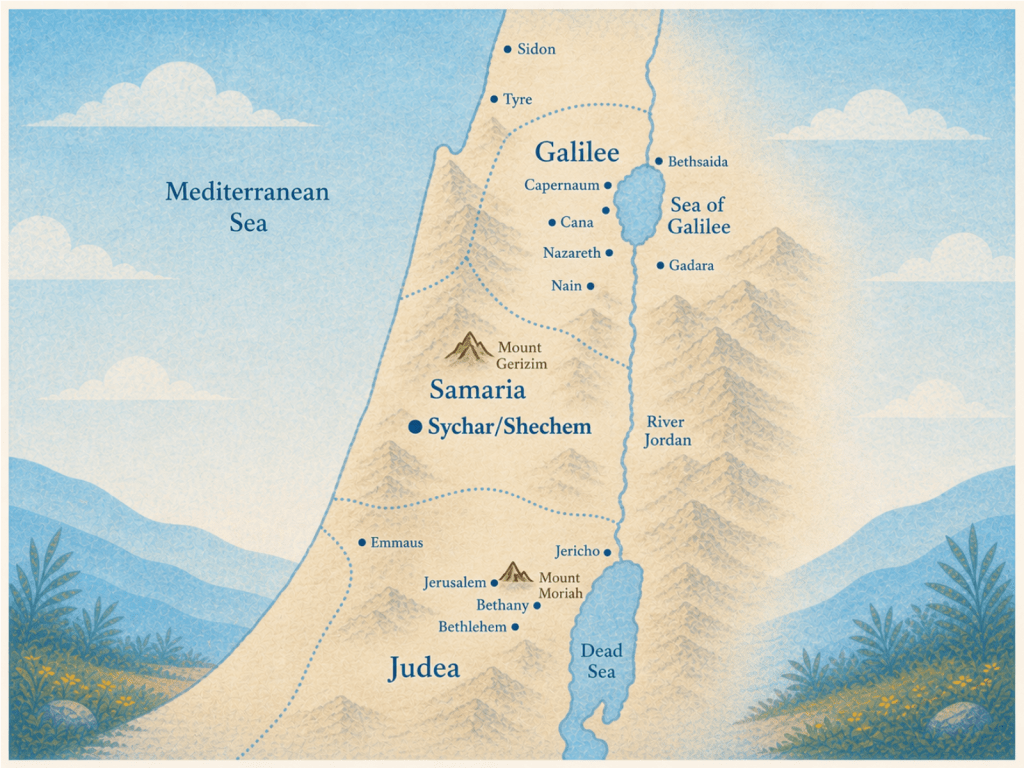
If you look on a map, that makes sense. It’s a straight shot—about 70 miles on foot—a two to three day trip. But one does not simply walk into Samaria…In fact, Jews avoided walking through it and would take the long way around, crossing the Jordan River and walking northward on the east side of the river in order to avoid ANY contact with Samaritans.
Years before, when the kingdom of Israel had split, the Northern kingdom had Samaria as its capitol, and the Southern Kingdom claimed Jerusalem. With the Assyrian conquest of the Northern kingdom, many people from Samaria were carted out, and people from other countries settled in and lived in the towns. With that colonization came a lot of other religious practices.
The writer of 2 Kings notes: 33 They worshiped the Lord, but they also served their own gods in accordance with the customs of the nations from which they had been brought.34To this day they persist in their former practices. They neither worship the Lord nor adhere to the decrees and regulations, the laws and commands that the Lord gave the descendants of Jacob, whom he named Israel. 2 Kings 17:33, 34
Because of their mixed religious practices, Samaritans were not looked on favorably by the Jews. By just walking through Samaria in Jesus’ day, a Jew would be deemed unclean. But Jesus is heading there anyway—on purpose. It is a DIVINE necessity.
5 So he came to a town in Samaria called Sychar, near the plot of ground Jacob had given to his son Joseph. 6 Jacob’s well was there, and Jesus, tired as he was from the journey, sat down by the well. It was about noon. John 4:5-6 NIV
Sychar is a village about a Roman mile from Shechem[1], at the base of Mt. Gerizim. Shechem is where Abraham built his first altar when entering Canaan.[2] Joshua gathered the twelve tribes of Israel at Shechem to renew their covenant with God.[3] Joseph’s bones were buried there.[4] It is the place where Abimelech was crowned king.[5] Shechem became the first capital of the Northern kingdom of Israel. This is where Jacob settled[6] and was thought to have built this well. Everyone thought of Jacob’s well as the oldest well in the world. Jesus sits down at the well at noon-the hottest time of the day. It’s time for a drink.
7 When a Samaritan woman came to draw water, Jesus said to her, “Will you give me a drink?” 8 (His disciples had gone into the town to buy food.) John 4:7-8 NIV
Middle Eastern wells do not have buckets attached. You have to take your own.[7] Maybe the disciples had taken theirs with them into town. Who knows? This is the place to pick up women, though—a well—is a place for romance. Think of a bar scene: if a man asks if he can buy you a drink, he’s not interested if you are thirsty or not. The imagery of a well, a woman, and a stranger from distant lands also evokes Old Testament stories of the patriarchs finding their respective brides beside a well.[8] The servant of Abraham who finds Rebecca for Isaac[9], there is Jacob who sees Rachel,[10] and Moses and Zipporah[11] who all have romantic encounters at a well. God used these marriages as a means of securing the redemption of his chosen people.[12]
Common courtesy called for Jesus withdrawing to a distance, indicating it was safe for her to approach the well. Jesus didn’t move. She comes near anyway.[13] Women usually show up to the well in the early morning or early evening because of the heat. The woman is alone, but not because she is an outcast, as some have previously thought. There is no evidence from the ancient world that “moral women went to the village well at certain times and degenerate women visited at other times.”[14] She would meet them in the streets of the village anyway, not just when they went to get water.[15] Jesus meets this Samaritan woman right where she is at—in the middle of her day—doing the thing that she does every day—over, and over, and over again.
Water is a necessity. Have you ever stopped to think how often you need water? This week I paid attention: wake up, take a shower, drink of water, wash hands, wash dishes, wash clothes, make food. Water for coffee, water for cleaning up. Water is essential!
Jesus talks to this woman, which is a social faux pax, and he humbly asks for her help.[16] But the laws of cleanliness forbade the Jews from even using the same utensils that the Samaritans used. And Samaritan women were seen by Jews as unclean from birth![17] So, 9 The Samaritan woman said to him, “You are a Jew and I am a Samaritan woman. How can you ask me for a drink?” (For Jews do not associate with Samaritans.) John 4:9 NIV
The tables are turned. She may be enjoying a rare moment of advantage, since it is the Jews who refuse to associate with Samaritans.[18]
10 Jesus answered her, “If you knew the gift of God and who it is that asks you for a drink, you would have asked him and he would have given you living water. 11 “Sir,” the woman said, “you have nothing to draw with and the well is deep. Where can you get this living water? 12 Are you greater than our father Jacob, who gave us the well and drank from it himself, as did also his sons and his livestock?” John 4:10-12 NIV
The term “living water” was thought to be water that flows from a spring or river, rather than a pool or well.[19] The better translation is ‘flowing water.’[20] Jacob’s well was fed by an underground stream.[21] Even today, it’s over 100 feet deep.[22] But it still had to be drawn up every day.
Living water was used for spiritual cleansing. Jews and Samaritans had purification rites. There were many situations that constituted uncleanness, and Leviticus 15 has a list of things that would fit into that category. Spiritual cleansing was done by using a Mikveh, or ritual bath. A Samaritan mikveh was discovered just last September, and it has steps around the entire outside, unlike the ones in Jerusalem.[23] Samaritans had mikvehs outside of their synagogues.[24] In the time of Jesus, the Temple in Jerusalem also had several Mikvehs for priests and there were public mikvehs as well. Mikvehs could be ponds, immersion pools, wells with natural groundwater, and natural flowing “living” water from springs and in rivers. [25] Living water must be water that comes from God—it had to come from a natural source, not something drawn by human hands. There are three basic areas where immersion in the mikveh is required according to Jewish Law:
- When using pots and eating utensils manufactured by a non-Jew.[26]
- After a woman has her monthly period. (Lev. 15:28) or gives birth (Luke 2:22).
- For both men and women when converting to Judaism.[27]
When Jesus tells the woman that she should be asking for living water, was he implying that he has access to better water than their forefather Jacob had? Is he saying that he needs to clean her jar before he can drink from it? Is he saying she needs to convert to being a Jew and be ceremonially cleansed?
But Jewish prophets had also spoke of living water that would someday flow out of Jerusalem—a gift which would mark the coming of the new age.[28] Jesus is not interested in pitting Jew off against Samaritan. He is interested in the inclusion of the Samaritans.[29]
13 Jesus answered, “Everyone who drinks this water will be thirsty again, 14 but whoever drinks the water I give them will never thirst. Indeed, the water I give them will become in them a spring of water welling up to eternal life.” 15 The woman said to him, “Sir, give me this water so that I won’t get thirsty and have to keep coming here to draw water.” John 4:13-15 NIV
Jesus offered her living water because he recognized her spiritual emptiness symbolized by her empty water jar.[30] She was interested, but not entirely sure what he meant. She may have thought that Jesus was going to offer a source of water that is close by, so that she wouldn’t have to come back and forth to the well every day to get water.[31] Sure, give me something that will lighten my daily grind. Give me a magic drink. And while you’re at it, give me something that will ease my pain—and make me feel good. Something that will lift my depression. Something that will provide social community for me.[32]
In the book of Proverbs, Wisdom, was said to be the spring of life. Jesus is saying that HE is wisdom—HE is the source and the substance of true life, light, and true worship.[33]
Unlike the other well scenarios, Jesus is not offering this woman a marriage proposal. He’s offering something more. 16 He told her, “Go, call your husband and come back.” John 4:16 NIV
The woman is ready for deeper teaching…she’s asking questions, and now it’s time to explain to her the spiritual significance of the living water. So Jesus challenges her, a woman, to GO, CALL, and BRING [34] her husband. All of this hits a sore spot.
17 “I have no husband,” she replied. Jesus said to her, “You are right when you say you have no husband. 18 The fact is, you have had five husbands, and the man you now have is not your husband. What you have just said is quite true.” John 4:17-18 NIV
We often think that this woman is of shady character. She certainly may have had a stigma attached to her. But if she was a prostitute, she probably would not have been allowed to use the well at all. Divorce in that era was the sole prerogative of the male.[35] So even though she has had 5 husbands, men had all the cards when it came to divorce. The woman is at the mercy of the man, and the Hillel school of thought held that a man could divorce his wife for any reason.[36] The text does not say she has been divorced, but only that she has had five husbands. Her history does not seem to concern Jesus,[37] nor does he accuse her of sin.[38]
Given rabbinic teaching, it is highly unlikely that she was divorced five times, but it is entirely credible that she was a widow several times, given the high death rate in that era.[39] A woman in that day was the property of her father and her husband. And she may have even been a widow—who was trapped in the levirate regulations of being passed from brother to brother in order to sire an heir for the dead brother.[40]
A woman would expect to receive bread, water, wool, flax, oil from her husband in that culture. But those gifts really come from God.[41] The Samaritan’s real provider is Jesus, and he is a different kind of man than she has ever encountered. This well scene in John 4 presents a kind of betrothal— not based on ethnic birth but on spiritual birth.[42] Her eyes are beginning to open to that reality.
19 “Sir,” the woman said, “I can see that you are a prophet. John 4:19 NIV
Last week we read about Jesus exercising this kind of prophetic insight regarding Nathanael. Jesus shows the Samaritan woman that he knows all about her, not in a digging up dirt kind of way, but as a way of getting her to understand who he really is.[43] She is getting closer. But she pushes back again—to try and expose him. She says:
20 Our ancestors worshiped on this mountain, but you Jews claim that the place where we must worship is in Jerusalem. John 4:20 NIV
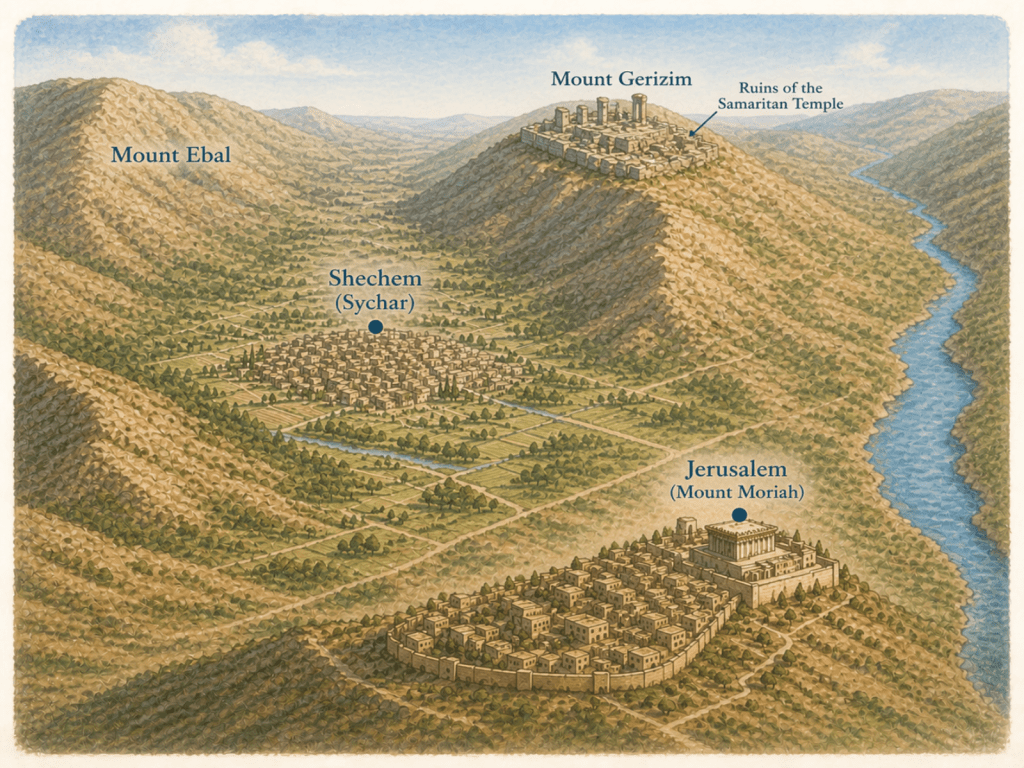
In the hill country of Samaria, the city of Shechem is in the valley between Mount Gerizim and Mount Ebal, and worship happens up on the mountain. In Jerusalem, the city surrounds the mountain where the Temple sits. Shechem and Jerusalem are about 40 miles apart geographically, but worlds apart in how they approached God. Samaritans and Jews were both descendants of Abraham, Isaac and Jacob, but they were bitter rivals,[44] and Samaritans had only negative stereotypes[45] assigned to them.
Here’s some of the background of those two Temples. When Jezebel was queen, Samaria became a center of idolatrous worship. Ahab built an altar for Baal in the house of Baal, which he had built in Samaria. After the Assyrians deported most of the citizens of the northern kingdom, they populated the towns of Samaria with pagan immigrants.[46] When the Samaritans finally returned from Captivity, the Jews in Jerusalem refused to allow them to take part in rebuilding that temple. So, the Samaritans built their own, somewhere around 400 B.C.E.[47] Some accounts say that it was built with the help of a foreign king, and its first high priest was a Jewish renegade married to a foreign woman,[48] and a leader named Sanballat basically said to the high priest: “Hey, don’t worry—you can keep your position. We’ll build you your own temple.”[49] All this made them apostate Jews.[50] But Samaritans saw themselves as true Israelites who stood in unbroken continuity with the religion of ancient Israel.[51] THEIR temple was the proper place to worship God!
Samaritans claimed that God commanded Abraham to sacrifice Isaac on Mount Gerizim, where their temple was built, and Jews say it was on Mount Moriah, where their temple was built. But Moses had read the law on Mount Gerizim! He had pronounced blessing on it![52]
Before the time of Jesus, the Samaritan temple at Mount Gerizim had been destroyed— in 128 B.C.E. [53] The high priest and Judean leader from the Maccabee dynasty demolished it. It was laid to waste, and then fire was set to the surrounding city,[54] where the priests lived.[55] It was an attempt to separate the Samaritans from their temple and the priesthood,[56] and use coercion to force the Samaritans to recognize the Jerusalem temple as the only legitimate place of worship.[57] It was the final breach between Jews and Samaritans.[58]
The destruction of the Samaritan temple enhanced the resentment and defiance towards Jerusalem.[59] They continued to worship on their mountain, without a temple. And they STILL do so. A large population of Samaritans lives on or near Mount Gerizim today and every year they celebrate the feast of Passover, with many pilgrims joining them.[60] It’s a sacred place.
This Samaritan woman wants to know what Jesus thinks is the correct site for worshipping God. If he says that Gerizim is the correct place, then the Samaritans win. If he says that Jerusalem is the correct place, then he’s not a prophet, and she has outed him. Jesus had already shown that he was free from Jewish prejudice against the Samaritans. Now he seeks to break down the prejudice of this Samaritan woman against the Jews.[61]
21 “Woman,” Jesus replied, “believe me, a time is coming when you will worship the Father neither on this mountain nor in Jerusalem. 22 You Samaritans worship what you do not know; we worship what we do know, for salvation is from the Jews. 23 Yet a time is coming and has now come when the true worshipers will worship the Father in the Spirit and in truth, for they are the kind of worshipers the Father seeks. 24 God is spirit, and his worshipers must worship in the Spirit and in truth.” John 4:21-24 NIV
Jesus’ mission is to make the worship of God possible not only for Jews, but also for Samaritans, and ultimately even for Gentiles. Jesus is proclaiming the gospel to this woman and setting her free to worship the true God.[62] From this point on, religion will no longer be linked to a holy place.[63] The Temple is a passing institution.[64] The living God cannot be contained geographically or architecturally. He transcends it all.[65] The Samaritans are also rightful children of Abraham, who are worthy of Jesus’ ministry.[66] And Jesus has crossed barriers of geography, gender and religious practices in this story, because he is on a divine mission to show this woman who he really is.
25 The woman said, “I know that Messiah” (called Christ) “is coming. When he comes, he will explain everything to us.” 26 Then Jesus declared, “I, the one speaking to you—I am he.” John 4:25-26 NIV
Jesus says it outright. Only on a few occasions will he ever directly admit who he is. “I am he.” It’s the first time that Jesus uses the phrase in John’s gospel.[67] It’s name of God given to Moses in Exodus—”I AM”. Later, he will say, ‘I am—the bread of life.’ ‘I am—the light of the world.’ ‘I AM—the door.’ ‘I AM—the good shepherd.’ I AM—the resurrection and the life, the truth and the way, and I AM—the vine.’
The Samaritan have hopes for a prophet like Moses to come. But it is the JEWISH Messiah who will save.[68] The Samaritans are invited to know Jesus and be reconciled to true Israel.[69] This woman finally recognizes him. She’s moved from seeing him: as a man, as a Jew, as a Rabbi, as a prophet, and now—as the Messiah.
27 Just then his disciples returned and were surprised to find him talking with a woman. But no one asked, “What do you want?” or “Why are you talking with her?” John 4:27 NIV
The disciples are so confused when they come back. Jesus seems to be romancing a Samaritan woman! It doesn’t look good. They may be concerned about the lack of propriety, or just surprised that Jesus is talking to anyone at all.[70] In rabbinic literature, it was frowned upon to speak in public, even with one’s wife, much less an unknown woman.[71] They don’t dare ask the traditional question, ‘Would you like us to get rid of her for you?—and they don’t dare to scold him. Better to stay quiet.[72]
At the beginning of this passage, we read that the disciples are busy baptizing people, left and right. Baptism was done in water—probably the Jordan river, like John the Baptist was also doing. That cleansing was a spiritual thing done to symbolize new life and belief in the Messiah. God’s people—the Jews—are starting to follow Jesus. But the Samaritans are God’s people, too, and Jesus messes with the disciples’ cultural tendencies as he trains them in ministry.
Jesus meets us where we are—and reveals himself as the only one who can truly satisfy.
He meets the disciples where they are at and invites them into a deeper understanding of who the good news is for. Just before this scene, Jesus meets with Nicodemus at night. He meets him where he is at and talks to him about being born again—of water and the spirit. Nicodemus is a male member of the Jewish religious establishment. And then Jesus meets this woman—a Samaritan—a female member of an enemy people.[73] And he reveals that he is the Messiah.
Even before this woman fully understands, the Spirit is at work—stirring her curiosity, drawing her into honest conversation, and opening her to recognize who Jesus is. The same Spirit who awakens her thirst is the one who turns her into a witness:
28 Then, leaving her water jar, the woman went back to the town and said to the people, 29 “Come [and] see a man who told me everything I ever did. Could this be the Messiah?” 30 They came out of the town and made their way toward him. John 4:28-30 NIV
The woman no longer cares what anyone thinks of her.[74] And unlike any of our possible former assumptions about her, the villagers respond to her without question or hesitation, indicating that she has sufficient credibility.[75] In fact, in Samaritan culture, the women may have been present in the synagogue services[76], and both sexes were educated in the Law.[77] It’s the JEWS that would have had a hard time seeing a Samaritan and a woman as a credible witness,[78] based on their customs.
The Samaritan woman becomes one of the first people to identify Jesus as the Messiah[79], and she becomes the first woman to preach the gospel in Christian history,[80] becoming a witness and a disciple like Andrew, and Philip.[81] In conjunction with the sermon last week, this woman shows us that you don’t have to have everything figured out to invite someone to Jesus—to Come and See.
39 Many of the Samaritans from that town believed in him because of the woman’s testimony, “He told me everything I ever did.” 40 So when the Samaritans came to him, they urged him to stay with them, and he stayed two days. 41 And because of his words many more became believers. 42 They said to the woman, “We no longer believe just because of what you said; now we have heard for ourselves, and we know that this man really is the Savior of the world.” John 4:39-42 NIV
She came to draw water that would quench thirst for an hour or two. She returns as a witness to the water that quenches the thirst of the spirit—forever![82] This story can be used to talk about foreign missions, about telling our neighbors the good news, about worshiping God in Spirit in truth—and that’s all good. But Jesus is not just being presented as the Messiah—he is God’s presence among us.[83]
Jesus meets us where we are—and reveals himself as the only one who can truly satisfy. Come and See.
When I was 30, I gave up my stuffed dog. I didn’t need it anymore. I had been married and had children, and it was time to put it away. And if you had blankets or thumbs to suck, I’m sure you put them away, too. But life has a way of leaving us thirsty. We outgrow stuffed animals…but we don’t always outgrow the things we turn to for comfort. And we’ve all learned how to cope—with our past, with our pain, with our responsibilities, with our circumstances. And sometimes we just keep going back to the same well.
Some of you remember the slogan: ‘Obey your thirst’ from the old Sprite campaign in the 90’s and brought back in 2024.[84] “When you’re thirsty, trust your gut.”[85] And honestly, most of us have been doing that our whole lives. We feel something missing… so we go looking for something to fill it. We’re looking for security—and so we save money—but it’s never enough. We’re looking for entertainment—and we turn to the television—but it’s rather empty. We’re looking for rest—and we take vacation—but we come back tired. We fill our desire for love with what the world says will do, until we’re broken and empty. We keep coming back to the water we know, and we’re not sure if there’s anything different out there.
What if the problem isn’t that we’re thirsty…but that we’ve been obeying the wrong thirst? Our soul’s deepest thirst is for God himself…we can never be satisfied without him.[86]
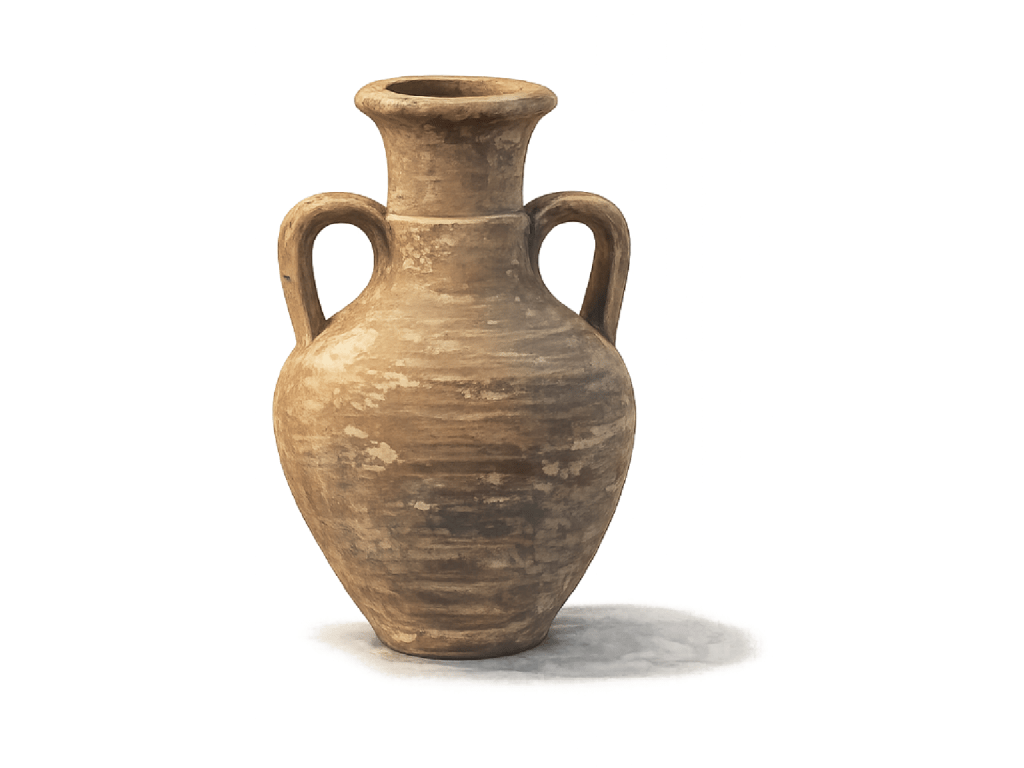
Then, leaving her water jar, the woman went back to the town…
After her encounter with Jesus, the Samaritan woman left behind her jar. It no longer mattered to her. She was ready to be filled with living water. She was leaving the old way of doing things behind. It’s reminiscent of the disciples leaving everything to follow Jesus in other gospels.[87]
Jesus said: “If anyone is thirsty, let him come to Me and drink. 38 “He who believes in Me, as the Scripture said, ‘From his innermost being will flow rivers of living water.’” He spoke this of the Spirit, whom those who believed in Him were to receive…John 7:37-39
Jesus is not just a man, not just a prophet— Jesus is the Messiah! And he says to us today: I AM. I AM what you are looking for. I AM your peace. I AM your security. I AM your salvation. When we recognize who Jesus really is, we can leave our water jar behind. Only his living water can satisfy our unquenchable thirst.[88]
Some of us are empty, grieving, struggling with anger, fatigue, whatever it is. But we all came in today with some kind of thirst. Maybe it’s just to be known, to be seen, to feel secure, to be loved. We have certain things that we use to try and satisfy us, too: Performance, distraction, numbing habits, even good things that we’ve made too important. Jesus meets us where we are—and invites us to set those things down. Only Jesus can satisfy the thirst you walked in here with today.
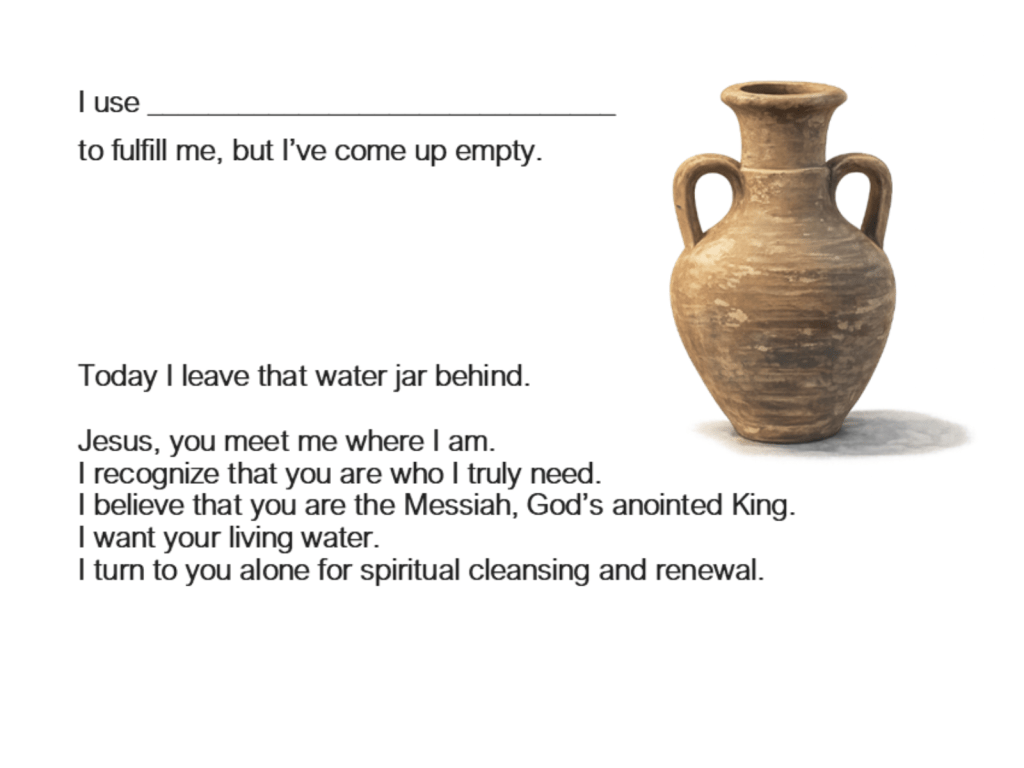
I have a card for you today that has a spot for you to write down something that may be YOUR water jar. It may be a place where life has become routine—or something that you use to fill a void—or that thing you do because you’ve always done it. I’m going to challenge you to write that thing down—no name needed—fill out your paper and bring it forward in these next moments…as a way to leave it behind. It’s may not be something you’re entirely comfortable with, but it may help you as you head into and go through this week. Use it as a tangible way to let something go—and let God fill you with something new.
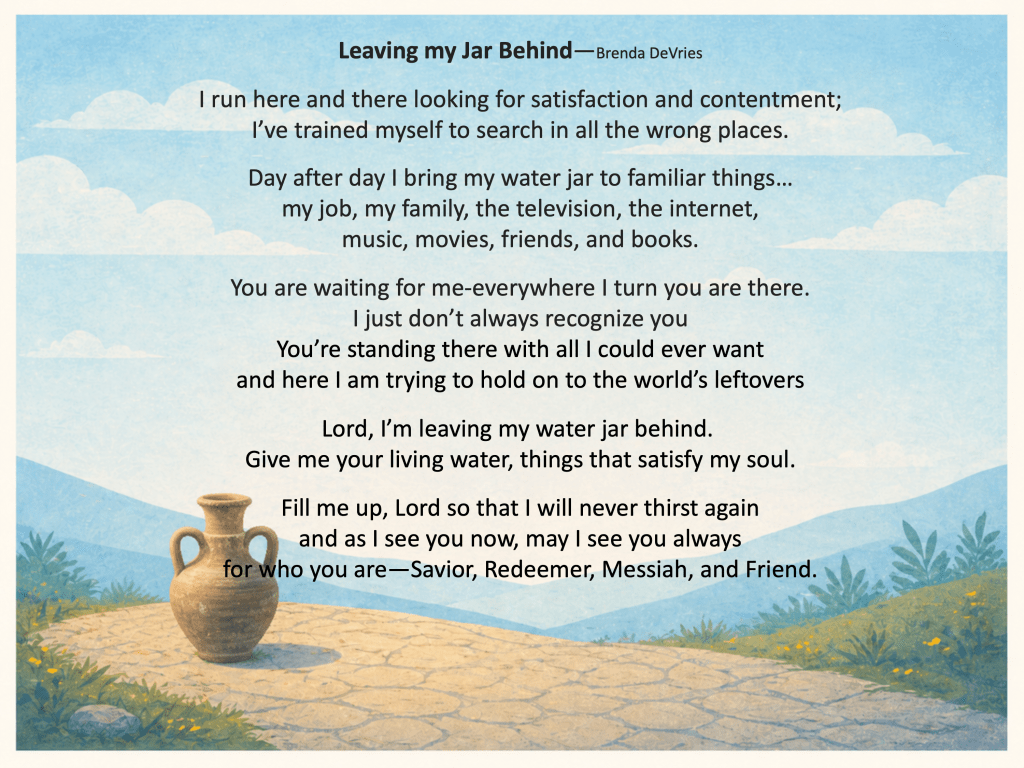
Closing Prayer: God, you meet us here—in a dry and weary land where there is no water. And into the things we think we know, you tell us about something different, something better, something deeper. We are just like the Samaritan woman—sometimes worshiping other gods—sometimes lonely—sometimes abused—sometimes far away from your people—or just living in the routine of life without giving you a second thought. Your Word has helped us to see you again, and we testify that you are the Messiah, the Christ, the Son of the Living God! Holy Spirit, by your power and strength, make us new. Refresh us, cleanse us, and make us fit for your kingdom. Amen.
—-
Bibliography
- Bailey, Kenneth E., Jesus Through Middle Eastern Eyes: Cultural Studies in the Gospels, Downers Grove: IVP Academic, 2008.
- Bruce, F.F., The Gospel of John, Grand Rapids: Eerdmans, 1983.
- The Encyclopedia of the Jewish Religion, New York: Adama Books, 1996.
- Green, Joel B., and Lee Martin McDonald, editors, The World of the New Testament: Cultural, Social, and Historical Contexts, Grand Rapids: Baker Academic, 2013.
- Jobes, Karen H., John Through Old Testament Eyes, Grand Rapids: Kregel Academic, 2021.
- Levine, Amy-Jill, Ben Witherington III, NCBC: The Gospel of Luke, Cambridge: Cambridge University Press, 2018.
- Metzger, Paul Louis, The Gospel of John: When Love Comes to Town, Downers Grove: IVP Books, 2010.
- Newsom, Carol A., Sharon H. Ringe, and Jacqueline E. Lapsley, editors, Women’s Bible Commentary, 3rd ed., Louisville: Westminster John Knox Press, 2012.
- Witherington, Ben III, John’s Wisdom: A Commentary on the Fourth Gospel, Louisville: Westminster John Knox Press, 1995.
- Wright, N.T., John for Everyone, Part 1, Louisville: Westminster John Knox Press, 2004.
Articles
- Ademiluka, Solomon O., “‘[Y]ou have had five husbands’: Interpreting the Samaritan woman’s marital experience (Jn 4:16–18) in the Nigerian context,” HTS Theological Studies, 79, no. 1, 2023, p1–8.
- Bourgel, Jonathan, “The Destruction of the Samaritan Temple by John Hyrcanus: A Reconsideration,” Journal of Biblical Literature, 135, no. 3, 2016, 505–523.
- Cahill, P. Joseph, “Narrative art in John 4,” Religious Studies Bulletin, 2, no. 2, April 1982, p41–47.
- Davidson, Jo Ann, “John 4: Another look at the Samaritan woman,” Andrews University Seminary Studies, 43, no. 1, Spring 2005, p159–168.
- Esler, Philip F., “Jesus and the Reduction of Intergroup Conflict: The Parable of the Good Samaritan in the Light of Social Identity Theory,” Biblical Interpretation, 8, 2000, p325–357.
- Foster, Timothy D., “Jesus and the Samaritan woman recast,” Australian Biblical Review, 70, 2022, p65–82.
- Graves, David W., “Worship in Spirit and Truth in John 4,” Lutheran Forum, 50, no. 3, Fall 2016, p15–16.
- Lamkin, James E., “‘Location, Location, Location’: A homiletic exegesis of John 4,” Review & Expositor, 96, no. 4, Fall 1999, p583–588.
- Maccini, Robert Gordon, “A reassessment of the woman at the well in John 4 in light of the Samaritan context,” Journal for the Study of the New Testament, 16, no. 53, April 1994, p35–46.
- McIntyre, Donald C., “A reappraisal of the Johannine well scene in light of recent research,” Eleutheria, 6, no. 2, 2022, p167–188.
- Mehring, Hanna-Maria, “The Samaritan woman as a quick-witted border crosser in John 4,” Religions, 15, no. 8, August 2024, p1–13.
- Pummer, Reinhard, “How to tell a Samaritan synagogue from a Jewish synagogue,” Biblical Archaeology Review, May/June 1998. https://library.biblicalarchaeology.org/article/how-to-tell-a-samaritan-synagogue-from-a-jewish-synagogue/
- Ritmeyer, Leen, “The Jerusalem Temple on Mount Gerizim: A Brief Visual History,” Ritmeyer Archaeological Design, January 21, 2021, https://www.ritmeyer.com/2021/01/21/the-jerusalem-temple-on-mount-gerizim/
- Ska, Jean Louis, “Jesus and the Samaritan woman (John 4): Using the Old Testament,” Landas, 13, no. 1, 1999, p81–94.
- Sauter, Megan, “The Temple on Mount Gerizim—In the Bible and Archaeology,” Biblical Archaeology Review, September 2, 2025.
- Tercatin, Rossella, “Mosaics, Mikvehs and Oil Lamps Found at Grand Estate Shed New Light on Ancient Samaritans,” The Times of Israel, September 3, 2025, https://www.timesofisrael.com/mosaics-mikvehs-and-oil-lamps-found-at-grand-estate-shed-new-light-on-ancient-samaritans/
- Vang, Bao B., “The marriage metaphor of Jesus and the Samaritan woman: A new interpretative reading of John 4:1–45,” Liberty Theological Review, 9, no. 1, 2025, p110–130.
- Wyckoff, Eric John, “What happens at the well?: Rethinking a biblical type scene,” Salesianum, 87, no. 1, 2025, p156–177.
Online Sources
- “Encyclopedia Judaica: Mikveh,” Jewish Virtual Library, http://www.jewishvirtuallibrary.org/jsource/judaica/ejud_0002_0014_0_13881.html
- “Proselyte Conversion Practices,” MB Soft Religious Resources, http://mb-soft.com/believe/txo/proselyt.htm
- Levy, Ari, “2,000-Year-Old Mikveh Discovered Underneath the Western Wall,” Israel Antiquities Authority, https://www.i24news.tv/en/news/israel/archeology/artc-2-000-year-old-mikveh-from-second-temple-period-discovered-underneath-the-western-wall
- “The Coca-Cola Company, Sprite ‘Obey Your Thirst’ Campaign,” https://www.coca-colacompany.com/media-center/sprite-taps-nfl-jalen-hurts-obey-your-thirst-campaign
- “YouTube, ‘Obey Your Thirst’ Advertisement,” https://www.youtube.com/watch?v=OEWnUYcO36E
- BiblePlaces.com, “Image Usage and Copyright,” https://www.bibleplaces.com/copyright/
—
Week Two: Come and See: Who Jesus Is
Small Group Questions
John 4:1-30; 39-42
Icebreaker
- What’s something you used to rely on for comfort that you’ve completely outgrown?
Read John 4:1-12 NIV
Now Jesus learned that the Pharisees had heard that he was gaining and baptizing more disciples than John— 2 although in fact it was not Jesus who baptized, but his disciples. 3 So he left Judea and went back once more to Galilee. 4 Now he had to go through Samaria. 5 So he came to a town in Samaria called Sychar, near the plot of ground Jacob had given to his son Joseph. 6 Jacob’s well was there, and Jesus, tired as he was from the journey, sat down by the well. It was about noon. 7 When a Samaritan woman came to draw water, Jesus said to her, “Will you give me a drink?” 8 (His disciples had gone into the town to buy food.) 9 The Samaritan woman said to him, “You are a Jew and I am a Samaritan woman. How can you ask me for a drink?” (For Jews do not associate with Samaritans.) 10 Jesus answered her, “If you knew the gift of God and who it is that asks you for a drink, you would have asked him and he would have given you living water.” 11 “Sir,” the woman said, “you have nothing to draw with and the well is deep. Where can you get this living water? 12 Are you greater than our father Jacob, who gave us the well and drank from it himself, as did also his sons and his livestock?”
Discussion
- Where is Jesus coming from, and where is he going? Why does that matter?
- What do you notice about the setting (time of day, location, who is present/absent)?
- Why do you think Jesus begins this conversation by asking for something (a drink), rather than offering something?
- What does this interaction show us about how Jesus approaches people?
- Jesus meets this woman in the middle of her everyday routine. Where does your life feel most like “routine” right now? What might it look like for Jesus to meet you there?
- If you were the woman at this point in the story, what would you be thinking about Jesus? What questions would you want to ask him?
Read John 4:13-18 NIV
Jesus answered, “Everyone who drinks this water will be thirsty again, 14 but whoever drinks the water I give them will never thirst. Indeed, the water I give them will become in them a spring of water welling up to eternal life.” 15 The woman said to him, “Sir, give me this water so that I won’t get thirsty and have to keep coming here to draw water.” 16 He told her, “Go, call your husband and come back.” 17 “I have no husband,” she replied. Jesus said to her, “You are right when you say you have no husband. 18 The fact is, you have had five husbands, and the man you now have is not your husband. What you have just said is quite true.”
Discussion
- What contrast does Jesus make between the well water and the water he offers?
- How does the woman respond to Jesus’ offer in verse 15?
- Why do you think the woman is so interested in this water?
- Where are you tempted to want Jesus to just make life easier?
- What changes in the conversation when Jesus says, “Go, call your husband”?
- What do you notice about the way Jesus responds to her answer? What doesn’t he say?
- Have you ever experienced God bringing something to your attention—not to shame you, but to invite you deeper?
Read John 4:19-26 NIV
Sir,” the woman said, “I can see that you are a prophet. 20 Our ancestors worshiped on this mountain, but you Jews claim that the place where we must worship is in Jerusalem.” 21 “Woman,” Jesus replied, “believe me, a time is coming when you will worship the Father neither on this mountain nor in Jerusalem. 22 You Samaritans worship what you do not know; we worship what we do know, for salvation is from the Jews. 23 Yet a time is coming and has now come when the true worshipers will worship the Father in the Spirit and in truth, for they are the kind of worshipers the Father seeks. 24 God is spirit, and his worshipers must worship in the Spirit and in truth.” 25 The woman said, “I know that Messiah” (called Christ) “is coming. When he comes, he will explain everything to us.” 26 Then Jesus declared, “I, the one speaking to you—I am he.”
Discussion
- Why do you think the woman shifts the conversation to worship? What might she be trying to do?
- What do you think it means to worship:
- “in Spirit”
- “in truth”?
- Why does Jesus say: “neither on this mountain nor in Jerusalem”? What does this teach us about where God can be worshiped and who can worship him?
- Are there ways you’ve unintentionally tied worship to:
- a place
- a style
- a routine
How does Jesus’ teaching challenge that?
- The woman moves from seeing Jesus as: a man → a prophet → the Messiah.
Which of these resonates most with you right now:
- Jesus as Savior
- Jesus as the one who truly satisfies
- Jesus as the one who sees and knows you
Read John 4:27-30, 39-42 NIV
Just then his disciples returned and were surprised to find him talking with a woman. But no one asked, “What do you want?” or “Why are you talking with her?” 28 Then, leaving her water jar, the woman went back to the town and said to the people, 29 “Come, see a man who told me everything I ever did. Could this be the Messiah?” 30 They came out of the town and made their way toward him.
Discussion
- How do the disciples react when they return?
- What does the woman leave behind?
- How do the people respond to the woman’s message and invitation?
- What helps move faith from secondhand knowledge to personal trust?
- What changes in the woman by the end of this passage?
- How does this story show the difference between hearing about Jesus and encountering him personally?
Personal Application
- What might a “water jar” represent in your own life?
- something familiar
- something you depend on
- something you keep returning to
- Is there something you sense God inviting you to “leave behind” right now?
- What would it look like this week to point someone toward Jesus—not because you have all the answers, but because you’ve encountered him yourself?
Closing Prayer
Lord Jesus, you meet us where we are and invite us to something deeper. Forgive us for the things we keep turning to that cannot truly satisfy. Fill us with your living water, renew us by your Spirit, and help us to follow you more fully this week. Amen.
[1] F.F. Bruce., The Gospel of John, Grand Rapids: Eerdmans, 1983, 101.
[2] Genesis 12:6.
[3] Joshua 24:1.
[4] Joshua 24:32.
[5] Judges 9:6.
[6] Genesis 33:19.
[7] Kenneth E. Bailey, Jesus Through Middle Eastern Eyes, Cultural Studies in the Gospels, Downers Grove: IVP Academic, 2008, 202.
[8] Bao B. Vang, “The marriage metaphor of Jesus and the Samaritan woman: A new interpretative reading of John 4:1–45,” Liberty Theological Review, 9, no. 1, 2025, p110–130, 111-112.
[9] Genesis 24.
[10] Genesis 29.
[11] Exodus 2.
[12] Bao B. Vang, “The marriage metaphor of Jesus and the Samaritan woman”, 114.
[13] Kenneth E. Bailey, Jesus Through Middle Eastern Eyes, Cultural Studies in the Gospels, Downers Grove: IVP Academic, 2008, 202.
[14] Foster, Timothy D., “Jesus And The Samaritan Woman Recast”, Australian Biblical Review, 70 2022, p65-82, 67.
[15] Foster, Timothy D., “Jesus And The Samaritan Woman Recast”, Australian Biblical Review, 70 2022, p65-82, 68.
[16] Kenneth E. Bailey, Jesus Through Middle Eastern Eyes, 203.
[17] Ben Witherington III, John’s Wisdom: A Commentary on the Fourth Gospel, Louisville: Westminster John Knox Press, 1995, 118.
[18] Timothy D. Foster, “Jesus And The Samaritan Woman Recast”, 74.
[19] N.T. Wright, John for Everyone, Part 1, Louisville: Westminster John Knox Press, 2004, 30.
[20] Bao B. Vang, “The marriage metaphor of Jesus and the Samaritan woman”, 118.
[21] F.F. Bruce, 102,
[22] F.F. Bruce, 104.
[23] Rossella Tercatin, “Mosaics, mikvehs and oil lamps found at grand estate shed new light on ancient Samaritans”,
The Times of Israel, September 3, 2025.
[24] Reinhard Pummer, “How to Tell a Samaritan Synagogue from a Jewish Synagogue”,
Biblical Archaeology Review, May/June 1998. https://library.biblicalarchaeology.org/article/how-to-tell-a-samaritan-synagogue-from-a-jewish-synagogue/
[25] http://www.jewishvirtuallibrary.org/jsource/judaica/ejud_0002_0014_0_13881.html
[26] The Encyclopedia of the Jewish Religion, New York: Adama Books, 1996, 263.
[27] http://mb-soft.com/believe/txo/proselyt.htm
[28] Timothy D. Foster, “Jesus And The Samaritan Woman Recast”, 75.
[29] Timothy D. Foster, “Jesus And The Samaritan Woman Recast”, 76.
[30] Bao B. Vang, “The marriage metaphor of Jesus and the Samaritan woman”, 115.
[31] Ben Witherington III, John’s Wisdom: A Commentary on the Fourth Gospel, Louisville: Westminster John Knox Press, 1995, 120.
[32] Kenneth E. Bailey, Jesus Through Middle Eastern Eyes, 207.
[33] Witherington, John’s Wisdom, 119.
[34] Kenneth E. Bailey, Jesus Through Middle Eastern Eyes, 208.
[35] Jo Ann Davidson, 165.
[36] Ademiluka, Solomon O. “‘[Y]ou have had five husbands’: Interpreting the Samaritan woman’s marital experience (Jn 4:16–18) in the Nigerian context,” HTS Theological Studies, 79, no. 1, 2023, p1–8, 3.
[37] Carol A. Newsom, Sharon H. Ringe, and Jacqueline E. Lapsley, editors, Women’s Bible Commentary, 3rd ed., Louisville: Westminster John Knox Press, 2012, 521.
[38] Ademiluka, Solomon O., “‘[Y]ou have had five husbands’: Interpreting the Samaritan woman’s marital experience (Jn 4:16–18) in the Nigerian context,” HTS Theological Studies, 79, no. 1, 2023, p1–8, 6.
[39] Timothy D. Foster, “Jesus And The Samaritan Woman Recast”, 70.
[40] Ademiluka, Solomon O. “You have had Five Husbands”, 3.
[41] Ska, Jean Louis, Jesus And The Samaritan Woman-using the Old Testament, 86.
[42] Vang, Bao B, “The marriage metaphor of Jesus and the Samaritan woman”, 110.
[43] Timothy D. Foster, “Jesus And The Samaritan Woman Recast”, 77.
[44] Amy-Jill Levine, Ben Witherington III, NCBC: The Gospel of Luke, Cambridge: Cambridge University Press, 2018, 285.
[45] Philip F. Esler, “Jesus and the Reduction Intergroup Conflict: The Parable Of The Good Samaritan In The Light of Social Identity Theory”, Biblical Interpretation, 2000, 425-357, 329.
[46] Green, Joel B., and Lee Martin McDonald, editors, The World of the New Testament: Cultural, Social, and Historical Contexts, Grand Rapids: Baker Academic, 2013, 208.
[47] Ben Witherington, III, John’s Wisdom, 117.
[48] Joel B. Green, Lee Martin McDonald, Editors, The World of the New Testament, 209-211.
[49] Mehring, Hanna-Maria, The Samaritan Woman as a Quick-Witted Border Crosser in John 4, Religions, 15 no 8 Aug 2024, p1-13, 6.
[50] Joel B. Green, Lee Martin McDonald, Editors, The World of the New Testament, Cultural, Social, and Historical Contexts, Grand Rapids: Baker Academic, 2013, 209-211.
[51] Joel B. Green, Lee Martin McDonald, 207.
[52] Deuteronomy 11:29
[53] Megan Sauter, “The Temple on Mount Gerizim—In the Bible and Archaeology: Worship at ancient temples”, Biblical Archaeology, September 02, 2025.
Link
[54] Jonathan Bourgel, 511.
[55] Bourgel, 520.
[56] Bourgel, 519.
[57] Bourgel, 522.
[58] Jonathan Bourgel, “The Destruction of the Samaritan Temple by John Hyrcanus: A Reconsideration, Journal of Biblical Literature, Sept 1, 2016, 135 (3): 505–523, 505.
[59] Bourgel, 522.
[60] Leen Ritmeyer, “The Jerusalem Temple on Mount Gerizim: A Brief Visual History of the Sacred Mount”, Ritmeyer Archaeological Design, 21/01/2021. https://www.ritmeyer.com/2021/01/21/the-jerusalem-temple-on-mount-gerizim/
CategoriesHistory, Site Info, Temple Mount
[61] Jo Ann Davidson, 163.
[62] Graves, David W., “Worship In Spirit And Truth In John 4”, Lutheran Forum, 50 no 3 Fall 2016, 15-16, 16.
[63] Timothy D. Foster, “Jesus And The Samaritan Woman Recast”, 78.
[64] McIntyre, 183.
[65] N.T. Wright, John for Everyone, Part 1, Louisville: Westminster John Knox Press, 2004, 33.
[66] McIntyre, 183.
[67] Karen H. Jobes, John Through Old Testament Eyes, Grand Rapids: Kregel Academic, 2021, 100.
[68] Timothy D. Foster, “Jesus And The Samaritan Woman Recast”, 79.
[69] McIntyre, 184-185.
[70] Timothy D. Foster, “Jesus And The Samaritan Woman Recast”, 69.
[71] Bao B. Vang, “The marriage metaphor of Jesus and the Samaritan woman”, 123.
[72] Kenneth E. Bailey, Jesus Through Middle Eastern Eyes, 212.
[73] Carol A. Newsom, Sharon H. Ringe, and Jacqueline E. Lapsley, editors, Women’s Bible Commentary, 3rd ed., Louisville: Westminster John Knox Press, 2012, 521.
[74] Paul Louis Metzger, The Gospel of John: When Love Comes to Town, Downers Grove: IVP Books, 2010, 77.
[75] Robert Gordon Maccini, “A reassessment of the woman at the well in John 4 in light of the Samaritan context,” Journal for the Study of the New Testament, 16, no. 53, April 1994, p35–46, 43.
[76] Robert Gordon Maccini, “A reassessment of the woman at the well in John 4,” 40.
[77] Robert Gordon Maccini, “A reassessment of the woman at the well in John 4,” 41.
[78] Robert Gordon Maccini, “A reassessment of the woman at the well in John 4,” 44.
[79] Jo Ann Davidson, 164.
[80] Kenneth E. Bailey, Jesus Through Middle Eastern Eyes, Cultural Studies in the Gospels, Downers Grove: IVP Academic, 2008, 201.
[81] Carol A. Newsom, Sharon H. Ringe, and Jacqueline E. Lapsley, editors, Women’s Bible Commentary, 3rd ed., Louisville: Westminster John Knox Press, 2012, 522.
[82] Kenneth E. Bailey, Jesus Through Middle Eastern Eyes, 212.
[83] Witherington, John’s Wisdom, 122.
[84] https://www.coca-colacompany.com/media-center/sprite-taps-nfl-jalen-hurts-obey-your-thirst-campaign
[85] https://www.youtube.com/watch?v=OEWnUYcO36E
[86] F.F. Bruce, 105.
[87] Karen H. Jobes, John Through Old Testament Eyes, Grand Rapids: Kregel Academic, 2021, 101.
[88] Paul Louis Metzger, The Gospel of John: When Love Comes to Town, Downers Grove: IVP Books, 2010, 77.

