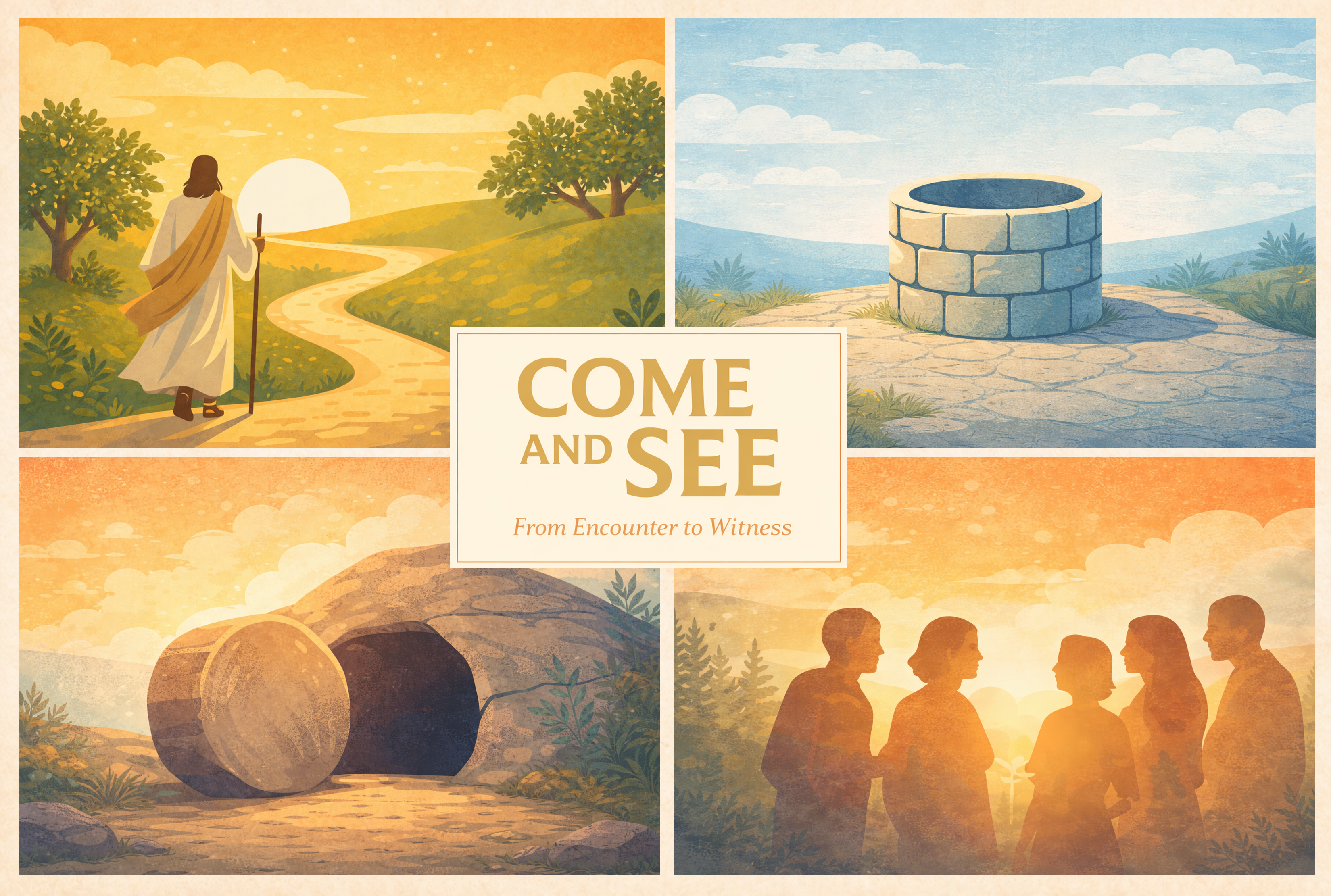

About these posts
These posts grow out of sermons I’ve written for my local church community. You’re welcome to use them—for teaching, small groups, preaching, or personal reflection. If you share them elsewhere, please include a simple attribution. If you’d ever like to share how they’re being used, you’re welcome to reach out through the Contact button.
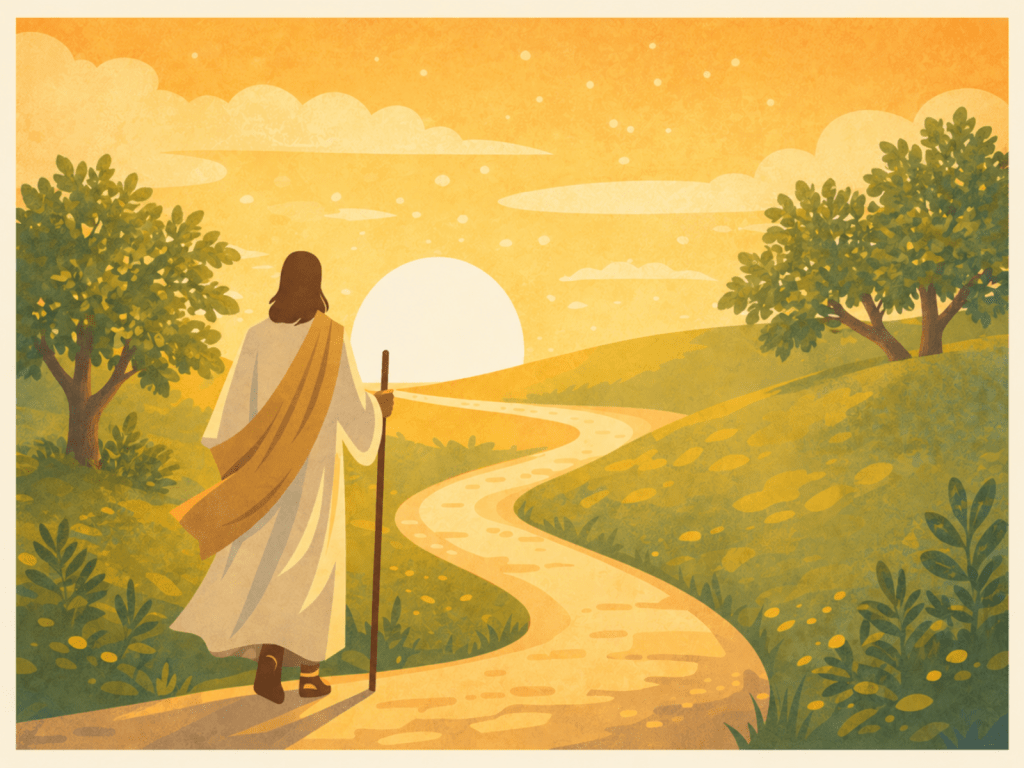
I don’t know about you, but when I go somewhere new, I want my GPS on. I want to know exactly where I’m going, how long it will take, and when I’m going to get there.
The GPS thing is a bit newer for me. I’m still an old school gal, and I have a hard copy of the Atlas in my back seat, and I like to follow along, especially on trips and sometimes I look for the backroads when we’re heading to a destination. When it comes to maps, though, I don’t just want directions—I want reassurance. I want to know I’m on the right road… that I didn’t miss a turn…that I’m going to arrive. Wouldn’t it be nice if life worked like that?
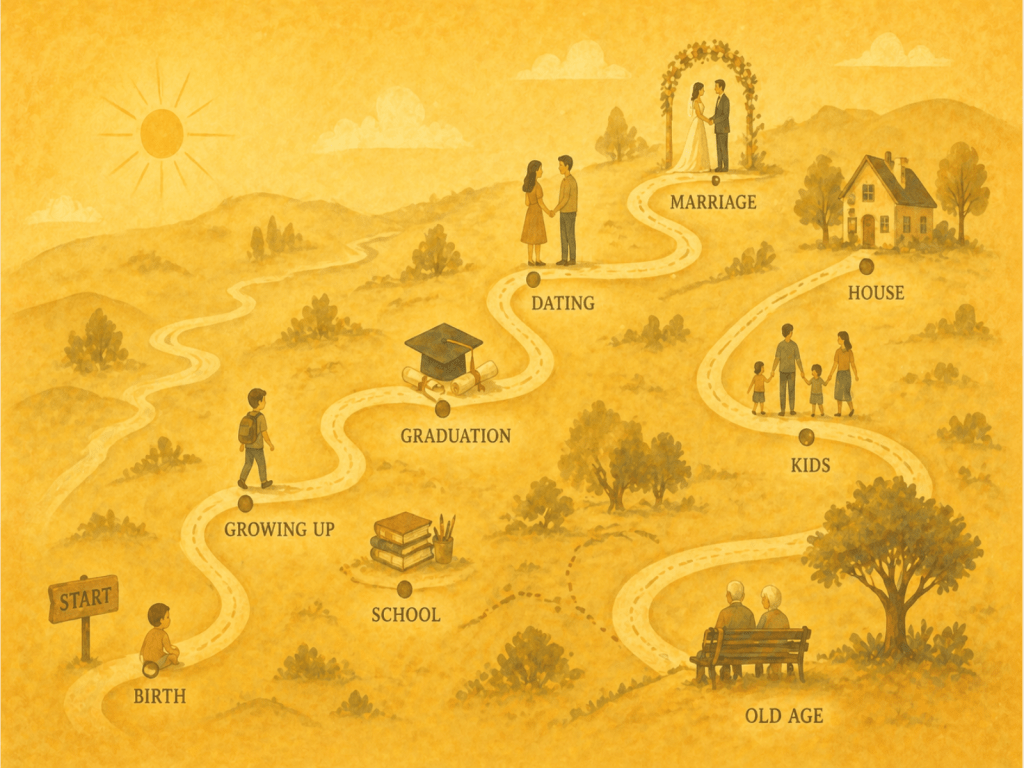
What if, just for a moment, you could pull up a map of your life? You could zoom out and see where you’re headed…see the right decisions… the wrong ones…the relationships that would work… and the ones that wouldn’t…You could see what to avoid… and what to choose. I think most of us would appreciate that. And honestly, when it comes to our faith itself, I think we would all like to have everything laid out: The route, the destination, how long it will take, and what exactly it will cost. We want to know where things are heading before we ever take a step.
We want a map of life, not just because we want directions, but because we’re looking for something: security, purpose, meaning, love, maybe the assurance that we’re not wasting our time on what isn’t important. But perhaps, what we are ultimately looking for is not a plan…but a person.
Our story today is the first in a series that will show us how faith begins with an invitation, grows through encounter, deepens through witness, and matures into a life that others can see. WE all have different stories about the ways we first encountered Jesus. Let’s begin today with the story of the first disciples’ meeting.
John writes this statement in chapter one of his gospel: No one has ever seen God, but the one and only Son, who is himself God and is in closest relationship with the Father, has made him known. (John 1:18) John THE BAPTIST is aware of God’s presence at work in the world. He is the one who was sent to prepare the way of the Lord. When Jesus comes towards the group that he is talking to, John testifies: “LOOK, the Lamb of God, who takes away the sin of the world! (John 1:29) I have seen and I testify that this is God’s Chosen One. (John 1:34)
The next day John was there again with two of his disciples. 36 When he saw Jesus passing by, he said, “Look, the Lamb of God!” 37 When the two disciples heard him say this, they followed Jesus. 38 Turning around, Jesus saw them following and asked, “What do you want?” They said, “Rabbi” (which means “Teacher”), “where are you staying?” 39 He said to them, “Come and see.” John 1:35-39 NIV
“Come and you will see”, read other versions. In the Message: “Come along and see for yourself.” John is depicting Jesus as, not just a wise person, but as Wisdom itself.[1] Early Jewish literature has texts that say: Come to me, all you that need instruction, and learn in my school. …See with your own eyes. (Sirach 51:23, 27) In the Old Testament, knowledge is not just something you’re told—it’s something you experience. True knowledge comes through experience. People were invited not just to hear wisdom, but to step into it and discover it for themselves.[2]
39 “Come,” he replied, “and you will see.” So they went and saw where he was staying, and they spent that day with him. It was about four in the afternoon. 40 Andrew, Simon Peter’s brother, was one of the two who heard what John had said and who had followed Jesus. 41 The first thing Andrew did was to find his brother Simon and tell him, “We have found the Messiah” (that is, the Christ). 42 And he brought him to Jesus. John 1:39-42
Everyone knows who Peter is, but Andrew is the one who introduces Peter to Jesus. Andrew is also the one who brought the boy with the five loaves and two fishes to Jesus, and he later brings a group of Greeks who want to meet Jesus—to see Jesus. Andrew is known as one who brings others to Jesus.[3] That pattern matters. People meet Jesus… and then they bring someone else. Discipleship starts with an invitation: Come and See.
Jesus looked at him and said, “You are Simon son of John. You will be called Cephas” (which, when translated, is Peter). The next day Jesus decided to leave for Galilee. Finding Philip, he said to him, “Follow me.” John 1:43 NIV
Traditionally, disciples would choose which rabbi they wanted to follow. But Jesus takes the initiative here and pursues Philip. And he doesn’t hand Philip a map. He invites him into a journey. “Follow me.”
44 Philip, like Andrew and Peter, was from the town of Bethsaida. 45 Philip found Nathanael and told him, “We have found the one Moses wrote about in the Law, and about whom the prophets also wrote—Jesus of Nazareth, the son of Joseph.” 46 “Nazareth! Can anything good come from there?” Nathanael asked. “Come and see,” said Philip. John 1:44-46
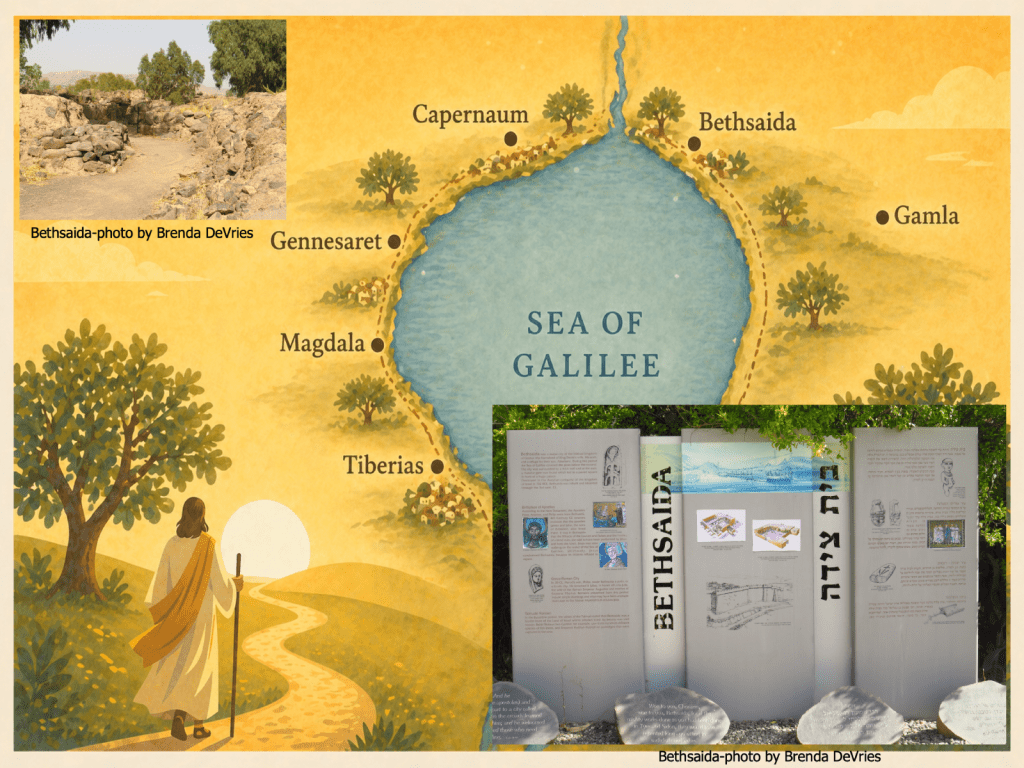
Andrew, Peter, and Philip were from the town of Bethsaida. Bethsaida means ‘house of the fisherman’ or ‘Fishertown’. It was a short distance east of the point where Jordan enters the Lake of Galilee.[4] In verse 43, the grammar implies that it was also Andrew and Peter who suggest that Jesus go to Galilee to find disciples.[5]
Nathanael was a Galilean from—Cana.[6] His name means, ‘given by God.”[7] His response to his brother’s news, “Can anything good come out of Nazareth?” is not quite the response that Philip had probably hoped for. But it’s probably typical. Nazareth was an unremarkable place.[8] No self-respecting Jew expected the Messiah to come from Calilee. The Temple was in Jerusalem, along with the teachers, and the pure Jews.[9] Galilee was on the margins. Nathanael is in for a surprise.
His skeptical response is real for many people. Maybe even for us. In our post-Enlightenment worldview of history, there is not much room for the supernatural, for miracles, angels, or God in person.[10] Many people also look at Jesus with sarcasm, assumptions, and quiet dismissals. But having questions is a part of the journey of following Jesus. That’s where we start. Doubting and having questions are not bad things.[11] It’s not a final rejection.[12] In the end, it’s better to be a Nathanael with open doubt than a Judas who betrays.[13]
Philip does not try to fix any of his questions. He doesn’t argue, explain theology, or defend. He does not give Nathanael a map either. He just says, ‘Come and See.’ And Nathanael comes.
47 When Jesus saw Nathanael approaching, he said of him, “Here truly is an Israelite in whom there is no deceit.” 48 “How do you know me?” Nathanael asked. Jesus answered, “I saw you while you were still under the fig tree before Philip called you.” John 1:47-48 NIV
A fig tree is a meaningful symbol in the Bible. It’s the first plant named in Genesis 3:7, and its leaves were used to cover Adam and Even’s nakedness. The fig tree and grapevine were adopted as symbols for the promise God saw in Israel (Hos 9:10)[14] Nathanael’s being under a fig tree may be an allusion to the traditional place where a teacher would study the Torah, making him out to be an expert in the Scriptures.[15] Maybe Nathanael had recently sat under the fig tree. Maybe he went there often. Who knows?[16] But Jesus tells Nathanael what he knows about him. He doesn’t give him an argument, or any other proof about who he is. He sees him. He knows Nathanael’s character. His statement may be paraphrased, Here is ‘one who is all Israel and no Jacob; …Jacob was traditionally associated with deceit.[17] Nathanael, like other Jews of his day, may have been wondering, “How could Israel’s salvation be revealed while so much of the old ‘Jacob was still evident in the nation’s life?”[18] Jesus’ statement takes him off guard. How could he possibly have known what Nathanael was thinking?
There’s a difference between being analyzed and being known. Being analyzed makes you feel exposed. Being known makes you feel seen. Jesus knows Nathanael and invites him to follow. He doesn’t give him a map with an explanation, he offers relationship—which involves presence and being known.
49 Then Nathanael declared, “Rabbi, you are the Son of God; you are the king of Israel.” 50 Jesus said, “You believe because I told you I saw you under the fig tree. You will see greater things than that.” 51 He then added, “Very truly I tell you, youwill see ‘heaven open, and the angels of God ascending and descending on’ the Son of Man.” John 1:49-51 NIV
In Genesis 28:12, Jacob dreamed of a ladder between heaven and earth, with angels ascending and descending on it. In this passage, Jesus takes the place of that ladder. As the Son of Man, HE becomes the meeting place between heaven and earth—where that connection now happens.[19]
Nathanael believes. His response and receptiveness are immediate. But Jesus redirects him: This is not the end of the journey. This is just the beginning. You’ll see things happening that show that God is on the move. “You will see greater things than these.”
Jesus invites us to Come and See not just to know about Him, but to know Him—and to invite others to do the same.
So, where is Jesus inviting YOU to come and see? John’s gospel gives us each the same invitation. Not just to gain knowledge about God, but to see and know God himself![20] Faith doesn’t grow from information alone—it grows from being WITH Him. The first step is an invitation to “Come and See.”
Maybe for some of you, the invitation starts with opening the Bible—not just to read it, but to come and see: not just what you’ve heard, not just what you’ve been told, but to know Jesus for yourself. Like Nathanael, you may be coming with hesitation, maybe even doubt. And that’s okay. Because Jesus meets you where you are.
In his book, “Come and See”, Jonathan Pennington writes about reading the Bible as a journey, or a road trip; that our journey of life experiences is shaped and interpreted over time by Scripture. The more we understand God’s words, the more we will be able to make sense of our complicated lives.[21] Reading the Bible is a journey. We don’t understand it all overnight. And Jesus doesn’t say, “Figure it all out first.” He says, “Come and see.” So, when we come and see, we do our homework, study ancient history, literature, and archaeology, or rely on good commentaries, so that we understand their worldview.[22] We never graduate from being exegetically rigorous: engaging in a detailed study of Scripture, its background, language, and history.[23] It’s like the kind of attention that avid sports fans give to learning their favorite players’ names and stats, or anyone with a different passion gives attention to their interest.[24]
Because when you begin to understand the text, you realize that Jesus is the greatest of all.[25] That’s what John is trying to tell us, as he points others to Jesus—“Look, the Lamb of God who takes away the sin of the world!”[26] Patrick Willson writes, “John’s Jesus—is not just a bunch of titles to be examined and studied, but a terrain to be explored. Whether we come to him as adventurers, sightseers, pilgrims or tourists, Jesus is a place, and a person, in which, ultimately, we are meant to abide.”[27]
Maybe for many of us, the invitation is not just to come, but to invite someone else to ‘come and see’, like Philip did. We all have people in our lives: friends, family, coworkers who we care about, and we want them to experience something more. We all know someone who is asking questions or searching…even if they don’t say it out loud. We may know people that struggle with the cynicism, the death of a friend, the healing that isn’t happening, and relationships that are falling apart.
It’s hard to talk about our faith sometimes. We might feel like we need all the answers, or we assume that people need convincing. But what if our role isn’t to convince people, but to simply invite people to experience God’s love. Maybe we can simply say ‘Come and See,’ and leave the rest to God.
It is astounding that the movement of Christianity started with just a small number of people who were excited enough about the presence of Jesus that they deliberately sought them out to tell them.[28] In John 1, Jesus calls his disciples, and then his disciples call other disciples.[29] And that is how followers of Jesus keep increasing to this day, as one has found another and shared the good news with him or her.[30]
Many of the characters in the early chapters of John are examples of how to come to faith in Jesus. The disciples, Jesus’ mother, Nicodemus, the Samaritan woman, the blind man…their faith is the first step along the way to believing that Jesus is the divine Son of God—the Messiah—the Lord![31]
John’s gospel is not just as a story or a mirror, but it’s a proposal for how [followers of Jesus] ought to live.[32] God calls the church to bring the gospel to a hurting world. “Come and see” is a doorway. It’s not the whole journey—just the first step, that leads to Jesus. Michael McDowell writes: Jesus invited in several disciples, and those disciples learned to act like Jesus, inviting others in like he did. As they spent time with Jesus, his disciples began to do the things that he did and say the same things that he said. They changed. They became like him. The church’s aim is to lead, train, and teach people to know, love, and become like Christ.[33]
At The Journey, we say that we are “a community of people following Jesus and making disciples.” It’s a lifetime commitment. Bringing people to Jesus is a journey where we share our faith and our lives. You may feel like that’s a big task for just one person. Just remember: God works his salvation in the most unlikely places, and among the least likely characters, and uses them to extend his kingdom.[34] God works among people with strange accents and customs, and people who do not always neatly fit into our cultural norms or congregational life,[35] either.
We may not be in Chicago or Washington D.C., but Jesus’ disciples were from Galilee, not Jerusalem. Nazareth was a small out of the way town, too, but because of Jesus, Nazareth, Bethlehem, Bethany and Cana are world-class towns in John’s Gospel, outclassing and rivaling the greatest cities known at that time.[36] And when our story becomes a part of his story, our towns, and our history takes on even cosmic and epic proportions,[37] writes Paul Metzger. So, maybe we can just be faithful people like John the Baptist, and like Phillip, who also prepare the way—so that others will come and see Jesus for themselves.
This morning has been full of invitations—to come, to bow down, to respond…and maybe the invitation for you today isn’t to have it all figured out—but simply to take one step: to know Jesus better, or to invite someone to follow. We don’t need the whole map. We simply need to follow the One who calls us to come—the only one who can give us hope, purpose and meaning in life: Jesus.
John finishes his gospel with these words: Jesus performed many other signs in the presence of his disciples, which are not recorded in this book. 31 But these are written that you may believethat Jesus is the Messiah, the Son of God, and that by believing you may have life in his name. John 20:30-31
Life may not unfold the way we planned—we can’t map out everything the way we want to. “Come and see” is an invitation to take a step, to start the journey. Because when we follow Jesus—we come to know God.
Prayer: Lord Jesus, thank you for your invitation to come and see. Thank you that you meet us where we are—with our questions, our doubts, and our searching. Help us to take the next step in following you, even when we don’t have the whole map. And give us the courage to invite others, simply and honestly, to come and see for themselves. We want to know you—not just know about you—and to walk with you. Amen.

Bibliography
- Barclay, William, The Gospel of John Volume 1, Revised Edition, Philadelphia, The Westminster Press, 1975.
- Bruce, F.F., The Gospel of John: Introduction, Exposition, and Notes, Grand Rapids: William B. Eerdmans Publishing Company, 1983.
- Jobes, Karen H., John Through Old Testament Eyes, Andrew T. Le Peau, Series Editor, Grand Rapids: Kregel Academic, 2021.
- Metzger, Paul Louis, The Gospel of John: When Love Comes to Town, Downers Grove: IVP Books, 2010.
- Pennington, Jonathan, Come & See, The Journey of Knowing God through Scripture, Wheaton: Crossway, 2023.
- Witherington III, Ben, John’s Wisdom, A Commentary on the Fourth Gospel, Louisville: Westminster John Knox Press, 1995.
Articles
- Chennattu, Rekha M., “On becoming disciples (John 1:35-51): insights from the Fourth Gospel,” Salesianum, 63 no 3 Jul – Sep 2001, 465-496.
- Frendo, Anthony J., Gellel, Adrian Mario, “’Come and see’: an existential approach to received wisdom”, International Journal of Children’s Spirituality, 12 no 1 Apr 2007, p9-16.
- Gomes, Peter J., “John 1:45-51”, Interpretation, 43 no 3 Jul 1989, 282-286.
- Koester, Craig R., “Messianic exegesis and the call of Nathanael (John 1:45-51)”, Journal for the Study of the New Testament, 12 no 39 May 1990, p23-34.
- McDowell, Michael T., “An Insider’s Church for Outsiders: The Johannine ‘Come and See’ Passages and Christian Engagement with the World”, Religions, 13 no 9 Sep 2022, p1-14.
- Moloney, Francis J., “The First Days of Jesus and the Role of the Disciples: A Study of John 1:19-51”, Australian Biblical Review, 2017, volume 65, p61-77.
- Rhees, Rush, “The confession of Nathanael, John i.45-49”, Journal of Biblical Literature, 17 no 1 1898, 21-30.
- Sánchez, Leopoldo A., “Can anything good come out of ___?: Come and see! Faithful witness in marginality and hospitality”, Concordia Journal, 41 no 2 Spr 2015, 111-123
- Tovey, Derek, “Stone of witness and stone of revelation: an exploration of inter-textual resonance in John 1:35-51”, Colloquium, 38 no 1 May 2006, p41-58.
- Trudinger, L. Paul, “An Israelite in whom there is no guile: an interpretative note on John 1:45:51”, The Evangelical Quarterly, 54 Apr – Jun 1982, 117-120
- Walker, William O Jr, “John 1:43-51 and ‘The Son of Man’ in the Fourth Gospel”, Journal for the Study of the New Testament, Apr 1995, volume 17, issue 56, p 31-42.
- Willson, Patrick J., “Come and see”, The Christian Century, 110 no 37 Dec 22 – 29 1993, p1297.
—
Week One: Come and See: For Yourself
Small Group Questions
John 1:35-51
Icebreaker Questions
- When you go somewhere new, are you more of a “GPS person” or someone who explores a bit? Why?
- When it comes to life, what kind of a ‘map’ would you want to have?
Read John 1:35–39 NIV
35 The next day John was there again with two of his disciples. 36 When he saw Jesus passing by, he said, “Look, the Lamb of God!” 37 When the two disciples heard him say this, they followed Jesus. 38 Turning around, Jesus saw them following and asked, “What do you want?” They said, “Rabbi” (which means “Teacher”), “where are you staying?” 39 “Come,” he replied, “and you will see.” So they went and saw where he was staying, and they spent that day with him. It was about four in the afternoon.
Discussion
- In this passage, several people invite others to meet Jesus (John the Baptist, Andrew, Philip). What do you notice about how they do it?
- If Jesus asked you that question today—“What do you want?”—how would you answer honestly?
- What do you think Jesus meant by “Come and see”?
How is that different from simply giving information about who He is?
- What are some ways we try to know Jesus without actually spending time with Him?
Read John 1:40-44.
40 Andrew, Simon Peter’s brother, was one of the two who heard what John had said and who had followed Jesus. 41 The first thing Andrew did was to find his brother Simon and tell him, “We have found the Messiah” (that is, the Christ). 42 And he brought him to Jesus. Jesus looked at him and said, “You are Simon son of John. You will be called Cephas” (which, when translated, is Peter). 43 The next day Jesus decided to leave for Galilee. Finding Philip, he said to him, “Follow me.” 44 Philip, like Andrew and Peter, was from the town of Bethsaida.
- Why do you think Andrew immediately goes to find his brother?
- What words does Andrew use to describe Jesus to Simon?
- What stands out to you about how Jesus calls Philip? What’s significant about Jesus taking the initiative here?
- How does the pattern “come → see → bring someone else” show up in this passage?
- Jesus gives Simon a new name (Cephas/Peter). What might this suggest about how Jesus sees people—not just as they are, but who they can become?
Read John 1:45–46 NIV
45 Philip found Nathanael and told him, “We have found the one Moses wrote about in the Law, and about whom the prophets also wrote—Jesus of Nazareth, the son of Joseph.” 46 “Nazareth! Can anything good come from there?” Nathanael asked. “Come and see,” said Philip.
- What do you notice about how Philip describes Jesus to Nathanael? What do you notice about what Philip does not do in this moment?
- Why do you think Nathanael responds the way he does? What kinds of assumptions or biases might be behind Nathanael’s statement?
- Where do you see similar skepticism or dismissiveness toward faith today?
- What is Philip’s response to Nathanael? Why do you think it’s so powerful?
- What is the difference between trying to convince someone and simply inviting them?
- When have you felt skeptical or hesitant about something related to faith? What helped you move forward—or what kept you from taking a step?
- What would it look like for you to simply invite someone you know to “come and see”?
Read John 1:47–48 NIV
47 When Jesus saw Nathanael approaching, he said of him, “Here truly is an Israelite in whom there is no deceit.” 48 “How do you know me?” Nathanael asked. Jesus answered, “I saw you while you were still under the fig tree before Philip called you.”
- What do you think it meant for Nathanael to hear Jesus say, “I saw you”?
- Why do you think Jesus highlights Nathanael’s character (honesty/no deceit) instead of correcting his skepticism?
- Are there areas of your life where you feel “hidden” or misunderstood?
- How does it make you feel to know that Jesus sees and knows you completely?
- In what ways is being truly known by Jesus different from being known by other people?
Read John 1:49-51 NIV
49 Then Nathanael declared, “Rabbi, you are the Son of God; you are the king of Israel.” 50 Jesus said, “You believe because I told you I saw you under the fig tree. You will see greater things than that.” 51 He then added, “Very truly I tell you, you will see ‘heaven open, and the angels of God ascending and descending on’the Son of Man.”
- What titles does Nathanael use for Jesus? What do these reveal about what he believes?
- What does his response tell us about the impact of being truly seen and known?
- What kinds of “greater things” do you think Jesus is pointing toward?
- How does this statement shift the focus from a moment of belief to an ongoing journey?
- How can you stay open to continuing to learn and grow, rather than settling into what you already know?
Personal Application
- What helps you most in growing your relationship with Jesus—Scripture, prayer, community, something else?
- Where might Jesus be inviting you to “come and see” right now?
spending time in Scripture
taking a step of obedience
bringing your questions honestly
- Who is someone in your life that might be open to an invitation—someone who is searching, questioning, or going through something?
- What might it look like for you to simply say, “Come and see”—without feeling like you need all the answers?
Closing Prayer: Lord Jesus, thank you for inviting us to come and see. Help us to know you more, to trust you with what we cannot see, and to take the next step in following you. Give us the courage to invite others as well. Amen.
[1] Witherington III, Ben, John’s Wisdom, A Commentary on the Fourth Gospel, Louisville: Westminster John Knox Press, 1995, 70.
[2] Frendo, Anthony J., Gellel, Adrian Mario, ‘Come and see’: an existential approach to received wisdom, International Journal of Children’s Spirituality, 12 no 1 Apr 2007, p9-16, 10.
[3] William Barclay, The Gospel of John Volume 1, Revised Edition, Philadelphia, The Westminster Press, 1975, 89.
[4] F.F. Bruce, The Gospel of John: Introduction, Exposition, and Notes, Grand Rapids: William B. Eerdmans Publishing Company, 1983, 59.
[5] Ben Witherington, III, John’s Wisdom, A Commentary on the Fourth Gospel, Louisville: Westminster John Knox Press, 1995, 70.
[6] F.F. Bruce, 60.
[7] Witherington, 71.
[8] Karen H. Jobes, John Through Old Testament Eyes, Andrew T. Le Peau, Series Editor, Grand Rapids: Kregel Academic, 2021, 51.
[9] Sánchez, Leopoldo A., “Can anything good come out of ___?: Come and see! Faithful witness in marginality and hospitality”, Concordia Journal, 41 no 2 Spr 2015, 111-123, 118.
[10] Witherington, 73.
[11] Witherington, 71.
[12] Witherington, 72.
[13] Witherington, 71.
[14] Karen H. Jobes, 51.
[15] Witherington, 71.
[16] F. F. Bruce, 61.
[17] F. F. Bruce, 60.
[18] Paul Trudinger, 118.
[19] Francis J. Moloney, 76.
[20] Jonathan Pennington, Come & See, The Journey of Knowing God through Scripture, Wheaton: Crossway, 2023, 3
[21] Pennington, 5.
[22] Witherington, 74.
[23] Pennington, 9.
[24] Pennington, 12.
[25] Paul Louis Metzger, The Gospel of John: When Love Comes to Town, Downers Grove: IVP Books, 2010, 51.
[26] Metzger, 52.
[27] Willson, Patrick J. “Come and see”, The Christian Century, 110 no 37 Dec 22 – 29 1993, p1297.
[28] Karen H. Jobes, John Through Old Testament Eyes, Andrew T. Le Peau, Series Editor, Grand Rapids: Kregel Academic, 2021, 48.
[29] Michael T. McDowell, 5.
[30] F.F. Bruce, 59.
[31] Metzger, 69.
[32] McDowell, 10.
[33] Michael T. McDowell, 7.
[34] Sánchez, Leopoldo A., “Can anything good come out of ___?: Come and see! Faithful witness in marginality and hospitality”, Concordia Journal, 41 no 2 Spr 2015, 111-123, 118.
[35] Sanchez, 120.
[36] Metzger, 55.
[37] Metzger, 55.

