

About these posts
These posts grow out of sermons I’ve written for my local church community. You’re welcome to use them—for teaching, small groups, preaching, or personal reflection. If you share them elsewhere, please include a simple attribution. If you’d ever like to share how they’re being used, you’re welcome to reach out through the Contact button. Leader’s Guides for Discussion Questions are available upon request.
I remember when we were in the beginning stages of church planting, and we visited several churches in the area. We did it to get an idea of what other church plants were like—of various sizes, in different denominations, and in different regions. I remember being at a church that invited people to shake hands and greet each other. What we weren’t aware of, was that this was an EXTENDED greeting time. People wandered over to various parts of the church, talking, saying hello, and even getting into conversations. (Some extroverts may enjoy that practice, and there’s probably good intent behind it, but I also have introvert friends who say that if their churches do that practice, they escape to the bathroom, or don’t show up in their services until that part is over.) We got a glance or a short hello from a couple of people, and then our small group stood there looking at each other down the long row we were in and just shrugged and stood in place for the rest of the time. It was the most awkward space I had been in as a visitor. We all said later that we felt out of place, marginalized, and overlooked.
That five minutes sealed the deal for us as a church. We were NOT going to do that in the future! That moment stuck with me—because it showed how easy it is for people to feel excluded, even in a place that means well. How many of you remember a moment like that—where you felt overlooked or out of place in a group?
One of the things that we DID enjoy, were the churches that provided food and warm hospitality. THAT became foundational for our practices today, and we share food together on a regular basis in our potlucks, picnics, and events. These are the kinds of things the early church runs into in Acts 6. We’ve been talking about tables a lot in our current series. In the early church, table fellowship was one of the core values. As they grew, however, many needs came up that they had to figure out. We’ll discover today that the church becomes what it’s meant to be when everyone participates in its life and care. In Acts 4, we get a memorable picture:
33 With great power the apostles continued to testify to the resurrection of the Lord Jesus. And God’s grace was so powerfully at work in them all 34 that there were no needy persons among them. For from time to time those who owned land or houses sold them, brought the money from the sales 35 and put it at the apostles’ feet, and it was distributed to anyone who had need. Acts 4:33-35 NIV
From the beginning, those who were following Jesus shared their resources. The care for the poor probably consisted mainly of food.[1] Later Jewish writings note that the poor were provided with meals on a daily basis, and had provision for other needs as well.[2] It wasn’t a form of communism; or else why would there still be those who were poorer than others?[3] It was a sign—that they knew they were a new family under God.[4] GOD was seen as the divine benefactor, who gives his people life and shows favor to them, and in turn, his people act as patrons to others in need.[5]
Living communally was much cheaper than trying support oneself. It was important for these people to belong to a group. Stop for a minute: think of five things that you have in your possession now that you could share with other people so not everyone would have to get one.[6] Name a couple of them! (tools, vehicles, clothes)
This is the picture we often hold onto—a community where no one is in need, where resources are shared, where care is natural and consistent. But what happens when that community grows? What happens when the table gets bigger—and not everyone is seen in the same way? Whenever even TWO people start to live together or share resources; background and culture can be a problem.[7] That’s where Acts 6 meets us.
In those days when the number of disciples was increasing, the Hellenistic Jewsamong them complained against the Hebraic Jews because their widows were being overlooked in the daily distribution of food. Acts 6:1 NIV
The cosmopolitan city of Jerusalem had a mixture of Jews from all over the world.[8] As things in this new movement progressed, the followers of Jesus no longer come from the same area, socioeconomic background, or linguistic heritage.[9] That is good, but it presents its own set of problems.
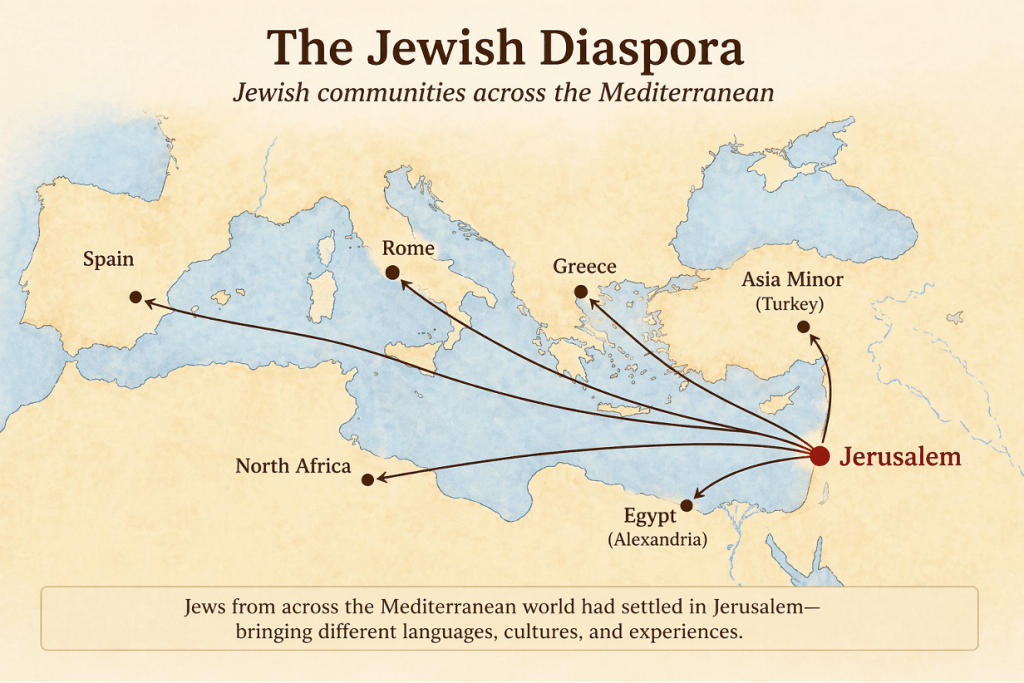
The church in Jerusalem had both Hebrews and Hellenists. The Hellenistic Jews are Jewish followers of Jesus, who speak only or mainly[10] Greek.[11] They were probably from the Diaspora, (the dispersion of Jews all around the known world)[12] who had settled in Jerusalem.[13] Every Jew knew at least a little Greek, since it was the common language for trade in the eastern Mediterranean world.[14] But Hellenists would have attended Greek-speaking synagogues.[15] Some of the upcoming leaders in the church will also be Hellenists, like Stephen, Philip, and eventually even Saul of Tarsus.[16] It’s the beginning of the bridge to the Gentile mission later.[17] But the current apostles—are Hebrews. They are the ones supervising the distribution.
In that society, the family was the center of the system of meaning,[18] and especially strong among the Jews of Palestine.[19] People only survived economically and socially through the ties with their extended families and clans.[20] The only social security people had in that world was the extended family.[21] Many immigrants came to Jerusalem as adults, which means they had less of a local extended kin network than the native Judeans did.[22]
Widows were the most vulnerable and powerless class of people in the ancient world.[23] Women grew up in their father’s house and then moved to their husband’s house. They didn’t have much property, if at all, and very little economic opportunity. They often married older men, which increased their chances of becoming widows at an early stage.[24] As a group, it’s estimated that widows comprised thirty percent of women in the ancient world.[25] The HELLENISTIC widows had probably come from outside of Jerusalem, as many couples did in their old age, so that they could be buried there.[26] If their husbands died, they were cut off from their family networks far away, AND maybe even cut off from local families, after they started following the ways of Jesus.[27] Even in many other parts of the world today, baptism means saying goodbye to an existing family.[28]
The new Christian community may have lived at subsistence level—think of the apostles who were fisherman but didn’t necessarily hire any other workers—they didn’t have a lot, but the early church DID have the benefits of an extended FAMILY: their homes were open to each other, and they shared in the daily tasks of survival.[29] Both Hebrews and Hellenists were a part of this new family group[30] now, believers in Jesus—with God as their Father…but no one had thought ahead for that kind of welfare system.[31]
The idea of democracy, human rights, equality of opportunity, or government social services to help the poor survive was beyond what anyone could have imagined.[32] The Jewish system of care for the poor was a basket that was circulated once a week, so that the needy could have food for the week,[33] and distributions from the money chest every Friday.[34] The Christians had to set up their own system.[35]
2 So the Twelve gathered all the disciples together and said, “It would not be right for us to neglect the ministry of the word of God in order to wait on tables.” Acts 6:2
The Twelve gathered ALL the disciples together to deal with the problem. This is the first time that the term ‘disciple’ is expanded beyond those who followed Jesus during his earthly ministry,[36] because more and more people are coming to believe and be a part of this movement. Last week we looked at Acts 2:42, which gave equal importance to four activities: teaching, fellowship, the breaking of bread, and prayer.[37] The common meals, and the work in preparing, serving and cleaning up—are significant in the life of this community![38] Up to this point, the APOSTLES are handling the finances,[39] teaching and preaching, and maybe their table service is slipping.[40]
To ‘wait on tables’ means to SERVE tables. It may mean the preparing of the meals and cleaning up afterward.[41] But let’s look at meals in the first century for a moment.
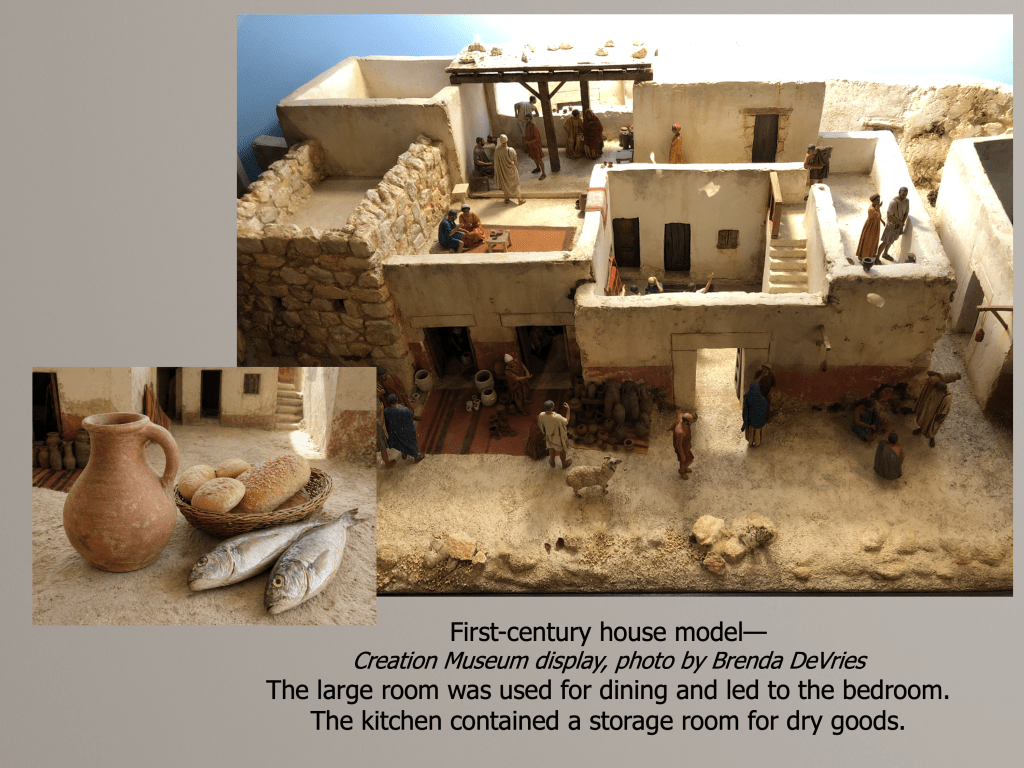
In a typical Palestinian home, the central and largest room was the dining room.[42] Bread was the staple. The weekly bread was baked before the Sabbath and eaten throughout the week. Families sometimes had fish and vegetables on the Sabbath, but meat was a luxury—for feasts and festivals. The poorest people would eat wheat or barley—and may have crushed grain and boiled it in water to make porridge.[43] They ate simply for the most part.
Rome was known for their banquets. They were lavish and long and displayed wealth and power. In Rome, the BANQUET was at the heart of association gatherings.[44] There were associations for builders, craftsman, accountants, merchants, carpenters, and people with common interests or trades. There were other associations based on religious beliefs. Your social ranking—was determined by the meal to which you were invited and the seat you were assigned.[45]
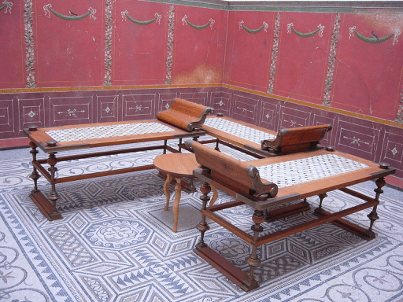
I’d always pictured people reclining while dining, propped up on couches.[46] And yes, a FORMAL dinner party was held in a room equipped with couches on which guests reclined while they ate,[47] because reclining was about status and social position. But laying down was mostly for formal meals with the wealthy, not for everyday eating. It happened a few times in the gospels, but the usual seat was a chair or bench,[48] and many people’s homes had very little furniture.[49] A “table” could be a square of leather spread on the ground like we might spread a picnic blanket, or it might be a very low slab of wood.[50]
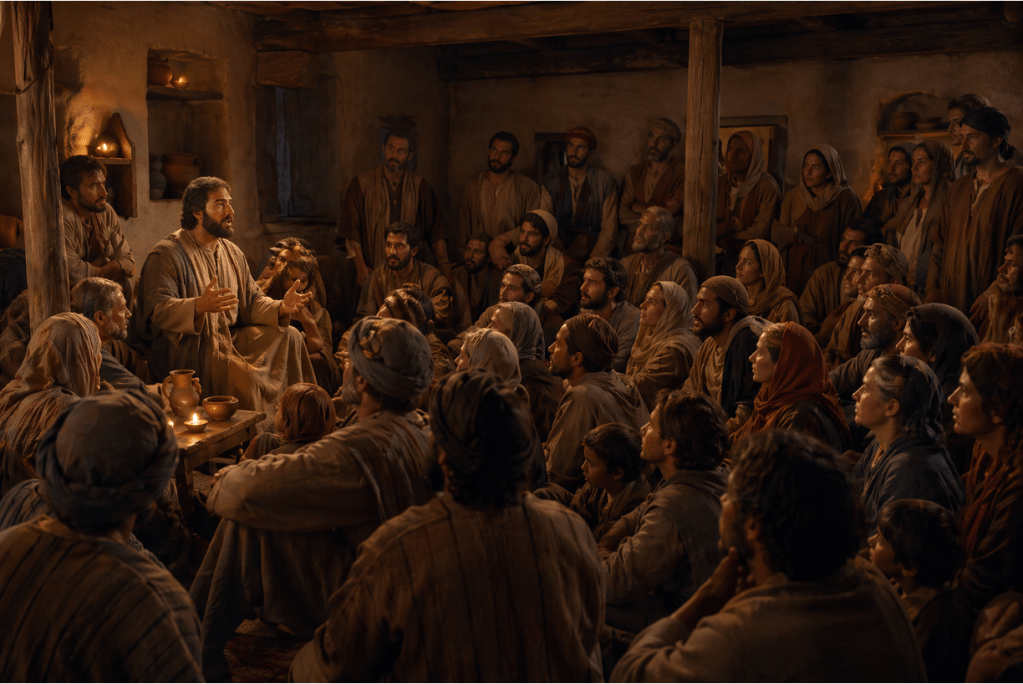
The church, or ekklesia, was just another term for a gathering of Roman citizens, or an association of like-minded people.[51] Rome considered the Jewish followers of Jesus to be a part of a movement within Judaism. They saw their meetings as ASSOCIATION meetings, which met for meals.[52] But eating together, and sharing the Lord’s Supper, was actually a community building activity, and an alternative social movement![53]
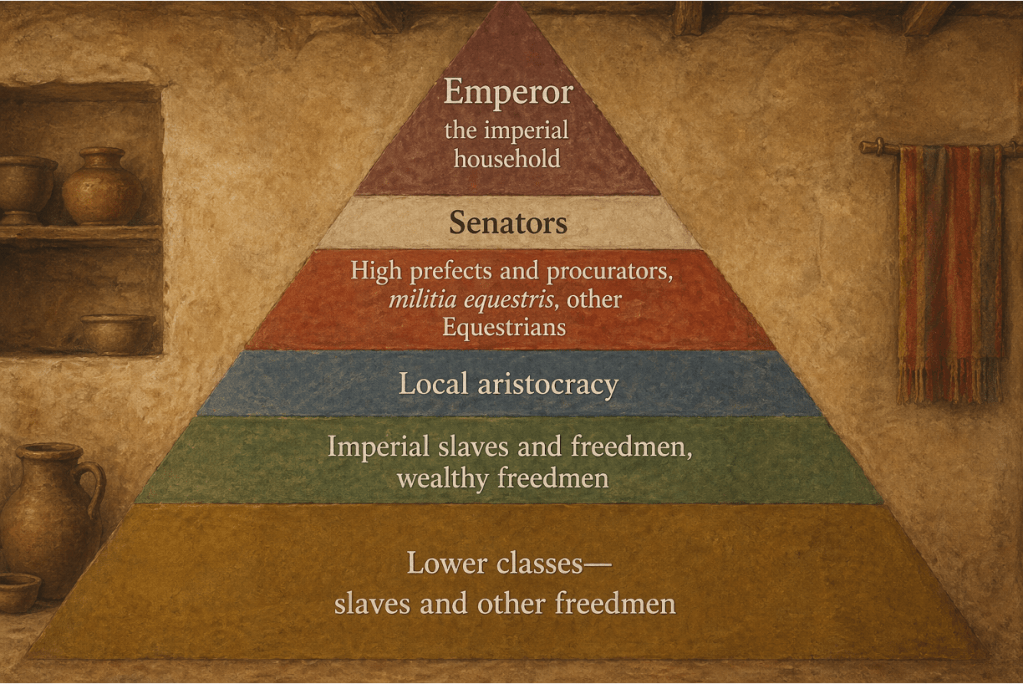
See, the Roman empire was a domination system.[54] Caesar was the fatherly benefactor, but the lowest people on the social pyramid were considered the expendables: beggars, social outcasts, the handicapped.[55] Jesus transformed meals to illustrate that God’s kingdom was all inclusive: women, children, slaves, and all prodigals.[56] GOD was a father to all. Everyone ate from a common table…and meals were an integral part of Christian worship.[57] So, when followers of Jesus would meet, they were inclusive, too, recruiting people from all segments of society regardless of gender, race, or class. In the end, THIS practice was what upended the entire system of Rome. The table fellowship of Christians began to dismantle the hierarchy, and to destabilize the political structure. And it was characterized by SERVANTHOOD.[58]
In Acts 6, the rapid growth in the early church means that the widows need more attention than the twelve apostles can provide.[59] But what kind of attention do they need? Our automatic assumption is that the Hellenistic widows were poor, right? But in this new community, nearly everyone was poor.[60] It’s not like the poor are singled out. We’ve read that possessions are shared and meals are eaten in common.[61] If that’s the case, then this doesn’t seem to be simply a problem of who received food—but something deeper about HOW they were being excluded.
Here’s where our English does us a disservice.
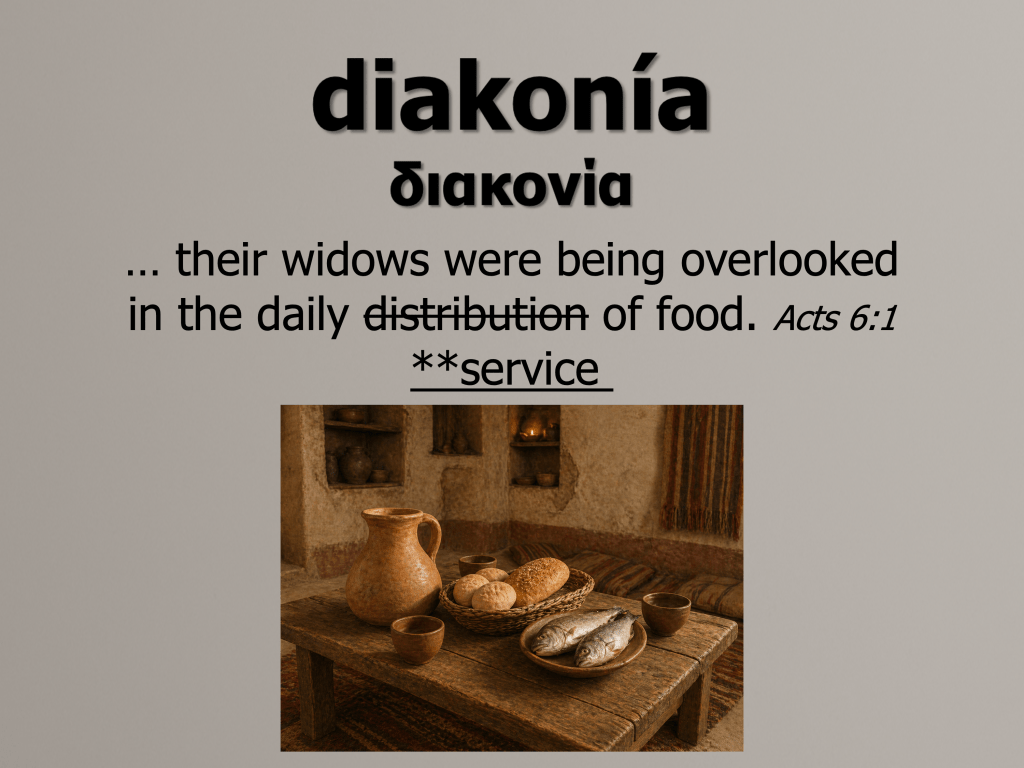
In the English in Acts 6:2, your Bible might say, the widows were being overlooked, or neglected, in the daily distribution of food. But in the Greek, it reads, they were being overlooked in the daily SERVICE of food.
Distribution is not even one of the attested meanings of this noun.[62] The apostles say—it would not be right to neglect the word of God in order to serve tables.[63] They want to devote themselves to prayer and the SERVICE of the word.[64] Those are the same words—service—or diakonía in the Greek: the service of tables—and the service of the word.[65] The widows were being overlooked in the service of food. Something had broken down—not in their belief, but in their participation.
Here’s where culture may play a role. In that time spinning, weaving, and sewing, as well as kitchen work and food preparation is primarily women’s work.[66] In the Gospels, women are often seen as preparing and serving meals for Jesus and his male disciples.[67] Martha’s service to Jesus and his disciples was diakonía.[68] The Greek widows may not have homes to manage anymore, but they also may not have necessarily been old—remember, many of them married older men—who died off quicker. These women are probably not lamenting their condition and expecting handouts or ‘Meals on Wheels.’[69] They may have been given tasks that helped them survive and thrive in this new community,[70] like doing meal prep and serving.[71]
Rita Finger writes: If you understand how ancient Mediterranean community life is structured, then you would know that the communal meals must have been prepared and served by the women. The bread-breaking ritual, which we now call communion, would have been part of the meal, so the work of women was an integral part of the spiritual life of the community. At the end of a day of labor, the daily meal became the central and unifying ritual of the Jesus-community. The work of women was literally holding the church together.[72]
NOW—when you have women from different cultures working and eating together, there can be tensions surrounding meal prep and organization.[73] And–it was more acceptable in the Diaspora—the areas outside of Jerusalem—for women to eat with men at social gatherings.[74] They had different table manners! And some of them may have had a higher degree of integration into Greek society,[75] and possibly some syncretized customs.[76] These are cross-cultural issues![77] On top of that, there may have been some tension and competition between the different groups of women for honors that were associated with the daily common meal, which was a highlight of the day for an entire community.[78] The complaint of the Hellenists is that their widows “were not allowed to participate in the daily meal.”[79]
In any case, the Hellenistic widows had enough clout in the community that they could complain and get results.[80]And in the ancient world, women, especially widows, could safely get away with complaining and even harassing authorities in ways that men could not, and it was often their only means to get justice in an unfair situation,[81]
like the persistent widow in Jesus’ parable.[82] This is not a minor disagreement, or a food fight.[83] It is an issue of unity![84] Their cries reach the ears of the apostles, who call ALL the disciples together to figure out what to do. And here’s the decision:
3 Brothers and sisters, choose seven men from among you who are known to be full of the Spirit and wisdom. We will turn this responsibility over to them 4 and will give our attention to prayer and the ministry of the word.” Acts 6:3-4 NIV
Why seven? According to Josephus, seven was a common number of leaders in many Judean communities.[85] And in ancient communities, groups were often known by their original number. Athens had ‘The Thirty,’ “The Four Hundred”, and ‘the Six hundred”; Rome had officials called ‘the Fifteen”, The ‘Seven”, or the Ten” and so forth.[86] Jesus group of disciples was called ‘the Twelve.’
Luke doesn’t ask, ‘Who is to blame for this situation?’. but rather, ‘What did the Apostles do to remedy the injustice?’[87] The apostles recognize their limitations and they follow Jesus’ model of delegation,[88] and a pattern similar to Moses’ administrative crisis.[89]
In Exodus 18, Moses was trying to lead and judge all the people by himself, handling every dispute from morning until night. His father-in-law, Jethro, saw what was going on and warned that this approach would wear both Moses and the people out. He advised Moses to focus on teaching God’s ways and to appoint capable, trustworthy leaders to share the responsibility. By delegating the work, the burden would be lighter, and the community better cared for.[90] Moses learned he couldn’t carry it alone—and neither could the apostles. Because God never designed His people to depend on one person—but on shared participation.
The guidelines Moses was given—was to: “select capable men from all the people—men who fear God, trustworthy men who hate dishonest gain…”[91] In Acts 6, the men are chosen along the same guidelines. They are trustworthy people, AND because they are also Hellenists, they will make sure that the minority’s voice was heard.[92]
So, the apostles appoint the seven to take care of the widows so that THEY can devote themselves to prayer and to the service—or ‘diakonía’ of the word. It would be tempting to say that the task of proclaiming the gospel is more significant than service to the needy, but the point here is that the fundamental task, the main task of the apostles is to witness to the resurrection of Jesus.[93] The role of “The Seven” is not inferior to that, it’s just a different focus.[94]
Remember: BOTH are called service—the service of the table and the service of the word. Which means this isn’t about one being more important than the other—it’s about the whole community taking part in what God is doing.
The church becomes what it’s meant to be when everyone participates in its life and care
Let’s read that again, and i’ll say the first line and you say the second: The church becomes what it’s meant to be—when EVERYONE participates in its life and care.
The widows in this story are doubly marginalized, as they are not only “widows” –but also widows of “the Hellenists,” who are outside of the center of power.[95] It’s easy for those who speak a different language and come from a different culture to be ignored or overlooked.[96] Who might be easy to overlook in our own circles? Craig Keener writes: It’s a good reminder for us to pay attention to the less powerful voices in our midst, whether that be women in more conservative churches; ethnic or cultural minorities; the younger or older members, those who are suffering, and so on.[97] At the Table of Participation—it is our job to pay attention to who gets heard, who gets included, and how leadership responds.
So why were seven MEN chosen to serve tables? Maybe the Hellenistic Greek widows are being left out of serving the food, and the men are appointed to supervise the quarreling women,[98] especially if there is tension and competition around the ‘who’ and the ‘how’ of the daily meals. It’s also noteworthy that this aligns with Jesus’ own call to his disciples in Luke’s Gospel.[99] In the Last Supper, Jesus, the ultimate teacher, said that the greater disciple is the one who serves[100], which, in that day, was a feminine role, or a male slave’s role.[101] Appointing men to be involved with the communal meal was a call to serve just as Jesus served,[102] and their task may have included some of the male-oriented tasks of food production in that day: planting, cultivating, harvesting crops, threshing barley or wheat; building fires to bake the bread.[103] And further, these seven may not actually be taking over the women’s work but overseeing the communal meals,[104] working WITH the women. And if they were bi-lingual, they would have been able to navigate that organization more effectively.[105]
“Waiting on tables” for these men is not just a menial task. It is precisely the means through which the Word of God can be proclaimed among other marginalized communities,[106] as they provide the setting—where table fellowship with the outcasts and the oppressed becomes possible.[107]
5 This proposal pleased the whole group. They chose Stephen, a man full of faith and of the Holy Spirit; also Philip, Procorus, Nicanor, Timon, Parmenas, and Nicolas from Antioch, a convert to Judaism. 6 They presented these men to the apostles, who prayed and laid their hands on them. Acts 6:5-6 NIV
These seven men are never seen serving tables.[108] But their work doesn’t preclude other tasks, either.[109] Some of the seven, like Stephen and Philip,[110] are also evangelists.[111] When they preach the Word; they pave the way for the Word to be preached beyond the Judeans.[112] And Philip’s four unmarried daughters who were all prophets, probably prepared him for nontraditional relationships around the table.[113]
This group of men is chosen and ordained as servants of the table. Again, the word ‘serve’ comes from the same word that is translated as ‘deacon’ in our ENGLISH texts, but Luke doesn’t call them deacons,[114] and there isn’t a formal name or formal office being established in this text.[115] Some churches today appoint deacons who are tasked with providing assistance to the widows and needy, managing benevolence and encouraging community outreach, while a deacon in the New Testament might meet tangible needs in the community, and serve food and drink, but it also included preaching, teaching, or mission work.
So, the role of “The Seven” is not the same as a diákonos in other Biblical texts.[116] Rather, it simply means, ‘servant.’ The apostle Paul was a diákonos, or ‘servant of the gospel’ and the church[117]; Epaphras, the founder of the church in Colossae,is described as a faithful diákonos of Christ.[118] And Phoebe—SHE was a diákonos of the church in Cenchreae.[119] The point is, this is not about a title OR an office, it is about the corporate recognition of leadership gifts and spiritual depth, and a commissioning of them to exercise those gifts within the church. And ultimately, they are not servants of the church members –but of Jesus Christ— who serve others in obedience to Him.[120]
The commissioning of the seven men is done by not just the apostles, but the entire gathering of believers. The community gives its assent, and the group prays and lays hands on them. In the Old Testament, prayer and the laying on of hands invokes God’s blessing on the persons receiving the gesture. (Numbers 27:18-23).[121] And in Acts 6, it doesn’t gift them with the Holy Spirit, they already have the Spirit.[122] This laying on of hands is for the commissioning for a task.[123]
7 So the word of God spread. The number of disciples in Jerusalem increased rapidly, and a large number of priests became obedient to the faith. Acts 6:7 NIV
There were probably between two and twenty thousand priests in that day.[124] One estimate lists around 18,000 Priests and Levites-for those who were on duty for two weeks each year in a rotation.[125] Many of those priests made so little money that they took up a trade when they were not serving at the Temple.[126]
And many of them were probably holy and humble, like Zechariah, father of John the Baptist,[127] and it’s priests like this that believe in the gospel as it is presented by the apostles of Jesus. Now, the apostles are claiming that God is indeed dwelling on earth-but in a far more dynamic form than the temple.[128] So, it also presents a tension as the priests are closely attached to the temple, and THAT way is no longer necessary for followers of Jesus.
At the table, something important is revealed: Not just who is fed—but who is seen. Not just who is present—but who is included. And when participation breaks down, people don’t just go hungry—they get overlooked.
The couple at Emmaus did not recognize Jesus until they broke bread together. Reta Finger writes: We too may not recognize Jesus unless we break bread with each other until all are satisfied and none are in need.[129] The table of participation shows us what kind of community we really are. Meals still matter. Not just because we like food—but because food gathers people, slows us down, and creates space for connection. Communal meals today continue to convey our theology, when Christians of all social classes and ethnic backgrounds come together around food.[130] We eat breakfast together every Sunday—bagels, juice, fruit, donuts, coffee…we eat together every week! Various ages, backgrounds and cultures—and we walk up to the table and can help ourselves—and help each other get food. It may feel simple—but it’s not insignificant. You might even call it sacramental.[131] It’s a small picture of a bigger truth: we are a people who are meant to share life together. And there are faithful servants of the table who help gather and distribute that food for us.
The church becomes what it’s meant to be when everyone participates in its life and care
This isn’t just the story of the Acts church—it’s still true today. The early church held both serving the word AND serving the table to be important. But the apostles protected their time for prayer and the ministry of the Word. The task of teaching, AND caring for the poor, became too great for them.[132]
I’m feeling that tension lately—between things that are all good, but too much for one person to carry. It’s not that I’m too good to be doing other things, but the service of the Word is preparing a different kind of meal, which shapes the entire community. And that’s exactly what we see in Acts 6. The answer isn’t choosing between what matters—it’s sharing the work so that EVERYTHING that matters can flourish. David Garland reminds us: Good preaching cannot stand alone; it requires good administration and good shepherding, such as caring for widows. Likewise, social ministry cannot stand alone.[133] So we need good leaders.
The ways of leadership in the early church were not fixed in stone or established by divine decree. They can be creatively adapted over time, based on the leading of the Holy Spirit and the challenges which arise.[134] The requirements in Acts 6 are still a good marker for all church leaders; wise, competent in administration, and filled with the Spirit.[135]
Today, we’re installing an elder, and we’re not just recognizing a position—we’re recognizing a calling to participate in the life and care of this church. The work of our elders matters—a lot! Leadership in the church is not about doing everything—it’s about helping the whole body function as it should. And just like in Acts 6, this moment isn’t about one person stepping up—it’s about ALL of us remembering that we each have a part to play.
At the Table of Participation, we see a community where needs are noticed, where voices are heard, where care is shared, and where the work of God moves forward. The Holy Spirit empowers every member for their own diakonía. In addition, there are people (like apostles, evangelists, shepherds and teachers) given as special gifts to the congregation to EQUIP the believers[136] for their diakonía[137] -their service. The church becomes what it’s meant to be when everyone participates in its life and care.
So the question for us is simple: Where is God inviting YOU to step in?
Prayer: Lord, thank you for calling us into your church—not just to belong, but to take part. Form us into a people who notice, who care, and who serve together. Show us where you are inviting us to step in, and give us willing hearts to respond. Amen.

Bibliography
- Beard, Mary, Pompeii: The Life of a Roman Town, London: Profile Books, 2008.
- Bird, Michael F. A Bird’s-Eye View of Luke and Acts, Context, Story, and Themes, Downers Grove: IVP Academic, 2023.
- Bruce, F. F., The Book of the Acts, Revised Edition, Grand Rapids: William B. Eerdmans Publishing Company, 1988.
- Finger, Reta Halteman, Of Widows and Meals: Communal Meals in the Book of Acts, Grand Rapids: William B. Eerdmans Publishing Company, 2007.
- Garland, David E., Acts, Teach the Text Commentary Series, Grand Rapids: BakerBooks, 2017.
- Gaventa, Beverly Roberts, The Acts of the Apostles, Abingdon New Testament Commentaries, Nashville: Abingdon Press, 2003.
- Green, Joel B., and Lee Martin McDonald, eds., The World of the New Testament: Cultural, Social, and Historical Contexts, Grand Rapids: Baker Academic, 2013.
- Haenchen, Ernst, The Acts of the Apostles: A Commentary, Philadelphia: The Westminster Press, 1971.
- Keener, Craig S., Acts, Cambridge: Cambridge University Press, 2020.
- Marshall, I. Howard, Acts, Tyndale New Testament Commentaries, Grand Rapids: William B. Eerdmans Publishing Company, 1980.
- Streett, R. Alan, Subversive Meals: An Analysis of the Lord’s Supper under Roman Domination during the First Century, Cambridge: James Clarke & Co., 2013.
- Ward, Kaari, ed., Jesus and His Times, Pleasantville, NY: The Reader’s Digest Association, Inc., 1992.
- Winter, Bruce W., Roman Wives, Roman Widows, Grand Rapids: William B. Eerdmans Publishing Co., 2003.
- Wright, N. T., Acts for Everyone, Part One: Chapters 1–12, Louisville: Westminster John Knox Press, 2008.
- Wright, N. T., The Challenge of Acts, Grand Rapids: Zondervan Academic, 2024.
- Zondervan, Dictionary of Biblical Imagery, edited by John A. Beck, Grand Rapids: Zondervan, 2011.
Articles
- Breed, Gert, “Diakonia in the New Testament and a vision for a biblically based ministry plan”, In die Skriflig, 53 no 1 2019, p1-7.
- Breed, Gert, “Living as a diakonos of Christ and pastoral care to the narcissistically entitled person” In die Skriflig, 55 no 1 2021, p1-10.
- Breed, Gert, “The Essence And Content Of The Work Of The Diakonos According To The New Testament”, Scriptura, 118 no 1 2019, p1-11.
- Kim, Hansung, “Rereading Acts 6:1-7: lessons for multicultural mission organizations”,
- Evangelical Missions Quarterly, Jan 2009, volume 45, issue 1, p56-63.
- Finger, Reta Halteman, “A Theology of Welcome: the hospitable hidden women of Acts 2, 4, and 6”, The Conrad Grebel Review, Winter 2005, p30-41.
- Lienhard, Joseph T., “Acts 6:1-6: a redactional view”, The Catholic Biblical Quarterly, 37 no 2 Apr 1975, p228-236.
- McCaughey, J Davis, “The intention of the author: some questions about the exegesis of Acts 6:1-6”, Australian Biblical Review, 7 no 1 – 4 Dec 1959, 27-36.
- Nagel, Norman E., “The twelve and the seven in Acts 6 and the needy”, Concordia Journal, 31 no 2 Apr 2005, p113-126.
- Pao, David W, “Waiters or preachers: Acts 6:1-7 and the Lukan table fellowship motif”, Journal of Biblical Literature, Spr 2011, volume 130, issue 1, p127-144.
- Panning, Armin J., “Acts 6: The ‘Ministry’ of the Seven”, Wisconsin Lutheran Quarterly, 93 no 1 Wint 1996, p11-17.
- Sell, Phillip, “The seven in Acts 6 as a ministry team”, Bibliotheca sacra, 167 no 665 Jan – Mar 2010, 58-67.
- Smith Dennis E., “Dinner with Jesus & Paul: The Social Role of Meals in the Greco-Roman World”, Biblical Archaeology Society, August 2004. https://library.biblicalarchaeology.org/article/dinner-with-jesus-paul/
- Spencer, F Scott, “Neglected Widows in Acts 6:1-7”, The Catholic Biblical Quarterly, 56 no 4 Oct 1994, p715-733.
Going Deeper Questions
- Have you ever had a moment where you felt overlooked or left out in a group? What made that experience stand out to you?
- What helps you feel seen and included in a community?
Read Acts 4:33-35, and Acts 6:7
- In Acts 4, the early church is described as having “no needy persons among them.” What changed by Acts 6:1?
- Why do you think the complaint of the Hellenistic widows was such a serious issue for the early church?
- The apostles call the whole group together to address the problem. What does that tell us about how decisions were made?
- How does the story of Moses in Exodus 18 help us understand what’s happening in Acts 6?
- Why is it important that the apostles didn’t try to do everything themselves?
Digging Deeper
- Many people read this passage as a problem of food distribution. The Greek reads that the widows were being overlooked in the daily SERVICE of food. What difference does it make to see this instead as a breakdown in participation and inclusion?
- What’s the difference between someone being given something… and someone being invited to take part?
- Where might we unintentionally “take care of needs” for people… without actually including them in the life of the community?
- The Hellenistic widows were outside the center of power. Who might be on the “edges” of communities today?
- How do language, culture, or background sometimes affect who gets heard?
The Table
- The word diakonia is used for both “serving tables” and “serving the word.”
What does this tell us about how God views different kinds of service? - Why do shared meals matter so much in building community?
- In what ways can “the table” (literal or symbolic) reveal who is being included—or overlooked?
The church becomes what it’s meant to be
when everyone participates in its life and care.
- What does participation look like beyond just volunteering?
- Why do you think it can be difficult for people to step into participation?
- What are some ways people already participate in the life of your church that might go unnoticed?
- What would it look like for your group (or church) to better notice and include those people who might be easy to overlook?
Personal Application
- If the Spirit equips all of us for participation, not just a few, what might be one way God has already equipped you to serve or contribute?
- What is one gift, resource, or ability you have that could be shared with others?
- When you think about your current season of life, what kind of participation feels realistic for you right now? Where is God inviting you to step in?
Prayer
Lord, thank you for inviting us not just to hear your Word, but to take part in your life together. Help us to notice those who are overlooked, to share what we’ve been given, and to serve one another with willing hearts. Show each of us where you are calling us to step in, and give us the courage to respond. Amen.
[1] Reta Halteman Finger, Of Widows and Meals, Communal meals in the Book of Acts, Grand Rapids: William B. Eerdmans Publishing Company, 2007, 89.
[2] Beverly Roberts Gaventa, The Acts of the Apostles, Abingdon New Testament Commentaries, Nashville: Abingdon Press, 2003, 113.
[3] Reta Halteman Finger, Of Widows and Meals, Communal meals in the Book of Acts, Grand Rapids: William B. Eerdmans Publishing Company, 2007, 83.
[4] N.T. Wright, Acts for Everyone, Part One, Chapters 1-12, Louisville: Westminster John Knox Press, 2008, 97.
[5] Finger, Of Widows and Meals, 127.
[6] Reta Halteman Finger, “A Theology of Welcome: the hospitable hidden women of Acts 2, 4, and 6”, The Conrad Grebel Review, Winter 2005, p30-41, 35.
[7] N.T. Wright, Acts for Everyone, 99.
[8] N.T. Wright, Acts for Everyone, 98.
[9] David E. Garland, Acts, Teach the Text Commentary Series, Mark L. Strauss and John H. Walton, General Editors, Grand Rapids: BakerBooks, 2017, 63.
[10] Craig S. Keener, Acts, 221.
[11] Beverly Roberts Gaventa, The Acts of the Apostles, Abingdon New Testament Commentaries, Nashville: Abingdon Press, 2003, 112.
[12] N.T. Wright, Acts for Everyone, 98.
[13] Marshall, 126.
[14] Marshall, 125.
[15] F.F. Bruce, The Book of the Acts, Revised Edition, TNICNT, Grand Rapids: Wiliam B. Eerdmans Publishing Company, 1988, 120.
[16] Craig S. Keener, Acts, Cambridge: Cambridge University Press, 2020, 218.
[17] Keener, 222.
[18] Finger, Of Widows and Meals, 128.
[19] Finger, Of Widows and Meals, 129.
[20] Finger, Of Widows and Meals, 143.
[21] Finger, Reta Halteman, “A Theology of Welcome: the hospitable hidden women of Acts 2, 4, and 6”, The Conrad Grebel Review, Winter 2005, p30-41, 35.
[22] Keener, 220.
[23] Reta Halteman Finger, Of Widows and Meals, Communal meals in the Book of Acts, Grand Rapids: William B. Eerdmans Publishing Company, 2007, 87.
[24] Gaventa, The Acts of the Apostles, 112.
[25] Bruce W. Winter, Roman Wives, Roman Widows, Grand Rapids: William B. Eerdmans Publishing Co., 2003, 124.
[26] N.T. Wright, Acts for Everyone, 98.
[27] Garland, Acts, 64.
[28] N.T. Wright, Acts for Everyone, 98.
[29] Finger, Of Widows and Meals, 132.
[30] Finger, Of Widows and Meals, 134.
[31] N.T. Wright, Acts for Everyone, 98.
[32] Reta Halteman Finger, “A Theology of Welcome: the hospitable hidden women of Acts 2, 4, and 6”, The Conrad Grebel Review, Winter 2005, p30-41.
[33] Finger, Of Widows and Meals, 254, 255.
[34] Bruce Winter, 127.
[35] Finger, Of Widows and Meals, 255.
[36] Garland, Acts, 64.
[37] Finger, Of Widows and Meals, 266.
[38] Finger, Of Widows and Meals, 267.
[39] Acts 4:35,37.
[40] Finger, Of Widows and Meals, 265.
[41] Finger, Of Widows and Meals, 257.
[42] Finger, Of Widows and Meals, 122.
[43] Finger, Of Widows and Meals, 122, 123.
[44] R. Alan Streett, Subversive Meals: An Analysis of the Lord’s Supper under Roman Domination during the First Century, Cambridge: James Clarke & Co., 2013, 45.
[45] R. Alan Streett, Subversive Meals: An Analysis of the Lord’s Supper under Roman Domination during the First Century, Cambridge: James Clarke & Co., 2013, 43.
[46] http://jmney-grimm.com/2013/11/roman-dining/
[47] Mary Beard, Pompeii: The Life of a Roman Town, London: Profile Books, 2008, 203.
[48] Reta Halteman Finger, 122.
[49] Jesus and His Times, Kaari Ward, Editor, Pleasantville: The Readers Digest Association, Inc., 1992, 93.
[50] John A. Beck, General Editor, Zondervan Dictionary of Biblical Imagery, Grand Rapids: Zondervan, 2011, 249.
[51] Streett, Subversive Meals, 127.
[52] Streett, Subversive Meals, 46.
[53] Streett, Subversive Meals, 50.
[54] Streett, Subversive Meals, 82.
[55] Streett, Subversive Meals, 109.
[56] Streett, Subversive Meals, 133.
[57] Finger, Of Widows and Meals, 90, 91.
[58] Streett, Subversive Meals, 128.
[59] Gaventa, The Acts of the Apostles, 114.
[60] Finger, Of Widows and Meals, 255.
[61] Finger, Of Widows and Meals, 257.
[62] Pao, David W., citing John N. Collins, Diakonia: Re-interpreting the Ancient Sources (New York: Oxford University Press, 1990), 230-31.
[63] Act 6:2
[64] Acts 2:6.
[65] Reta Halteman Finger, Of Widows and Meals, 86.
[66] Finger, Of Widows and Meals, 262.
[67] Finger, Of Widows and Meals, 263.
[68] Michael F. Bird, A Bird’s-Eye View of Luke and Acts, 171.
[69] Finger, “A Theology of Welcome”, 39.
[70] Finger, Of Widows and Meals, 275.
[71] Finger, Of Widows and Meals, 262.
[72] Finger, Reta Halteman, “A Theology of Welcome: the hospitable hidden women of Acts 2, 4, and 6”, The Conrad Grebel Review, Winter 2005, p30-41, 36-37.
[73] Finger, Of Widows and Meals, 275.
[74] Finger, Of Widows and Meals, 263.
[75] Joel B. Green Lee Martin McDonald, editors, The World of the New Testament: Cultural, Social, and Historical Contexts, Grand Rapids: Baker Academic, 2013, 282.
[76] Hansung Kim, “Rereading Acts 6:1-7: lessons for multicultural mission organizations”,
Evangelical Missions Quarterly, Jan 2009, volume 45, issue 1, p56-63, 58.
[77] Hansung Kim, 59.
[78] Finger, Of Widows and Meals, 264.
[79] Pao, David W, “Waiters or preachers: Acts 6:1-7 and the Lukan table fellowship motif”, Journal of Biblical Literature, Spr 2011, volume 130, issue 1, p127-144, 137.
[80] Finger, Of Widows and Meals, 264.
[81] Craig S. Keener, Acts, 222.
[82] Luke 18:1-8.
[83] Finger, “A Theology of Welcome”,38.
[84] McCaughey, J Davis, “The intention of the author: some questions about the exegesis of Acts 6:1-6”, Australian Biblical Review, 7 no 1 – 4 Dec 1959, 27-36, 35.
[85] Keener, 223.
[86] Keener, 223, footnote 706.
[87] Ernst Haenchen, The Acts of the Apostles, A Commentary, Philadelphia: The Westminster Press, 1971, 262.
[88] Craig S. Keener, Acts, 222, Luke 9:1-2, 13-14, 10:1-2.
[89] N.T. Wright, Acts for Everyone, 99.
[90] Exodus 18:13-22
[91] Exodus 18:21
[92] Craig S. Keener, Acts, 225.
[93] Gaventa, The Acts of the Apostles, 114.
[94] Sell, Phillip, “The seven in Acts 6 as a ministry team”, Bibliotheca sacra, 167 no 665 Jan – Mar 2010, 58-67, 63.
[95] Pao, David W., 138.
[96] Garland, Acts, 65.
[97] Craig S. Keener, Acts, 227.
[98] Finger, Of Widows and Meals, 275.
[99] Finger, Of Widows and Meals, 275.
[100] Luke 22: 27.
[101] Finger, Of Widows and Meals, 263.
[102] Finger, Of Widows and Meals, 268.
[103] Finger, Of Widows and Meals, 271.
[104] Finger, “A Theology of Welcome”, 40.
[105] Finger, Of Widows and Meals, 272.
[106] Pao, David W., 143.
[107] Pao, David W., 139.
[108] Gaventa, The Acts of the Apostles, 114.
[109] Finger, Of Widows and Meals, 273.
[110] F.F. Bruce, The Book of the Acts, 122.
[111] I. Howard Marshall, Acts, Tyndale New Testament Commentaries, Grand Rapids: William B. Eerdmans Publishing Company, 1980, 125.
[112] Pao, David W., 139.
[113] Finger, Of Widows and Meals, 274.
[114] Marshall, 126.
[115] Garland, Acts, 66.
[116] Craig S. Keener, Acts, 223, footnote 707.
[117] Colossians 1:23, 25; Ephesians 3:7
[118] Colossians 1:7.
[119] Romans 16:1.
[120] Garland, Acts, 66.
[121] Gaventa, The Acts of the Apostles, 115.
[122] F.F. Bruce, The Book of the Acts, 122.
[123] Garland, 65.
[124] Craig S. Keener, Acts, 227.
[125] Marshall, 128, cf. Luke 1:8.
[126] Ernst Haenchen, The Acts of the Apostles, A Commentary, Philadelphia: The Westminster Press, 1971, 264.
[127] F.F. Bruce, The Book of the Acts, 123.
[128] N.T. Wright, The Challenge of Acts, Grand Rapids: Zondervan Academic, 2024, 42.
[129] Finger, Of Widows and Meals, 286.
[130] Finger, Of Widows and Meals, 280-281.
[131] Finger, “A Theology of Welcome”,40.
[132] Marshall, 126.
[133] Garland, Acts, 66.
[134] Willimon, 60.
[135] F.F. Bruce, The Book of the Acts, 121.
[136] Breed, Gert, “Diakonia in the New Testament and a vision for a biblically based ministry plan”, In die Skriflig, 53 no 1 2019, 1-7, 2.
[137] Ephesians 4:11, 12.

