

About these posts
These posts grow out of sermons I’ve written for my local church community. You’re welcome to use them—for teaching, small groups, preaching, or personal reflection. If you share them elsewhere, please include a simple attribution. If you’d ever like to share how they’re being used, you’re welcome to reach out through the Contact button.

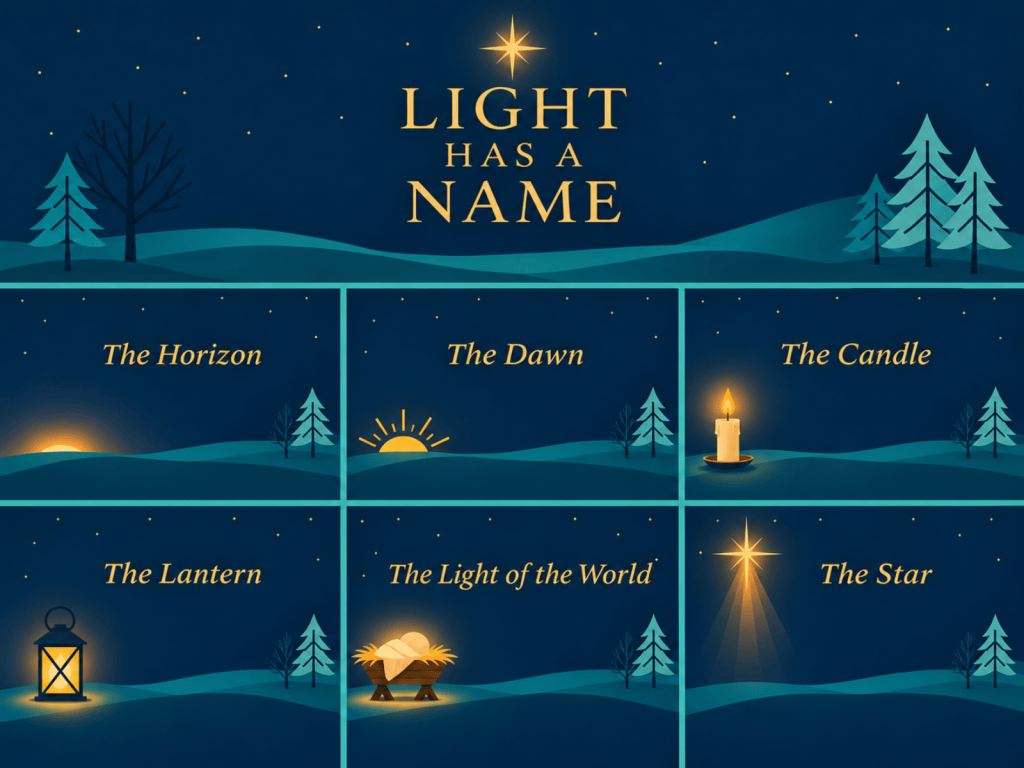
We’re starting a new series today—a week before Advent actually begins. I thought it might be nice this year to prep our minds and our hearts just before we enter this season, because it can be such a hectic time of year. Whether or not you’ve been listening, Christmas music has already been playing for three weeks on the radio, and the stores are in full swing for the holiday season. And we haven’t even had Thanksgiving yet! But into all the hustle and bustle, the truth of Christmas is present: Jesus has come! And he enters our world still today with the Light of his presence. He comes into our darkness—and he brings light.
We’re going to experience Advent in 6 segments this year: The Horizon, The Dawn, The Candle, The Lantern, The Light of the World, and then The Star—as we get close to Epiphany in January—the Sunday where we celebrate the coming of the Wise Men. I’m hoping that it will tie this season together into a cohesive unit as we walk through the start of the darkest weeks of the year, that also coincide with the brightest lights of the season. It’s an ironic contrast. And I believe that God is inviting us to reshape our vision as we look at the birth of Jesus once again.
Have you ever been to a desert? 12 years ago, I took a trip to Israel and spent time in the desert—three days in fact. Yes, we had a bus to travel between places, and ample water, and a hotel room to sleep in. But after just three days’ time, I was utterly and totally sick of the desert. Hot, dusty, dry, hard work—it was something I’ll never forget.
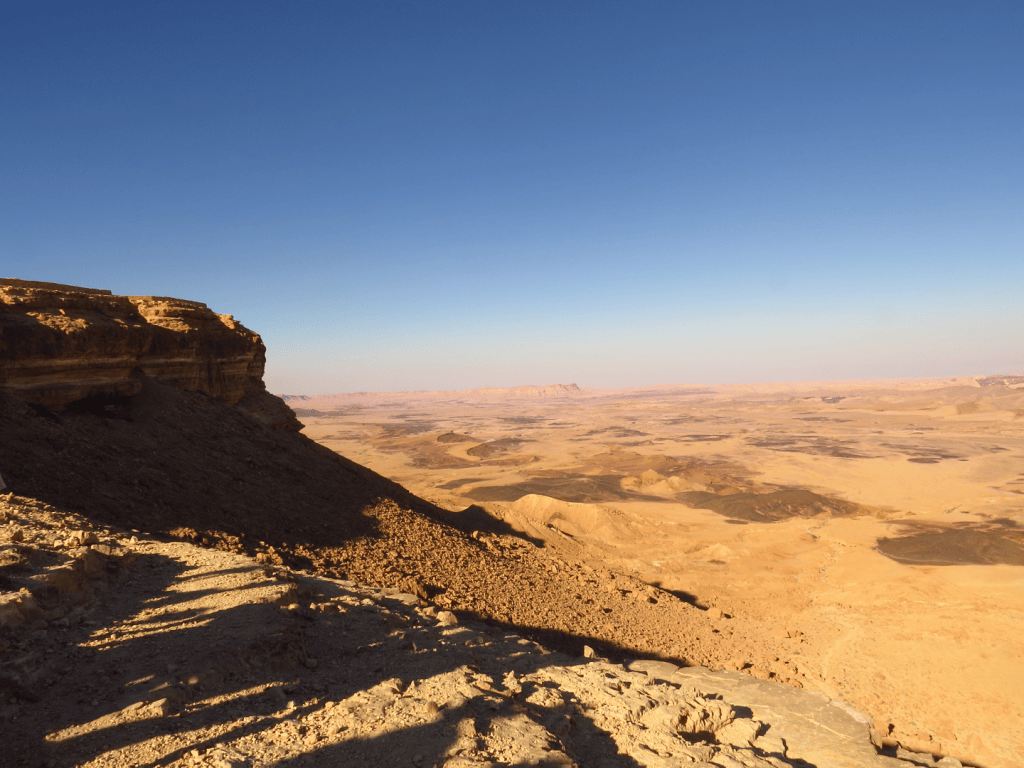
Here’s a picture overlooking some of that desert area—area that the Israelites went through—on the way from Egypt to the Promised Land. Not very promising, is it? You definitely wouldn’t want to be caught in this kind of terrain on your own, or without resources to get you from one end to another. The desert is a demanding place to be in. It strips away any illusions. It exposes weakness.
Maybe you haven’t been to a literal desert—but you’ve definitely experienced a time of wilderness in your life. Job loss. Divorce. Heart attack. Cancer. Depression. It’s difficult to see anything of beauty when you’re in a place like that. It’s challenging to focus on anything other than what you are going through. Your world shrinks. Things are difficult and dry—and finding God in the picture—can be a struggle. We often assume that ‘wilderness’ means God is absent. Isaiah says the opposite. The people of Israel experienced many ‘desert’ situations in their lives. Those who were slaves in Egypt were delivered by Yahweh’s mighty hand and taken into the wilderness. It was there that they learned to depend on God, and they learned who he was and they began to learn and walk in his ways.
But even after they were settled in the Promised Land, they continued to worship other gods. They were warned, time and time again that there would be consequences to their actions, and yet they persisted in their sin. The prophet Isaiah came to king Hezekiah in the later part of Isaiah 39, with a picture of a grim future.
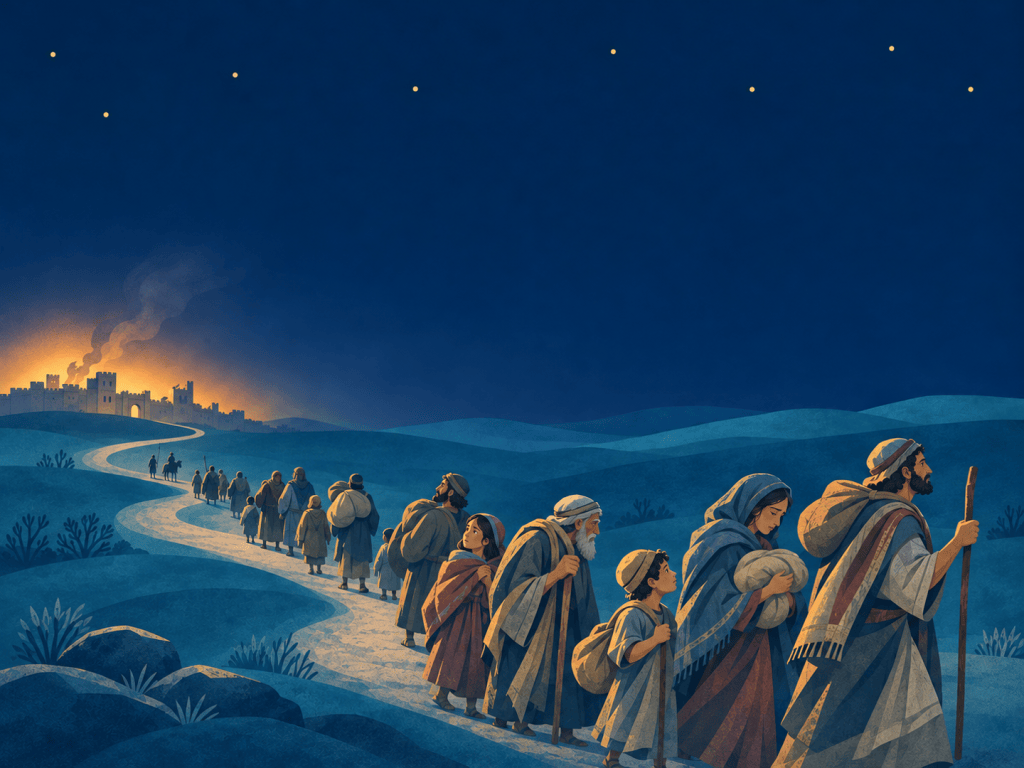
And when Isaiah 40 begins, the people of Israel are in exile in Babylon. They had been carried far from home after Jerusalem was conquered and the temple destroyed. Living under the power of Babylon, surrounded by its wealth, armies, and gods, they were grieving everything they had lost—and wondering whether their own failure had placed them beyond God’s reach. They aren’t just suffering the loss of their homes and homeland. They feel powerless. There is no visible future. The horizon—looks empty and dark. But there is no place too far, no situation too dark, where God’s presence cannot be found. The Psalmist writes:
…even the darkness will not be dark to you; the night will shine like the day, for darkness is as light to you. Psalm 139:12 NIV
God is going to teach his people how to see in the wilderness.
In Isaiah 40: God invites them to reshape their vision of who He is and of who they are
We’re going to study the text of Isaiah 40 this morning. It’s one of the most traditional and frequently read—Old Testament passages during Advent because it offers a message of light, renewal, and grace—to a people waiting in darkness. I’m sure that many parts of it will be familiar to us as we read it. I wrote a paper on this text in seminary—10 years ago! —and thought that I could draw on some of the things I learned then as we look at it today in light of Advent. So, here we go:
Comfort, comfort my people, says your God. 2 Speak tenderly to Jerusalem,
and proclaim to her that her hard service has been completed, that her sin has been paid for, that she has received from the Lord’s hand double for all her sins. Isaiah 40:1-2 NIV
There are three commands here. ‘Comfort’ –is a command. The comfort is for those who are grieving,[1] which in this case is the people who have been in exile. It’s repeated for emphasis[2] with the sense that God ‘keeps saying’ it.[3] ‘Comfort, Comfort.’
The second command is to speak. The ones commanded to speak could be the priests[4], or a nameless person. And this isn’t just about passing on information, but this is a command to speak to Jerusalem’s heart—the heart that is hurting. The third command is to proclaim—to call out: her service has ended, her iniquity is pardoned, and that she has received double for all her sins. It has the connotation—that the punishment exactly matches the time[5] they have spent in captivity,[6] and the justice of God is satisfied.[7] It’s an expression of divine sympathy and even identification with Israel’s suffering.[8] Comfort. Speak tenderly. Proclaim to her the good news!
God invites them to reshape their vision of who He is and of who they are
Who is God? The God who still claims them. He‘s the God who speaks comfort, pardon, and the end of a sentence. Who are they? They are still His people— even after failure and exile. Comforted, forgiven, and not forgotten.
Notice: God speaks before anything changes. The people are still in exile here. The landscape hasn’t changed. But God has begun to change the way they see. Before they even get a glimpse of the road home, God gives them something they need even more: the assurance that they still belong to him. Exile may describe WHERE they are, but it does not define WHO they are. Their failure is real, and its consequences have been painful—but failure will not have the final word.
Maybe you really need to hear that today, too. Your circumstances may not have changed lately. You may be living with loss, regret, uncertainty, or the consequences of something that cannot be undone. But God’s FIRST word to his people in the wilderness is not rejection. It is comfort. The God who still claims his people is already speaking a future they cannot yet see.
And then another voice calls out. This time, it announces that God himself is coming.
3 A voice of one calling: “In the wilderness prepare the way for the Lord; make straight in the desert a highway for our God. 4 Every valley shall be raised up, every mountain and hill made low; the rough ground shall become level, the rugged places a plain. 5 And the glory of the Lord will be revealed, and all people will see it together. For the mouth of the Lord has spoken.” Isaiah 40:3-5
The word ‘wilderness’ is used 21 times in Isaiah. In the Egyptian world, the desert, sea and sky were places that were without role or function and were thought to have been present before creation.[9] The desert was also seen as a place to pass through before going to the place of the dead, and it was thought to have obstacles and gates to go through[10] as well.
A voice cries to prepare a way in the wilderness—for Yahweh. A highway is to be made in the desert for God. This is similar to the manner in which a herald required valleys to be filled and roads to be constructed where a monarch and his army would pass,[11] and the whole scene is represented as a march, or return of Yahweh at the head of his people back to the land of Judea.[12] The idea of a ‘highway to our God’ may be drawing a deliberate and subtle contrast between the outward show of Babylonian rituals (*and it’s assumed by many that the exiles were impressed with those) and the claims of Israel’s redemption, and what God had achieved—set against what the Babylonian gods made a show to do.[13] There may be overtones of the Exodus wilderness wanderings here, in the sense that God comes to help his people, because they cannot help themselves.[14] The act of building a highway, then, is one of faith, because the people don’t yet see their King, but they dare to believe that he is coming.[15] The voice calls out—not for them to escape the wilderness, but to prepare a way. The wilderness is not absence – it’s the place of encounter. God is coming! In this second stanza of Isaiah 40:
God invites them to reshape their vision of who He is and of who they are
Who is God? The One who comes to meet them in the wilderness. Who are they? People who prepare the way and trust his promise even before they can see its fulfillment.
Verse five brings the pieces of Isaiah 40:1-11 together in pronouncing that the aim of all of this—is to reveal the glory of Yahweh so that ALL people will see it together.[16]
The issue isn’t that people can’t see, it’s that they’ve been trained to look at the wrong things. And what should they be looking for?
6 A voice says, “Cry out.” And I said, “What shall I cry?” “All people are like grass, and all their faithfulness is like the flowers of the field. 7 The grass withers and the flowers fall, because the breath of the Lord blows on them. Surely the people are grass. 8 The grass withers and the flowers fall, but the word of our God endures forever.” Isaiah 40:6-8 NIV
Psalm 90:5-6 contains similar imagery, [17] as does James 1 and 1 Peter 1, if you remember the related wording. The grass withers and the flower fades. The people are like grass. But the word of Yahweh lasts forever. In the desert of Egypt and the Levant, a hot dry wind from the east can turn the countryside from green to brown in 48 hours or less. Isaiah compares that to the breath or spirit of Yahweh.[18] The breath of Yahweh is an image of divine judgment.[19]

The contrast is the power and permanence of the prophetic word with the impermanence of political power and human pretensions, with specific reference to Babylon.[20] It’s easy to be impressed by things that don’t last. Babylon appeared immovable. Its wealth was dazzling, its armies were powerful, and its rulers seemed to control the future. We have our own Babylons—political movements, economic systems, powerful institutions, technology, wealth, and human achievement. They command our attention and invite our trust. But Isaiah reminds us that everything built on human power—is grass. It may look permanent from where we stand, but it does not have the final word. I would say that’s a good reminder for us as well.
This section is recalibrating the sight of the people in captivity. God is trying to free them from trusting what cannot last. The people are compared to grass, in their covenant loyalty and keeping the promises towards Yahweh,[21] AND…the rulers and nations like Babylon—are also like grass in that even the mighty will fade away.
What WE are looking at also shapes what we trust. God wants his people to put their eyes on him. In the helplessness that people experience in economic, social, political and military systems, Isaiah declares, even today, that these staggering powers do not have the last word.[22] The promises of the future do not depend on man,[23] but on word of God—which doesn’t just mean ‘word’ in the Hebrew, but also ‘deeds’. God’s word and also his deeds[24] will stand forever. In this section:
God invites them (again) to reshape their vision of who He is and of who they are
Who is God? The One whose word endures. Who are they? Frail and impermanent people—whose future rests not in their own faithfulness, but in the enduring word of God. Here’s the fourth stanza of Isaiah 40.
9 You who bring good news to Zion, go up on a high mountain. You who bring good news to Jerusalem, lift up your voice with a shout, lift it up, do not be afraid; say to the towns of Judah, “Here is your God!” 10 See, the Sovereign Lord comes with power, and he rules with a mighty arm. See, his reward is with him, and his recompense accompanies him. 11 He tends his flock like a shepherd: He gathers the lambs in his arms and carries them close to his heart; he gently leads those that have young. Isaiah 40:9-11 NIV
It wasn’t uncommon for a messenger to go up on a mountain to make a proclamation, where he could be seen and heard.[25] There’s another double command here: to lift up your voice.
The verbs in verse 9 are all feminine, which may point to Zion or Jerusalem being personified as the messenger…to proclaim to her sister cities the joyful news,[26] not just as the recipients of a message, but also the ones entrusted with a message![27] God is opening their eyes to a new reality. But that’s not the end. They are being comforted, forgiven and restored, and then prepared to share the message. God is coming with power! His arm rules! The arm is a symbol of strength,[28] and that imagery is found in the Psalms[29] and in Exodus,[30] and it suggests an exodus power,[31] which is appropriate in relation to a return from exile.[32] God is portrayed here as someone who is mighty by himself, and his arm will rule and bring judgment.
And it’s not just judgment, but Isaiah says that he will bring his reward with him. This exact phrase shows up again in Isaiah 62:11b and in Revelation 22:12 there is similar wording: ‘Behold, I am coming quickly, and My reward is with Me, to render to every man according to what he has done.’ John the elder could be drawing on the Isaiah texts and imagery here—and where Isaiah pictures the removal of the exiles from Babylon, John envisions the removal of Babylon from the exiles.[33] God is a mighty God, AND he comes as a just God who will take care of his enemies and will also reward his people.
Did you notice?—the image of a shepherd is added in verse eleven. The metaphor of a shepherd in the Ancient Near East had royal connotations of strong leadership and tender care.[34] Nebuchadnezzar, the Babylonian king of the exile, called himself ‘the righteous king, faithful shepherd who leads the peoples.’[35] Other kings may call themselves a shepherd, but God is Israel’s true Shepherd-King—powerful enough to deliver and tender enough to care for his flock in the wilderness.
In this fourth stanza of Isaiah 40: God invites them to reshape their vision of who He is and of who they are
Who is God? The mighty King who is also the tender Shepherd. He has absolute power, and cares for the society’s outcasts and most vulnerable people.[36] He will lead his people home—to a place of rest—in their own land. Who are they? The flock he carries—AND the messengers who proclaim, “Here is your God!”
The message of Isaiah 40:1-11 is one of comfort for a people in exile. God is on the move! Help is on the way! Although life is frail, kingdoms come and go, and loyalties will wane, the word of God is forever, and he will keep his promises. As Israel is given the good news, she also becomes the BEARER of good news to her sister cities, and in turn, as a witness to the rest of the world.

But the message of Isaiah is not just for the exiles in Babylon. In this life we still may experience life in the desert where we ask, ‘where are you, God?’ God answers us through the words of Isaiah, today, giving not only comfort but also a call to preach. What do we preach? The word of God. Why? Because it will endure forever![37] Yahweh is still our God, and we are his people. The relationship is real, and the payment for our sin has been completed through Jesus. The images of a strong ruler and compassionate God give us hope and assurance for our final exodus from sin and death.
It’s the week before Advent—the season when the Church turns its attention toward the coming of Christ. Before we celebrate his arrival, we pause at the HORIZON, learning to watch, wait, and recognize the God who comes to us. In Isaiah 40, the people are eyes down, focused on the day to day—stuck in exile—languishing in the wilderness. But God draws their eyes up—to the Horizon. Centuries later, the Gospel writer Mark reaches back to these words to introduce John the Baptist: “A voice of one calling in the wilderness, ‘Prepare the way for the Lord, make straight paths for him.’”[38]
Isaiah’s words found their fulfillment in Jesus Christ. The mighty God arrived in the vulnerability of a child. The Shepherd came to gather the lost and carry the weak. The eternal Word took on our frail flesh and lived among us. The One whose arm rules with power stretched out his arms upon a cross to rescue us. In Jesus Christ, we see who God is. AND in Jesus Christ, we discover who WE are: people God has come to claim,
people he carries close to his heart, and people entrusted with good news for the world.
Advent is about people learning to recognize the Light when He comes. The horizon may still look empty. The landscape may not yet have changed. But we know who is coming. God is preparing a way. So today,
God invites US to reshape our vision of who He is and of who we are
Who is God? He is the God who still comes into the wilderness. He speaks comfort. His word endures. He rules with power and carries his people close to his heart. And who are we? We are his people—we may feel frail, but we are not forgotten; we are comforted, carried, and commissioned to say to the world, “Here is your God!” May we show through our lives and our testimony that Jesus is the Light of the World, as we celebrate him during this season.
PRAYER: Gracious God, you are the One who meets us in the wilderness. When the horizon looks empty, when the road ahead is uncertain, and when our circumstances make it difficult to see you, lift our eyes. Speak comfort to those who are grieving. Speak peace to those carrying regret. Remind those who feel forgotten that they are still yours. Gather the weary in your arms, carry the vulnerable close to your heart, and gently lead those who are struggling to find their way. Forgive us for being impressed by things that don’t last. We place our confidence in human power, political movements, wealth, institutions, and our own achievements. Reshape our vision, Lord. Teach us to trust not in the kingdoms that rise and fall, but in your Word, which endures forever. Prepare a way through the wilderness of our lives. Raise what has been brought low. Bring down the pride that stands in your way. Smooth the rough places within us, and make us ready to recognize Jesus when he comes. As we look toward Advent, help us to watch the horizon with hope, because we know who is coming, even if the landscape hasn’t changed yet. You are our mighty King and our tender Shepherd. You speak comfort. You keep your promises. You carry your people close to your heart. And because we belong to you, give us courage to lift our voices and proclaim who you are through our words and our lives this Advent season. May the light of Jesus shine through us in every dark and weary place. We pray in his mighty name. Amen.

Bibliography
- Barnes, Albert, Notes on the Old Testament: Explanatory and Practical, 7th edition, Grand Rapids: Baker Book House, 1967.
- Blenkinsopp, Joseph, Isaiah 40-55, New Haven: Yale University Press, 2002.
- Brown, F., S. Driver and C. Briggs, The Brown-Driver-Briggs Hebrew and English Lexicon, 13th edition, Peabody: Hendrickson Publishers, Inc., 2010.
- Chilton, Bruce D., The Isaiah Targum Vol. II, Collegeville: Minnesota: The Liturgical Press, 1987.
- Garland, D. David, Isaiah: A Study Guide Commentary, Grand Rapids: Zondervan, 1968.
- Goldingay, John, Isaiah, Grand Rapids: Baker Books, 2001.
- Hilber, John W., Psalms: Zondervan Illustrated Bible Backgrounds Commentary, Grand Rapids: Zondervan, 2013.
- Hallo, William W., The World’s Oldest Literature: Studies in Sumerian Belles Lettres, Leiden: Brill, 2010, 353, 381.
- Laniak, Timothy S., Shepherds After My Own Heart: Pastoral Traditions and Leadership in the Bible, Downers Grove: InterVarsity Press, 2006.
- Longman, Tremper III, and David E. Garland, eds., The Expositor’s Bible Commentary:
- Proverbs-Isaiah, Grand Rapids: Zondervan, 2008.
- Matthews, Victor H. and Don C. Benjamin, Old Testament Parallels: Laws and Stories from the Ancient Near East, New York: Paulist Press, 2006.
- Motyer, J. Alec, The Prophecy of Isaiah, Downers Grove: InterVarsity Press, 1993.
- Oswalt, John N., The New International Commentary on the Old Testament: The Book of Isaiah: Chapters 40-66, Grand Rapids: William B. Eerdmans Publishing Company, 1998.
- Pietersma, Albert and Benjamin G. Wright, eds., A New English Translation of the Septuagint, New York: Oxford University Press, 2007.
- Spore, Andrew P., The Joy of Exile: A Formational Guide to the Revelation of St. John,
- Cochranton: Dead Man Walking Productions and Publishing, 2004.
- Tull, Patricia K., Isaiah 1-39, Macon: Smyth & Helwys Publishing, 2010.
- Watts, John D.W., Word Biblical Commentary, Isaiah 34-66, Waco: Word Books, 1987.
Articles
- Eddinger, Terry W., “An Analysis of Isaiah 40:1-11,” Bulletin for Biblical Research, 1999, 119-135.
- Geller, Stephen A. “A Poetic Analysis of Isaiah 40:1-2”, Harvard Theological Review, 77 no 3 – 4 Jul – Oct 1984, 413-420.
- Goldingay, John, “The Breath of Yahweh Scorching, Confounding, Anointing: The Message of Isaiah 40-42, Journal of Pentecostal Theology, 5 no 11 Dec 1997, 3-34.
- Limburg, James, “Exposition of Isaiah 40:1-11”, Interpretation, 29 no 4 Oct 1975, 406-411.
- Seufert, Matthew, “Isaiah’s Herald”, The Westminster Theological Journal, 77 no 2 Fall 2015, 219-235.
- Snodgrass, Klyne, “Streams of tradition emerging from Isaiah 40:1-5 and their adaptation in the New Testament” Journal for the Study of the New Testament, 8 Jul 1980, 24-45.
- Tidwell, Neville, “The Cultic Background of Isaiah 40:1-11”, Journal of Theology for Southern Africa, 3 Jun 1973, 41-54.
- Van Seters, Arthur, “Isaiah 40:1-11”, Interpretation, 35 no 4 Oct 1981, 401-404.
Going Deeper Questions
Think of a time when you were waiting for something important. What helped you remain hopeful—or made the waiting especially difficult?
Throughout Isaiah 40:1-11, God invites the people to reshape their vision of who He is, and of who they are
Read Isaiah 40:1–2 NIV
Comfort, comfort my people, says your God. 2 Speak tenderly to Jerusalem, and proclaim to her that her hard service has been completed, that her sin has been paid for, that she has received from the Lord’s hand double for all her sins.
[In this section, God invites them to see him as the one who speaks comfort, pardon, and the end of a sentence. They are reminded that they are still His people—even after failure and exile. Comforted, forgiven, and not forgotten.]
- God’s first word to the exiles is “Comfort.” What does this reveal about God’s heart toward people who are grieving, ashamed, or living with the consequences of failure?
Read Isaiah 40:3-5 NIV.
3 A voice of one calling: “In the wilderness prepare the way for the Lord; make straight in the desert a highway for our God. 4 Every valley shall be raised up, every mountain and hill made low; the rough ground shall become level, the rugged places a plain. 5 And the glory of the Lord will be revealed, and all people will see it together.
For the mouth of the Lord has spoken.”
[In this section, God shows them that He is the One who comes to meet them in the wilderness. They are people who prepare the way and trust his promise even before they can see its fulfillment.]
- The people are still in Babylon when God announces that their future is changing. What might it look like to trust God’s promise before your circumstances have changed?
- “Exile” described where Israel was, but it did not define who they were. What circumstances or failures are you sometimes tempted to treat as your identity? What does God say about who you are?
- Preparing a highway for a king was an act of expectation: the people built the road because they believed the king was coming. What could “prepare the way for the Lord” look like in your life during this Advent season?
Read Isaiah 40:6-8 NIV
6 A voice says, “Cry out.” And I said, “What shall I cry?” “All people are like grass, and all their faithfulness is like the flowers of the field. 7 The grass withers and the flowers fall, because the breath of the Lord blows on them. Surely the people are grass. 8 The grass withers and the flowers fall, but the word of our God endures forever.”
[In this section, God reveals Himself as the One whose word endures. They are frail and impermanent people—whose future rests not in their own faithfulness, but in the enduring word of God.]
- Isaiah compares people and human glory to grass that withers. What are some modern “Babylons”—powers, systems, achievements, or institutions—that appear permanent and invite our trust? How can we live responsibly within them without placing our hope in them?
Read Isaiah 40:9-11 NIV
9 You who bring good news to Zion, go up on a high mountain. You who bring good news to Jerusalem, lift up your voice with a shout, lift it up, do not be afraid; say to the towns of Judah, “Here is your God!” 10 See, the Sovereign Lord comes with power, and he rules with a mighty arm. See, his reward is with him, and his recompense accompanies him. 11 He tends his flock like a shepherd: He gathers the lambs in his arms and carries them close to his heart; he gently leads those that have young.
[In this last stanza, God is portrayed as the mighty King who is also the tender Shepherd who cares for the outcast and vulnerable. He will lead his people home. They are the flock he carries and the messengers who proclaim, ‘Here is your God!”]
- God is portrayed as both a powerful King and a tender Shepherd. Which image do you most need right now? Which one is more difficult for you to trust?
- Those who receive the good news become the ones entrusted to proclaim it. How might your words and actions say, “Here is your God!” to someone who is living through darkness or uncertainty?
- As you look toward the horizon of Advent, where do you need God to reshape your vision—of who he is, of who you are, or of what truly lasts?
[1] Oswalt, John N., The Book of Isaiah: Chapters 40-66, Grand Rapids: Eerdmans, 1998, 49.
[2] Albert Barnes, Notes on the Old Testament: Explanatory and Practical, 7th edition, Grand Rapids: Baker Book House, 1967, 52.
[3] J. Alec Motyer, The Prophecy of Isaiah, Downers Grove: InterVarsity Press, 1993, 299.
[4] Bruce D. Chilton, The Isaiah Targum Vol. II, Collegeville: Minnesota: The Liturgical Press, 1987, 77.
[5] Jeremiah 25:8-14 ‘…these nations shall serve the king of Babylon seventy years.’
[6] Motyer, 299.
[7] Franz Delitzsch, The Prophecies of Isaiah, Vol. II, Grand Rapids: Wm. B. Eerdmans Publishing Company, 1967, 140.
[8] Stephen A. Geller, “A Poetic Analysis of Isaiah 40:1-2”, Harvard Theological Review, 77, 1984, 419.
[9] John H. Walton, Ancient Near Eastern Thought and the Old Testament, Grand Rapids: Baker Academic, 2006, 186.
[10] Walton, 178.
[11] Barnes, 51.
[12] Barnes, 55.
[13] Neville Tidwell, “The Cultic Background of Isaiah 40:1-11”, Journal of Theology for Southern Africa, Jun 1973, 42.
[14] Oswalt, John N., The Book of Isaiah: Chapters 40-66, Grand Rapids: Eerdmans, 1998, 52.
[15] Oswalt, 52.
[16] John Goldingay, Isaiah, Grand Rapids: Baker Books, 2001, 224.
[17] ‘like grass…: in the morning it flourishes and is renewed; in the evening it fades and withers’.
[18] Oswalt, John N., The Book of Isaiah: Chapters 40-66, Grand Rapids: Eerdmans, 1998, 53.
[19] ‘You blew with your wind; the sea covered them; they sank like lead in the mighty waters.’
[20] Joseph Blenkinsopp, Isaiah 40-55, New Haven: Yale University Press, 2002, 180.
[21] Isaiah 5:24 ‘…as dry grass sinks down in the flame, so their root will be as rottenness, and their blossom go up like dust; for they have rejected the law of the LORD of hosts…’
[22] Arthur Van Seters, “Isaiah 40:1-11”, Interpretation, 35 Oct 1981, 404.
[23] D. David Garland, Isaiah: A Study Guide Commentary, Grand Rapids: Zondervan, 1968, 83.
[24] Terry W. Eddinger, “An Analysis of Isaiah 40:1-11”, Bulletin for Biblical Research, 1999, 130.
[25] Barnes, 62.
[26] Blenkinsopp, Joseph, Isaiah 40-55, New Haven: Yale University Press, 2002, 185.
[27] Oswalt, John N., The Book of Isaiah: Chapters 40-66, Grand Rapids: Eerdmans, 1998, 54.
[28] Barnes, 63.
[29] Psalm 89:13, 98:1 ‘His aright hand and his holy arm have worked salvation for him.’
[30] Exodus 6:6 ‘I will redeem you with an outstretched arm’.
[31] Deut. 4:34 ‘…by a mighty hand and an outstretched arm…which the LORD…did for you in Egypt…’
[32] Longman, 722.
[33] Andrew P. Spore, The Joy of Exile: A Formational Guide to the Revelation of St. John, Cochranton: Dead Man Walking Productions and Publishing, 2004, 157.
[34] John W. Hilber, Psalms: Zondervan Illustrated Bible Backgrounds Commentary, Grand Rapids: Zondervan, 2013, 26.
[35] Timothy S. Laniak, Shepherds After My Own Heart: Pastoral Traditions and Leadership in the Bible, Downers Grove: InterVarsity Press, 2006, 66.
[36] Blekinsopp, 187.
[37] James Limburg, “Exposition of Isaiah 40:1-11”, Interpretation, 29 no 4 Oct 1975, 410.
[38] Mark 1:1-3

