
About these posts
These posts grow out of sermons I’ve written for my local church community. You’re welcome to use them—for teaching, small groups, preaching, or personal reflection. If you share them elsewhere, please include a simple attribution. If you’d ever like to share how they’re being used, you’re welcome to reach out through the Contact button.
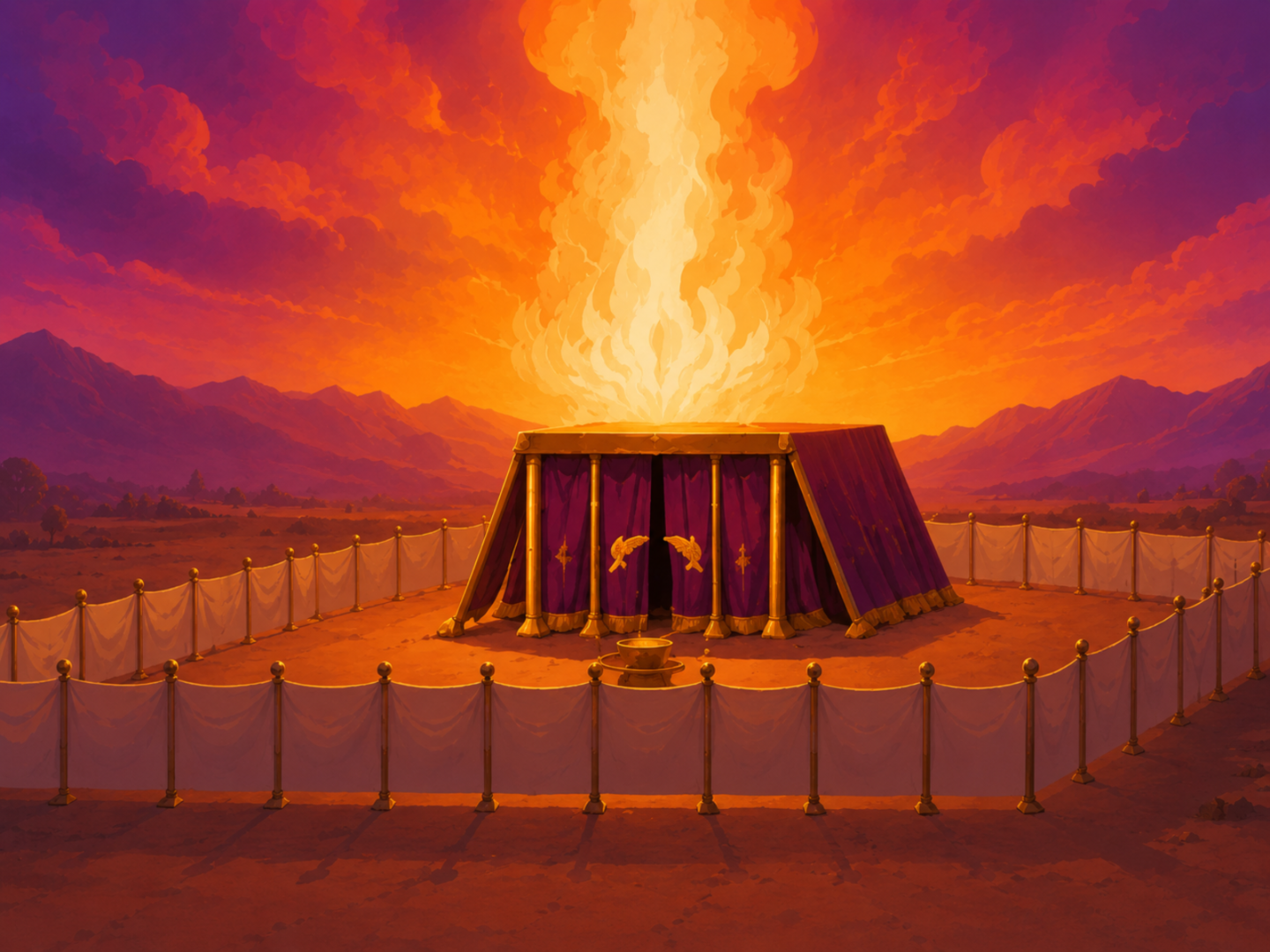
For the past several weeks, we’ve been watching the Israelites prepare a home for God. They’ve gathered materials, contributed their skills, and followed the detailed instructions God gave Moses. We’ve heard about the ark, the lampstand, the altar, the curtains, and the priestly garments. We’ve also witnessed some pretty spectacular failures along the way.
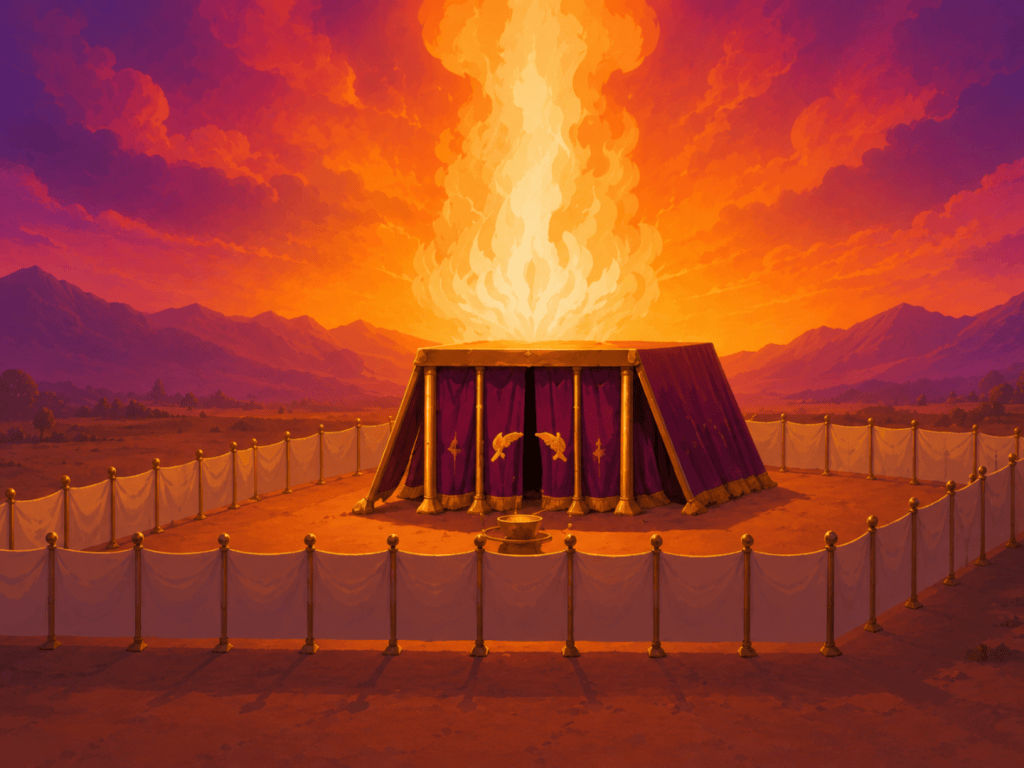
Now, in Exodus 40, everything is ready. But will God actually come? After everything that has happened, after all the complaining, rebellion, and disobedience, will the God who rescued Israel from Egypt truly make His home among them? The answer is breathtaking. This last chapter is an exclamation point on what Exodus has been trying to say since the beginning.[1]
Then the Lord said to Moses: 2 “Set up the tabernacle, the tent of meeting, on the first day of the first month. Exodus 40:1,2 NIV
The Tabernacle and the Tent of meeting now merge.[2] According to rabbinic tradition, the work took about two and a half months.[3] The Tabernacle is to be erected just two weeks short of the first anniversary of the Exodus from Egypt, and exactly nine months since arriving at Sinai. This is New Year’s day, the first day of the first month of the year,[4] a date which has another link with the Creation narrative.[5] This first month was also when the Israelites celebrated the Passover, so as they start their second year in the wilderness, the appropriate Passover offerings will be brought.[6] It’s a new year, a new people, and a new beginning.[7]
The tabernacle is a sign that God has not abandoned His original purpose for creation. Human beings were created to live in God’s presence. Sin disrupted that relationship, but God’s desire to dwell with His people never disappeared. The tabernacle is one more step in God’s great work of redemption. And God used human hands to construct it. God says to Moses:
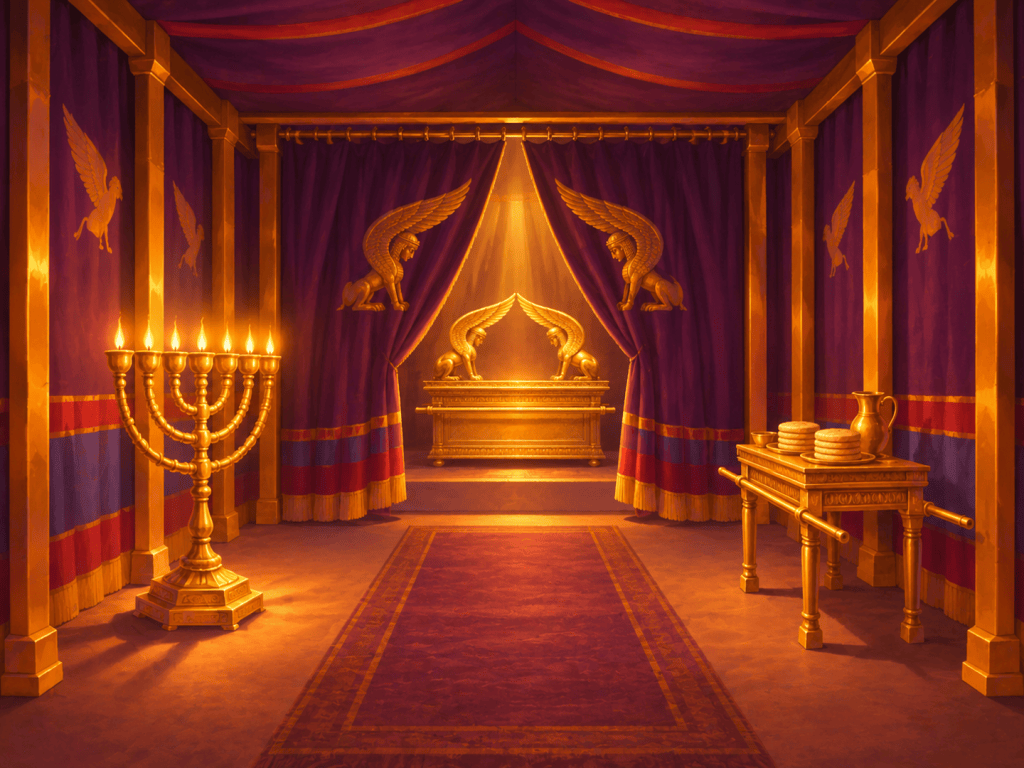
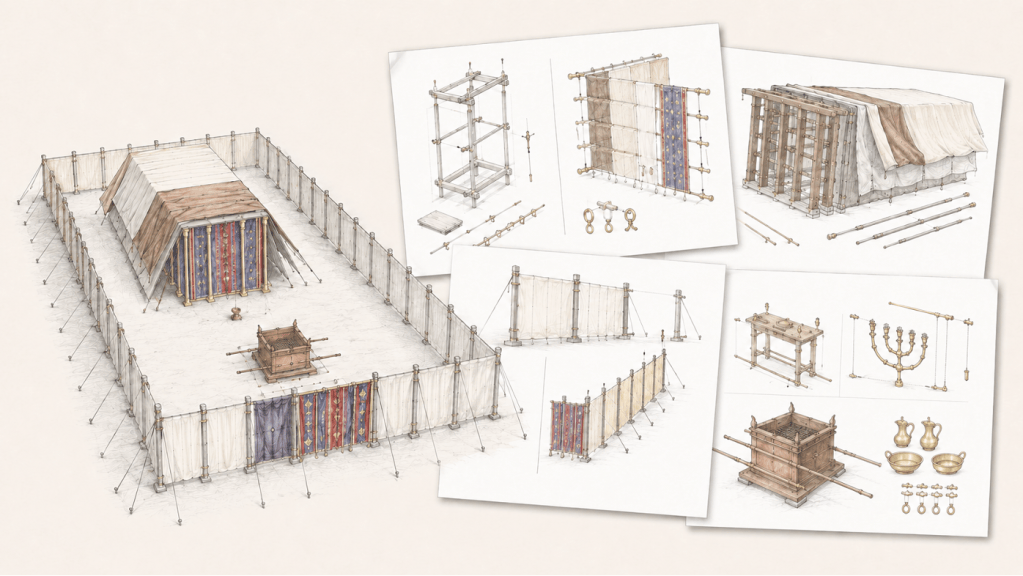
3 Place the ark of the covenant law in it and shield the ark with the curtain. 4 Bring in the table and set out what belongs on it. Then bring in the lampstand and set up its lamps. 5 Place the gold altar of incense in front of the ark of the covenant law and put the curtain at the entrance to the tabernacle.
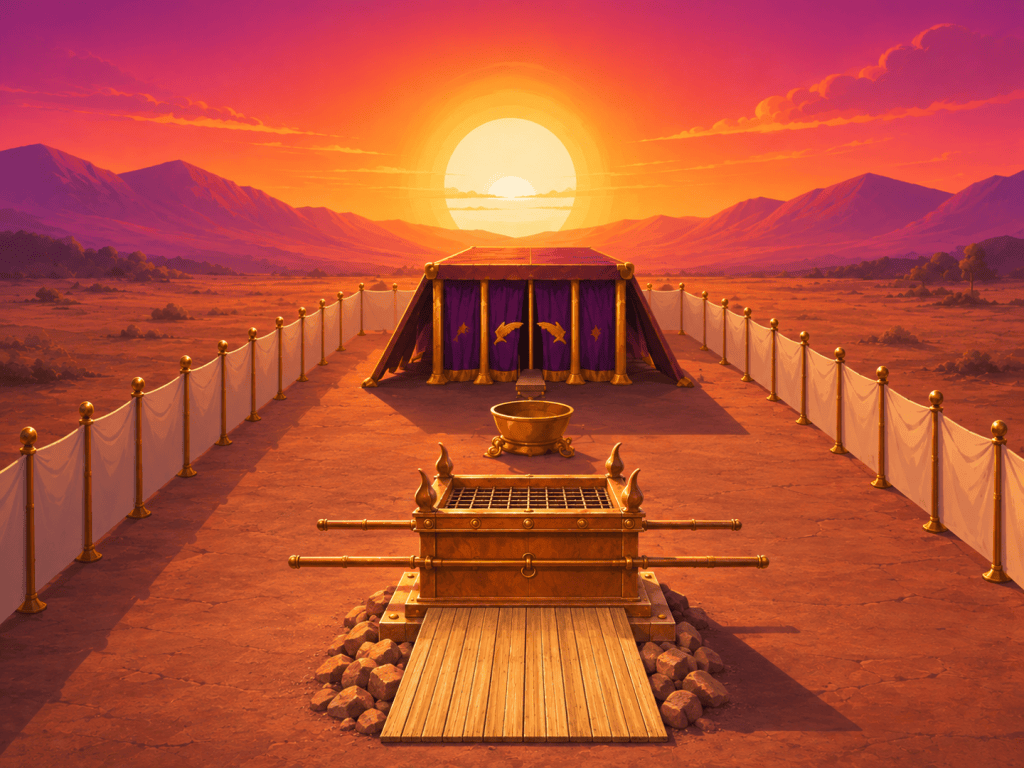
6 Place the altar of burnt offering in front of the entrance to the tabernacle, the tent of meeting; 7 place the basin between the tent of meeting and the altar and put water in it. 8 Set up the courtyard around it and put the curtain at the entrance to the courtyard. 9 Take the anointing oil and anoint the tabernacle and everything in it; consecrate it and all its furnishings, and it will be holy. 10 Then anoint the altar of burnt offering and all its utensils; consecrate the altar, and it will be most holy. 11 Anoint the basin and its stand and consecrate them.

12 Bring Aaron and his sons to the entrance to the tent of meeting and wash them with water. 13 Then dress Aaron in the sacred garments, anoint him and consecrate him so he may serve me as priest. 14 Bring his sons and dress them in tunics. 15 Anoint them just as you anointed their father, so they may serve me as priests. Their anointing will be to a priesthood that will continue throughout their generations.
16 Moses did everything just as the Lord commanded him. Exodus 40:3-16 NIV
If all of this sounds familiar, it’s because we’ve heard these instructions before! God has already explained how everything is supposed to be constructed and arranged. Now, they’re actually doing it. But they haven’t built this tabernacle to convince God to come near. They are responding to God’s invitation to dwell among them. Did you notice the repeated emphasis on obedience? Verse 16 tells us that Moses did everything just as the Lord commanded him. That might not seem particularly remarkable, except when we remember what happened earlier! The people decided they couldn’t wait for Moses to return from the mountain and built a golden calf instead. They had tried to approach God on their own terms. But now they’re following His instructions through Moses. And that pattern is going to keep going. I’ll read the next sections, and you read the bolded part:
17 So the tabernacle was set up on the first day of the first month in the second year. 18 When Moses set up the tabernacle, he put the bases in place, erected the frames, inserted the crossbars and set up the posts. 19 Then he spread the tent over the tabernacle and put the covering over the tent, as the Lord commanded him.
20 He took the tablets of the covenant law and placed them in the ark, attached the poles to the ark and put the atonement cover over it. 21 Then he brought the ark into the tabernacle and hung the shielding curtain and shielded the ark of the covenant law, as the Lord commanded him.
22 Moses placed the table in the tent of meeting on the north side of the tabernacle outside the curtain 23 and set out the bread on it before the Lord, as the Lord commanded him.
24 He placed the lampstand in the tent of meeting opposite the table on the south side of the tabernacle 25 and set up the lamps before the Lord, as the Lord commanded him.
26 Moses placed the gold altar in the tent of meeting in front of the curtain 27 and burned fragrant incense on it, as the Lord commanded him.
28 Then he put up the curtain at the entrance to the tabernacle. 29 He set the altar of burnt offering near the entrance to the tabernacle, the tent of meeting, and offered on it burnt offerings and grain offerings, as the Lord commanded him.
30 He placed the basin between the tent of meeting and the altar and put water in it for washing, 31 and Moses and Aaron and his sons used it to wash their hands and feet. 32 They washed whenever they entered the tent of meeting or approached the altar, as the Lord commanded Moses.
33 Then Moses set up the courtyard around the tabernacle and altar and put up the curtain at the entrance to the courtyard. And so Moses finished the work. Exodus 40:17-33
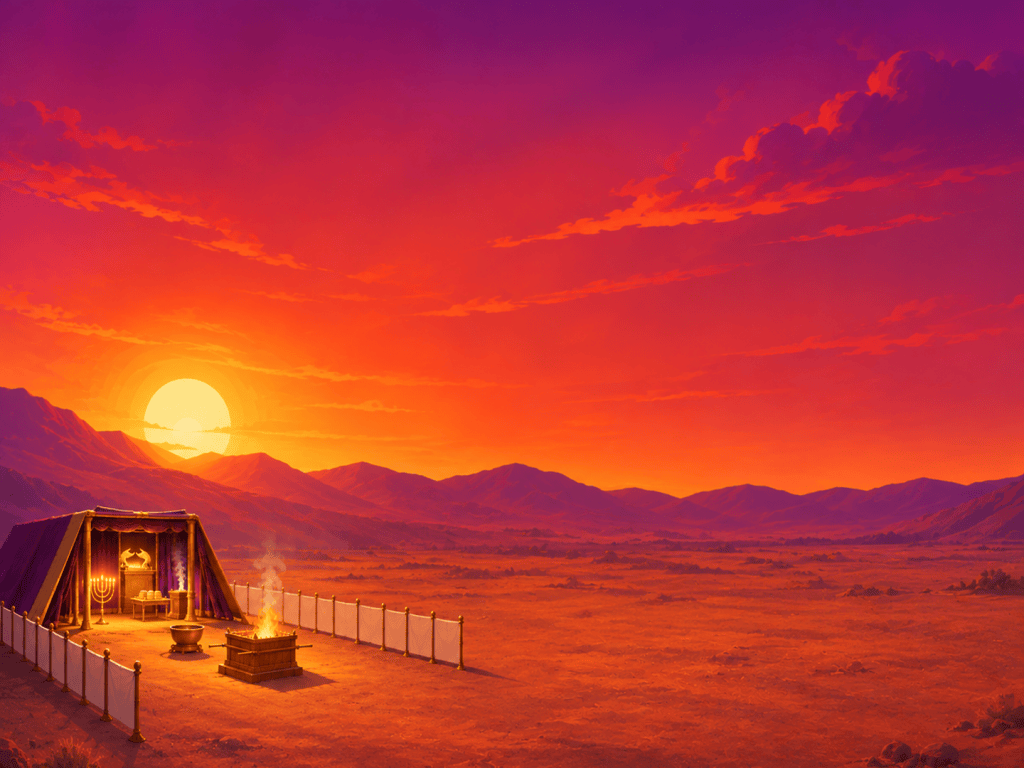
Everything is finally put together and used for the first time. The ark is brought into the tabernacle and the curtain is hung. Incense is burned on the altar for the first time. Moses, Aaron, and Aaron’s sons wash their hands and feet for the first time in the bronze basin.[8] The Tabernacle will now function as the place where sacrifices are offered, as in all Ancient Near Eastern cults, and it is the place where the physical and eternal contract between God and Israel is preserved[9] in the Ark. But the tabernacle isn’t complete just because the construction is finished. God Himself must come.
34 Then the cloud covered the tent of meeting, and the glory of the Lord filled the tabernacle. 35 Moses could not enter the tent of meeting because the cloud had settled on it, and the glory of the Lord filled the tabernacle. Exodus 40:34-35 NIV
Can you imagine what that moment must have been like? For months, the people have been working. They’ve brought their gifts, spun the yarn, crafted the furnishings, and carefully constructed everything according to God’s instructions. And now the work is finished. But no one can make God appear. They can’t summon His glory. They can’t manufacture His presence. But then, the promise God made in Exodus 25:8 became reality. “Have them make a sanctuary for me, and I will dwell among them.” After everything that has happened, God has kept His word.
Mountains can’t move or relocate—but God can![10] God leaves Mount Sinai and comes visibly to his house—to dwell among his people.[11] The tabernacle is now God’s dwelling place on earth. But the cloud is not above the tabernacle—it settles ON it, and God is part of it—he inhabits it, even though he is not confined to it.[12] The Tabernacle is not the only place on earth where God’s presence could be found.[13]
The cloud was with the people when they left Egypt and when they came to Mount Sinai, and now, on the way to the land of Canaan.[14] When the first temple in Jerusalem was built, the cloud descended like that again.[15]
And isn’t it interesting that Moses was the building supervisor of God’s new house, but now that the owner, God, has moved in, Moses cannot just walk in at will.[16] There are boundaries, and Moses must respect them.[17] Access to God is not something that can be taken for granted. It is done on his terms, because He is holy.[18]

In the ancient world, the mountain was where heaven and earth would meet. On the mountain, people can access God’s power and his presence. God placed humanity in a mountain garden in Genesis, but when they decided to go their own way and did not listen to the wisdom of God, they are driven from the mountain, and out of God’s presence. Abraham is tested on a mountain, where God asks him to sacrifice Isaac.
In the end, God provides the sacrifice, and Isaac is spared. Abraham’s children grow into a nation, are enslaved in Egypt, and through a series of plagues, creation is undone, and chaos descends on Egypt. In the desert, Moses goes up a mountain to receive God’s wisdom and take it to the people.[19] Once again, the mountain is a meeting place between heaven and earth.
When we look closely at the way the final chapters of Exodus are arranged, we discover that the biblical writer has been preparing us for this moment all along. In this series, we’ve been studying Exodus chapters 25–40 and the building of the tabernacle. And there’s a fascinating literary structure in these chapters that helps us see what the writer wants us to understand. The major events are arranged in corresponding pairs, with one particularly significant event right at the center. Take a look:
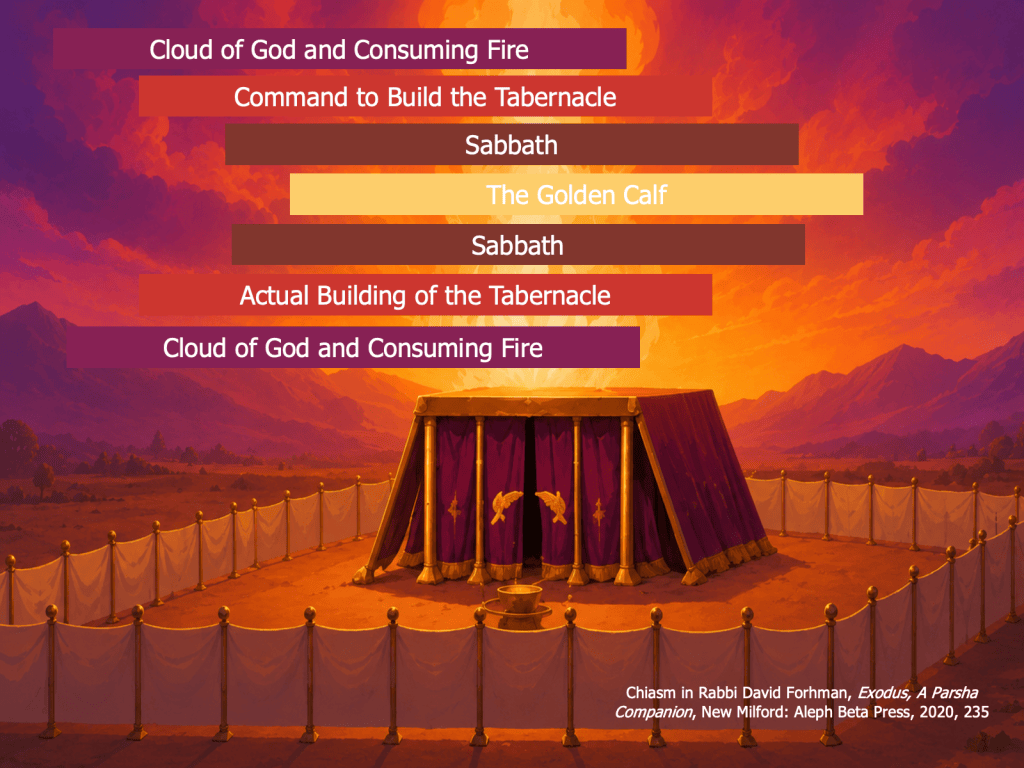
This is a basic chart that comes from Rabbi David Fohrman[20] and frames the chapters we’ve been looking at.
CLOUD OF GOD AND CONSUMING FIRE
In Exodus 24, Moses goes up the mountain, and the cloud of God covers that mountain.
Mountains are things that God has made—and often understood as places where heaven and earth meet. And Mount Sinai certainly was a meeting place between heaven and earth! Remember what happened there? God’s glory descended on the mountain, accompanied by thunder, lightning, fire, and a thick cloud. The mountain trembled, and the people were terrified. God’s presence was unmistakable!
COMMAND TO BUILD THE TABERNACLE
But the people couldn’t just walk up the mountain and meet with God whenever they wanted. There were boundaries. God’s holiness was dangerous to approach carelessly.
Moses was invited into the cloud, and God tells him that he wants the people to build a Tabernacle—where he would dwell among them. God lives outside of time and space, but he desired to have a place in this world, where he and his people would be able to have a relationship, and he would meet with them.
SABBATH
The Tabernacle was a building. The Sabbath was a time period—set aside for people and God to spend time together. It’s where the people make a place in time for God. Think about that for a minute. God wasn’t just interested in a special building. He wanted to shape the rhythm of their lives.
And so, God commanded the observation of the Sabbath. The tabernacle would be a sacred place, set apart for God’s presence. But the Sabbath was sacred time, set apart for rest and fellowship with Him—when they would stop their work and remember who they were—and whose they were. And both were gifts.
And isn’t it interesting that both of these gifts surround the story of the golden calf?
THE GOLDEN CALF
The building of the Golden calf was an attempt to establish a connection with God on behalf of the people. Moses was supposed to do that for them, but when he was gone for 40 days and nights, they gathered around Aaron and demanded that he fix the problem. They tried to make a vehicle for connecting with God—on their own.
SABBATH
And so, right before the people build the tabernacle, they are reminded AGAIN that their REST is just as important as the work! The Sabbath defines them as God’s people. It was a privilege! As they rest, they imitate God, and in a way, the experience that Moses had on the mountain was recreated. No calves necessary.
TABERNACLE
Then the Tabernacle is finally built. It a place and space that allowed access to God. The tabernacle would become the new meeting place between heaven and earth.
CLOUD OF GOD AND CONSUMING FIRE
In the end, God’s glory permeates the Tabernacle—the building that PEOPLE have made. God’s mountain presence comes down to dwell among the people in Israel’s camp.[21] But unlike the mountain, the holiness of God’s cloud is so intense that Moses can’t even enter the space.[22] The intensity dwarfs the actual Sinai experience![23]
At the center of this story is Israel’s failure to be faithful to God. But surrounding that failure is the faithfulness of a God who has not given up on His people.
36 In all the travels of the Israelites, whenever the cloud lifted from above the tabernacle, they would set out; 37 but if the cloud did not lift, they did not set out—until the day it lifted. 38 So the cloud of the Lord was over the tabernacle by day, and fire was in the cloud by night, in the sight of all the Israelites during all their travels. Exodus 40:36-38 NIV
God doesn’t just move in. He moves with His people.
Let’s try that again with me saying the first line and you saying the second.
Leader: God doesn’t just move in. All: He moves with His people.
God comes to dwell among a people who have repeatedly failed Him. His presence is evidence of His mercy and covenant faithfulness. It is a gift. And God moves with them—the cloud and fire are God’s continuing presence and direction. He asks them to follow Him—and his presence shapes their lives. The tabernacle isn’t a permanent stone building in a settled city. It’s a tent! The people will continue to be on the move. When the cloud lifts, the people travel. When the cloud remains, the people stay. They don’t get to control the schedule. They don’t get to decide how long they’ll remain in one place. Their responsibility is to follow.
Having God among them changes how Israel must live. As God’s presence travels with the people in the Tabernacle, they are invited to live according to God’s ways wherever they go.[24] They are called to trust His timing, obey His instructions, and remain faithful along the journey.
Exodus ends without telling us when they will reach the Promised Land. They have no guarantee that the way will be easy. But they have the assurance that God will be with them. The greatest gift God gives Israel isn’t the Promised Land. It’s His presence!
Where have you seen evidence of God’s faithfulness in your own journey? I want you to think about that for a minute. Maybe you have experienced God’s help or deliverance in some way in your life this year. What needs has God met, sometimes in ways you didn’t expect? What might it look like to trust that God is with you, even when you don’t know where the road is leading? Sometimes, following God means moving forward when we’d rather stay where we are. And sometimes, it means waiting when we’d much rather get moving! Neither is necessarily easy. The people in the desert had to learn to trust God’s presence, whether the cloud was moving or remaining in place. And we do, too.
Maybe today you’re facing a decision, and you’re not sure which direction to take. Maybe you’re waiting for something to change, and the waiting has gone on much longer than you expected. Or maybe life has taken an unexpected turn, and you’re trying to figure out what comes next.
The promise of God’s presence doesn’t mean the journey will be easy. And it doesn’t mean we’ll always understand what He’s doing. But it does mean that we are not abandoned along the way.
Leader: God doesn’t just move in. All: He moves with His people.
The book of Exodus sets the stage for all the other stories in the Old Testament.[25] Exodus is the story of the people of God—in bondage, enslaved, delivered, and on the way to the Promised Land. The story ends before they ever get there. They’ve been rescued from Egypt. They’ve received God’s covenant. They’ve built the tabernacle, and God’s glory has filled it. But they’re still in the wilderness!
Exodus is not the end, though. It is really only the beginning of the story.[26] And it’s not only the story of the people of Israel. It’s OUR story, too![27] WE are part of God’s grand redemption story—the true story of the whole world. And the tabernacle was never meant to be the final expression of God’s desire to dwell among His people. In the Biblical story, the Tabernacle and Temple were not local shrines, but cosmic theaters of God’s glory, writes N.T. Wright. The Incarnation [of Jesus] was not a quick rescue mission, but God personally returning to his own creation…God has always intended to unite creation with himself through the Logos (or, Word of God).[28]
Centuries later, the apostle John would write these extraordinary words: The Word became flesh and made his dwelling among us. We have seen his glory, the glory of the one and only Son, who came from the Father, full of grace and truth. — John 1:14
Did you catch that? The Word became flesh and made His dwelling among us. The Greek word John uses for dwelling carries the idea of pitching a tent, or tabernacling among us. John’s first readers, familiar with the story of Exodus, would have recognized the significance. The God who once revealed His glory in a cloud above the tabernacle had now revealed His glory in a person—Jesus Christ. Matthew portrays Jesus as the New Moses. The Lord’s Supper is tied to the Passover. The apostle Paul uses Exodus imagery when he talks about baptism.[29] It’s all Exodus lingo!
And the God of Exodus is STILL guiding his people. He isn’t leading us to Canaan—but to a better heavenly country, says the writer of Hebrews.[30]
God doesn’t just move in. All: He moves with His people.
From the Garden of Eden to the tabernacle in the wilderness, from the manger in Bethlehem to the promise of a new heaven and a new earth, the story of Scripture is the story of a God who desires to dwell with His people. The tabernacle is only a shadow of the closeness of God that is available to the church.[31] God is with us in Jesus. And He’s not finished with the story.
Prayer: Almighty and Merciful God, we thank You for Your faithfulness. Throughout the story of Exodus, we’ve seen Your patience, Your mercy, and Your steadfast love for a people who didn’t always get it right. We’re reminded that we don’t always get it right, either. Yet You continue to draw near to us. Thank You for the gift of Your presence, and for sending Jesus Christ to make His dwelling among us. Lord, help us to trust You with the journeys we’re on. When You call us to move forward, give us the courage to follow. When You call us to wait, give us the patience to remain faithful. When the road ahead is uncertain, remind us that we are never alone. May Your presence shape the way we live, the choices we make, and the way we love and serve others. You are the God who comes near, the God who remains faithful, and the God who goes with His people. And for that, we give You thanks. In the name of Jesus Christ, we pray. Amen.
Bibliography
Alter, Robert; The Five Books of Moses, New York: W.W. Norton & Company, 2004.
Bruckner, James K.; Exodus, Grand Rapids: Baker Books, 2008.
Cassuto, Umberto; A Commentary on the Book of Exodus, Skokie: Varda Books, 2005.
Childs, Brevard; The Book of Exodus, Louisville: The Westminster Press, 1974.
Durham, John I.; Word Biblical Commentary: Exodus, Waco: Word Books, 1987.
Enns, Peter; Exodus: The NIV Application Commentary, Grand Rapids: Zondervan, 2000.
Enns, Peter; Exodus for Normal People, Perkiomenville: The Bible for Normal People, 2021.
Fohrman, Rabbi David; Exodus: A Parsha Companion, New Milford: Aleph Beta Press, 2020.
Fretheim, Terence E.; Exodus, Interpretation Bible Commentary, Louisville: Westminster John Knox Press, 1991.
Goldingay, John; Exodus & Leviticus for everyone, Louisville: John Knox Press, 2010.
Hamilton, Victor; Exodus, Grand Rapids, Baker Academic, 2011.
Merida, Tony; Exodus, Nashville: B&H Publishing Group, 2014.
Meyers, Carol; Exodus, Cambridge: Cambridge University Press, 2005.
Propp, William H.C.; Exodus 19-40; New York: Doubleday, 2006.
Sarna, Nahum M.; Exodus, Philadelphia: The Jewish Publication Society, 1991.
Stuart, Douglas K.; Exodus, Nashville: B&H Publishing Group, 2006.
*Leader’s Guide available on request
Small Group Questions
The God Who Comes Near.
Week Nine: When God Moves In
Exodus 40:1–2, 17–33, 34–35, 36–38
Icebreaker —
- Have you ever moved into a new home or helped someone else move? What was the most memorable, funny, or frustrating part of the experience? What finally made the new place feel like home?
Preparing a Place for God
Read Exodus 40:1–2, 17–33 NIV
Then the Lord said to Moses: 2 “Set up the tabernacle, the tent of meeting, on the first day of the first month.
17 So the tabernacle was set up on the first day of the first month in the second year. 18 When Moses set up the tabernacle, he put the bases in place, erected the frames, inserted the crossbars and set up the posts. 19 Then he spread the tent over the tabernacle and put the covering over the tent, as the Lord commanded him.
20 He took the tablets of the covenant law and placed them in the ark, attached the poles to the ark and put the atonement cover over it. 21 Then he brought the ark into the tabernacle and hung the shielding curtain and shielded the ark of the covenant law, as the Lord commanded him.
22 Moses placed the table in the tent of meeting on the north side of the tabernacle outside the curtain 23 and set out the bread on it before the Lord, as the Lord commanded him.
24 He placed the lampstand in the tent of meeting opposite the table on the south side of the tabernacle 25 and set up the lamps before the Lord, as the Lord commanded him.
26 Moses placed the gold altar in the tent of meeting in front of the curtain 27 and burned fragrant incense on it, as the Lord commanded him.
28 Then he put up the curtain at the entrance to the tabernacle. 29 He set the altar of burnt offering near the entrance to the tabernacle, the tent of meeting, and offered on it burnt offerings and grain offerings, as the Lord commanded him.
30 He placed the basin between the tent of meeting and the altar and put water in it for washing, 31 and Moses and Aaron and his sons used it to wash their hands and feet. 32 They washed whenever they entered the tent of meeting or approached the altar, as the Lord commanded Moses.
33 Then Moses set up the courtyard around the tabernacle and altar and put up the curtain at the entrance to the courtyard. And so Moses finished the work.
Discussion
- The tabernacle was set up on the first day of the first month of Israel’s second year after leaving Egypt. Why might the timing of this event be significant for a people who had experienced slavery, deliverance, and a new covenant with God?
- As you read verses 17–33, what repeated phrase stands out? Why do you think the writer emphasizes that Moses did everything “as the Lord commanded him”?
- Think back to the golden calf incident in Exodus 32. How does Israel’s behavior in that chapter contrast with what we see happening in Exodus 40? What might this teach us about obedience and our relationship with God?
- The tabernacle was constructed from materials donated by the people and fashioned by skilled workers. God invited ordinary people to participate in something extraordinary. What are some seemingly ordinary skills, gifts, or activities that God can use for His purposes? Can you think of examples within our own church?
- Imagine you were an Israelite watching the tabernacle being assembled. After everything your people had experienced, what emotions might you have felt? Excitement? Wonder? Uncertainty? Something else?
When God Moves In
Read Exodus 40:34–35 NIV
34 Then the cloud covered the tent of meeting, and the glory of the Lord filled the tabernacle. 35 Moses could not enter the tent of meeting because the cloud had settled on it, and the glory of the Lord filled the tabernacle.
Discussion
- God had promised in Exodus 25:8, “Have them make a sanctuary for me, and I will dwell among them.” What is significant about the fulfillment of that promise, especially considering Israel’s repeated failures?
- God’s glory filled the tabernacle so completely that even Moses couldn’t enter. What does this reveal about God’s holiness? How do we balance the truth that God desires to be near us with the reality that He is holy and worthy of reverence?
- Throughout Exodus, God’s presence is associated with a cloud and fire. In Exodus 24, the cloud covered Mount Sinai. Now it fills the tabernacle. What is significant about God’s presence moving from the mountain to a tent in the middle of Israel’s camp?
- If you could have witnessed one moment from the entire Exodus story, which would you choose and why? Would it be the burning bush, the crossing of the Red Sea, the giving of the commandments, God’s glory filling the tabernacle, or something else?
- The golden calf represented Israel’s attempt to establish a connection with God on their own terms. What are some ways people today might try to shape God according to their own expectations rather than allowing Him to shape their lives?
God Moves With His People
Read Exodus 40:36–38 NIV
36 In all the travels of the Israelites, whenever the cloud lifted from above the tabernacle, they would set out; 37 but if the cloud did not lift, they did not set out—until the day it lifted. 38 So the cloud of the Lord was over the tabernacle by day, and fire was in the cloud by night, in the sight of all the Israelites during all their travels.
Discussion
- Exodus ends without Israel reaching the Promised Land. Why do you think the book concludes with God’s presence guiding His people rather than with their arrival at their destination?
- The Israelites moved when the cloud lifted and stayed when it remained over the tabernacle. Which do you think would have been harder for you—moving when you wanted to stay, or staying when you wanted to move? Why?
- Imagine your small group had to follow the same travel arrangements as Israel. No advance schedule, no itinerary, and no knowing when it would be time to pack up again! What would be the biggest challenge for you? Who in the group would be most likely to have everything packed and ready to go?
- There’s an important difference between asking God to bless the plans we’ve already made and seeking to follow where He leads. How can we recognize that difference in our everyday decisions?
- What does it mean to trust God’s timing? Can you share an experience when you had to wait longer than you wanted, or when life moved in a direction you hadn’t anticipated? What did you learn?
- God’s presence didn’t mean Israel’s journey would be free from hardship. How does knowing that God is with us change the way we face difficulties, even when our circumstances don’t change?
God doesn’t just move in. He moves with His people.
The God Who Comes Near
- Exodus 40 brings the story of the tabernacle to its climax, but the golden calf incident stands at the center of the larger narrative. What does that arrangement suggest about human failure, God’s mercy, and His faithfulness to His promises?
Read John 1:14 in the versions below:
The Word became flesh and made his dwelling among us. We have seen his glory, the glory of the one and only Son, who came from the Father, full of grace and truth. NIV
And the Word became flesh and tabernacled among us. We looked upon His glory, the glory of the one and only from the Father, full of grace and truth. TLV
- The Greek word translated “dwelling” carries the idea of pitching a tent or tabernacling among us. How does understanding the tabernacle in Exodus deepen your appreciation of what John is saying about Jesus?
- The tabernacle was a place where God dwelt among His people. The New Testament teaches that, through the Holy Spirit, God now dwells in His people (1 Corinthians 3:16). How should that truth affect the way we understand ourselves, our relationships, and our daily lives?
Personal Application
If you genuinely believed that God’s presence was more important than knowing exactly where your life was headed, what might change about the way you approach this coming week?
Closing
The greatest gift God gave Israel wasn’t simply the promise of a new land. It was His presence. Invite each person to share one word or phrase describing what they need from God in the journey ahead—perhaps courage, patience, wisdom, peace, trust, or hope.
Prayer/Leader: Heavenly Father, Thank You for Your faithfulness and Your presence in our lives. Help us to trust You when the way ahead is uncertain, to follow when You lead, and to wait when You ask us to be still. Move our hearts to live according to Your purposes, and remind us that wherever You lead, You are with us. In Jesus’ name, Amen.
[1] Peter Enns, Exodus: The NIV Application Commentary, Grand Rapids: Zondervan, 2000, 601.
[2] James K. Bruckner, Exodus, Grand Rapids: Baker Books, 2008, 328.
[3] Nahum M. Sarna, Exodus, Philadelphia: The Jewish Publication Society, 1991, 234. According to a rabbinic tradition, it was finished on the twenty-fifth day of the ninth month, which is Kislev. (Moses is said to have come down the mountain the second time on Yom Kippur, the tenth day of Tishrei)
[4] Peter Enns, Exodus for Normal People, Perkiomenville: The Bible for Normal People, 2021, 197.
[5] Nahum M. Sarna, Exodus, Philadelphia: The Jewish Publication Society, 1991, 235. Exodus 19:1
[6] Douglas K. Stuart, Exodus, Nashville: B&H Publishing Group, 2006, 788.
[7] Peter Enns, Exodus for Normal People, Perkiomenville: The Bible for Normal People, 2021, 197.
[8] James K. Bruckner, Exodus, Grand Rapids: Baker Books, 2008, 329.
[9] Robert Alter, The Five Books of Moses, New York: W.W. Norton & Company, 2004, 534.
[10] Victor Hamilton, Exodus, Grand Rapids, Baker Academic, 2011, 620.
[11] Douglas K. Stuart, Exodus, Nashville: B&H Publishing Group, 2006, 791.
[12] Carol Meyers, Exodus, Cambridge: Cambridge University Press, 2005, 283.
[13] Terence E. Fretheim, Exodus, Interpretation Bible Commentary, Louisville: Westminster John Knox Press, 1991, 315.
[14] Peter Enns, Exodus: The NIV Application Commentary, Grand Rapids: Zondervan, 2000, 598.
[15] John Goldingay, Exodus & Leviticus for everyone, Louisville: John Knox Press, 2010, 129.
[16] Douglas K. Stuart, Exodus, Nashville: B&H Publishing Group, 2006, 793.
[17] Victor Hamilton, Exodus, Grand Rapids, Baker Academic, 2011, 621.
[18] Peter Enns, Exodus: The NIV Application Commentary, Grand Rapids: Zondervan, 2000, 600.
[19] https://bibleproject.com/guides/the-mountain/
[20] Chiasm in Rabbi David Forhman, Exodus, 235.
[21] https://bibleproject.com/guides/the-mountain/
[22] Rabbi David Fohrman, Exodus: A Parsha Companion, New Milford: Aleph Beta Press, 2020, 235-245.
[23] Rabbi David Fohrman, Exodus: A Parsha Companion, New Milford: Aleph Beta Press, 2020., 247.
[24] https://bibleproject.com/guides/the-mountain/
[25] Peter Enns, Exodus for Normal People, Perkiomenville: The Bible for Normal People, 2021, 198.
[26] Tony Merida, Exodus, Nashville: B&H Publishing Group, 2014, 220.
[27] Based on Tony Merida, Exodus, Nashville: B&H Publishing Group, 2014, 220.
[28] N.T. Wright, Michael F. Bird, https://michaelfbird.substack.com/p/gods-homecoming-nt-wright
[29] Peter Enns, Exodus for Normal People, Perkiomenville: The Bible for Normal People, 2021, 198.
[30] Peter Enns, Exodus: The NIV Application Commentary, Grand Rapids: Zondervan, 2000, 602, Hebrews 11:16.
[31] Douglas K. Stuart, Exodus, Nashville: B&H Publishing Group, 2006, 794.

