
About these posts
These posts grow out of sermons I’ve written for my local church community. You’re welcome to use them—for teaching, small groups, preaching, or personal reflection. If you share them elsewhere, please include a simple attribution. If you’d ever like to share how they’re being used, you’re welcome to reach out through the Contact button. Leader’s Guides for Discussion Questions are available upon request.
If you happen to look the wrong way through a telescope, you will discover that things appear small, far away, narrow. There’s no depth to the picture. Looking at things through the wrong lens distorts everything. Life…can be like that. We’ve all had moments where things that once felt clear… don’t anymore. A relationship we thought would last… A situation we thought would resolve…A season we thought would feel different…And somewhere along the way, we realize—this isn’t what we expected. We may find ourselves saying—sometimes out loud, sometimes quietly: ‘We had hoped…’”
Sometimes the problem isn’t what we’re looking at…it’s HOW we’re looking at it. What we need is not just a new perspective, but someone outside of us—someone greater than us—to help us see. When we come to God’s table, our eyes are opened and our vision is transformed. Our story today comes from Luke’s gospel, chapter 24, beginning at verse 13:
Now that same day two of them were going to a village called Emmaus, about seven miles from Jerusalem. 14 They were talking with each other about everything that had happened. Luke 24:13-14 NIV
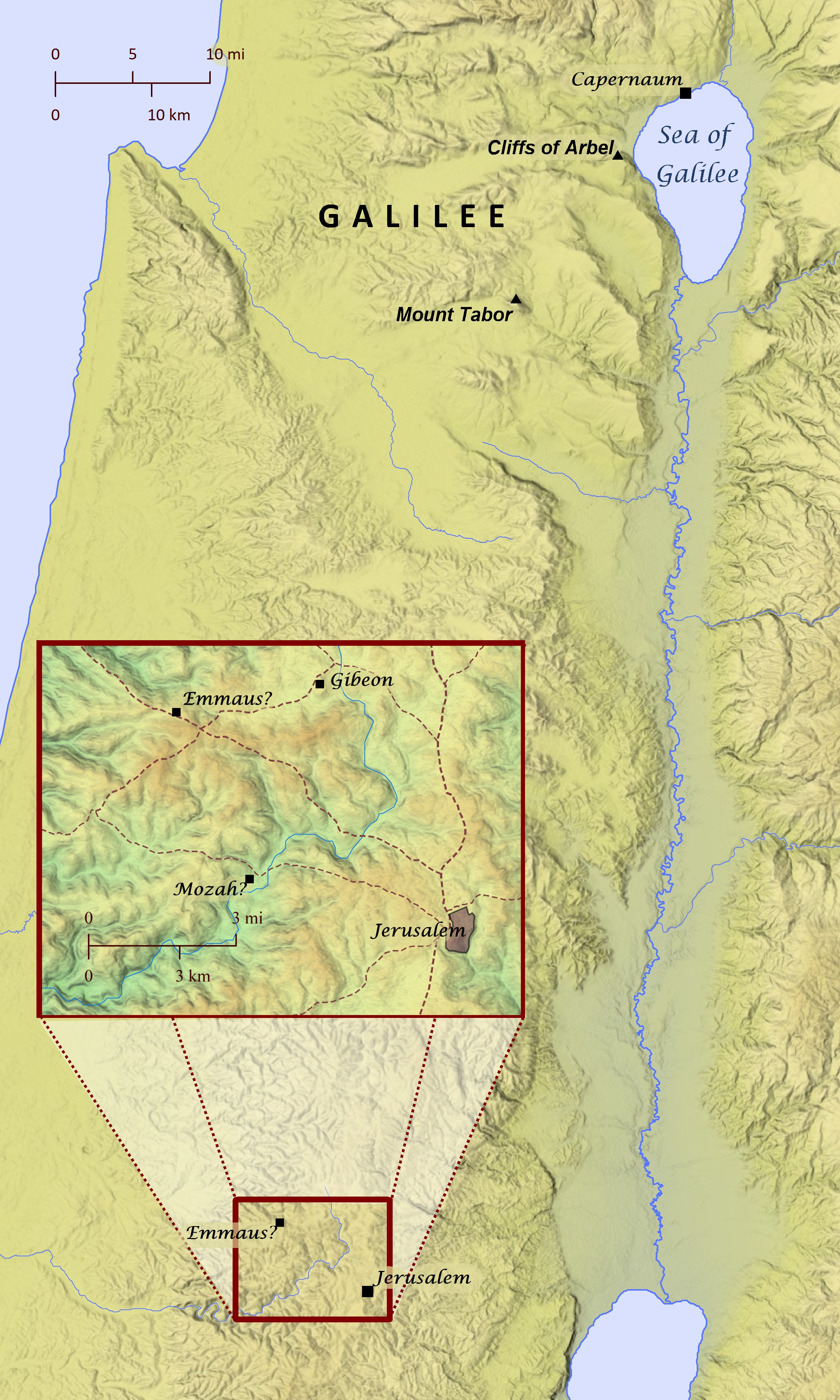
There are two sites with the name Emmaus in Israel during the Second Temple Period, four possible locations on the map,[1] and nine contenders for the Biblical site.[2] Seven miles reads as sixty stadia, which could also be a round-trip distance.[3] We don’t actually know which Emmaus this was…but we do know this—they were walking AWAY from Jerusalem. This may be a married couple—Cleopas and Mary, from John’s Gospel.[4] As these two people walk, they are talking about the latest events. There were so many things to discuss, just like there are for us today.[5] Politics and religion are deep topics, and everything that has happened in THEIR world has been huge!
15 As they talked and discussed these things with each other, Jesus himself came up and walked along with them; 16 but they were kept from recognizing him. Luke 24:15-16 NIV
Jesus may have seemed to be just another person coming back from the Passover celebration in Jerusalem.[6] They didn’t think anything of his appearance alongside of them. Something about Jesus’ body after the tomb had been transformed. But he’s still Jesus. He is the same, and yet different.[7] Luke writes that they have been intentionally kept from recognizing him.[8]
17 He asked them, “What are you discussing together as you walk along?” They stood still, their faces downcast. Luke 24:17 NIV
As it happens, when you look down, you don’t notice what’s going on around you. Not in a bigger sense. They were concerned about one thing. They are devastated about the events that have happened—sad, angry even.[9] The irony is that they consider themselves to be more informed than they actually are.[10] If ANYONE knew what had happened, it was Jesus![11]
18 One of them, named Cleopas, asked him, “Are you the only one visiting Jerusalem who does not know the things that have happened there in these days?” 19 “What things?” he asked. “About Jesus of Nazareth,” they replied. “He was a prophet, powerful in word and deed before God and all the people. 20 The chief priests and our rulers handed him over to be sentenced to death, and they crucified him; 21 but we had hoped that he was the one who was going to redeem Israel. And what is more, it is the third day since all this took place. 22 In addition, some of our women amazed us. They went to the tomb early this morning 23 but didn’t find his body. They came and told us that they had seen a vision of angels, who said he was alive. 24 Then some of our companions went to the tomb and found it just as the women had said, but they did not see Jesus.” Luke 24:18-24 NIV
We like to give Thomas a bad rap for doubting, but he was not alone.[12] The report of the women had obviously failed to convince everyone.[13] Even the disciples considered it utter nonsense at first.[14] All these two can think about is what could have been. “We had hoped…” But if they were so close to what was going on and so devastated, then why are they leaving town? Didn’t anyone care about what happened to Jesus’ body?[15] It IS still just the first day of the week—the SAME day that Jesus rose.[16] Jesus…has had enough.
25 He said to them, “How foolish you are, and how slow to believe all that the prophets have spoken! 26 Did not the Messiah have to suffer these things and then enter his glory?” 27 And beginning with Moses and all the Prophets, he explained to them what was said in all the Scriptures concerning himself. Luke 24:25-27 NIV
Jesus is not going to keep them in the dark. His mission was stated clearly early on in Luke’s gospel where Jesus says, “He (God) has sent me to proclaim freedom for the prisoners and recovery of sight for the blind.”[17] That statement was not just about physical healing, but also spiritual perception, understanding, recognition. Joel Green writes: “What has happened with Jesus can be understood ONLY in light of the Scriptures, yet the Scriptures themselves can be understood ONLY in light of what has happened with Jesus.”[18] These two people saw Jesus as a prophet like Moses, but they misunderstood his prophecies about his own suffering, death, and resurrection. And he is not just a prophet, he is more…he is the Savior who will redeem Israel.[19]
Imagine someone hands you a telescope and says, ‘Look at the horizon.’ You lift it up—but you’re holding it backwards, like the girl in the first picture. Everything looks small and insignificant. You might even think there’s nothing there. But then, someone gently turns it around—and suddenly—everything comes into focus. What looked small now fills your vision. Nothing out there changed, but now you’re seeing it as it really is.
Astronauts talk about this when they go into space. They see the same Earth—but from a completely different vantage point-in the context of its cosmic backdrop.

The Artemis II astronauts became the first humans in decades to see the far side of the Moon[20] with their own eyes—places no one had directly seen before. Seeing Earth from space changes how they understand everything. Borders disappear…priorities shift.
Nothing about earth has changed. Just the perspective has. Christina Koch, one of the Artemis astronauts, said this about seeing Earth from space: “What you realize is that every single person you know is sustained by this thin band of atmosphere. Everything outside of it is completely inhospitable. You don’t see borders. You don’t see religious lines. You don’t see political boundaries. All you see is Earth… and you realize we are far more alike than we are different.”[21]
That’s what happens on the road to Emmaus. The disciples are looking at the same events—the cross, the empty tomb, the story they’ve lived in—but they’re seeing it through the wrong lens.” And Jesus doesn’t give them a new reality—he helps them see the same reality rightly. N.T. Wright describes it as, “They, like everybody else in Israel, had been reading the Bible through the wrong end of the telescope. They had been seeing it as the long story of how God would redeem Israel FROM suffering, but it was instead the story of how God would redeem Israel THROUGH suffering; through in particular, the suffering which would be taken on himself by Israel’s representative, the Messiah.[22]
These two people on the road had zoomed in on one part of God’s story—victory, restoration, triumph—and they missed the larger picture. The perspective of these two disciples prevented them from seeing what stood right in front of them.[23] Jesus is going to adjust their lens. He’s not giving them a new story—he’s turning the telescope around. They continue to walk and talk. Probably for hours.
28 As they approached the village to which they were going, Jesus continued on as if he were going farther. 29 But they urged him strongly, “Stay with us, for it is nearly evening; the day is almost over.” So he went in to stay with them. 30 When he was at the table with them, he took bread, gave thanks, broke it and began to give it to them. 31 Then their eyes were opened and they recognized him, and he disappeared from their sight. Luke 24:28-31 NIV
This is no ordinary meal. Jesus somehow moves from guest to host—as he takes the bread and gives it to them.[24] And it is in the intimacy of fellowship that Jesus is recognized.[25] Maybe they saw the nail prints in his hands. Maybe the familiarity in the way he broke the bread jarred their memory. But at the table, their eyes were opened.
Suddenly, they were able to see everything clearly—literally and figuratively—for the first time.[26] They had been staring into the face of Jesus for hours, but now they connected the dots. They truly recognized who Jesus was—as the Messiah, the Suffering Servant, the Son of God, and their risen Lord![27] When their eyes were opened—everything changed. And then he disappeared.
32 They asked each other, “Were not our hearts burning within us while he talked with us on the road and opened the Scriptures to us?” 33 They got up and returned at once to Jerusalem. There they found the Eleven and those with them, assembled together 34 and saying, “It is true! The Lord has risen and has appeared to Simon.” 35 Then the two told what had happened on the way, and how Jesus was recognized by them when he broke the bread. Luke 24:32-35 NIV
Darrell Bock reminds us that the Table is the place where Jesus was heard and where his presence came across most intimately. Jesus reveals himself in the midst of the basic movements of life.[28] Understanding comes in the meal fellowship of the community, in welcoming and feeding strangers, and accompanied by instruction related to Jesus.[29] This is ourcalling, our place as a church, and as followers of Jesus.
Jesus is not physically present, but he is spiritually present among the community of believers through the breaking of bread.[30] The Table is where we are transformed.
At the table, the risen Christ opens our eyes to his presence—and everything is transformed.
HOW does transformation happen then? Where does it begin?
1. Transformation begins with presence
Before anything is understood in this story, Jesus comes near and walks with them. These two people are walking away in grief, confusion, and dashed expectation. Jesus is already with them, but they don’t truly know it yet. Notice, Jesus doesn’t correct them immediately. He joins them. It may be at our lowest times when Jesus pays a visit—When someone has died, when we have no work, when life turns in a direction other than what we had thought—[31] “Oh, but we had hoped.” We had hoped the marriage would heal. We had hoped the diagnosis would improve. We had hoped this season of ministry would feel lighter. We had hoped God would have shown up differently by now. Sometimes Jesus is closer than we ever realized. Christ often meets us in the ordinary road, in conversation, in sorrow, in questions, in disappointment.
He meets us inside our current understanding, not after we’ve figured things out.
2. Transformation happens through reframing the story
Jesus opens the Scriptures before he opens their eyes. He teaches them first. Their hearts begin to burn before their eyes fully see. That is a lovely reminder that transformation often begins quietly and inwardly before it becomes clear outwardly.
Sometimes Christ is at work in us before we know how to name it. The problem for us is often a misread story. We have grief and longings that need to be reinterpreted through Scripture, just like these two on the Emmaus road.
As followers of Jesus, if we don’t know our Bibles, we won’t know how to make scriptural sense of what happens to us.[32] We need to put ourselves in the places where transformation can take place then: small groups, Bible Studies, Sunday morning gatherings. Sometimes what we need isn’t a different situation… but a different sight.
We need Jesus to help us read the Scriptures…whenever we study the Bible by ourselves, or in larger groups.[33] N.T. Wright says, ‘Take scripture away, and the sacrament becomes a piece of magic. Take the sacrament away, and scripture becomes an intellectual or emotional exercise, detached from real life. Put them together, and you have the center of Christian living as Luke understood it.[34]
3. Transformation is often felt before it is seen
The two in our story say, “Were not our hearts burning within us…?” God often works internally before visibly. We might say, “I don’t fully see it yet, but something is stirring.” “I can’t explain it, but something is shifting.” Transformation is not instant or something necessarily extravagant. It begins with Scripture and the presence of God.
4. Transformation requires invitation and lingering
Jesus acts like he’s going farther. They say: “Stay with us.” They INVITE him to the table. Transformation deepens where there is space, hunger, and invitation. It’s making room for the Spirit of God to do the work. We must pay attention to the quiet ways that Jesus comes near. Allow your heart to be open to the stories of Scripture. Open your eyes to see him in the breaking of the bread.[35]
5. Transformation culminates in recognition
The turning point is not just on the road, but at the table. The risen Christ is recognized in a simple, physical, ordinary act—taking, blessing, breaking, giving. And Jesus keeps meeting people at tables, and in the breaking of bread. The table becomes the place of recognition, communion, and new creation.
Transformation happens in the ordinary act of receiving from Christ. In the first meal of the Bible, the woman took the fruit and ate it, and gave it to her husband, and he ate it…and their eyes were both opened, and they knew that they were naked. In this first meal of NEW creation, Jesus takes the bread, blesses it, broke it, and gave it to them, and the eyes of them were both opened, and they recognized him. These two people—possibly husband and wife, discover that the curse has been broken. Death has been defeated. God’s NEW creation, has burst in upon the world of sorrow.[36] That recognition is a real part of transformation.
Finally, 6. Transformation results in reversal of direction
The two on the road had been walking away from Jerusalem as though the story was over. But after meeting and recognizing Jesus, what seemed like the end becomes the beginning. They turn around. They go BACK. They become witnesses. A real encounter with the risen Christ reorients our direction, too—not just how we feel—but where we go next.
At the table, the risen Christ opens our eyes to his presence—and everything is transformed.
We just looked at part of HOW transformation happens. But what does transformation LOOK like—in real life!? Let me give a few concrete examples of what you might experience.
Despair → Hope (without circumstances changing)
The diagnosis hasn’t changed… but despair loosens its grip. The situation at work is still messy… but you’re no longer overwhelmed by it. The relationship is still complicated… but you’re not without hope.
Confusion → Clarity (about what God is doing)
“Why is this happening?” becomes, “I don’t fully understand, but I trust that God is at work.” “This ruined everything” is shifted to: “Maybe this ISN’T the end of the story.”
Distance → Awareness of Presence
Christ doesn’t suddenly show up—he opens our eyes to where he already is. “Where was God in that?” is now: “He was with me, even when I couldn’t see it.” Feeling alone shifts to becoming aware you’re not alone.
Transformation also looks like
Hearts that are numb → Hearts that are alive
Scripture may have felt flat → suddenly it speaks. Worship feels routine → and then something stirs again. Prayer may have felt empty…and now, you begin to sense connection again.
Retreat → Return (direction changes)
Retreat becomes a return. Instead of pulling back from community, you are leaning back in. Instead of avoiding something hard, you step toward it. Instead of feeling done, there is a re-engaging.
And then transformation looks like the movement from
Silence → Witness
Before, you may have been keeping your faith quiet, now you find yourself speaking about what God has done. An internal struggle turns into a shared testimony.
At the table, the risen Christ opens our eyes to his presence—and everything is transformed.
Maybe Luke only lists one of the names in this story so that you can fill your name in the other spot.[37] WE are invited to see Jesus in the breaking of the bread. …the simple meal points forward to what becomes the central symbolic action of Jesus’ people…. Scripture and sacrament, word and meal, are joined tightly together.
The road to Emmaus is just the beginning.[38] Emmaus says: Christ may already be nearer than you know. He may be walking with you before you recognize him. He may be opening something in you before your eyes can yet see it. And at his table, in his presence, in the breaking of bread, he still opens eyes and turns people back toward life. May Christ meet you on the road, open your eyes to his presence, and turn you back toward life.
PRAYER: Risen Lord Jesus, we thank you that you come near—even when we do not recognize you. You walk with us in our confusion, in our disappointment, in all the places where we find ourselves saying, “We had hoped…” Spirit of the Living God, open our eyes, we pray. Not just to understand more, but to see you—present, alive, at work among us. Where our vision has been narrow, widen it. Where our perspective has been distorted, restore it. Where we have misunderstood your story, teach us again. As Jesus did on the road, open the Scriptures to us. Let our hearts burn within us as your truth takes hold. As you did at the table, make yourself known to us—in the simple, ordinary moments of life, in the breaking of bread, in the life of your people gathered together.
Reorient us, Lord. Where we have been walking away, turn us back toward you. Where we have grown distant, draw us near. Where we have been silent, give us words to bear witness. And as you open our eyes, transform us—not by changing everything around us, but by helping us see what is already true: that Christ is with us, that he is risen, and that your new creation has begun. We offer ourselves to you, God—our questions, our hopes, our lives. Meet us on the road. Open our eyes at the table. And lead us forward in your life. In Jesus’ holy name we pray, Amen.

Bibliography
Bock, Darrell L., Luke, The IVP New Testament Commentary Series, Downers Grove, InterVarsity Press, 1994.
Evans, Craig A., Luke, New International Biblical Commentary, Peabody, Hendrickson Publishers, 1990.
Garland, David E., Luke, Exegetical Commentary on the New Testament, Grand Rapids, Zondervan Academic, 2011.
Green, Joel B., The Gospel of Luke, The New International Commentary on the New Testament, Grand Rapids, William B. Eerdmans Publishing Company, 1997.
Levine, Amy-Jill, and Ben Witherington III, The Gospel of Luke, New Cambridge Bible Commentary, Cambridge, Cambridge University Press, 2018.
Swindoll, Charles R., Insights on Luke, Grand Rapids, Zondervan, 2012.
Wright, N. T., Luke for Everyone, Louisville, Westminster John Knox Press, 2004.
Wright, N. T., Lent for Everyone: Luke, Year C, Louisville, Westminster John Knox Press, 2009.
Articles & Online Resources
Bivin, David N., “A Farewell to the Emmaus Road,” Jerusalem Perspective, January 13, 2017, https://www.jerusalemperspective.com/16208/
Gourinard, Henri, “The Emmaus Trail: Jerusalem’s Newest Hiking Trail Visits a Site from the Gospels and More,” Biblical Archaeology Society, June 10, 2025, https://www.biblicalarchaeology.org/daily/biblical-sites-places/the-emmaus-trail/
Packer, J. I., “Walking to Emmaus with the Great Physician,” Christianity Today, April 10, 1981, https://www.christianitytoday.com/1981/04/walking-to-emmaus-with-great-physician/
Images & Visual Resources
Dunn, Andrew, Wrong End of the Telescope, Wikimedia Commons, CC BY-SA 2.0, https://commons.wikimedia.org/wiki/File:Wrong_end_of_the_telescope_%288506489570%29.jpg
BibleMapper.com, “Jesus Resurrection Map,” https://biblemapper.com/blog/images/md-res/JesusResurrection.jpg
NASA, “Earth Setting Behind the Moon During Artemis II Flyby,” https://www.cnn.com/2026/04/01/science/gallery/moon-mission-artemis-2-photos
Wattles, Jackie, ‘It really bent your mind’: The life-altering phenomenon astronauts experience in space’, CNN Science, April 8, 2026. https://www.cnn.com/2026/04/08/science/overview-effect-astronauts-in-space
Going Deeper Questions
- Have you ever looked through binoculars or a telescope the wrong way? What did everything look like?
Looking at things with the wrong lens can give us a distorted, narrow view, or keep us from seeing the true scale of what’s really there.
Margie Littell writes about how she used to look as salvation as something small and far away. After studying the Bible more carefully, she realized she was looking in the wrong end of the telescope. When Jesus said that the kingdom of God was near, it wasn’t about his second coming, way in the future, he was telling his disciples that when he died and rose again they could join his kingdom! Jesus’ reign began at Calvary. His kingdom is right here, right now![39]
- Where do you tend to see God’s work as “far away” instead of near?
- What might it look like to believe that Jesus’ kingdom is already present in this world right now?
Read Luke 24:13-16 NIV
- The text says these two were “talking and discussing.” What’s the difference between those two words? What does that suggest about their conversation?
- Why do you think Jesus joins them as a fellow traveler rather than immediately revealing himself?
- Have you ever been so focused on a situation that you missed what else was happening around you? Have you ever experienced God being present in your life—but only recognized it later?
Transformation begins with presence
Sometimes Jesus is closer than we ever realized. Christ often meets us in the ordinary road, in conversation, in sorrow, in questions, in disappointment.
Read Luke 24:17-24 NIV
- What do you notice about the emotional state of the two when Jesus asks, “What are you discussing?”
- Have you ever had the right information about something—but still misunderstood what was really going on? How can partial truth lead to a distorted perspective?
- What kinds of conversations do we tend to have when we’re processing disappointment or confusion? How might our grief and expectations shape what we were able—or unable—to see?
- What do you make of the phrase: “we had hoped…”? What does it reveal about their expectations?
- What are some “I had hoped…” moments in your life?
- When life doesn’t go as expected, what kind of story are you most tempted to believe?
- They have heard the report of the empty tomb—but it hasn’t changed their direction. What is the difference between hearing information and believing it?
- If you were walking with them, what would you say to them at this point?
Read Luke 24:25-27 NIV
- Luke emphasizes that Jesus teaches them from Moses, the Prophets, and all the Scriptures. What part of God’s story had they focused on—and what had they missed?
- Jesus doesn’t change their circumstances—he changes how they understand the story. What’s the difference between: God saving us from suffering and God working through suffering?
- Have you ever had to completely rethink something you believed about God?
- What does this passage suggest about the role of Scripture in our spiritual growth?
- What are some ways we can put ourselves in places where Scripture can shape our understanding, and guard against reading Scripture through our assumptions? (as individuals and as a group)
Transformation happens through reframing the story
We have grief and longings that need to be reinterpreted through Scripture, just like these two on the Emmaus road. If we don’t know our Bibles, we won’t be able to make good sense of what happens to us.
At the table, the risen Christ opens our eyes to his presence—
and everything is transformed
Read Luke 24:28-32 NIV
- Jesus does not force himself on them—he waits to be invited. What does that reveal about how Jesus relates to us?
- The disciples say, “Were not our hearts burning within us…?” Have you ever experienced something shifting in your heart before you could fully explain it? Or a moment where something suddenly “clicked” spiritually?
- Jesus is finally recognized in the breaking of the bread. Why might Luke emphasize this sequence? (took, blessed, broke, gave)
- Why might the table be such an important place of encounter throughout the Gospels?
- How does this moment connect to other meals Jesus shared with his disciples?
- Jesus shows up in ordinary, everyday moments. What practices can help us slow down enough to recognize God’s presence?
Transformation is often felt before it is seen
It not instant or something necessarily extravagant. It begins with Scripture and the presence of God.
Transformation requires invitation and lingering
Transformation deepens when we make room for the Spirit of God to work.
Transformation culminates in recognition
The table becomes the place of recognition, communion, and new creation
Read Luke 24:33-35 NIV
- What changes after they recognize Jesus?
- Why is it significant that they immediately return to Jerusalem?
- What role does community play in confirming and strengthening faith in this passage?
- How does hearing others’ experiences of Jesus impact your own faith?
- What are some ways we can practice sharing what God is doing in our lives?
Transformation results in reversal of direction
A real encounter with the risen Christ reorients how where we go next.
Personal Application
- Where do you see the need in your own life for Jesus to help you understand Scripture more deeply?
- Where might God be inviting you to re-engage instead of retreat?
- What might “returning to Jerusalem” look like in your life right now?
What Transformation Looks Like
- Which of these resonates most with you as real places of what transformation looks like in your life?
-Despair → Hope (things haven’t changed, but I have hope)
-Confusion → Clarity (I trust God is at work)
-Distance → Awareness of God’s presence (God is with me even if I can’t see him)
-Numbness → Hearts coming alive (movement from empty to something stirring)
-Retreat → Return (instead of pulling back, I am leaning in)
-Silence → Witness (I’m no longer quiet, I speak about what God has done)
- Where do you see God beginning to transform something in your life?
- If you have truly encountered the risen Christ—what is one step you feel prompted to take this week?
Closing Prayer
Jesus, open our eyes to your presence. Help us to see what is already true—that you are near, that your kingdom has begun, and that you are at work in us. Amen.
[1] David N. Bivin, “A Farewell to the Emmaus Road”, January 13, 2017. https://www.jerusalemperspective.com/16208/?srsltid=AfmBOopV-o62HgV1tLFoEy-A286d8FRji31EBfRKEh6bwW2JMUJsH11i
[2] Henri Gourinard, “The Emmaus Trail: Jerusalem’s newest hiking trail visits a site from the Gospels and more”,
Biblical Archaeological Society, June 10, 2025.
[3]David E. Garland, Luke, Exegetical Commentary on the New Testament, General Editor: Clinton E. Arnold, Grand Rapids: Zondervan Academic, 2011, 949.
[4] John 19:25, based on N.T. Wright, Luke for Everyone, Louisville: Westminster John Knox Press, 2004, 293.
[5] Darrell L. Bock, Luke, The IVP New Testament Commentary Series, Series Editor, Grant R. Osborne, Consulting Editors, D. Stuart Briscoe and Haddon Robinson, Downers Grove: InterVarsity Press, 1994, 383.
[6] Amy-Jill Levine, Ben Witherington III, The Gospel of Luke, NCBC, Cambridge: Cambridge University Press, 2018, 656.
[7] N.T. Wright, Luke for Everyone, 295.
[8] David E. Garland, Luke, Exegetical Commentary on the New Testament, General Editor: Clinton E. Arnold, Grand Rapids: Zondervan Academic, 2011, 950.
[9] Amy-Jill Levine, Ben Witherington III, The Gospel of Luke, NCBC, Cambridge: Cambridge University Press, 2018, 657.
[10] Amy-Jill Levine, Ben Witherington III, The Gospel of Luke, NCBC, Cambridge: Cambridge University Press, 2018, 658.
[11] Charles R. Swindoll, Insights on Luke, Grand Rapids: Zondervan, 2012, 521.
[12] Bock, 384.
[13] Craig A. Evans, Luke, New International Biblical Commentary, Peabody: Hendrickson Publishers, 1990, 350.
[14] Luke 24:11.
[15] Levine, Witherington, 661.
[16] David E. Garland, Luke, Exegetical Commentary on the New Testament, General Editor: Clinton E. Arnold, Grand Rapids: Zondervan Academic, 2011, 946.
[17] Luke 4:18
[18] Joel B. Green, The Gospel of Luke, TNICNT, Grand Rapids: Williamm B. Eerdmans Publishing Co, 1997, 844.
[19] Joel B. Green, The Gospel of Luke, TNICNT, Grand Rapids: Williamm B. Eerdmans Publishing Co, 1997, 846-847.
[20] Earth sets behind the moon on Monday, April 6, during the lunar flyby of the Artemis II mission. NASA. https://www.cnn.com/2026/04/01/science/gallery/moon-mission-artemis-2-photos
[21] Jackie Wattles, ‘It really bent your mind’: The life-altering phenomenon astronauts experience in space’, CNN Science, April 8, 2026. https://www.cnn.com/2026/04/08/science/overview-effect-astronauts-in-space
[22] N.T. Wright, Luke for Everyone, 294.
[23] Based on Charles R. Swindoll, Insights on Luke, Grand Rapids: Zondervan, 2012, 521-522.
[24] David E. Garland, Luke, Exegetical Commentary on the New Testament, General Editor: Clinton E. Arnold, Grand Rapids: Zondervan Academic, 2011, 955.
[25] Bock, 385.
[26] Charles R. Swindoll, Insights on Luke, Grand Rapids: Zondervan, 2012, 523.
[27] Swindoll, 523.
[28] Garland, 955.
[29] Garland, 956.
[30] Garland, 957.
[31] Swindowll, 523.
[32] Based on J. I. Packer, “Walking to Emmaus with the Great Physician”, Christianity Today, April 10, 1981.
[33] N.T. Wright, Luke for Everyone, Louisville: Westminster John Knox Press, 2004, 295.
[34] N.T. Wright, Luke for Everyone, Louisville: Westminster John Knox Press, 2004, 297-298.
[35] Based on N.T. Wright, Lent for Everyone, Luke, Year C, A Daily Devotional, Louisville: Westminster John Knox Press, 2009, 118.
[36] N.T. Wright, Luke for Everyone, Louisville: Westminster John Knox Press, 2004, 296.
[37] Based on N.T. Wright, Lent for Everyone, Luke, Year C, A Daily Devotional, Louisville: Westminster John Knox Press, 2009, 116.
[38] N.T. Wright, Luke for Everyone, Louisville: Westminster John Knox Press, 2004, 298.
[39] https://www.facebook.com/groups/1589933454620133/posts/1849214778691998/