
About these posts
These posts grow out of sermons I’ve written for my local church community. You’re welcome to use them—for teaching, small groups, preaching, or personal reflection. If you share them elsewhere, please include a simple attribution. If you’d ever like to share how they’re being used, you’re welcome to reach out through the Contact button. Leader’s Guides for Discussion Questions are available upon request.
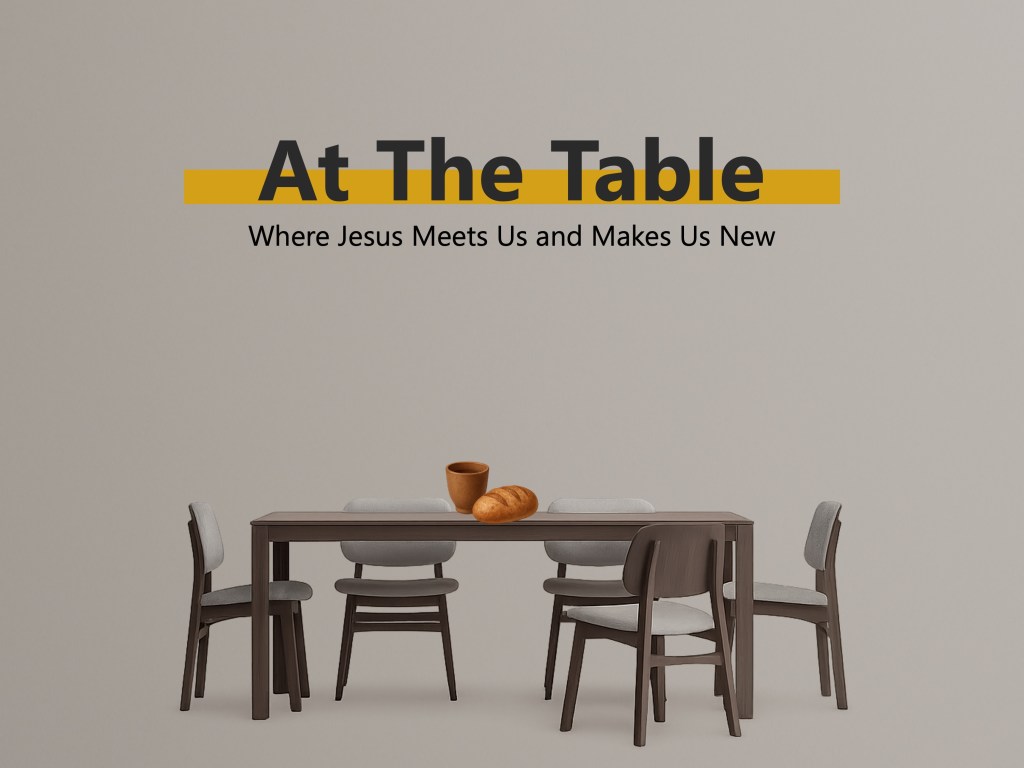
There are moments in life when everything feels unsettled. When relationships feel uncertain. When the future feels unclear. When our hearts are carrying more than we expected to carry. It is often in those very moments that we discover what kind of table God sets. In Luke’s Gospel, Jesus gathers with his disciples for what will become one of the most sacred meals in the life of the church. This meal is not peaceful in the way we imagine holy moments to be. There is anxiety in the room. There is confusion, tension.
There is even betrayal already unfolding. There is talk of suffering. And still — Jesus sets a table. Luke loves meals. This is his seventh meal scene, and his most dramatic.[1] He uses a meal scene to point to the relationship between the Passover and the kingdom.[2]
14 When the hour came, Jesus and his apostles reclined at the table. 15 And he said to them, “I have eagerly desired to eat this Passover with you before I suffer. 16 For I tell you, I will not eat it again until it finds fulfillment in the kingdom of God.” 17 After taking the cup, he gave thanks and said, “Take this and divide it among you. 18 For I tell you I will not drink again from the fruit of the vine until the kingdom of God comes.” 19 And he took bread, gave thanks and broke it, and gave it to them, saying, “This is my body given for you; do this in remembrance of me.” 20 In the same way, after the supper he took the cup, saying, “This cup is the new covenant in my blood, which is poured out for you. 21 But the hand of him who is going to betray me is with mine on the table. 22 The Son of Man will go as it has been decreed. But woe to that man who betrays him!” 23 They began to question among themselves which of them it might be who would do this. Luke 22:14-23
As this section begins, we realize that Jesus’ death is just around the corner. The hour arrives—the divinely appointed time of destiny.[3] The clock chimes just before the horrific events which are to come.[4] For Luke, this hour would be sundown on the date that the angel of death passed over the Israelites who had marked their doors with the blood of lambs.[5] This is not just “the Last Supper.” In Luke, this is a royal meal. It is the Table of the King. But it is a shocking kind of kingship. So, what does it mean to sit at The Table of the King? At this table we see:
1. The King who is the Host
Kings invited people to their tables to show favor, belonging, protection, covenant loyalty. In the ancient world, to be invited to a king’s table was not just about food.
It meant you lived under the king’s protection. You shared in his provision. You belonged in his kingdom. In Luke 22, Jesus is doing exactly this. We’ve talked about many tables in this series: Tables of Abundance, of Possibility, of Returning to the Lord, of Welcome, Invitation, and Radical grace. This is a climax table. It’s the Table of the King. Jesus is the hostof the meal, and then the meal itself. Kings normally provide food. Jesus BECOMES the bread. This is staggering.
Many commentators note that Jesus does not eat or drink at this meal.[6] He abstains from eating and drinking,[7] possibly as a way of fasting, just as he did in the wilderness before Satan tempted him.[8] Here, he feeds his disciples. He is the host. And this is where we find ourselves in the story—we are not the ones hosting this table. We are the ones Jesus welcomes, and the ones he feeds. At this table, Jesus is also
2. The King who redefines power
In the ancient world, the greater person sits at table while the lesser person serves the meal. But not here. Jesus washes his disciples’ feet before this meal.[9] His status as lord and king is expressed in the shape of his humble service.[10] Instead of saying: “Serve me,” he says: “I give myself for you.” In this same chapter, the disciples argue about greatness, and Jesus teaches servant leadership. He predicts his betrayal, and he speaks of suffering. This is not accidental. Luke is showing that the kingdom is being revealed at the table. Jesus locates himself as the master who reclines at a table, where he is their host, but he is also their servant. He reverses the understanding of how the powerful should function.[11]
Amy-Jill Levine and Ben Witherington write: Jesus is not running an egalitarian movement; he is reversing the understanding of how the powerful, including himself, function.[12] Jesus is the king who redefines power. The Table of the King means authority through sacrifice, leadership through self-giving, victory through surrender.
His disciples are called to turn away from their obsession with their own status to attend to the needs of others, too.[13] His table reveals what kind of kingdom he invites us into. If this is our King, then this is the shape of our lives—Not people who grasp for power, but people who give ourselves away. And then at his table, Jesus is:
3. The King who gives a new covenant identity
Luke is clear that salvation comes to and through Israel. Through Jesus, God fulfills his promises to redeem and renew Israel and to extend salvation to the Gentiles. There is something “new” in the new covenant, but it is a continuation of what Israel is supposed to be in the new era:[14] the medium of God’s blessing, a light to the nations, an expanded people of God—Jews and Gentiles who are defined by faith in Jesus, a new community. Jesus is the true Israelite who will reverse the curse of sin.
Jesus renews the divine covenant with his disciples—a bond of love and allegiance between God and humanity—but he also extends the covenant beyond his immediate table partners to all who embrace the ‘good news to the poor’,[15] those who are outside the boundaries of God’s people.[16]
Jesus has come to do for Israel and the whole world what God did through Moses and Aaron in the first Exodus. Jesus will deliver his people by taking on the powers of evil. His followers will find life and freedom through his death.[17] The old covenant identity came through law, national identity and ritual obedience. Jesus initiates new covenant markers: his body and blood, life transformation, belonging through grace, and Spirit-shaped identity. At the Table of the King, allegiance is formed through grace, not fear.
Jesus’ death is like food and drink—Passover food and drink, God’s food and drink for God’s freedom-people.[18] In a Passover meal, the head of the family would pronounce a blessing over the first cup, which is then shared, followed by herbs dipped in a sauce. When the second cup is ready, the youngest son asks why this night is different from other nights, and the head of the family tells the story of the Exodus. The meal is an act of remembrance and thanksgiving for God’s liberation of an oppressed people.[19]
Jesus and his disciples may be remembering Passover, but they are reclining at the table…like free people do.[20] They are not just remembering a story of freedom—they are being formed into a people who belong.
A Passover meal is typically shared in a family or kin group. Jesus shares it with his disciples, making them a part of his household, where he is the head.[21] He gives his followers a new covenant identity. And this is where we find ourselves—not just remembering a story, but being drawn into it. We are the people he is forming—a people who belong, brought into his household, and shaped by his covenant love. Jesus is also
4. The King whose table includes broken people
Jesus’ practices of table fellowship are so radically open that all kinds of people are drawn in and included.[22] Judas sits at his table. Sometimes rejection and failure come from within the ranks.[23] The religious leaders were able to get Judas in their scheme to get Jesus arrested. Judas is just about ready to head out the door to give Jesus’ location to the chief priests. He may be influenced by Satan, but he has also fallen victim to the lure of money.[24] Jesus KNEW that was going to happen.
Peter is sitting at the table. Peter’s identity and vocation as an apostle are at stake.[25] Jesus warns him about his coming denials and predicts Peter’s temporary unfaithfulness.[26] His bravado is obvious as he professes that he is ready to suffer for Jesus.[27] And after dinner, he will take up a sword to try and defend him, but later, he will deny Jesus three times, and he will weep bitterly about it. Jesus knew that. And he is prepared to forgive him when Peter repents later.
The rest of the disciples who were sitting at the table all have their flaws, too. Some of them have gotten into a fight over who is greater.[28] They were fearful, impulsive, and doubtful about this man they called Lord. They misunderstand his words and take his remarks literally and incorrectly.[29] They are self-centered, and worried about their own reputations.[30] Jesus knew all of that and still welcomed them to his table.
And then—at this table of broken people—Jesus becomes the one who is broken for them. He took bread, gave thanks and broke it, and gave it to them, saying, “This is my body given for you; do this in remembrance of me.” (Luke 22:19) It’s reminiscent of the feeding of the multitudes.[31] Notice, he’s not saying that the bread becomes his body, or that he enters the bread with his presence.[32] When Jesus breaks the bread and gives it to his disciples, it means that what has happened to the bread will also happen to him.[33] ‘Giving one’s body’ is an image for giving one’s life (in battle) for the sake of one’s people.[34]
The Table of the King is not for the worthy. It is for the broken. It is for Judas, for Peter, and even for the fearful disciples. Jesus feeds broken people, and he is broken FOR them. We are also among those who fall short, who misunderstand, who fail. And still, Jesus welcomes us, feeds us, and gives himself for us at the Table of the King.
And finally, Jesus is
5. The King whose table points forward
The celebration of Passover encompassed past, present, and future. It was an anticipation of a second exodus, an eschatological deliverance.[35] It’s what Jesus has been talking about as he practiced table fellowship with people—the anticipation of the coming banquet where his own meal practices would be the norm.[36] When the people of God participated in the Passover meal, they relived the Exodus, where God liberated them from slavery and death in Egypt, but they also anticipated their share in God’s future and final salvation.[37] This table is past (Exodus covenant memory); present (the cross is about to happen); and future (kingdom banquet). The table of the King encompasses all of it. The kingdom is God’s present reign and a future realm. The kingdom is present now and longed for as a future hope. The kingdom of God is the present restoration AND a coming redemption. It is now and not yet.[38]
The Table of the King is where grace creates allegiance, sacrifice defines power, where covenant shapes identity, broken people are welcome, and future is embodied. And WE find ourselves at this table, too, living between what God has done, what God is doing, and what God will still complete. We are a people who remember, a people who trust, and a people who hope—because the story is not finished.
Jesus didn’t teach his disciples a theory. He gave them an act to perform—a meal to share.[39] Early Christians also had a table they gathered around each week. They had no temple, no statues, no priests, no special cult. The only thing visible was a table. The table was the continuation of Jesus’ table fellowship—the embodiment of God’s gift, the truth made visible among them.[40] Jesus called his disciples to “Do this in remembrance of me.” Do this—not simply repeating the ritual or recalling the memory of Jesus[41], but doing what Jesus did: Breaking bread, and sharing it with others, giving selflessly and pouring themselves out on behalf of others.[42] The openness to outsiders, an indifference towards issues of status, honor, and the like—these table manners of Jesus should be embodied in the community of those who call him Lord.[43] Jesus’ disciples are to reverse how the social system functions.[44]
When we come to this table, it is not a ritual to complete—but a gift to receive. When we break the bread and drink the wine, we are drawn into salvation, into healing life. The powers may still rage, but they have been defeated, and our rescue is secure.[45]
At the Table of the King, we are reminded whose we are and who we are becoming. We are not just remembering an event. We are remembering an identity. We are forgiven people. Sent people. Loved people. We are not people defined by fear. Not people defined by failure. Not people defined by what we carry into this space. We are people who belong to Christ. People who are fed by grace. People who are held in covenant love. People who are being shaped by a different kind of kingdom. We walk as people who have been fed, people who have been claimed, people who know that even death itself will not have the final word. We break bread and drink the cup at the Table of the King as a sign of allegiance to the One who reigns through sacrifice.
Every table we have seen has been leading to this moment. C.S. Lewis once imagined a world where a stone table represented the ancient law — the old magic — the system that demanded death for betrayal. But he also imagined a deeper magic — that when an innocent one willingly gave himself for the guilty, the stone table would crack, and death itself would begin to run backward. On the night of this meal, Jesus is preparing to go to his own table— not a stone table, but a cross. And something deeper than law… deeper than sin… deeper than death…is about to break open. And now we walk forward from this table into a week where we will remember betrayal…suffering…the cross…But we do not walk into it alone. We carry this table with us. Because the King who hosts the table is the King who gives himself—and the King who will rise.
PRAYER: Lord Jesus, we have come to your table and received what we could not give ourselves. Your body, given for us. Your blood, poured out for us. And in this meal, you have reminded us who we are—we are yours. As we enter this, keep us near to you. When we see betrayal, remind us of your faithfulness. When we see suffering, remind us of your love. When we come to the cross, remind us that you have already gone there for us. Shape us as your people—not by fear or performance, but by grace. And teach us to live as those who belong to your kingdom. And now, Lord, as we lift our voices, receive our praise—You are our Savior, full of mercy and grace. You are our Redeemer, faithful and true. We belong to you. We pray this in your mighty name. Amen.

Bibliography
- Bird, Michael F. A Bird’s-Eye View of Luke and Acts: Context, Story, and Themes. Downers Grove: InterVarsity Press, 2023.
- Bock, Darrell L. Luke. The IVP New Testament Commentary Series. Edited by Grant R. Osborne. Downers Grove: IVP Academic, 1994.
- Garland, David E. Luke. Exegetical Commentary on the New Testament. Edited by Clinton E. Arnold. Grand Rapids: Zondervan Academic, 2011.
- Green, Joel B. The Gospel of Luke. The New International Commentary on the New Testament. Grand Rapids: William B. Eerdmans Publishing Company, 1997.
- Levine, Amy-Jill, and Ben Witherington III. The Gospel of Luke. New Cambridge Bible Commentary. Cambridge: Cambridge University Press, 2018.
- Nolland, John. Luke 18:35–24:53. Word Biblical Commentary. Vol. 35C. Dallas: Word Books, 1993.
- Wright, N. T. Lent for Everyone: Luke, Year C. Louisville: Westminster John Knox Press, 2009.
- Wright, N. T. Luke for Everyone. Louisville: Westminster John Knox Press, 2004.
—
Going Deeper Questions
Have you ever been at a meal where the atmosphere felt tense or awkward? What made it feel that way?
Read Luke 22:14–23.
When the hour came, Jesus and his apostles reclined at the table. 15 And he said to them, “I have eagerly desired to eat this Passover with you before I suffer. 16 For I tell you, I will not eat it again until it finds fulfillment in the kingdom of God.” 17 After taking the cup, he gave thanks and said, “Take this and divide it among you. 18 For I tell you I will not drink again from the fruit of the vine until the kingdom of God comes.” 19 And he took bread, gave thanks and broke it, and gave it to them, saying, “This is my body given for you; do this in remembrance of me.” 20 In the same way, after the supper he took the cup, saying, “This cup is the new covenant in my blood, which is poured out for you. 21 But the hand of him who is going to betray me is with mine on the table. 22 The Son of Man will go as it has been decreed. But woe to that man who betrays him!” 23 They began to question among themselves which of them it might be who would do this.
At the Table of the King, Jesus is:
1. The King who is the Host
- In the ancient world, to eat at a king’s table meant belonging, protection, and provision. How do you see those themes present in this meal?
- How is Jesus’ way of hosting different from what we might expect from a king?
- What do you notice about Jesus’ role at the table in this passage? What is he doing—and not doing?
- What do you think it says about Jesus that he chooses to host a meal at a time like this?
- When you hear that you are invited to the King’s table, what is your honest reaction? (Comfort? Resistance? Gratitude? Uncertainty?)
- What do you think it means that Jesus doesn’t just provide the meal—he gives himself?
2. The King Who Redefines Power
- How do you think people then would typically expect a king or leader to act?
- What do you notice about how power is understood in this passage (or in the surrounding verses Luke 22:24-27)?
- Why do you think the disciples (and us) struggle to understand Jesus’ version of power?
- Can you think of an example—at work, in leadership, or in public life—where power is used differently than the way Jesus models it here?
- Can you think of a real-life example of someone using power in a self-giving way instead of a controlling way?
- Where in your life are you most tempted to seek control, recognition, or status?
- How does it change the way you think about Jesus when you picture him as someone who invites and serves, rather than demands?
3. The King who gives a new covenant identity
- In the Old Testament, covenant identity was shaped by law, rituals, and national identity. What seems different about the identity Jesus is forming here?
- This meal is connected to Passover. Passover is a meal of remembrance where God’s people recall how he rescued them from slavery in Egypt through the blood of a lamb—saving them from death and leading them into freedom, shaping them into his people. If you were one of the disciples at this meal, what might feel familiar from Passover—and what might feel surprising or new about what Jesus is saying and doing?
- Jesus shares this meal with his disciples like a family meal. What stands out to you about the idea of being brought into God’s household?
- A covenant describes a relationship of love and allegiance between God and his people. What do you think it means to belong to God in a committed, ongoing relationship like that?
- What do you think it means to be shaped into a people, not just individuals?
4. The King whose table includes broken people
- Who is present at the table in this passage? What do you notice about what Jesus knows about each of them?
- Jesus chooses to stay and preside over the meal, despite what he knows. What does this reveal about his character?
- If you were one of the disciples sitting at this table, what do you think you would be feeling in that moment? (Luke 22:21-22)
- Without sharing details, in what ways do you relate more to: -Peter (overconfident, then failing), or -the other disciples (confused, fearful, uncertain)?
- Jesus feeds broken people, and he is broken for them. What does that mean to you? How does that change the way you think about your own brokenness?
- What do you think it looks like to come to Jesus honestly, instead of trying to hide or fix yourself first?
- How can we become a community that reflects Jesus’ table-one that welcomes people honestly, not just when they have it all together?
5. The King whose table points forward
- How do you think the story of Passover and rescue connects to what Jesus is about to go through?
- This meal connects the past (God’s rescue), the present (what Jesus is about to do), and the future (what God will still complete). Which of those—past, present, or future—do you find yourself holding onto most right now? Why?
- Have you ever been in a season where you were waiting for something to change, heal, or be made right? What was that like?
- How might this idea—that God is still working and not finished yet—speak into how you think and live?
- What is one small, practical way you could “carry the table with you” this week?
Personal Application
- What is one thing you want to remember from this passage this week?
- Where might you be holding onto control, status, or recognition? What would it look like to practice Jesus’ kind of self-giving instead?
- Who in your life might God be inviting you to serve in a quiet or unseen way?
- Remember that you belong at Christ’s table. Who in your life might God be inviting you to welcome, include, or make space for?
- Finish this sentence prayer: “Jesus, thank you that at your table I am ________.”
Closing Prayer: Lord Jesus, thank you for inviting us to your table—for welcoming us, feeding us, and giving yourself for us. Shape us as your people, formed by your grace and your love. Help us to carry your table into the places we go this week. Amen.
[1] Bock, 347.
[2] Joel B. Green, The Gospel of Luke, The New International Commentary on the New Testament, Grand Rapids: William B. Eerdmans Publishing Company, 1997, 749.
[3] Joel B. Green, The Gospel of Luke, The New International Commentary on the New Testament, Grand Rapids: William B. Eerdmans Publishing Company, 1997, 748.
[4] David E. Garland, Luke, Exegetical Commentary on the New Testament, ed. Clinton E. Arnold, Grand Rapids: Zondervan Academic, 2011, 853.
[5] Amy-Jill Levine, Ben Witherington III, The Gospel of Luke, New Cambridge Bible Commentary, Cambridge University Press, 2018, 588.
[6] Levine, Witherington, 589.
[7] Garland, 854.
[8] Levine, Witherington, 589.
[9] Darrell L. Bock, 352.
[10] Luke B. Green, 769.
[11] Levine, Witherington, 594.
[12] Levine, Witherington, 594.
[13] Joel B. Green, 769.
[14] Based on Michael F. Bird, 72.
[15] Joel B. Green, 764.
[16] Joel B. Green, 211.
[17] N.T. Wright, Luke for Everyone, 262, 263.
[18] N.T. Wright, Lent for Everyone, Luke, Year C, Louisville: Westminster John Knox Press, 2009,93.
[19] Luke B. Green, 758.
[20] Levine, Witherington, 588.
[21] Joel B. Green, 756.
[22] Joel B. Green, 765.
[23] Darrell L. Bock, Luke, the IVP New Testament Commentary Series, Grant R. Osborne, Series Editor, D. Stuart Briscoe and Haddon Robinson, Consulting Editors, Downers Grove, IVP Academic, 1994, 345.
[24] Joel B. Green, 754.
[25] Joel B. Green, 772.
[26] Bock, 353.
[27] Joel B. Green, 773.
[28] Luke 9:46-48
[29] Bock, 354.
[30] Levine, Witherington, 593.
[31] Luke 9:10-17.
[32] Bock, 349.
[33] Garland, 856.
[34] Luke B. Green, 761 (citing Nolland, 3:1054 (with reference, e.g., to Thucydides 2.43.2).
[35] Luke B. Green, 759.
[36] Luke B. Green, 759, Cf. Isa 2:2-4; 35:6-9; 32:122; 55:1-2; 65:13; Luke 12:35-37; 13:28-29; 14:15.
[37] Garland, 857.
[38] Michael F. Bird, A Bird’s-Eye View of Luke and Acts, Context, Story, and Themes, Downers Grove, InterVarsity Press, 2023, 113.
[39] N.T. Wright, Luke for Everyone, Louisville: Westminster John Knox Press, 2001, 2004, 262.
[40] Garland, 857, (Schweizer, Jesus, the Parable of God, 47).
[41] Garland, 859.
[42] Garland, 860.
[43] Joel B. Green, 762.
[44] Levine, Witherington, 594.
[45] N.T. Wright, Luke for Everyone, 264.
 Preach it Sista