
About these posts
These posts grow out of sermons I’ve written for my local church community. You’re welcome to use them—for teaching, small groups, preaching, or personal reflection. If you share them elsewhere, please include a simple attribution. If you’d ever like to share how they’re being used, you’re welcome to reach out through the Contact button.
One of the things I love about the big holidays: Thanksgiving, Christmas, Easter—is the family gatherings around a table. Our table is getting smaller lately—or rather, our family has grown. Sometimes the little ones get their own table now, just so that we can accommodate the numbers. And it’s usually loud and chaotic…and wonderful.
When many of us picture a table, we might picture something like a Norman Rockwell painting. The family gathered. Everyone is present. Food on the table. No one rushing. No one uncomfortable. No one distracted. Those images may have shaped our imagination. But they are also idealized. Most of our tables don’t look like that on a daily basis. Maybe it’s just two of you—or you eat by yourself more often. Maybe table time is brief. Schedules press, or bodies hurt. Sometimes we get antsy, tired, grieving, or already thinking about what comes next. Sometimes it’s tense at the table. And sometimes it’s just… ordinary.
Over the next weeks, we’re going to follow Jesus to a series of tables…and eventually, to the Table where everything changed. In the Bible, tables are more than furniture—they are places of transformation. Tables are where needs are revealed. Tables are where relationships form. Tables are where identity shifts. And tables are where God often chooses to act quietly, generously, and unexpectedly. At His table:
Jesus meets us in our emptiness and fills it with abundance
And that’s good news—because most of us don’t come to the table at our best. We come as we are, and that’s where Jesus chooses to meet us. Scripture doesn’t tell us that transformation happens because we linger—it happens because we show up… even briefly, even imperfectly.
The Gospels don’t present an image of perfect tables either. The first table Jesus shows up to in John’s Gospel is at a wedding. The table is full. The guests are having a good time. The celebration hasn’t stopped. But—the wine has quietly run out. THIS story is the opening week—the first sermon of the series—a story in the first week of Jesus’ ministry—and a foreshadowing of what is to come.[1]
On the third day a wedding took place at Cana in Galilee. John 2:1a NIV
What do you notice first? My mind immediately went to ‘on the third day.’ Scholars aren’t sure whether this was the third day of Jesus’ ministry, going back to the first chapter, right before this, where Jesus was baptized and then on the next day called his disciples…OR whether this will be the third day of the wedding feast. Regardless, that lingo brings back some images. In the days of creation in Genesis, the Third day is when the land brings forth vegetation—and it is good. On that day, there are actually TWO declarations of ‘it is good’—one on the land, and one on the vegetation.
Throughout the Bible, God often is doing something special on the “third day”. On the “third day”, God provided a substitution for Abraham and Isaac on the altar. (Genesis 22:4-14). On the “third day”, God showed up at Sinai (Exodus 19:10-11), and the people said, ‘we will do whatever the Lord says!’ and then Moses, Aaron and the elders had a spiritual feast in the presence of God, where they beheld his glory! We also know that on the “third day”, Jesus was raised to life (Luke 24:46). Maybe John’s telling of this story is also getting us to notice God’s timetable and connect the dots in a meaningful way. It’s something to pay attention to.
On the third day a wedding took place at Cana in Galilee. Jesus’ mother was there, 2 and Jesus and his disciples had also been invited to the wedding. 3 When the wine was gone, Jesus’ mother said to him, “They have no more wine.” John 2:1-3 NIV
Jesus has just come from Bethany beyond the Jordan, which is a place of repentance, testimony, and calling disciples. This is not accidental. Cana isn’t just the next stop down the road. Jesus has traveled days to get there — from the Jordan River into the heart of Galilee — and the first sign happens not in the wilderness, but at a table. In the last chapter, Jesus called Nathaniel, who was from Cana,[2] and now, Jesus and his disciples get an invite to a wedding celebration there. Some have suggested that Mary may have had a close connection to the family hosting the wedding, because of how naturally she steps into the situation. John doesn’t tell us those details— but he does show us that she notices the need, and she trusts Jesus with it.
Weddings in ancient Israel could go on for days. It was customary to serve the best wine first, and then the cheap wine, when guests would be tipsy enough not to notice.[3]
I—am not a wine drinker. No wine at the wedding? No big deal. For this situation and these families? That’s another story. Marriages involved two families. Running out of wine during the celebration would have caused the loss of one family’s reputation and honor.[4] It would be embarrassing and shameful to run out of wine so early. It’s not a life-or-death emergency—but Jesus’ mother, Mary, gently names that something has run dry.
It’s the middle of winter—two weeks before Lent. Where might you be running dry? -your energy? -patience? -joy? -maybe your faith isn’t broken, but it feels flat. -are you sitting with a quiet disappointment? God’s table isn’t only for the deeply broken. It’s also for the quietly empty. Mary says to Jesus…’they have no more wine.’
4 “Woman, why do you involve me?” Jesus replied. “My hour has not yet come.” 5 His mother said to the servants, “Do whatever he tells you.” John 2:3-5 NIV
Jesus transforms her remark and takes it as if it were a request.[5] By the way, Jesus isn’t dissing his momma. “Woman” is a normal form of address for a man. It may even close to saying ‘ma’am’.[6] He is respectful, and aware of her distress.[7] But he’s not calling her ‘mother’, which he never does in John’s gospel.[8] In fact, there are no known examples of a son using such a term to address his mother.[9] But his statement says that he is no longer relating to her at a family level. Jesus’ identity is now rooted in his mission that was given to him by his heavenly Father.[10] And if Mary is going to be a part of Jesus’ mission—it will not be as his mother.[11]
I wonder: What was Jesus’ expectation of when ‘his time’ would come? Did he think something was going to happen in a more public place? In Jerusalem? This is just a small-town wedding. There is food, wine, laughter, community. But it’s a party, not a synagogue. There is no sermon, no request for healing, no desperate prayer circle. And, you know what? Some of the most significant moments of grace in our lives don’t arrive during a crisis either…they arrive when we didn’t even know we were running out.
6 Nearby stood six stone water jars, the kind used by the Jews for ceremonial washing, each holding from twenty to thirty gallons. John 2:6 NIV
Ceremonial jars were made out of stone.[12] They were heavy, expensive, and designed to hold water. Water from these jars would have been used for: Hand-washing before meals, washing of cups or serving vessels, possibly foot-washing for guests. It was mainly about preparing people and space for shared eating.
Clay containers were thought to make water impure. Wine was sometimes kept in jars made out of clay sealed with resin or pitch, or in wineskins—that were breathable, flexible, and portable.
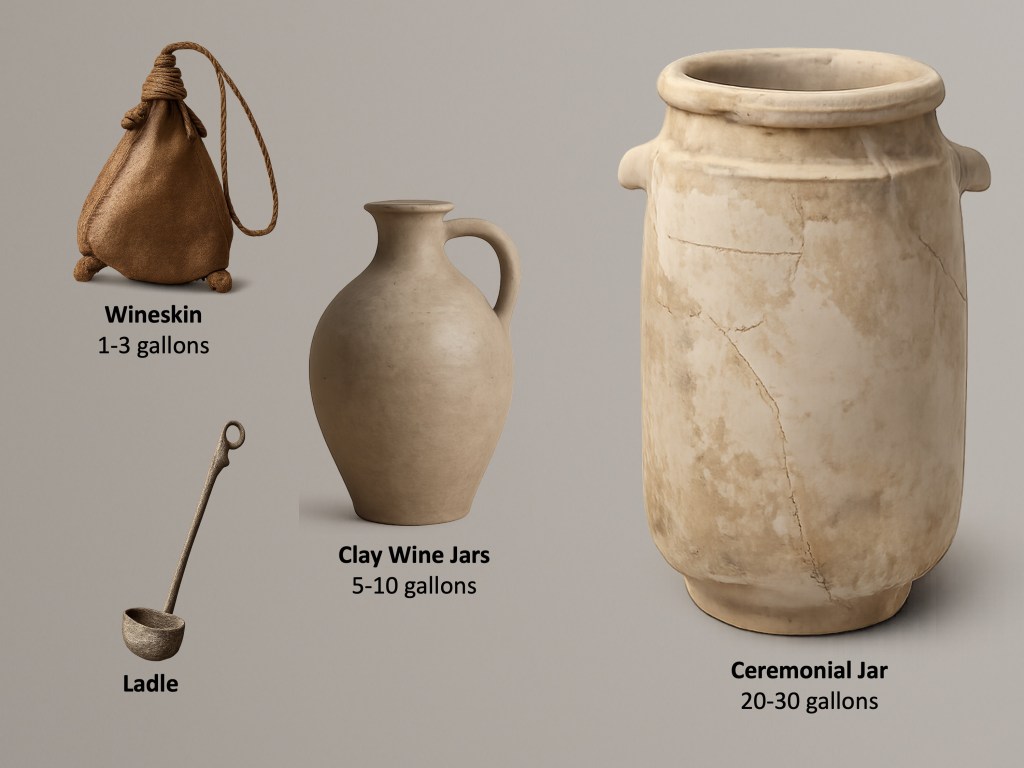
Now look at the size difference. A wineskin would hold 3-5 gallons. Decent. It would be poured and shared in cups. That works with travelers, shepherds, outdoor meals, or with just a few people. But at a wedding feast, with guests and servants, wine would be served, not casually passed. A large clay wine jar could hold 5-10 gallons of wine. Servants or hosts would draw wine from the clay jar with a long ladle, pour it into a smaller serving jug, and then pour it into individual cups, circulating and refilling as needed. Clay jars were ideal for weddings because they were manageable, and porous enough to help preserve the wine. These were the normal procedures.
Ceremonial stone jars were made from limestone. They stood about waist high on an adult, they were heavy—and they could hold 20-30 gallons, which means when they were full, they would weigh 300-400 pounds![13]
Notice that Jesus doesn’t shame the emptiness at the wedding. He doesn’t ask the host why he let it run out. He just gives instructions, and he is about to bring abundance that borders on absurd!
7 Jesus said to the servants, “Fill the jars with water”; so they filled them to the brim. 8 Then he told them, “Now draw some out and take it to the master of the banquet.” They did so, 9 and the master of the banquet tasted the water that had been turned into wine. He did not realize where it had come from, though the servants who had drawn the water knew. Then he called the bridegroom aside 10 and said, “Everyone brings out the choice wine first and then the cheaper wine after the guests have had too much to drink; but you have saved the best till now.” John 2:7-10 NIV
Jesus doesn’t just fix the problem. He doesn’t just save the people from a slight embarrassment. This is not just a ‘little’ wine. It’s not barely enough to cover what is needed. The water becomes 180 gallons of the good stuff! It’s the BEST wine. When Jesus brings abundance, it’s not just enough to survive—it’s enough to celebrate!
On the surface, the wedding celebration was saved. Shame is avoided, and the feast continues. Because the wine flows: people can continue to connect and celebrate. But who actually knew what was going on? The master of the banquet and the head steward don’t know. The guests don’t know. But the servants know. And beneath all that is happening, a deeper joy emerges. The heavenly bridegroom is present with his people! John writes:
11 What Jesus did here in Cana of Galilee was the first of the signs through which he revealed his glory; and his disciples believed in him. John 2:11 NIV
This miracle is a sign and symbol of something and someone who is greater—Jesus![14] The disciples aren’t thinking ‘Wow, great wine!…but rather, “Something about this man reveals God!” It’s an encounter with the divine. God cares about ordinary human joy, and relational joy, but the ultimate joy… is that Jesus is present! The transition from the old age to the new age has begun. Jesus’ words and actions here foreshadow the shedding of his blood—not just an external cleansing, but internal transformation.[15]
Jesus’ bigger desire was not to provide wine for a wedding, or to help his mother—but to show a picture of the future table of abundance—where his disciples, his mother, his church, would sit at a wedding feast that would have no end. This is the first sign in John’s gospel. It points forward. Jesus took a catastrophe and turned it into abundance. At the wedding, some people noticed, some people didn’t. Some may have celebrated briefly and moved on. But grace flowed anyway.
The wine flows freely here at Cana…but one day, Jesus will offer HIMSELF so the joy can never run out. Jesus brings joy, abundance, and unexpected grace where we’ve run dry. Some of us don’t realize we’re running dry until we stop long enough to notice. Is there some part of your life that feels that way right now? What place is still there—still functioning—but feels empty? And what might it mean to let Jesus meet you there, without fixing it first?
The season of Lent begins in just a couple of weeks. Sometimes Lent can feel like a season of joylessness: “I have to give things up, grit my teeth, try harder, be better!”
But what if it’s less about what you are supposed to give UP, and more about what Jesus wants to GIVE? What if it’s cutting out things… to make room? Not for the sake of emptiness, but emptying to be filled—about letting Jesus fill what is depleted in us?
Jesus isn’t a party pooper. The first place he takes his disciples to is a wedding. His first miracle was to create space for people to enjoy themselves. He brought a gift into a very real situation and gave a young couple and their guests the chance to celebrate, to laugh, and to dance. Now, not every day with Jesus is a party. But God is not trying to sap all the joy out of life. When his mother says they don’t have any more wine,
Jesus doesn’t fold his arms and say, ‘then let them have less!’ He told them to fill up the jars…ALL of them! Jesus gives MORE! This wedding is just a foretaste—it’s an appetizer for what is coming.[16] “You will see greater things”, said Jesus.[17]
One Bishop notes that the WORLD usually gives its best pleasures first, and what follows is not always so good. But Jesus reverses the order. He gives us the feast after the fast, the Resurrection after the Crucifixion, the joy of Easter Sunday after the sorrow of Good Friday.[18] God saves the best for last.[19] You may doubt that Jesus has YOUR best saved up for last,[20] but this story is meant to show us who Jesus is, so that you believe and have life in him![21] Joyful life! Abundant life!
Jesus meets us in our emptiness and fills it with abundance
In the wedding at Cana, Jesus didn’t create something new—he filled what was already there. The jars were already there to support shared life together. Jesus did not reject that system. He filled it with joy. Jesus filled the everyday jars with wine. He uses the most ordinary, faithful structures already there and, by his presence, transforms their meaning — with fulfillment and abundance. Most people never know what happened. But the servants know. And the disciples begin to see who Jesus is.
God often brings joy out of ordinary faithfulness. Our routines, our habits, our everyday practices. Those are not obstacles to grace. They are often the vessels that God fills, and sometimes the transformation happens quietly, long before it becomes visible. I invite you to notice what happens when you share space at a table this week. Sometimes, simply showing up at the table is enough for Jesus to do more than we imagined.
If it helps you, you’re welcome to open your hands as a way of saying to Jesus, “I’m open. I’m here.”
PRAYER
Jesus, we open our hands to you. You know the places in our lives that feel empty, tired, or quietly dry. The things we carry, and the things we’ve stopped naming. Meet us here, just as we are. Fill what is empty with your life, your joy, and your abundance. We receive what you give. Amen.

*Some images accompanying this post were created using AI-assisted tools and curated by the author.
—
Bibliography
- Metzger, Paul Louis, The Gospel of John: When Love Comes to Town, Downers Grove: IVP Books, 2010.
- Witherington III, Ben, John’s Wisdom, Louisville: Westminster John Knox Press, 1995.
Articles
- Barnes, M Craig, “A glimpse of Cana”, The Christian Century, 136 no 18 Aug 28 2019.
- Buckley, Michael J .1931-2019, “What Mary saw at Cana-The indispensability of others”, The Christian Century, 133 no 18 Aug 31 2016, 26-29.
- Clendenen, E Ray, “Jesus’s Blood At The Wedding In Cana?”, Journal of the Evangelical Theological Society, 63 no 3 Sep 2020, 491-503.
- Elowsky, Joel C ., “The Wedding of Cana in the Interpretation of the Early Church”, Concordia Journal, 49 no 3 Sum 2023, 55-66.
- Emmons, D. D., “The Wedding at Cana-The divinity of Jesus revealed”, The Priest, 81 no 1 Jan 2025, 25-31.
- Hintze, Robin Michael, “The Wedding at Cana”, Lutheran Forum, 56 no 2 Sum 2022, 25-28.
- Jojko, Bernadeta, “The Hour of Jesus and the Wedding Feast at Cana (John 2vs1-11)”, Verbum Vitae, 38 no 1 2020, 125-147.
- Matand Bulembat, “Jean-Bosco, Head-waiter and bridegroom of the wedding at Cana-structure and meaning of John 2.1-12”, Journal for the Study of the New Testament, 30 no 1 Sep 2007, 55-73.
- Ndugbu, Kizito Uzoma, Ndugbu, Augustina Ngozi, Ijechukwu, Ihembu Mary, “The Wedding Feast at Cana-A Mariophany of the Mother of Mercy (John 2vs1-11)”, Journal of Biblical Theology, 4 no 3 Jul – Sep 2021, 218-235.
GOING DEEPER QUESTIONS
Icebreaker Questions
- When you think about a table, what’s the first image that comes to mind?
- Are you more likely to linger at a table, or move on quickly once the meal is done?
- Share about a time when food helped create connection, or a meal that felt especially meaningful to you.
- What’s one food that immediately makes a table feel welcoming to you?
In first-century Jewish culture, weddings were multi-day communal celebrations, and providing food and wine was a matter of honor for the families involved.
Read John 2:1-2 NIV
On the third day a wedding took place at Cana in Galilee. Jesus’ mother was there, 2 and Jesus and his disciples had also been invited to the wedding.
Discussion
- What’s your ideal length for a meal—15 minutes or 2 hours?
- Would you rather attend a multi-day wedding feast or a short modern wedding?
- Who arrives at the wedding first in John’s telling?
- What does it suggest about Jesus that he attends a wedding at all?
- If Jesus showed up at one of your regular gatherings, which one would surprise you most?
Read John 2:3-5 NIV
3 When the wine was gone, Jesus’ mother said to him, “They have no more wine.”
4 “Woman, why do you involve me?” Jesus replied. “My hour has not yet come.”
5 His mother said to the servants, “Do whatever he tells you.”
Discussion
- What is the problem in this story, and who notices it first?
- Why do you think Mary names the need so simply: “They have no more wine”?
- Why might running out of wine be more than a small inconvenience in this setting?
- What does Mary seem to expect when she speaks to Jesus?
- What stands out to you about Mary’s instruction to the servants?
- Why do you think we often notice big crises more easily than quiet depletion?
- What does Mary do after Jesus responds the way he does?
Read John 2:6-10 NIV
6 Nearby stood six stone water jars, the kind used by the Jews for ceremonial washing, each holding from twenty to thirty gallons.
7 Jesus said to the servants, “Fill the jars with water”; so they filled them to the brim.
8 Then he told them, “Now draw some out and take it to the master of the banquet.”
They did so, 9 and the master of the banquet tasted the water that had been turned into wine. He did not realize where it had come from, though the servants who had drawn the water knew. Then he called the bridegroom aside 10 and said, “Everyone brings out the choice wine first and then the cheaper wine after the guests have had too much to drink; but you have saved the best till now.”
The jars are stone, not clay, because stone was considered resistant to ritual impurity. Ceremonial washing was connected to preparation for shared life and meals. Each jar holds 20–30 gallons — far larger than wine vessels.
Discussion
- Why do you think John tells us about the stone jars and their original purpose?
- Picture one of the servants—what might they be thinking or feeling? Why do you think they get to be the ones who know what happened?
- What stands out to you about Jesus using vessels that were already there?
- What might this story be suggesting about how Jesus views ordinary routines, practices, or relationships? Can you think of a time when something ordinary became unexpectedly meaningful?
- How does the amount and abundance of wine produced shape how you understand this miracle?
- What does this story suggest about where God’s generosity is most likely to appear?
Read John 2:11 NIV
11 What Jesus did here in Cana of Galilee was the first of the signs through which he revealed his glory; and his disciples believed in him.
Discussion
- Which phrase in this verse draws your attention most?
- Why do you think Jesus’ first sign in John’s Gospel happens at a wedding rather than in a synagogue or a need for healing?
- Who sees the glory in this moment? Who does not seem to see it? Why do you think Jesus allows the miracle to remain largely hidden?
- Why do you think belief, not amazement or celebration, is the outcome John emphasizes?
- What kind of belief do you think is forming in the disciples here?
Read Revelation 19:6–9 – The marriage supper of the Lamb
Then I heard what sounded like a great multitude, like the roar of rushing waters and like loud peals of thunder, shouting:
“Hallelujah! For our Lord God Almighty reigns.
7 Let us rejoice and be glad and give him glory!
For the wedding of the Lamb has come, and his bride has made herself ready.
8 Fine linen, bright and clean, was given her to wear.”
(Fine linen stands for the righteous acts of God’s holy people.)
9 Then the angel said to me, “Write this: Blessed are those who are invited to the wedding supper of the Lamb!” And he added, “These are the true words of God.”
Discussion
- Why do you think the Bible ends with a wedding feast rather than a courtroom scene?
- What similarities do you notice between abundance at Cana and abundance here?
- What part of this passage feels most hopeful to you right now?
- What does this future table say about God’s intention for joy and community?
- Who do you imagine sitting near you at this feast?
Wrap up:
- Where do you most often experience connection—with food involved or not?
- If you hosted a meal, what would you focus on—food, conversation, or atmosphere?
- What would it look like to notice God’s presence at the tables you already have?
Personal Application:
- Where might Jesus be willing to meet you right now—in something ordinary?
- What small form of “table fellowship” feels realistic in this season of life?
Examples:
-coffee
-dessert
-standing at the counter
-sitting together briefly after eating
- What’s one place in your life that already exists—but might be open to becoming a place of greater presence or connection?
Closing Prayer
Optional prayer posture: Open hands
Jesus, we come just as we are. You know the places in our lives that feel ordinary, tired, or quietly empty. Meet us there. Fill what has run dry with your presence, your joy, and your abundance. Help us notice where you are already at work, and receive what you are giving. Amen.
[1] Based on Clendenen, E Ray, “Jesus’s Blood At The Wedding In Cana?”, Journal of the Evangelical Theological Society, 63 no 3 Sep 2020, 491-503, 492.
[2] John 21:2.
[3] Witherington, 78.
[4] Jojko, Bernadeta, “The Hour of Jesus and the Wedding Feast at Cana (John 2vs1-11)”, Verbum Vitae, 38 no 1 2020, p125-147, 131 (footnote 30)
[5] Buckley, Michael J .1931-2019, “What Mary saw at Cana-The indispensability of others”, The Christian Century, 133 no 18 Aug 31 2016, 26-29, 26.
[6] Matand Bulembat, “Jean-Bosco, Head-waiter and bridegroom of the wedding at Cana-structure and meaning of John 2.1-12”, Journal for the Study of the New Testament, 30 no 1 Sep 2007, 55-73, 67.
[7] Matand Bulembat, 70.
[8] Ben Witherington III, John’s Wisdom, Louisville: Westminster John Knox Press, 1995, 76.
[9] Witherintgon, 79.
[10] Jojko, 134.
[11] Witherington, 79.
[12] https://www.gotquestions.org/waterpots-of-stone.html?utm_source=chatgpt.com
[13] Low estimate (20 gal + lighter jar): 167 lb (water) + ~120 lb (stone) ≈ 287 lb
High estimate (30 gal + heavier jar): 250 lb (water) + ~180 lb (stone) ≈ 430 lb
[14] Witherington, 82.
[15] Clendenen, 501.
[16] Hintze, Robin Michael, “The Wedding at Cana”, Lutheran Forum, 56 no 2 Sum 2022, 25-28, 26-27.
[17] John 1:50
[18] Emmons, D. D., “The Wedding at Cana-The divinity of Jesus revealed”, The Priest, 81 no 1 Jan 2025, 25-31, 31.
[19] Witherington, 78.
[20] Metzger, 57.
[21] Metzger, 58.
 Preach it Sista