

Sometimes I get impatient waiting for little things — an email reply, a green light, the microwave. It’s much harder when the waiting isn’t minutes — it’s YEARS. Or when it’s not the traffic you’re waiting on, it’s God. I’ve had seasons where I’ve prayed, and nothing seemed to change. You know those times when you keep showing up, keep doing the right things, but it feels like your prayers are just bouncing off the ceiling? I’ve been there — wondering if God’s timing is stuck, or if maybe I did something wrong. Waiting can make your faith feel fragile. It can make you wonder if God is still paying attention.
We’ve all had seasons when it feels like nothing is happening. Heaven feels quiet. Life feels stuck. A dream that once felt alive now feels irrelevant or impossible. You feel helpless in the face of endless violence, division, and cynicism. Maybe you’re wondering if your best years are behind you. You’re in a marriage that feels more like coexisting than connecting or maybe you’ve spent years praying for reconciliation that never comes. Maybe you are longing for children, companionship, or family, and the silence hurts. You keep showing up to pray, but it feels like no one’s listening. You read Scripture, sing, serve — doing all the “right things,” but everything feels dry and hollow. You wonder if you’ve run out of purpose — if God is done using you. Sometimes, we stop even asking — we just settle. We live as though the silence means the story is over.
What do we do when God seems silent or absent? That’s exactly where Israel was in Judges 13. The people weren’t crying out anymore. The light of faith was fading. And into that silence — into that barrenness — God steps in. Not to a hero or a prophet, but to an ordinary couple.
Again the Israelites did evil in the eyes of the Lord, so the Lord delivered them into the hands of the Philistines for forty years. 2 A certain man of Zorah, named Manoah, from the clan of the Danites, had a wife who was childless, unable to give birth. Judges 13:1-2
That first sentence might seem like a typical part of the vicious cycle, but the oppression is longer—40 years! There is no sign of repentance, and there is no cry for relief from the people. Perhaps they have just gotten used to their situation. To be given into the hands of the Philistines meant that they fraternized readily with them, that intermarrying with them was acceptable…they had totally sold out to the values of the Philistine world.[1] We don’t even know if they want a deliverer![2] Nor do we know if this couple has been praying for a child. And yet God is still preparing a deliverance.[3] God is going to do a new thing. He initiates a new strategy.[4] Before the cry for help comes, God is already writing the rescue story.
We are introduced to a man from a certain geographic region and tribal affiliation, which are important pieces of the set up.[5]
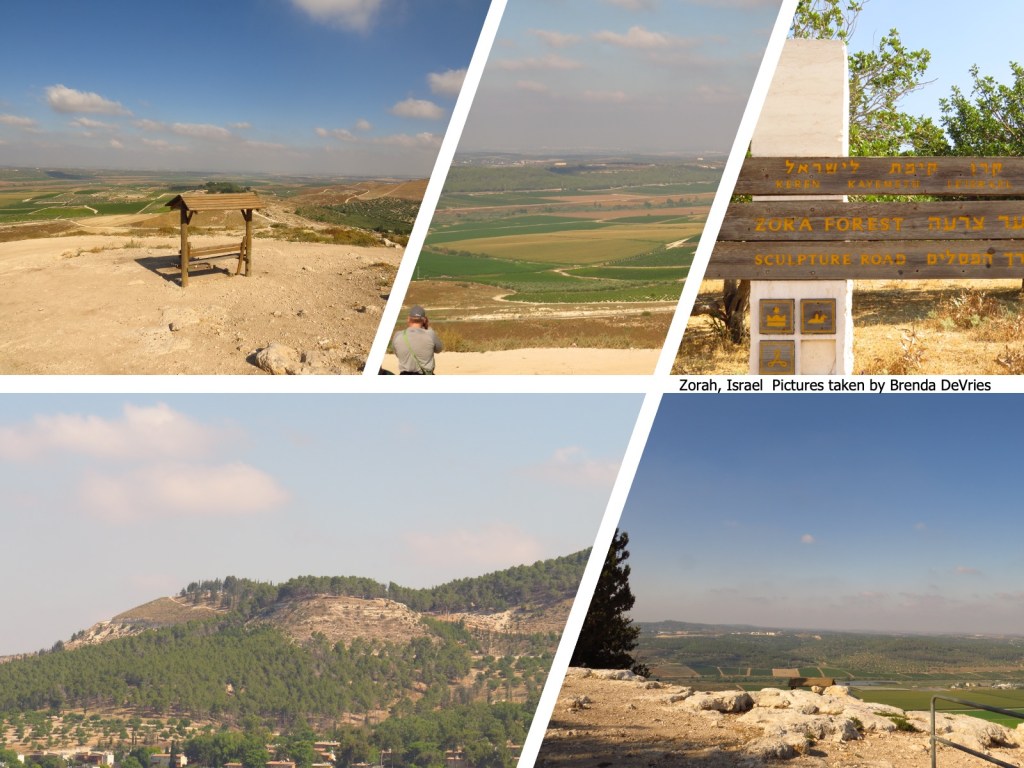
Zorah sits on a hill overlooking the Sorek Valley. I have been to Zorah, and was able to take some pictures there, and this is the first time I’ve had occasion to use them! This couple is from Zorah, from the clan of the Danites.
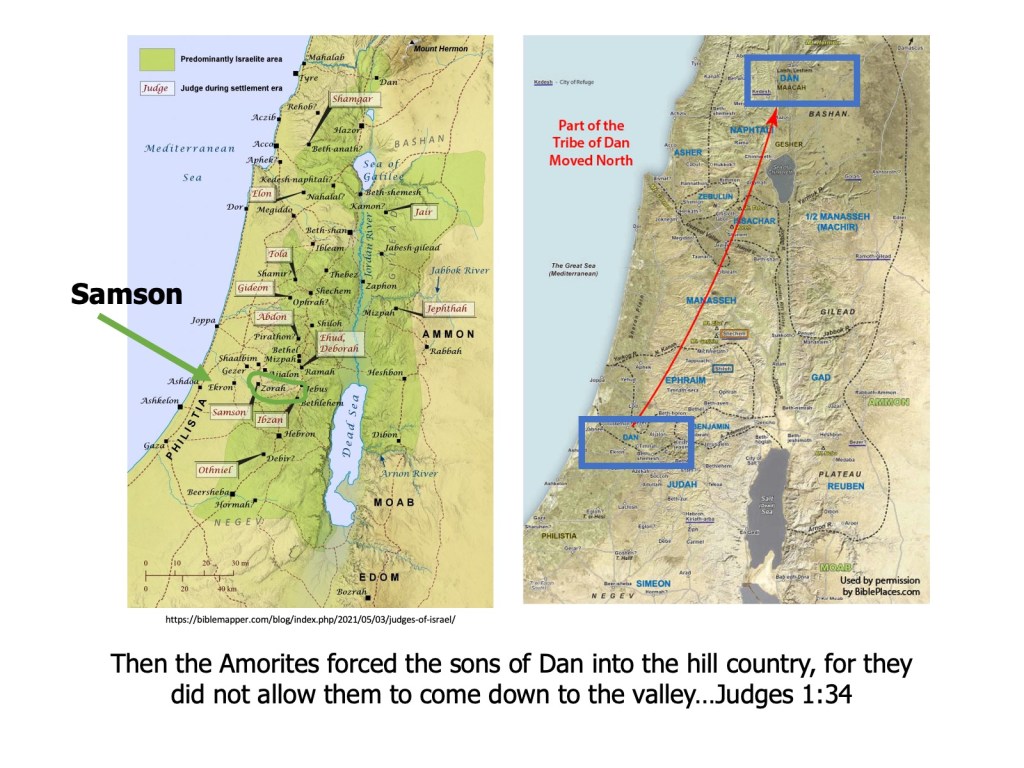
After entering the Promised Land, the Danites get forced out of their territory. Judges 1 tells us: Then the Amorites forced the sons of Dan into the hill country, for they did not allow them to come down to the valley…Judges 1:34
The Danites were seafarers[6], and in the song of Deborah, they were criticized for staying in their ships during the battle.[7] Because of pressure from the Philistines, a portion of the tribe abandoned their hopes of settling near the central coast, and they migrating to the north of Philistine territory. It’s likely that not all the tribe of Dan moved, so the next judge will become a judge over just a remnant of the Danites that remained in the south.[8]
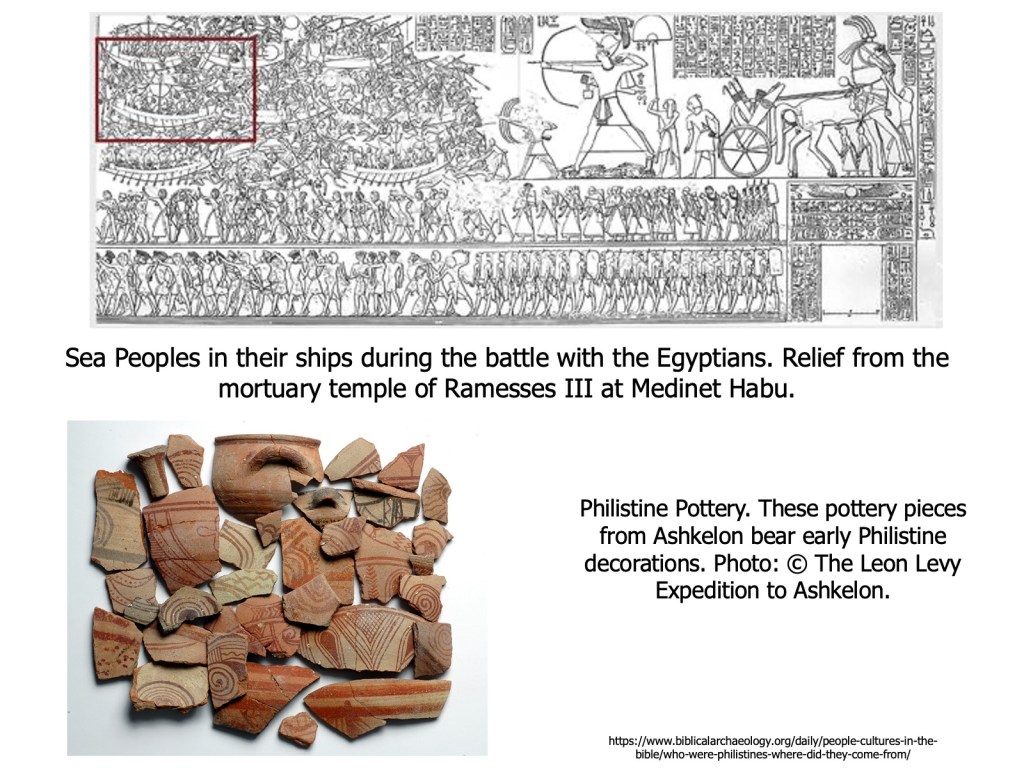
The Philistines were also Sea Peoples[9], who inhabited the southwestern coastal strip of Canaan/Israel/Palestine, and had an adversarial relationship with the Israelites.[10] We first heard about the Philistines, when Shamgar saved Israel by killing 600 of them with an oxgoad.[11] Then, just before Jephthah, God gave the people of Israel into the hands of the Philistines and the Ammonites.[12] At the beginning of the Iron Age, the Philistines were a people who were considered culturally more advanced.[13] We’ll learn more about them next time. So, our story opens with a couple from Zorah, part of the Danites, who were under the thumb of Philistine rule. And they were childless.
Barrenness was often seen as a stigma—a sign of divine displeasure.[14] For a Hebrew woman, it was a shattering and shameful condition.[15] We shouldn’t interpret it in light of our modern-day views of family, but instead, according to ancient values.[16] Not having children jeopardized the future of the ancient community, as well as one’s personal future.[17] Jephthah’s future was cut off because he sacrificed his daughter. This couple’s future is cut off at the front end.[18] It’s another sign that things are not going well for God’s people in the land, and part of it is due to their own apostasy.[19] We are not told a lot about this couple’s situation. It doesn’t say she is old, like Sarah was.[20] She isn’t complaining about her situation, or trying other ways to get a child, like Sarah or Rachel do.[21]
A name in Israelite thought—characterizes and conveys a person’s essence. We never learn this woman’s name,[22] even though she is the most important HUMAN character in this chapter.[23] But not knowing her name does not detract from her character in any way.[24] As a woman…in a patriarchal world, she too, will be a hero in her own right.[25] I read an article where she is titled ‘Eshet Manoah, which in the Hebrew means ‘wife of Manoah’[26], and it helps distinguish her a little better.
3 The angel of the Lord appeared to her and said, “You are barren and childless, but you are going to become pregnant and give birth to a son. 4 Now see to it that you drink no wine or other fermented drink and that you do not eat anything unclean.” 5 “You will become pregnant and have a son whose head is never to be touched by a razor because the boy is to be a Nazirite, dedicated to God from the womb. He will take the lead in delivering Israel from the hands of the Philistines.” Judges 13:3-5
The angel issues what sounds like the first-ever surgeon general’s warning.[27] And SHE…must take a Nazirite vow.[28] Men or women could dedicate themselves to God for a period of time, usually in gratitude for answered prayer, or as a preparation for holy war.[29] Numbers 6 has laws about the Nazarites. The word Nazir means “to be set apart,”[30] or to be “dedicated” to God.[31] Nazirites were to be separate from other people.
They may not eat or drink anything that comes from grapes. That means, no wine, no strong drink, no grape juice, no fruit, no seeds, no skin, and no vinegar. Grapes are also associated with feasts and celebrations—it was a sign of luxurious living.[32] And since grapes were one of the economic and dietary mainstays of that culture, it was a true dietary restriction.[33] That makes it harder! Nazirites could not cut their hair, and they are to avoid things that are unclean, much like a priest,[34] who abstains from drinking wine while serving in the tabernacle,[35] and must not have contact with the dead.[36] These were all ways of showing that you were “in training” toward a goal.[37]
In the years of the wilderness wanderings, the people were set apart for a time by not drinking wine or strong drink.[38] In Judges 5:2, the song of Deborah, it says that ‘the locks hung loose in Israel,’[39] probably a Nazirite vow, as a preparation for war. This kind of Nazarite dedication was VOLUNTARY, and only for a limited time, and then ended when a person made a burnt offering. The Apostle Paul made this kind of vow two times in Acts[40], after which he had his head shaved.[41] Samuel was the only other person who lives his entire life under a Nazarite vow.[42] The difference for this baby, this child – is that the vow started before he was even born, and it is imposed on him![43] The term used in Judges 13 is Nazir Elohim, a “Divine Nazarite![44]” He has a call on his life since his conception! The angel doesn’t give any other specifications.
6 Then the woman went to her husband and told him, “A man of God came to me. He looked like an angel of God, very awesome. I didn’t ask him where he came from, and he didn’t tell me his name. 7 But he said to me, ‘You will become pregnant and have a son. Now then, drink no wine or other fermented drink and do not eat anything unclean, because the boy will be a Nazirite of God from the womb until the day of his death.’” Judges 13:6-7
Mrs. Manoah[45] reports back to her husband, but she leaves out a couple of things. She doesn’t tell him about not cutting the child’s hair, and she leaves out the part about her son ‘beginning’ to deliver Israel. She ADDS that he will be a Nazarite until the day he dies.[46] She also was quite trusting—considering she didn’t even think to ask him where he came from or what his name was! He doesn’t have wings or a halo, so the messenger’s identity is still a mystery.
8 Then Manoah prayed to the Lord: “Pardon your servant, Lord. I beg you to let the man of God you sent to us come again to teach us how to bring up the boy who is to be born.” Judges 13:8
Manoah is not easily convinced. Can you blame him? Who IS this ‘man of God’? You didn’t get his name? Are you sure? Manoah may believe that his wife had an affair. Maybe this was just a cover up for an act of foul play.[47] Maybe Manoah is feeling slighted because HE wasn’t addressed first.[48] But…
9 God heard Manoah, and the angel of God came again to the woman while she was out in the field; but her husband Manoah was not with her. 10 The woman hurried to tell her husband, “He’s here! The man who appeared to me the other day!” 11 Manoah got up and followed his wife. When he came to the man, he said, “Are you the man who talked to my wife?” “I am,” he said. 12 So Manoah asked him, “When your words are fulfilled, what is to be the rule that governs the boy’s life and work?” 13 The angel of the Lord answered, “Your wife must do all that I have told her. 14 She must not eat anything that comes from the grapevine, nor drink any wine or other fermented drink nor eat anything unclean. She must do everything I have commanded her.” Judges 13:9-14
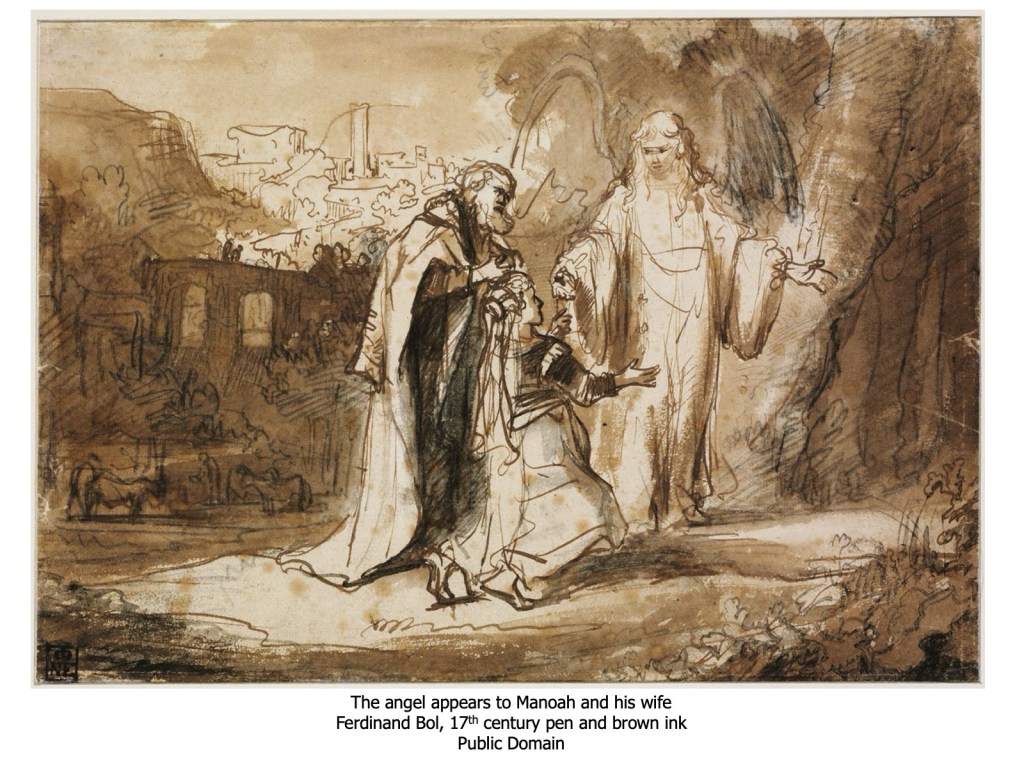
There’s a touch of humor here. God hears Manoah’s request loud and clear, but the messenger comes to his wife alone in the field again! When his wife retrieves him, the angel tells Manoah less than what he said to his wife. His answers are short and sweet. And he frames all his instructions – with repeated references to the woman: Let HER…SHE must…SHE must…SHE must…[50] For sure now, this couple cannot claim ignorance. They know what God expects of them as parents of this promised child.[51] The narrator continues to portray Manoah in a comical light: ignorant, skeptical and dim-witted.[52] Manoah wants to take back some form of control[53], so, he invites the messenger for dinner.
15 Manoah said to the angel of the Lord, “We would like you to stay until we prepare a young goat for you.” 16 The angel of the Lord replied, “Even though you detain me, I will not eat any of your food. But if you prepare a burnt offering, offer it to the Lord.” (Manoah did not realize that it was the angel of the Lord.) 17 Then Manoah inquired of the angel of the Lord, “What is your name, so that we may honor you when your word comes true?” 18 He replied, “Why do you ask my name? It is too amazing for you to understand. It is wonderful.[54] Judges 13:15-18
In the ancient world, if you knew the name of a heavenly being, you could have power over it. Manoah keeps trying.[55] But he also may be a bit nervous. In the Hebrew, he has a bit of a stutter[56] as he asks, “Who your name?”[57] The visitor, and the ways of God, are a riddle.[58] Will Manoah figure it out?
19 Then Manoah took a young goat, together with the grain offering, and sacrificed it on a rock to the Lord. And the Lord did an amazing thing while Manoah and his wife watched: 20 As the flame blazed up from the altar toward heaven, the angel of the Lord ascended in the flame. Seeing this, Manoah and his wife fell with their faces to the ground. 21 When the angel of the Lord did not show himself again to Manoah and his wife, Manoah realized that it was the angel of the Lord. 22 “We are doomed to die!” he said to his wife. “We have seen God!” 23 But his wife answered, “If the Lord had meant to kill us, he would not have accepted a burnt offering and grain offering from our hands, nor shown us all these things or now told us this.” Judges 13:19-23
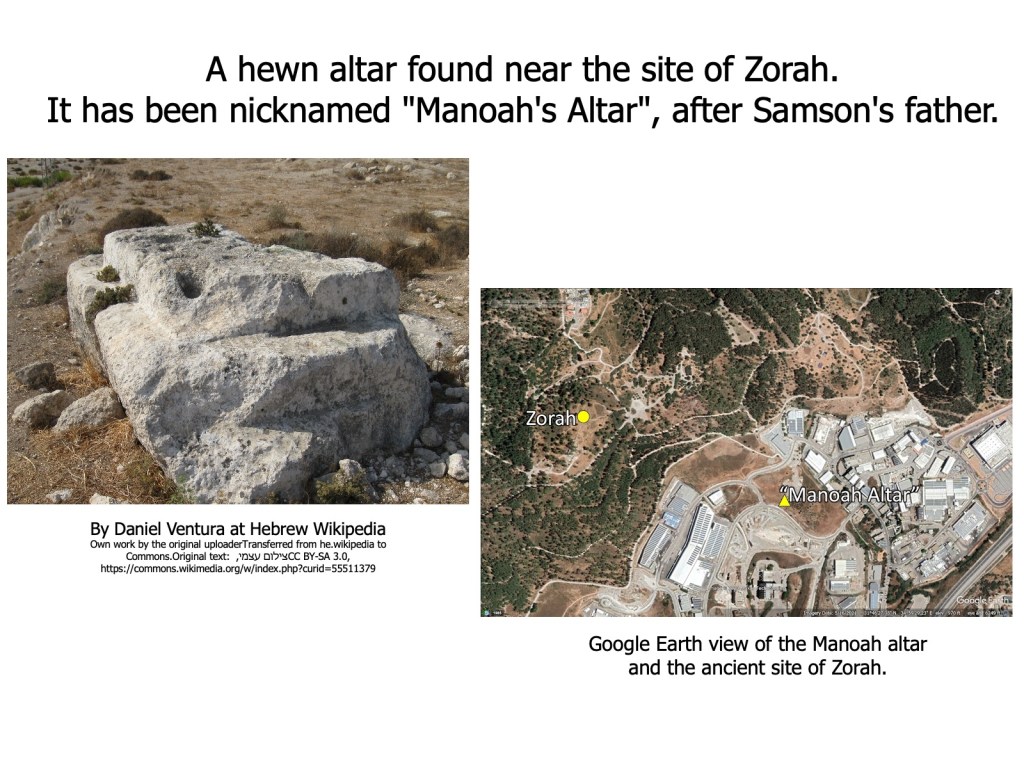
A rock-hewn altar was found just below the hill of Zorah.[59] It has been nicknamed “Manoah’s Altar”[60], after Samson’s father.[61]
The offering of food in this scene is very similar to the Gideon story. A messenger appears to Gideon, and he received a call to deliver Israel. He asked for a sign, presents a goat and unleavened bread on a rock. The messenger touches the gifts with his staff, and flames leap from the rock and the messenger leaves. Both Gideon and Manoah are afraid and realize that they have seen the angel of the Lord. God tells Gideon he will not die. Manoah’s wife relays the same message.[62] One of the differences is that the messenger accepts Gideon’s meal, but here, he rejects Manoah’s offer. “No thanks.” Why don’t you offer it as a sacrifice to God?[63] Wink. Wink. And then—the angel disappears into thin air. Even now, you might feel a little hair standing on the back of your neck if you put yourself in their place for a moment.
In this story, Manoah is depicted as a little bit foolish and controlling, while his wife is mature and trusting.[64] But together, they believe the promise and are on board with the angel’s instructions. Only Ishmael, Isaac, John the Baptist and Jesus are announced to their mothers and fathers in the same way that Samson is to Manoah and his wife. The only difference here—is that the angel did NOT name the child.[65]
24 The woman gave birth to a boy and named him Samson. He grew and the Lord blessed him, 25 and the Spirit of the Lord began to stir him while he was in Mahaneh-Dan, [or, the Camp of Dan] between Zorah and Eshtaol. Judges 13:24-25
The Old Testament reports mothers naming their children more often than fathers.[66] Samson, or Shimshon[67], (Šimšôn) remember our ‘S’ lesson from last week? Try saying that once: Shimshon. Sounds a little different than our English pronunciation.

Shimshon could have a hint of the name Shemesh—like the Canaanite sun god Shemesh, or the Hebrew word for sun with a diminutive ending, meaning “little sun”, someone who brings a ray of light in the dark days of the judges.[68] The boy grew and the Lord blessed him. He will be the next savior.[69]
We have no indication that Samson truly understood his calling as a deliverer.[70] God knows! Manoah and his wife know! WE know! But does Samson know?[71] His mother may be a model of Israelite womanhood, but the females that he associates with – will be anything but.[72] As a child, Samson experiences God’s Spirit. The coming of the Spirit on the judges is not a sign of approval. It is the power needed to accomplish acts for God.[73] We might start getting excited: Surely there are heroic battle stories coming, where the mighty Samson delivers Israel from the Philistines and obeys his vows and serves God with all his heart!![74] Don’t hold your breath. You know the vicious cycle by now.
Promise and fulfillment frame the story in Judges 13.[75] God provides a deliverer, even if Israel isn’t interested. And that’s really what the story is all about.[76] Manoah and his wife were an unlikely couple.[77] Why were they chosen? They are not leaders, warriors, or prophets. They live in a dark time, surrounded by compromise. There is nothing flashy about them, but God begins his extraordinary work through them. One person hears, the other questions; both seek understanding. Together—they witness God’s promise.

Put this story in context. This is the darkest period in the history of the judges, and the lamp of God was in danger of going out.[78] Daniel Block writes: Together this couple appears to present a model home, a beacon of light in the dark days of the judges. They are a pair whose faith and piety are rewarded by the miraculous healing of the woman’s barrenness and the birth of an extraordinary son.[79]
The feeling that life is barren, meaningless, and bearing no fruit—is a problem that recurs in every culture and historical era.[80] What do we do when God seems silent or absent? Can we believe that God is preparing something we can’t yet see? What would it look like to trust that God is already striking a match? When your life feels fruitless, God is not finished. God gives hope in the dark. Samson would begin the deliverance for God’s people in Judges, but he points beyond himself—to Jesus. His birth, too, was announced to an ordinary couple. Jesus didn’t just begin deliverance — He finished it. He provided rest from our enemies, and victory over sin.[81] The same God who gave Israel hope in the dark gives us Jesus — the Light of the world, who shines in our deepest night. God’s promises always point toward Jesus.
God is doing something new. The prophet Isaiah offers an extraordinary word to both the barren woman and to the eunuch in Isaiah.[82] To the barren woman? Do not be afraid or ashamed. The LORD is your husband—and you will have more children than you know what to do with in his kingdom. To the eunuch? God will give you an everlasting name that will endure forever—better than sons and daughters. Laura Smit writes: With the coming of Jesus, the whole family structure of God’s people changes. There is now a NEW way to understand what it is to be part of the family of God… Family structures take on new significance, and on the other hand, they are no longer necessary. …God continues to desire our fruitfulness, but now fruitfulness is primarily seen in how we function within the family of the church, for the biological family will pass away after death, while the community of the church persists into eternity…[83] In the Old Testament, God who appears to all these barren people, promising the coming of children. He is still the one who makes all of us fruitful and who continues to be concerned with lives that bear good fruit.[84]
The focus in Judges 13 …was particularly on the messenger who brings the news of Samson’s birth. In all three sections the messenger is the central character.[85] Samson’s mother was given no name in this story, and she spoke with the Angel of the Lord, who would not give his name. An angel was a heavenly messenger, sent by God on a mission. But the Angel of the Lord is God Himself.[86] Again, Laura Smit reminds us: As in other appearances of the Angel of the Lord, we can best understand this as a preincarnate appearance of Christ, whose name is Wonderful.[87] The same term, ‘wonderful’ that the angel of the Lord uses about his name is in the Song of Miriam, describing God’s abilities.[88] Who among the gods is like you, Lord? Who is like you—majestic in holiness, awesome in glory, working wonders?[89]
God is doing something new in this story, and every promise of new life, every story of deliverance, ultimately leads to Christ. Jesus is our true “Nazarite” — fully consecrated, perfectly obedient, the one who brings lasting salvation. In essence, he took a Nazirite vow the night before he died, promising not to drink of the fruit of the vine until his disciples were together again in the Father’s house.[90]
The Nazarite call is about focus, not restriction. Nazarites say ‘no’ to perfectly natural things to say ‘yes’ to something more important.[91] What would it mean ‘to be separate’ like that today? Not the ‘I DON’T do this…I DON’T do that’…and I DON’T have any joy anymore…but what does it mean to be someone whose heart and life are set apart to God, and who lives for Him?[92] It’s not about being weird — it’s about being dedicated. It’s not about what we avoid — it’s about who we belong to. To be “set apart” today isn’t about strange restrictions — it’s about distinct devotion. It means orienting our choices, habits, and time toward God’s purposes. SO…What if we chose to start the day in prayer or Scripture instead of immediately scrolling or checking messages? If we set aside moments of silence or Sabbath rest in a culture that glorifies busyness? In a world that prizes constant connection, holiness often looks like attention — choosing to be connected first to God. Being set apart also isn’t about avoiding people — it’s about being different among them. We can choose kindness online when others choose outrage. We can stay faithful in marriage when culture treats commitment as optional. We can trust God’s timing instead of forcing outcomes. We can choose generosity over self-preservation. We can be people who look ordinary but live as quiet signs of God’s kingdom in our neighborhoods.
God Sets Apart the Ordinary to Accomplish the Extraordinary
Being set apart doesn’t begin when we do something big for God — it begins when we trust Him in the small, unseen places. God doesn’t ask for extraordinary ability — only ordinary obedience: living with a heart oriented toward God’s purpose in every ordinary moment. The SAME God is at work in our world today! And his pattern remains. He chooses the unlikely, the humble, the ordinary — Manoah and his wife, shepherds, fishermen, teenagers, prostitutes, and former enemies of God. In Christ, WE are now the ones set apart — ordinary people filled with extraordinary grace. Peter writes: “YOU all are a chosen people, a royal priesthood, a holy nation, God’s special possession…” (1 Peter 2:9)
In this story, Mrs. Manoah heard from God first. Manoah questioned. Together, they sought understanding — and in their unity, God’s word was confirmed. God’s story often begins in homes, long before heroes stand on battlefields. Faith grows when we listen together for God’s voice. Sometimes we hear God most clearly in conversation —when faith is shared and tested in community…when we stop trying to control outcomes and seek His presence together.
What would it look like if you met with someone else to pray…not to ‘fix’ each other, but to listen for what God might be doing beneath the surface. What if, as couples, we ask God for wisdom and are open to each other’s insight. As friends, we encouraged each other through prayer and waiting? What if, as a church, we choose to trust God’s provision and act in faith in a culture that chases spectacle? Listening for God’s voice isn’t just a private practice — it’s a shared rhythm. In marriage, friendship, church life — are we listening together for God’s direction? God often reveals His will not to isolated individuals, but to communities who wait, pray, and listen together. The world may not notice, but heaven does. Because …God sets apart the ordinary to accomplish His extraordinary purposes. When we do that, maybe we’ll also be entertaining angels unaware…[93]
The faithfulness of Samson’s parents precedes him. Unlike any of the other judges, Samson’s preparation is extensive. His parents are chosen and instructed, and his training and lifestyle are laid out.[94] But Samson will have to grow up before he can deliver anybody, and even then, his qualifications appear doubtful. Will he succeed? Only time will tell.[95]
But God has not abandoned his people. He is at work behind the scenes, graciously intervening to bring another deliverer.[96] God is already writing the rescue story. God is starting something new.
PRAYER: Almighty God, You are the One who starts something new. In seasons of waiting, when our hearts feel barren and our prayers seem unanswered, You are already at work — preparing deliverance we cannot yet see. Thank You for the story of Manoah and his wife —ordinary people through whom You did extraordinary things. Teach us to listen together for Your voice, to trust You when heaven feels silent, and to live set apart — not in isolation, but in devotion, belonging fully to You. When life feels dry or dark, remind us that Your light still breaks through the shadows. When our strength runs out, fill us with Your Spirit again —that our small acts of faithfulness might shine like lamps in the night. Set us apart, Lord —for Your purposes, in our homes, in our work, and in our church. Use our ordinary lives to carry Your extraordinary grace into the world. In the name of Jesus — the true Deliverer, the Light in our darkness — we pray, Amen.
Bibliography
- Arnold, Bill T. and H.G.M. Williamson, eds, Dictionary of the Old Testament Historical Books, Downers Grove: InterVarsity Press, 2005.
- Block, Daniel I. Judges, Ruth, Nashville: B&H Publishing Group, 1999.
- Boda, Mark J., Mary L. Conway, Daniel I. Block, general editor; Judges, Exegetical Commentary on the Old Testament, Grand Rapids: Zondervan Academic, 2022.
- Brown, F; S. Driver, and C. Briggs, The Brown-Driver-Briggs Hebrew and English Lexicon, Peabody: Hendrickson Publishers, 2010.
- Butler, Trent C., Word Biblical Commentary: Judges, Grand Rapids: Zondervan, 2009.
- Frolov, Serge, Judges, Grand Rapids: William B. Eerdmans Publishing Company, 2013.
- Frymer-Kensy, Tikva, Reading the Women of the Bible: A New Interpretation of their stories, New York: Schocken Books, 2002.
- Goldingay, John, Joshua, Judges & Ruth for Everyone, Louisville: Westminster John Knox Press, 2011.
- Inrig, Gary, Hearts of Iron, Feet of Clay, Chicago: Moody Bible Institute, 1979.
- Keller, Timothy, Judges for You, Charlotte: The Good Book Company, 2013.
- Matthews, Victor H., Judges & Ruth, Cambridge: Cambridge University Press, 2004.
- McCann, J. Clinton, Judges, Louisville: John Knox Press, 2002.
- Wilcock, Michael, editor, J.A. Motyer, The Message of Judges: Revised Edition, Downers Soggin, J. Alberto, Judges, Philadelphia: The Westminster Press, 1981.
- Smit, Laura A. and Stephen E. Fowl, Brazos Theological Commentary on the Bible: Judges and Ruth, Grand Rapids: Brazos Press, 2018.
- Grove: Illinois, 1992, 2021.
Articles
- Chisholm, Robert B Jr., “A note on Judges 13:20-21: sorting out the syntax”, Jewish Bible Quarterly, 38 no 1 Jan-Mar 2010, 10-12.
- Exum, J Cheryl, “Promise and fulfillment: narrative art in Judges 13”, Journal of Biblical Literature, 99 no 1 Mar 1980, 43-59.
- Greene, H. B. “Hebrew Rock Altars.” The Biblical World 9, no. 5 (1897): 329–40. http://www.jstor.org/stable/3140288.
- Hanauer, J. E. (1885). “The Rock Altar of Zorah”. Palestine Exploration Quarterly. 17 (3): 183–184.
- Niemann, Hermann Michael, “Zorah, Eshtaol, Beth-Shemesh and Dan’s Migration to the South: A Region and Its Traditions in the Late Bronze and Iron Ages”, Journal for the Study of the Old Testament, 24 no 86 Dec 1999, 25-48.
- Palmer, Robb C., From A Pastor’s Notebook: Male-Female Themes In Judges 13-16m Priscilla Papers, 10 no 4 1996, 8.
- Philip, Graham, “The Early Bronze Age of the Southern Levant: A Landscape Approach”, Mediterranean archaeology, Volume 16. Sydney: University of Sydney, Dept. of Archaeology, 2003
- Roskoski, John, “Samson: Judge of Israel, Hero of Faith I”, Journal of Biblical Theology, 1 no 4 Oct – Dec 2018, 31-48.
- Roskoski, John, “The Recurring Theme of “Beginning” in the Samson Narratives”, Journal of Biblical Theology, 5 no 3 Jul – Sep 2022, 38-54.
- Ross, Jillian L., “Type-Casting The Samson Family: Genesis Parodies In Judges 13-14”, Journal of the Evangelical Theological Society, 64 no 2 Jun 2021, 237-252.
- Zucker, David J., Josephus on the Begetting of Samson: A Treasury of Biblical Tropes, CCAR Journal, 67 no 1 Wint 2020, 138-157.
- Zucker, David J., “Manoah’s Wife In Late Second Temple Literature”, Jewish Bible Quarterly, 47 no 2 Apr – Jun 2019, 103-112.
- Zucker, David J., “Sperm Donation and Surrogacy in the Time When the Judges Judged”, CCAR Journal, 69 no 1 Wint 2022, 12-22.
Websites: Accessed between November 3-5, 2025
- https://www.myjewishlearning.com/article/eshet-manoah/
- Rabbanit Leah Sarna and Ethan Schwartz, “Eshet Manoah: Mother of the Mighty Samson”, https://www.myjewishlearning.com/article/eshet-manoah/
- https://en.wikipedia.org/wiki/Zorah#:~:text=Zorah%20was%20situated%20on%20the,of%20Jerusalem%20near%20Nahal%20Sorek
- https://crossroadsbible.net/2023/07/05/manoahs-altar-near-ancient-zorah/
—
Going Deeper Questions
-What’s something you’ve had to wait a long time for — maybe a package, an answer, or a season of life to change? How did that waiting shape you?
Read Judges 13:1-3 (Hope in the Dark)
-The people weren’t even crying out for help anymore — they’d grown used to life under oppression. Why do you think people sometimes stop hoping or praying when things feel stuck?
-Why might silence or apathy be even more dangerous than rebellion?
-Barrenness in Scripture often symbolizes hopelessness or fruitlessness.
What might “barrenness” look like in our modern lives — spiritually, emotionally, relationally, or in ministry?
-The angel appears not to a priest or prophet, but to an unnamed woman. What does that choice tell us about the kind of people God loves to use? How can our church make more room for “ordinary” voices to be heard?
-How does it feel to know that God is already preparing deliverance — even when they (and you) can’t see it yet?
-In what ways can we rekindle hope when faith feels dry or routine?
Read Judges 13:4–5 (Ordinary People, Extraordinary Purpose)
–The angel gives commands before the promise is fulfilled — before the pregnancy even happens. Why do you think God sometimes calls us to obedience before we see the results? Think of a time when you felt unqualified — how did God use you anyway?
-The angel’s message includes dietary restrictions and lifestyle boundaries — markers of being “set apart.” What do you think being set apart for God meant for Manoah’s wife — and for Samson?
-Why is it so easy to mistake “being set apart” for being superior or separate from people?
-The Nazarite vow meant saying “no” to good things to say “yes” to something greater.
What would it look like for you to live intentionally “in training” for God’s purposes?
-In what ways do your personal habits and faith shape the people around you — family, coworkers, friends, or children?
-Samson “will begin to deliver Israel.” What does that phrase tell us about the way God’s salvation often unfolds — gradually, not instantly? How can we learn to celebrate the beginnings of God’s work, even when it’s not finished?
Read Judges 13:6–14 (Listening Together for God’s Voice)
-The woman hears the angel’s words and passes them to her husband — but she doesn’t include every detail. What do you notice about her retelling? What gets emphasized or left out?
-Why is it sometimes hard to share a spiritual experience with someone else who wasn’t there?
-Manoah prays that God would “send the man again to teach us.” What does this prayer reveal about Manoah’s heart? Doubt? Desire? Leadership?
-How do you typically respond when you’re unsure if you heard God correctly — do you act, wait, or ask again?
-How does this story encourage us to seek God’s guidance together — in marriage, friendships, or church community?
-Where in your life right now do you need to stop acting alone and start listening with others for God’s direction?
Read Judges 13:15-20 (Wonder and Worship)
-Manoah keeps trying to manage the situation — offering a meal, asking the angel’s name, trying to understand. What do you notice about his need to “get a handle” on the moment?
-When are you most tempted to try to control how God works — instead of simply trusting Him?
-What’s a name that means something special to you — maybe a family name, nickname, or a biblical one?
-The angel says his name is “too wonderful” (or “beyond understanding”). What does that teach us about who God is?
-Why do you think we’re often more comfortable with a God we can explain than a God who remains mysterious?
Read Judges 13:21–23 (When God Seems Silent)
-When is the last time you felt awe at God’s presence — not fear, but that holy sense of being small in a beautiful way?
-Manoah interprets the encounter as judgment; his wife interprets it as grace. How can two people experience the same event and draw such different conclusions about God?
-What can we learn from her calm, grounded faith in the face of uncertainty, especially when emotions or circumstances feel overwhelming?
-How does your heart respond to the idea that God is not out to destroy you, but delights to dwell with you?
-How do you discern the difference between God’s silence and His preparation?
Read Judges 13:24–25 (Pointing Ahead)
–For all the dramatic angel appearances, the story ends quietly — a baby is born. Why do you think God often begins His biggest works in ordinary moments?
-How does this story of hope in a barren place point us forward to Jesus — the true Deliverer?
-Where might God be quietly planting new life — in you, in our church, or in the world — even where everything still looks barren?
God Sets Apart the Ordinary to Accomplish the Extraordinary
Practical Applications for Being Set Apart
Here are some practical ideas as you go through your week.
Personally-Life in the Every Day
Being set apart isn’t about being strange — it’s about being devoted.
- Start your day differently. Begin each morning with a few quiet minutes to surrender your plans, distractions, and anxieties to God before you check your phone or open your email. (“Lord, set this day apart for You.”)
- Guard what shapes your heart. Samson’s vow meant saying “no” to normal things (like wine) to say “yes” to God’s calling. Today, that might mean fasting from media, gossip, comparison, or habits that dull your attention to the Spirit.
- Practice holy habits of attention. Slow down. Pay attention to God’s presence in small, unseen moments — a sunset, a child’s laugh, a quiet conviction, a friend’s need. Holiness begins with noticing.
- Choose obedience over image. Being set apart isn’t about appearing religious — it’s about quietly aligning your life with God’s will, even when nobody sees.
—
Relationally-With Others
Holiness isn’t withdrawal from people; it’s being different among them
- Speak blessing in a cynical world. Use your words to build up rather than tear down — especially online or in conflict. Samson’s strength was physical; yours may be the power of gracious speech.
- Practice integrity in relationships. Be faithful in marriage, dependable in friendship, and honest at work — living in such a way that others sense God’s trustworthiness through you.
—
In Community — Faith Together
Holiness flourishes in community, not isolation.
- Worship faithfully. Make gathering with the church a rhythm of grace, not an optional activity. When you show up — week after week — you model a life anchored in God’s presence.
- Listen for God’s voice together. Like Manoah and his wife, faith grows when believers discern together. Create space in your small group or friendships to ask: “What might God be saying to us?”
- Encourage someone quietly. Being set apart often looks like ordinary acts of faithfulness that no one applauds but heaven notices.
Missionally— Carriers of Hope in the Dark
To be set apart isn’t to retreat — it’s to reflect.
- Bring light where it’s dark. Step intentionally into spaces that feel hopeless — schools, workplaces, neighborhoods — as someone carrying peace, not panic.
- Respond differently to the world’s noise. Don’t mirror the outrage, fear, or despair around you. Live from the calm confidence that God is already writing the rescue story.
- Serve without spotlight. Look for small ways to serve unseen — praying for a neighbor, paying for someone’s meal, mentoring a teen — acts that reveal the quiet strength of those set apart for God.
—
Closing Reflection and Prayer
What is one small, concrete way you will live ‘set apart’ for God this week?
Invite everyone to finish this sentence:
“This week, I want to live set apart by ____________.”
All: God, help us trust that You are working even when we can’t see it.
Set us apart for Your purposes — right where we are. Teach us to recognize Your blessing, trust Your timing, and stay open to the quiet stirring of Your Spirit. Amen.
[1]Michael Wilcock, , editor, J.A. Motyer, The Message of Judges: Revised Edition, Downers Grove: Illinois, 1992, 2021, 98.
[2] Daniel I. Block, Judges, Ruth, Nashville: B&H Publishing Group, 1999, 395.
[3] Laura A. Smit and Stephen E. Fowl, Brazos Theological Commentary on the Bible: Judges and Ruth, Grand Rapids: Brazos Press, 2018, 147.
[4] Mark J. Boda, and Mary L. Conway, Daniel I. Block, general editor; Judges, Exegetical Commentary on the Old Testament, Grand Rapids: Zondervan Academic, 2022, 595.
[5] Daniel I. Block, 399.
[6] Graham Philip, “The Early Bronze Age of the Southern Levant: A Landscape Approach”, Mediterranean archaeology, Volume 16. Sydney: University of Sydney, Dept. of Archaeology, 2003, 117.
[7] Judges 5:17
[8] Boda, Conway, 747, footnote 6, based on Klein, Irony in Judges, 144.
[9] https://library.biblicalarchaeology.org/article/piece-by-piece-exploring-the-origins-of-the-philistines/
[10] Bill T. Arnold and H.G.M. Williamson, eds, Dictionary of the Old Testament Historical Books, Downers Grove: InterVarsity Press, 2005, 782.
[11] Judges 3:31
[12] Judges 10:7
[13] Arnold, Williamson, Dictionary of the Old Testament Historical Books, 782,
[14] J Cheryl Exum, “Promise and fulfillment: narrative art in Judges 13”, Journal of Biblical Literature, 99 no 1 Mar 1980, 43-59, 47.
[15] Gary Inrig, Hearts of Iron, Feet of Clay, Chicago: Moody Bible Institute, 1979, 209.
[16] Daniel I. Block, Judges, 400.
[17] Laura A. Smit, Fowl, 152.
[18] Block, 401.
[19] Block, 401.
[20] Gen. 18:12.
[21] Gen. 16:3, 30:3.
[22] J Cheryl Exum, 48.
[23] Daniel I. Block, 400.
[24] J Cheryl Exum, 48.
[25] https://www.myjewishlearning.com/article/eshet-manoah/
[26] https://www.myjewishlearning.com/article/eshet-manoah/
[27] Rabbanit Leah Sarna and Ethan Schwartz, “Eshet Manoah: Mother of the Mighty Samson”, https://www.myjewishlearning.com/article/eshet-manoah/ accessed Nov 4, 2025.
[28] Trent C. Butler, Word Biblical Commentary: Judges, Grand Rapids: Zondervan, 2009, 324.
[29] Boda, Conway, 603.
[30] Gary Inrig, 211.
[31] John Goldingay, Joshua, Judges & Ruth for Everyone, Louisville: Westminster John Knox Press, 2011, 134.
[32] Inrig, 212.
[33] Victor H., Matthews, Judges & Ruth, Cambridge: Cambridge University Press, 2004,135.
[34] Smit, Fowl, 149.
[35] Leviticus 10:9
[36] Numbers 19.
[37] Timothy Keller, Judges for You, Charlotte: The Good Book Company, 2013, 126.
[38] Deuteronomy 29:6
[39] Judges 5:2 in the Hebrew!
[40] Acts 18:18, 21:23-26.
[41] https://biblehub.com/commentaries/ellicott/acts/18.htm
[42] 1 Samuel 1:11, 21.
[43] Block, 403.
[44] Zucker, Sperm Donation, 13.
[45] Michael Wilcock, 103.
[46] Boda, Conway, 604.
[47] https://www.myjewishlearning.com/article/eshet-manoah/
[48] Victor Matthews, 141.
[49] Ferdinand Bol, 17th century pen and brown ink, Public Domain.
[50] Boda, Conway, 605.
[51] Butler, 328.
[52] Block, 397, 398.
[53] Boda, Conway, 606.
[54] From the EXB version, and based on the Hebrew.
[55] Based on Boda, Conway, 606.
[56] Block, 413, footnote 263, based on Boling, Judges, 222, who characterizes it as stuttering.
[57] Butler, 329.
[58] Block, 414.
[59] https://crossroadsbible.net/2023/07/05/manoahs-altar-near-ancient-zorah/
[60] Hanauer, J. E. (1885). “The Rock Altar of Zorah”. Palestine Exploration Quarterly. 17 (3): 183–184. doi:10.1179/peq.1885.17.3.183. ISSN 0031-0328
[61] https://en.wikipedia.org/wiki/Zorah#:~:text=Zorah%20was%20situated%20on%20the,of%20Jerusalem%20near%20Nahal%20Sorek.
[62] Based on a comparison chart in Block, 411.
[63] Based on Block, 412.
[64] Boda, Conway, 610.
[65] Matthews, 139.
[66] Block, 416.
[67] Boda, Conway, 610.
[68] Block, 416, 417.
[69] Wilcock, 104.
[70] Butler 327.
[71] Based on Block, 396.
[72] Based on Block, 392.
[73] Butler, 330.
[74] Based on Butler, 331.
[75] Exum, J Cheryl, Promise and fulfillment-narrative art in Judges 13, 44.
[76] Based on Block, 398, 399.
[77] Wilcock, 100.
[78] Block, 419.
[79] Block, 418.
[80] Smit, Fowl, 152.
[81] Based on Keller, 128.
[82] Isaiah 54:1-3; 56:4-5
[83] Smit, Fowl, 154.
[84] Smit, Fowl, 154.
[85] Cheryl J. Exum, 46.
[86] Inrig, 210.
[87] Smit, Fowl, 152.
[88] Matthews, 142, citing R.G. Boling, Judges, 1975, 222.
[89] Exodus 15:11 NIV
[90] Smit, Fowl, 149.
[91] Wilcock, 100.
[92] Based on Inrig, 214.
[93] From Michael W. Smith song, “Trilogy: Angels Unaware” from the album I’ll Lead You Home, 1995, and ‘Maybe we are entertaining angels unaware…” Do not forget to show hospitality to strangers, for by so doing some people have shown hospitality to angels without knowing it. Hebrews 13:2
[94] Boda, Conway, 597.
[95] Block, 420.
[96] Block, 420.
 Preach it Sista