
Have you ever promised something in the heat of the moment? “Sure, I’ll do that…I promise!” ‘Kiddo, if you just go to sleep, I’ll buy you a prize tomorrow!’ After a big family dinner, we swear, ‘That’s it — no more dessert for the rest of the year!’ ‘God, if you just help me pass this test, I’ll read my Bible every morning for the rest of my life!’ ‘O Lord, if this police officer lets me off with a warning, I’ll start volunteering in the nursery!’ We all know what it’s like to make a promise in panic — and regret it later.
The judge in our story made a vow that had devastating consequences. But God doesn’t want bargains — He wants trust. Today we’ll learn: When our faith falters, God’s faithfulness stands firm. Judges 10 starts off with some information about two minor judges. The judges basically come out of a town or a tribe during this era of transition. They are appointed representatives to administer justice and rule over civil affairs.[1]
After the time of Abimelech, a man of Issachar named Tola son of Puah, the son of Dodo, rose to save Israel. He lived in Shamir, in the hill country of Ephraim. 2 He judged Israel twenty-three years; then he died, and was buried in Shamir. Judges 10:1-2
We get Tola’s name, hometown, length of reign, tribe of origin and death notice.[2] That’s all we get. Tola lived, he led he died. And the way that Tola ‘saved Israel”? He may have cleaned up some of the mess after Abimelech’s oppressive and evil rule.
This story shows us Tola’s deep rootedness within his community with his generational and tribal identity.[3] His rule is quiet and uneventful[4]…a respite in a world of chaos.
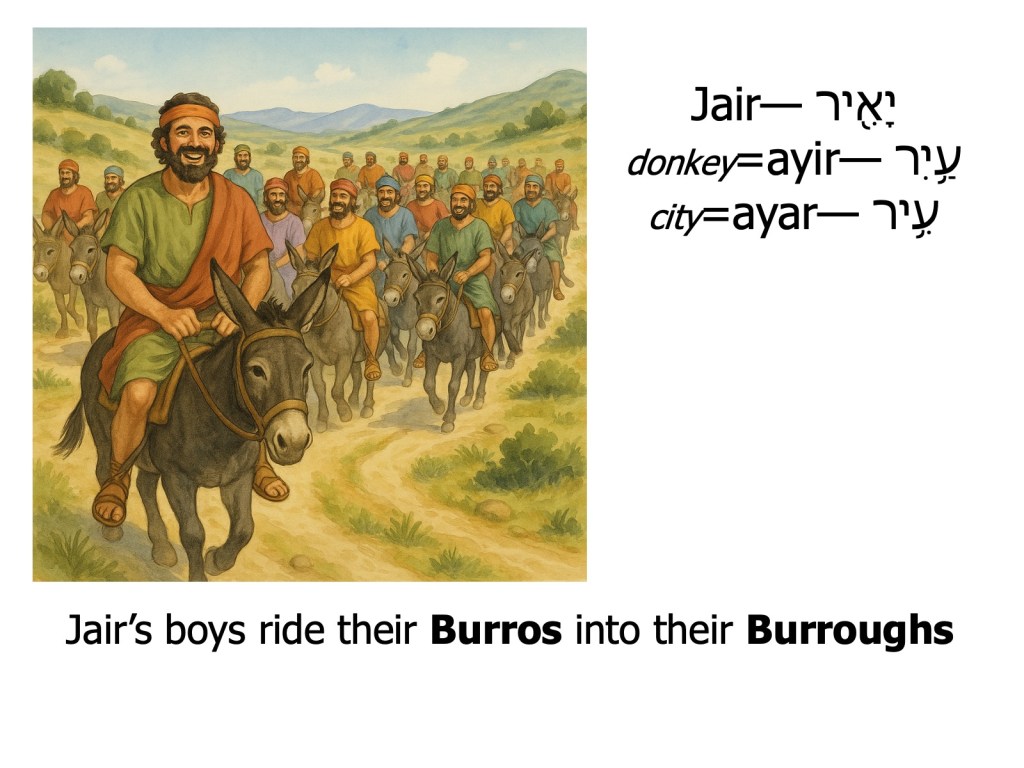
3 He was followed by Jair of Gilead, who led Israel twenty-two years. 4 He had thirty sons, who rode thirty donkeys. They controlled thirty towns in Gilead, which to this day are called Havvoth Jair. 5 When Jair died, he was buried in Kamon. Judges 10:3-5
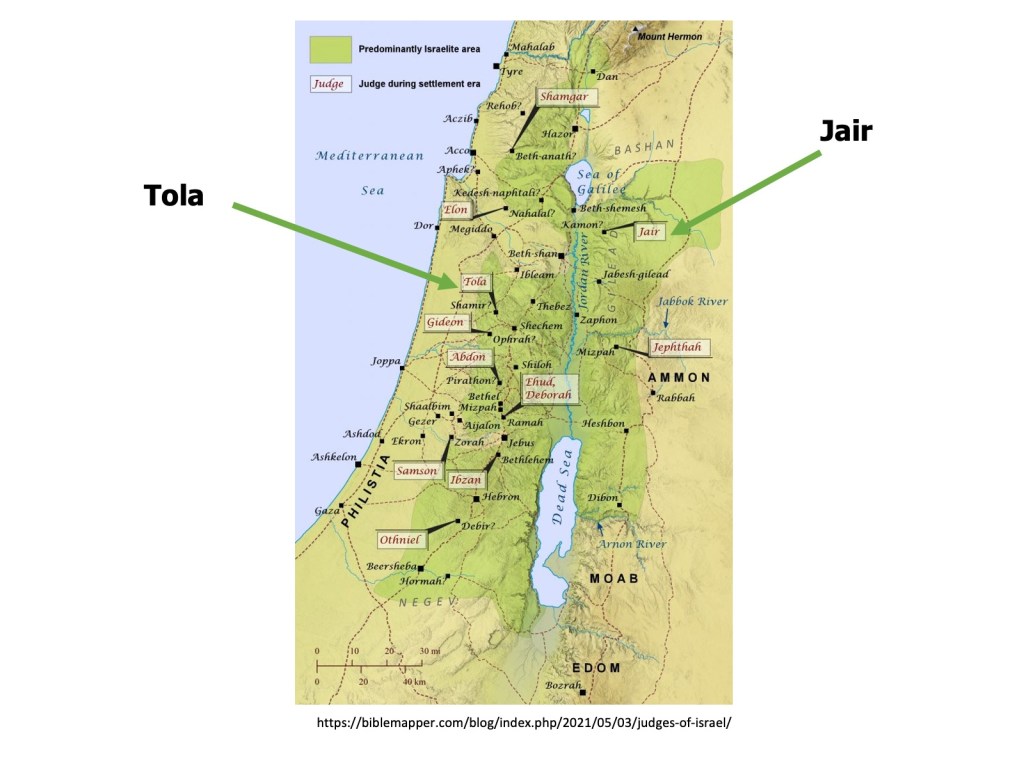
Jair comes from a completely different background and area than the other judges. There is no mention of an adversary or any fighting. Another little blip of peace in the land? In his lifetime, there is a new generation that grows up and influences the community, as the sons spread out into the land.[5] In the ancient world, the number of children you had, livestock, and territory was all a sign of status and wealth—and here, it looks like a bit of a royal tribute![6] Jair had thirty sons, who each got a donkey and an inheritance of land that was divvied up.
Some commentators say it means that Jair is materialistic,[7] but it seems to have a humorous, light tone. Any time the Bible has a pun, it’s worth a glance and a chuckle! Jair [יָאִ֖יר] —in the Hebrew—has sons who each ride an ayir, [עַ֥יִר] and who have charge over an ‘ayar [עִ֥יר]. In the English we might say—his boys ride their burros to the Burroughs.[8] It’s a bright spot in these stories that gives us some relief before the descent into chaos[9] once more.
Mark Boda and Mary Conway write about these two minor judges and note that: These leaders are not people who have epic exploits to talk about. But neither does the community suffer from crisis after crisis! These two men show us lives that are epitomized by consistency and carefulness, which provides the environment for safe and sustained growth among God’s people.[10] Even if far from perfect, these judges were constructive and faithful, and there is no mention of sin.[11] There’s something in me that strikes a chord in that, as I work through the rhythm of daily and weekly care for this congregation. As a pastor, I strive to be the kind of person that offers a stable environment, and who points people to Jesus, our ultimate leader, shepherd, and judge!
And there goes 45 years in the life of Israel. There is no time of oppression, there is no cry out to God, and there also is no word from God.[12]
Again the Israelites did evil in the eyes of the Lord. They served the Baals and the Ashtoreths, and the gods of Aram, the gods of Sidon, the gods of Moab, the gods of the Ammonites and the gods of the Philistines. And because the Israelites forsook the Lord and no longer served him, 7 he became angry with them. He sold them into the hands of the Philistines and the Ammonites, 8 who that year shattered and crushed them. For eighteen years they oppressed all the Israelites on the east side of the Jordan in Gilead, the land of the Amorites. 9 The Ammonites also crossed the Jordan to fight against Judah, Benjamin and Ephraim; Israel was in great distress. 10 Then the Israelites cried out to the Lord, “We have sinned against you, forsaking our God and serving the Baals.” Judges 10:6-10
Are you surprised at this? You shouldn’t be…it’s another vicious cycle. Kind of. We’re going to start seeing a little change from what we’ve come to expect. The Ammonites were related to Israel through Lot. They shatter and crush, or, as Trent Butler notes: “They extinguish and exterminate the sons of Israel,”[13] specifically targeting the tribes of Judah, Benjamin and Ephraim. Judah has done pretty well in Judges so far. Benjamin failed to drive out the Jebusites in chapter one[14], but they did participate in the battle with Deborah and Barak.[15] Ephraim has been mentioned several times already in Judges, in both good and bad ways.[16]
As before, the people call out to God as a last resort. “God help us! Help! Help! Rescue!” And God responds to their cries, but NOT in the same way as before. To be fair, this is the first time we actually see a real confession! It looks like a bargaining chip,[17] though, more than a genuine repentance. They admit that they are doing wrong, but there is no change in lifestyle or attitude.[18] Right now, they just want to confess their sin and have God save them again. God is angry with them (vs7), and disappointed[19], and rightly so. He’s not going to listen to people who do not listen to him.[20]
11 The Lord replied, “When the Egyptians, the Amorites, the Ammonites, the Philistines, 12 the Sidonians, the Amalekites and the Maonites oppressed you and you cried to me for help, did I not save you from their hands? 13 But you have forsaken me and served other gods, so I will no longer save you. 14 Go and cry out to the gods you have chosen. Let them save you when you are in trouble!” 15 But the Israelites said to the Lord, “We have sinned. Do with us whatever you think best, but please rescue us now.” 16 Then they got rid of the foreign gods among them and served the Lord. And he could bear Israel’s misery no longer. Judges 10:11-16
To their credit, the Israelites try again. Confession is the first step of repentance.[21] Then…it’s action. And the people remove their foreign gods and worship Yahweh. God’s heart is not hard. And aren’t we grateful?
WHEN OUR FAITH FALTERS, GOD’S FAITHFULNESS STANDS FIRM
It’s something we have already seen time and time again in the story of the Judges. ‘God could bear their misery no longer’. But that statement is a mixed one. God was weary of their misery. His spirit was impatient with the suffering of Israel. He cannot tolerate their misery, but he is frustrated, exasperated and angry to have to be in this situation.[22] He was cut to the quick.[23] Those statements all express a little of God’s response. And even though he is troubled, God makes no promises to raise up a leader this time. So…they look around on their own.
17 When the Ammonites were called to arms and camped in Gilead, the Israelites assembled and camped at Mizpah. 18 The leaders of the people of Gilead said to each other, “Whoever will take the lead in attacking the Ammonites will be head over all who live in Gilead.” Jephthah the Gileadite was a mighty warrior. His father was Gilead; his mother was a prostitute. 2 Gilead’s wife also bore him sons, and when they were grown up, they drove Jephthah away. “You are not going to get any inheritance in our family,” they said, “because you are the son of another woman.” 3 So Jephthah fled from his brothers and settled in the land of Tob, where a gang of scoundrels gathered around him and followed him. Judges 10:17-18, 11:1-3
Jephthah is called a mighty warrior, just like Gideon had been in chapter six.[24] He is also a bramble, in the tradition of Abimelech.[25] But even Abimelech’s mother was listed as a concubine, at least recognized as a second wife of sorts. But Jephthah’s mom was a prostitute.[26] We don’t know if she was an Israelite or a Canaanite, or even what her name is.[27] Just like Abimelech, Jephthah is estranged from his half-brothers,[28] who aren’t interested in any claim to be an heir.[29] Once again, this leader is all about power rather than a call to service.[30] There is nothing promising about him as a judge.[31]
Just because he is an exceptional warrior does not mean that God is blessing or will bless him. He establishes his reputation as a leader of a band of brigands.[32] Where Gideon and Abimelech almost have a dynasty, Jephthah controls a limited number of people.[33] His story will be a heroic tragedy.[34]
4 Some time later, when the Ammonites were fighting against Israel, 5 the elders of Gilead went to get Jephthah from the land of Tob. 6 “Come,” they said, “be our commander, so we can fight the Ammonites.” 7 Jephthah said to them, “Didn’t you hate me and drive me from my father’s house? Why do you come to me now, when you’re in trouble?” 8 The elders of Gilead said to him, “Nevertheless, we are turning to you now; come with us to fight the Ammonites, and you will be head over all of us who live in Gilead.” 9 Jephthah answered, “Suppose you take me back to fight the Ammonites and the Lord gives them to me—will I really be your head?” 10 The elders of Gilead replied, “The Lord is our witness; we will certainly do as you say.” 11 So Jephthah went with the elders of Gilead, and the people made him head and commander over them. And he repeated all his words before the Lord in Mizpah. Judges 11:4-11
Jephthah is in no mind to ‘forgive and forget.’[35] The leaders first offer him a position as a general military commander.[36] But he knows that they are desperate, and so he plays his trump card. “If I work for you, you need to give me full rights as a citizen.”[37] “Give me back my rights and inheritance!” They counteroffer with a higher position—not just a military position, but one with political overtones—a more permanent and prestigious leadership position.[38] Jephthah is sworn in before God…even though God is not listed as participating in this process—which means that any of his victories will be seen as divine affirmation of his position.[39] Clever move!
Once his swearing in ceremony is finished, Jephthah gets down to business. As the newly appointed leader, he brings a lawsuit against the Ammonite king.[40] Jephthah is skilled as a statesman and negotiator.[41] He masterfully argues from a historical point of view, he uses theological, personal, and chronological arguments that are quite remarkable.[42]
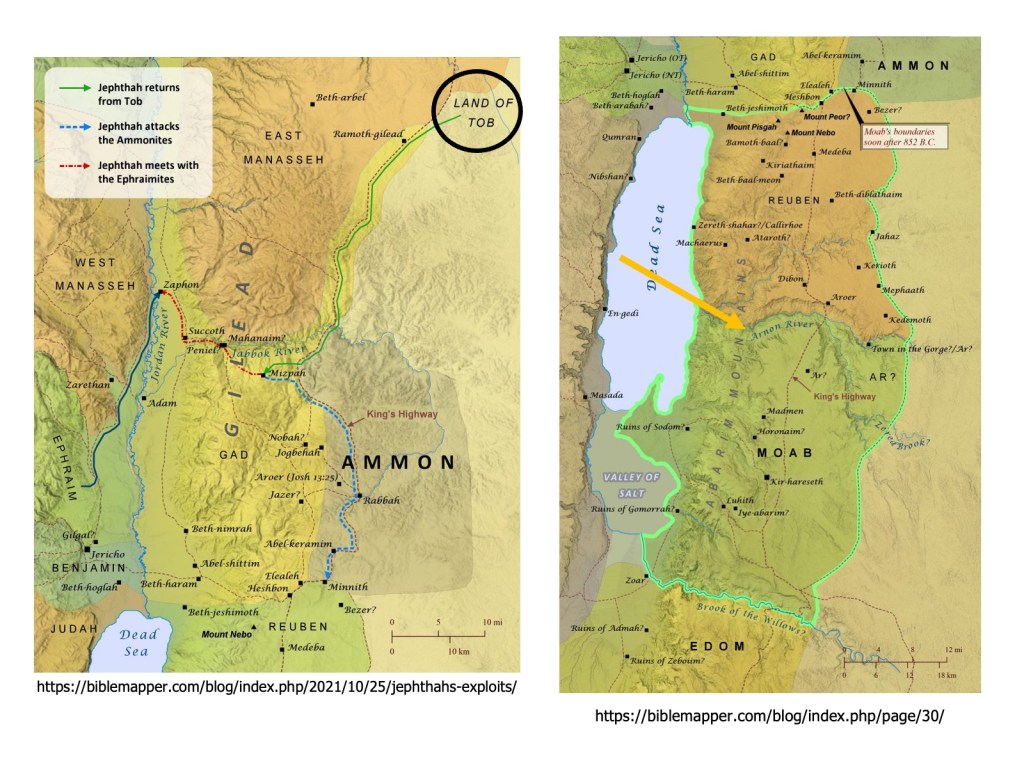
12 Then Jephthah sent messengers to the Ammonite king with the question: “What do you have against me that you have attacked my country?” 13 The king of the Ammonites answered Jephthah’s messengers, “When Israel came up out of Egypt, they took away my land from the Arnon to the Jabbok, all the way to the Jordan. Now give it back peaceably.” 14 Jephthah sent back messengers to the Ammonite king, 15 saying: “This is what Jephthah says: Israel did not take the land of Moab or the land of the Ammonites. 16 But when they came up out of Egypt, Israel went through the wilderness to the Red Sea and on to Kadesh. 17 Then Israel sent messengers to the king of Edom, saying, ‘Give us permission to go through your country,’ but the king of Edom would not listen. They sent also to the king of Moab, and he refused. So Israel stayed at Kadesh. 18 “Next they traveled through the wilderness, skirted the lands of Edom and Moab, passed along the eastern side of the country of Moab, and camped on the other side of the Arnon. They did not enter the territory of Moab, for the Arnon was its border. 19 Then Israel sent messengers to Sihon king of the Amorites, who ruled in Heshbon, and said to him, ‘Let us pass through your country to our own place.’ 20 Sihon, however, did not trust Israel to pass through his territory. He mustered all his troops and encamped at Jahaz and fought with Israel. 21 Then the Lord, the God of Israel, gave Sihon and his whole army into Israel’s hands, and they defeated them. Israel took over all the land of the Amorites who lived in that country, 22 capturing all of it from the Arnon to the Jabbok and from the desert to the Jordan. 23 Now since the Lord, the God of Israel, has driven the Amorites out before his people Israel, what right have you to take it over? 24 Will you not take what your god Chemosh gives you? Likewise, whatever the Lord our God has given us, we will possess. 25 Are you any better than Balak son of Zippor, king of Moab? Did he ever quarrel with Israel or fight with them? 26 For three hundred years Israel ccupied Heshbon, Aroer, the surrounding settlements and all the towns along the Arnon. Why didn’t you retake them during that time? 27 I have not wronged you, but you are doing me wrong by waging war against me. Let the Lord, the Judge, decide the dispute this day between the Israelites and the Ammonites.” Judges 11:12-27
Jephthah lectures the king about the historical circumstances of Israel’s occupation of Gilead—but like many politicians, he also mixes up the facts and conflates them.[43] Score! He uses theology to explain how they got the land—while intentionally (?) substituting the god Chemosh as their god, when it should have been Milkom.[44] (It’s a faux pas to mismatch the deities of countries, but he might be doing it to drive his own propaganda.[45]) He piously gives Yahweh the credit for giving them the land, but it’s not even a good representation of his own theology.[46] He then basically says to the Ammonite king—”who do you think you are?”[47] And why are you doing this now? It’s been over three hundred years!
It’s interesting that Jephthah names God as the Judge of Israel! (vs27) He expresses a belief that his case will be settled in heaven by no other gods, only Yahweh. It is his finest hour:[48] on the surface at least. He sure knows how to use the right words—a smooth talker, but he will soon show that he doesn’t know how to keep his mouth shut.[49]
28 The king of Ammon, however, paid no attention to the message Jephthah sent him. 29 Then the Spirit of the Lord came on Jephthah. He crossed Gilead and Manasseh, passed through Mizpah of Gilead, and from there he advanced against the Ammonites. Judges 10:28-29
It’s not surprising that the king of Ammon does not listen. And God becomes an active agent for the first time in Jephthah’s story. It feels a little bit like the same thing that Othniel and Gideon have experienced.[50] It is a spark of hope, as God graciously works through someone he has not explicitly selected.[51] This is a sign that he endorses Jephthah’s leadership—at least as a military commander![52] It doesn’t mean that everything he does can be attributed to the Spirit. But this moment, this battle is special. Jephthah is even included in the hall of fame in Hebrews 11:32, along with Barak, Gideon, and Samson. An unlikely list!
But now…we get to the part of his story that you may remember. To their great credit, the Hebrew Bible keeps the narrative of Jephthah and his actions, even if they are disturbing.[53] It’s up to us to study it and learn from it what we may. Jephthah is extremely confused in his ideas about God. He combines the pagan practices of the land and tries to meld them all together. Jephthah is not a prophet, he is not a priest…
he is a man who leads a group of thugs—and all he wants—is for God to give him political and military victory—a sad and scary combination. “God, you have to help me, or I’ll lose my position and my power!” Not a good recipe for life. For the first time in the text, Jephthah speaks to God—but in a bargain,[54] which some scholars see as shrewd and calculating—an attempt to manipulate the circumstances to his own advantage.[55]
30 And Jephthah made a vow to the Lord: “If you give the Ammonites into my hands, 31 whatever comes out of the door of my house to meet me when I return in triumph from the Ammonites will be the Lord’s, and I will sacrifice it as a burnt offering.” Judges 11:30-31
Typically, a burnt offering would only be an animal, but they are living in a land littered with pagan idolatry—and offering up a person as a sacrifice was not uncommon in some of the other lands nearby.[56] The nations surrounding Israel — especially the Ammonites and Moabites — sometimes offered their children as burnt sacrifices to their gods, usually Molech, who was also known by other names.[57] They built altars or bronze idols with outstretched arms, often hollow, with a furnace or fire beneath.
Infants or young children were placed on the heated arms as offerings, or on a pile of firewood.[58] Drums or loud instruments were beaten to drown out the cries of the victims. This sacrifice was seen as an ultimate act of devotion — meant to secure the god’s favor, blessing, or deliverance in war or famine. It was part of their state religion!
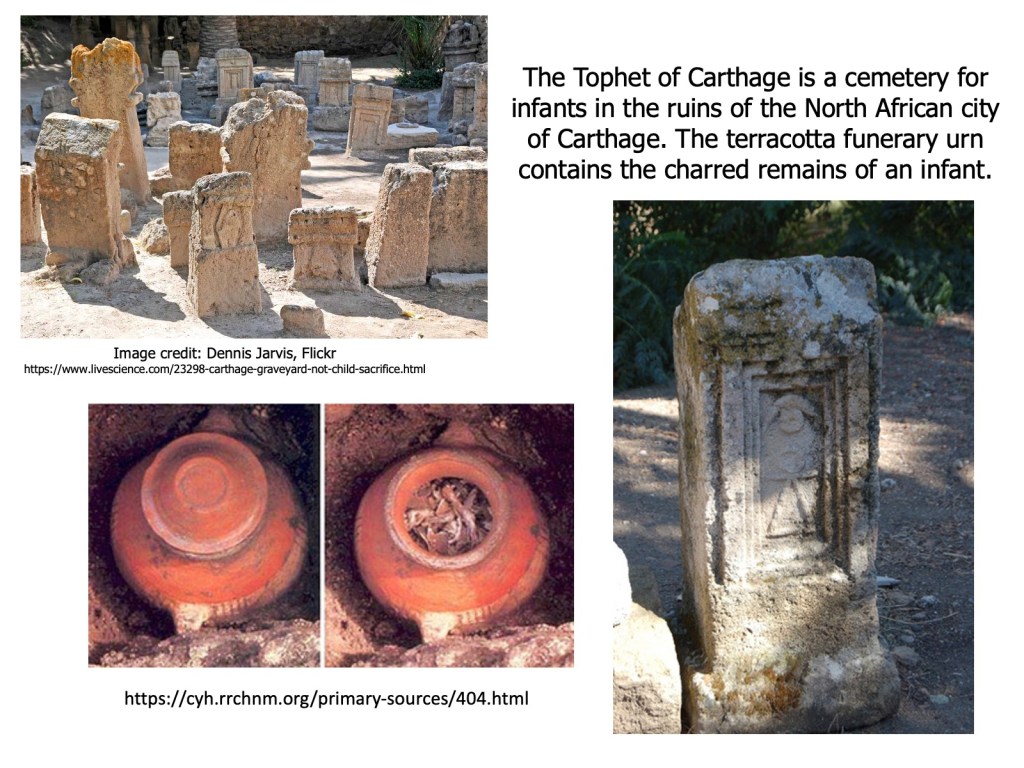
The Tophet of Carthage is a cemetery for infants in the ruins of the North African city of Carthage. There are no adults there, only infants, lambs, and goat kids.[60] Many of the grave stelae are marked with dedications to Baal and Tanit, who are the patron deities of Carthage. Sacrifices to appease the gods or to ask favors seem to be supported by some inscriptions, but there may also be evidence that small animals were sacrificed in place of the children.[61] High mortality rates were also a thing.
What Jephthah’s vow boils down to is that he didn’t trust God. He offered a bargain when God wanted his belief. He made a vow when God was already going to give a victory. His proposal is something that goes entirely against what God wanted. God condemned this kind of practice! He wanted his people to be different than the surrounding nations! Listen. Jephthah had to expect that it would be someONE, not someTHING that would come out of his house after a win in battle. In the ancient world, the men would go to battle, and the women would lead the coming home celebrations with dancing and tambourines. We saw this already in Judges 5 after the battle with Sisera.[62] Maybe Jephthah assumed that it would be a servant girl, or maybe his mother-in-law. St. Augustine thought that he must have intended to sacrifice his wife.[63] But it’s also possible that he KNEW his daughter would come out first, and that he bargained with God that which was most precious to him—his only daughter.[64] The costliest sacrifice brings the greatest honor?[65] It’s a high stakes gamble. It is much darker than Gideon’s test with the fleece. And it will turn out badly for him.
32 Then Jephthah went over to fight the Ammonites, and the Lord gave them into his hands. 33 He devastated twenty towns from Aroer to the vicinity of Minnith, as far as Abel Keramim. Thus Israel subdued Ammon. 34 When Jephthah returned to his home in Mizpah, who should come out to meet him but his daughter, dancing to the sound of timbrels! She was an only child. Except for her he had neither son nor daughter. 35 When he saw her, he tore his clothes and cried, “Oh no, my daughter! You have brought me down and I am devastated. I have made a vow to the Lord that I cannot break.” Judges 11:32-35
This is Jephthah’s ONLY child. Without her, there are no descendants and his name will die—the worst fate that the Biblical community could envision.[66] If he sacrifices his daughter, he will have no future. Right now some of you are thinking, ‘hey now!…really? Is this even okay?’ Short answer? No. Even the first people to hear this story would be horrified![67] Notice that his words are terribly egocentric. He’s only thinking about himself. It’s all about his own loss, and not the terrible consequences for her. “I” am devastated—“I” have made a vow that “I” can’t break. He blames his daughter for coming out of the house—instead of admitting that he made a foolish mistake.[68] And he doesn’t even seem to try to get out of it—or ask if he can offer something else instead—money, an animal? What in the world? Leviticus 27:1-8 has exactly the amount of money that could be given as a substitute when making a vow like this![69] He could have rescued her, redeemed her! The irony is that Jephthah delivers the Israelites from the people who sacrifice their children to their gods, and then turns around and sacrifices his daughter to Yahweh, who does NOT accept human sacrifice![70]
Trent Butler writes: “The vow says nothing about God—it says multitudes about Jephthah.”[71] God did not demand this, God did not sanction this, God does not accept this practice as something positive. Child sacrifice is a tragedy.[72]
36 “My father,” she replied, “you have given your word to the Lord. Do to me just as you promised, now that the Lord has avenged you of your enemies, the Ammonites. 37 But grant me this one request,” she said. “Give me two months to roam the hills and weep with my friends, because I will never marry.” 38 “You may go,” he said. And he let her go for two months. She and her friends went into the hills and wept because she would never marry. 39 After the two months, she returned to her father, and he did to her as he had vowed. And she was a virgin. From this comes the Israelite tradition 40 that each year the young women of Israel go out for four days to commemorate the daughter of Jephthah the Gileadite. Judges 11:36-40
Some interpreters say that Jephthah did not really sacrifice his daughter as a burnt offering, rather, she was dedicated to the Lord as a virgin for the rest of her life.[73] I had seen this idea before and thought—yes, that sounds nice! I like that ending! But sadly, the plain meaning here—is a literal burnt offering.[74] It’s horrific. And Jephthah is to blame. The Targum Jonathan, an Aramaic translation of the Prophets section of the Hebrew Bible[75], adds this: “And it became a decree in Israel that no one may offer up his son or his daughter for a burnt offering, as Jephthah the Gileadite did, who did not ask Phinehas the priest. For if he had asked Phinehas the priest, he would have rescued her with a monetary consecration.[76]
Jephthah’s daughter is a victim in this story. The whole thing looks and feels senseless,[77] and yet she is obedient, brave, and courageous.[78] She could have shifted the blame back on her dad. She could have run away. She is a heroine, worthy of admiration.[79] Her example of self-sacrifice, honoring of the vow, and her fate was commemorated from here on out.
Girls in the ancient world who entered puberty knew that their lives were not their own. Like Achsah in our first story, she could be given to the man of her father’s choice. She could be enslaved, raped, or a trophy of war. Young girls would admire Jephthah’s daughter. Instead of being given to an ordinary man, she was given to God in a state of permanent union with him.[80] Instead of going passively to her fate, she chose to honor her father’s vow. For young girls after this, the ritual that was established prepared them to return and accept their fate, while at the same time being comforted that they didn’t have to face what Jephthah’s daughter did.[81] By the time of the early church, a young virgin did not bewail her virginity when going to martyrdom, either—she saw it as going as a bride to her Bridegroom.[82]
The end of this story is so startling. Unlike the narrative in Genesis 22, with the story of Isaac on the altar, there is no last-minute intervention by God, no ram in the thicket. [83] There is no graphic description of the sacrifice, either, only an awful sense of emptiness, and a reminder of what might have been if Jephthah had been less manipulative and more faithful.[84] He takes the shame of Ammon and brings it into Israel.[85] Jephthah carries out a murder, and God is implicated.[86] But God is NOT to blame. Jephthah destroyed his own house.[87]
This story shows us that things are unraveling in the book of Judges. Civil war, violence against women, society going to pieces—[88] it is all too common in these stories now. And who will judge rightly? Jephthah is the judge—the appointed leader because of his mighty victory. No one else has authority over him! There are no systems or institutions of law in place that anyone abides by at this point. Everyone is doing what is right in their own eyes. The rest of the book of Judges is going to continue to spiral until society finally implodes.[89]
So, where is God in this story? Well, He shows up when the people cry out to him for help. He is not manipulated by their words, but he IS moved by his own compassion. Even though he refuses to help at first, he sees their suffering and is merciful. It’s a reminder that God does care about his people, even when they—and we— are not worthy of his love.
WHEN OUR FAITH FALTERS, GOD’S FAITHFULNESS STANDS FIRM
Even though God is upset and angry, he IS involved in the rescue of Israel. The same Spirit who empowered Gideon, Deborah and Othniel comes on Jephthah, an unlikely judge for sure! God empowers him, but Jephthah still operates under his own wisdom. He speaks God’s name but behaves like the nations around him do—and practices the things that Israel was supposed to reject. It’s what happens when culture shapes our view of God more than covenant truth.
When Jephthah foolishly makes a rash vow—God shows up again—in the Silence. God says nothing. There is no approval, no intervention, no voice from heaven. The silence itself speaks volumes.
All throughout these stories in Judges, God allows people to make their choices and reap the consequences. It’s a sobering echo of Israel’s condition: They keep speaking in religious terms, but they don’t really know His heart. God wants relationship, not ritual! He is not a deity to be bargained with. Even so, God is the faithful Redeemer—working through broken and unlikely people. This story makes us long for a true and better savior—and Jesus is the one who will come: someone who will not make a rash vow, but will offer himself willingly. Jesus will be a true and better deliverer.
Jephthah makes a rash vow to gain victory; Jesus resolutely volunteers himself to bring salvation. Where Jephthah’s foolish vow took an innocent life, Jesus’ faithful obedience gives His own life for the guilty. Where Jephthah’s faith falters, Jesus’ faithfulness endures. One leads Israel briefly, the other will reign eternally…over every tribe, nation and tongue!
Maybe, like Jephthah, WE try to bargain our way into God’s blessing — making promises, deals, or sacrifices to prove our devotion or earn His favor. But the Spirit of God doesn’t trade in bargains. One medieval scholar said, “If someone vows to commit a sin in Yahweh’s honor, the fact that Yahweh’s’ honor was intended does not set aside the sin.”[90] Instead, God invites us to trust him, and to submit ourselves to living in the way that he requires. The Holy Spirit leads us—not to bribe God with our vows, but to believe God with our hearts — to rest in what Jesus has already accomplished. And that’s the freedom we stand in: not fear-driven promises, but Spirit-led surrender.
The Apostle Paul writes to Timothy, a young pastor serving in Ephesus stating: Here is a trustworthy saying: If we died with him, we will also live with him; if we endure, we will also reign with him. If we disown him, he will also disown us; if we are faithless, he remains faithful, for he cannot disown himself. 2 Timothy 2:11-13
Even when we are faithless — when our vows break, when our zeal outruns our wisdom, when our promises crumble — He remains faithful. Because faithfulness isn’t just something God does; it’s who He IS! Jephthah sacrificed another to fulfill his word; Jesus sacrificed Himself to fulfill GOD’S Word. Through Him, we are invited into a relationship that doesn’t depend on our perfection but on HIS enduring promise.
WHEN OUR FAITH FALTERS, GOD’S FAITHFULNESS STANDS FIRM
Prayer: Gracious and faithful God, we thank You that Your mercy outlasts our mistakes, and Your promises stand even when ours fail. Like Jephthah, we often speak too quickly, trying to bargain with You when You’ve already given us grace. Forgive us for the vows we make in fear and the ways we try to earn what You freely give. Teach us the gentleness of Your Spirit—to trust instead of trade, to rest instead of strive, to follow instead of force. Thank You, Lord Jesus, that where Jephthah sacrificed another to fulfill his word, You sacrificed Yourself to fulfill the Father’s Word. Your cross is the end of our bargains and the beginning of our freedom. When we are faithless, remind us that You remain faithful, for You cannot disown Yourself. Make us people who live by Your Spirit, who endure in hope, and who trust in the God who never fails. In the name of our faithful Savior, Jesus Christ, Amen.
—
Bibliography
- Block, Daniel I. Judges, Ruth, Nashville: B&H Publishing Group, 1999.
- Boda, Mark J., Mary L. Conway, Daniel I. Block, general editor; Judges, Exegetical Commentary on the Old Testament, Grand Rapids: Zondervan Academic, 2022.
- Brown, F; S. Driver, and C. Briggs, The Brown-Driver-Briggs Hebrew and English Lexicon, Peabody: Hendrickson Publishers, 2010.
- Butler, Trent C., Word Biblical Commentary: Judges, Grand Rapids: Zondervan, 2009.
- Frolov, Serge, Judges, Grand Rapids: William B. Eerdmans Publishing Company, 2013.
- Frymer-Kensy, Tikva, Reading the Women of the Bible: A New Interpretation of their stories, New York: Schocken Books, 2002.
- Inrig, Gary, Hearts of Iron, Feet of Clay, Chicago: Moody Bible Institute, 1979.
- King, Philip J., Lawrence E. Stager, Life in Biblical Israel, Louisville: Westminster John Knox Press, 2001.
- Soggin, J. Alberto, Judges, Philadelphia: The Westminster Press, 1981.
- Smit, Laura A. and Stephen E. Fowl, Brazos Theological Commentary on the Bible: Judges and Ruth, Grand Rapids: Brazos Press, 2018.
- Matthews, Victor H., Judges & Ruth, Cambridge: Cambridge University Press, 2004.
- McCann, J. Clinton, Judges, Louisville: John Knox Press, 2002.
- Pietersma, Albert, Benjamin G. Wright, A New English Translation of the Septuagint and the Other Greek Translations, New York: Oxford University Press, 2007.
- Wilcock, Michael, editor, J.A. Motyer, The Message of Judges: Revised Edition, Downers Grove: Illinois, 1992, 2021.
Articles
- Amos, N Scott, “’Do to Me According to What Has Gone Out of Your Mouth’: A Reformation Debate on the Tragedy of Jephthah and his Daughter”, Reformation & Renaissance Review, 21 no 1 Mar 2019, 3-26.
- Bae, Hee-Sook, “A new approach to Jephthah’s vow: Antanaclasis (Judges 10-11)”, Journal for the Study of the Old Testament, 48 no 1 Sep 2023, 3-17.
- Baker, Robin, “Double Trouble: Counting the Cost of Jephthah”, Journal of Biblical Literature, 137 no 1 2018, 29-50.
- Beavis, Mary Ann, “A daughter in Israel: celebrating Bat Jephthah (Judg. 11:39d-40)”,
- Feminist Theology, 13 no 1 Sep 2004, 11-25.
- Bloch-Smith, Elizabeth, “A stratified account of Jephthah’s negotiations and battle: Judges 11:12-33 from an archaeological perspective”, Journal of Biblical Literature, 134 no 2 2015, 291-311.
- Bodoff, Lippman, The Tragedy of Jephthah, Jewish Bible Quarterly, 28 no 4 Oct-Dec 2000, 251-255.
- Chisholm, Robert B. Jr., “The ethical challenge of Jephthah’s fulfilled vow”, Bibliotheca sacra, 167 no 668 Oct-Dec 2010, 404-422.
- Cole, Casey S., “The Binding of Jephthah: Learning Orthopathy from the Daughter of Judges 11”, Journal of Pentecostal Theology, 29 no 2 2020, 145-157.
- Davis, Tamie S., “The condemnation of Jephthah”, Tyndale Bulletin, 64 no 1 2013, 1-16.
- Doling, J Christian, “A Man After Yahweh-Chemosh’s Own Heart: Syncretism and Davidic Allusions in the Story of Jephthaha’, Eleutheria, 8 no 2 2025, 46-72.
- Finkelstein, Israel, “The old Jephthah tale in Judges: geographical and historical considerations”, Biblica, 97 no 1 2016, 1-15.
- Graybill, Rhiannon, “No Child Left Behind: Reading Jephthah’s Daughter with The Babylon Complex”, New York : Fordham University Press, 2014, The Bible & Critical Theory, 11 no 2 2015, 36-50.
- Koplowitz-Breier, Anat. “A Nameless Bride of Death: Jephthah’s Daughter in American Jewish Women’s Poetry” Open Theology, vol. 6, no. 1, 2020, 1-14.
- Monroe, Lauren A. S., “Disembodied women: sacrificial language and the deaths of Bat-Jephthah, Cozbi, and the Bethlehemite concubine”, The Catholic Biblical Quarterly, 75 no 1 Jan 2013, 32-52.
- Lockwood, Peter F., “Jephthah’s Daughter: Awake to Her Wicked Father (Judges 11:29-40)”, Word & World, 40 no 3 Sum 2020, 210-218.
- Reiss, Moshe, “The sacrifice of Jephthah’s daughter: Jewish and Christian perspectives”, Louvain Studies, 36 no 4 Wint 2012, 321-336.
- Scicluna, Andrew. (2023). The Fires of Moloch. The Mirror – Undergraduate History Journal, 40 (1), 23–31. Retrieved from https://ojs.lib.uwo.ca/index.php/westernumirror/article/view/15900
- Smerko, Margaret A., “Eshet Chayil: Remembering Bath-Jephthah In Judges 11:34-40”, Journal of Theta Alpha Kappa, 45 no 1 Spr 2021, 1-12.
- Tore, Makmur; Ndolu, Nelci Nafalia, “The political vow of Jephthah in Judges 11:30-31”, Verbum et Ecclesia, 42 no 1 2021, 1-6.
- Van Pelt, Miles V. “Rethinking Jephthah’s Foolish Vow,” The Gospel Coalition, 14 October 2014, https://www.thegospelcoalition.org/article/rethinking-jephthah-foolish-vow/
- Zucker, David J., “Jephthah: Faithful Fighter; Faithless Father Ancient and Contemporary Views”, Biblical Theology Bulletin, 52 no 1 Feb 2022, 37-47.
Websites—accessed from October 20-25, 2025
https://cyh.rrchnm.org/primary-sources/404.html “Tophet of Carthage,” in Children and Youth in History, Item #404, https://cyh.rrchnm.org/items/show/404 (accessed October 22, 2025).
https://www.thetorah.com/article/molekh-the-sacrifice-of-babies?
https://www.livescience.com/23298-carthage-graveyard-not-child-sacrifice.html
Cemetary or Sacrifice in Carthage
https://en.wikipedia.org/wiki/Targum_Jonathan
Going Deeper Questions
Tell a (lighthearted) story about a promise you made “in the heat of the moment.” How did it turn out?
Read Judges 10:1-5
–What kind of “wins” do Tola and Jair represent? (What is missing from their stories compared to the other judges?)
-Jair’s story contains a Hebrew pun (Jair / ayir / ayar) — “his boys rode burros to the Burroughs.” Why might the author include humor here?
-Steady, uneventful leadership is easy to miss—and easy to undervalue. Sometimes “saving” look like stability rather than spectacle. When in your life has God called you to serve faithfully without applause, excitement, or visible results?
-If your family history were summarized in just two verses, what would you hope people would say about it? (Write or share one sentence.)
Read Judges 10:6-16 (The cycle… and a turn)
–How is this rebellion the same as earlier ones in Judges — and how is it different?
-The Israelites served many gods at once (v. 6). If you could translate that to today’s culture, what “gods” do people serve simultaneously?
Examples: success, comfort, busyness, approval, entertainment…
–If you had to name your “functional god” — the thing you tend to trust more than God when you’re stressed — what would it be?
-Compare the people’s first response (10:10) with their second (10:15–16). What changed?
-How can you tell the difference between regret (“I’m sorry I got caught”) and repentance (“I’m ready to change”)? (vs16) What spiritual disciplines today help us act out repentance rather than just talk about it?
-“He could bear Israel’s misery no longer” (10:16). What does this verse reveal about God’s heart? How does His compassion coexist with His justice?
Read Judges 10:17–11:11 (Choosing a leader)
–What stands out about Jephthah’s background? What obstacles did he face because of his family story? How has Jephthah’s past (family rejection, outlaws) formed him—for better and for worse?
-The elders offer him command, but he bargains for rulership (vv. 8–9). What’s the difference between serving and seizing leadership?
-What do you notice about the deal-making between Jephthah and the elders? Where do you see wisdom? where do you see ambition?
-If your old classmates or coworkers suddenly asked you to lead them, how would that feel? What emotions would rise up?
Read this short summary of Judges 11:12–28
Jephthah sends messengers to the king of Ammon asking why he’s attacking.
The Ammonite king claims Israel stole land from the Arnon to the Jabbok when they came from Egypt. Jephthah replies with a history lesson: Israel avoided Moab and Ammon, was attacked by Sihon king of the Amorites, and then—by the Lord’s help—took Amorite territory (Arnon–Jabbok–Jordan), which Israel has held for 300 years; therefore it isn’t Ammon’s land. He appeals to God as the true Judge to decide the dispute—yet the Ammonite king refuses to listen.
Jephthah makes a solid case—and some of it is highly commendable, but he twists some of the facts, and his speech is a mixture of pride and politics. Jephthah knows Israel’s history but not God’s heart. He can recite the facts of deliverance yet never pauses to seek the Deliverer. God isn’t impressed with clever speeches.
-What happens when we start using God’s truth as a tool to justify our position rather than a mirror to humble our hearts?
Read Judges 11:29–Then the Spirit of the Lord came on Jephthah. He crossed Gilead and Manasseh, passed through Mizpah of Gilead, and from there he advanced against the Ammonites.
–What does it mean that “the Spirit of the Lord came on Jephthah”? What kinds of empowerment did this usually bring to the judges?
-Does it surprise you that the Spirit’s presence doesn’t automatically prevent Jephthah’s foolishness? Have you ever thought “If God’s Spirit is with me, I can’t mess up?”
-What’s the difference between being empowered by the Spirit and being guided by the Spirit?
Read Judges 11:30–40 (The vow)
–What exactly does Jephthah vow in verses 30–31? Why do you think he made this promise?
–What do you think Jephthah expected to come out of his house first? What does that tell us about his mindset and view of God?
-What do Jephthah’s words center—God, his daughter, or himself? Where do you hear blame-shifting?
-Scripture allowed redemption from rash vows (cf. Lev 27:1-8). What faithful alternatives might Jephthah have pursued?
-How does Jephthah’s daughter respond (vv. 36–37)? What stands out to you about her character?
-Have you ever tried to make a deal with God — “If You will… then I will…”? Why do fear and control make bargains with God so attractive? What’s the difference between a promise of faith and a vow of fear?
-How should we talk about this passage with tenderness (especially for those with trauma or grief)? What can we honor in the daughter without endorsing the vow?
When our faith falters, God’s faithfulness stands firm
Jephthah makes a rash vow to gain victory; Jesus resolutely volunteers himself to bring salvation. Where Jephthah’s foolish vow took an innocent life, Jesus’ faithful obedience gives His own life for the guilty. Where Jephthah’s faith falters, Jesus’ faithfulness endures.
Read Hebrews 11:32-42–And what more shall I say? I do not have time to tell about Gideon, Barak, Samson and Jephthah, about David and Samuel and the prophets, 33 who through faith conquered kingdoms, administered justice, and gained what was promised; who shut the mouths of lions, 34 quenched the fury of the flames, and escaped the edge of the sword; whose weakness was turned to strength; and who became powerful in battle and routed foreign armies.
–If God can use unlikely people like Jephthah, Gideon, Barak and Samson, how might that shape your view of who He can use in your life, your church, or your story?
-Where have you seen God’s faithfulness stand firm even when your faith faltered? –
Application and Practice
-Where are you tempted to “trade” with God (If You… I’ll…)? Name one subtle bargain you’ve caught in your own heart lately.
-What’s one arena where you need quiet consistency this month? What first step would faithfulness (not flash) look like?
-“God wants trust, not bargains.” What practices build trust: prayer of surrender, waiting, community counsel, Scripture? Which one will you lean into this week?
-Words matter. What boundary will you put on your speech—before God and people? (e.g., 24-hour rule before making commitments; invite one trusted friend to challenge your vows/pledges.)
–Surrender card: Write one bargain you’ve been making with God. Cross it out and rewrite a one-sentence prayer of trust. Place it where you’ll see it daily.
–Quiet faithfulness check-in: Choose one consistent, unseen act of obedience (Scripture, prayer, service) and do it three times this week.
Prayer: Lord, thank You that when our faith falters, Your faithfulness stands firm. Forgive us for our rash words and fearful bargains. Teach us to trust You fully, to follow Your Spirit’s lead, and to rest in the grace of Jesus, our faithful Deliverer. Amen.
[1] Based on Butler, Trent C., Word Biblical Commentary: Judges, Grand Rapids: Zondervan, 2009, 259.
[2] Butler, 260.
[3] Boda, Mark J., Mary L. Conway, Daniel I. Block, general editor; Judges, Exegetical Commentary on the Old Testament, Grand Rapids: Zondervan Academic, 2022, 495.
[4] Boda, Conway, 492.
[5] Boda, Conway, 495.
[6] Boda, Conway, 494.
[7] Butler, Trent, 268.
[8] Boda, Conway, 494.
[9] Boda, Conway, 492.
[10] Boda, Conway, 495.
[11] Boda, Conway, 498-499.
[12] Boda, Conway, 485.
[13] Butler, 263.
[14] Judges 1:21
[15] Judges 5:14
[16] Judges 1:29, 3:27, 4:5, 5:14, 7:24, 8:1-2,
[17] Butler, 264.
[18] Boda, Conway, 510, 511.
[19] Boda, Conway, 511.
[20] Butler, 261.
[21] Boda, Conway, 512.
[22] Butler, 266, 267.
[23] Boda, Conway, 513, footnote 13.
[24] Judges 6:12
[25] Block, Daniel I. Judges, Ruth, Nashville: B&H Publishing Group, 1999, 351.
[26] Block, 352.
[27] Block, 353.
[28] Block, 355.
[29] Butler, 281.
[30] Based on Butler, 267.
[31] Butler, 280.
[32] Block, 354.
[33] Butler, 255.
[34] Butler, 277.
[35] David J. Zucker, “Jephthah- Faithful Fighter; Faithless Father Ancient and Contemporary Views,” Biblical Theology Bulletin, Feb 2022, 37-47, 40.
[36] Butler, 282.
[37] Block, 355.
[38] Butler, 282,283.
[39] Matthews, Victor H., Judges & Ruth, Cambridge: Cambridge University Press, 2004,119.
[40] Block, 358.
[41] Block, 358.
[42] Block, 359.
[43] Block, 360.
[44] Block, 361.
[45] Block, 362.
[46] Block, 362.
[47] Block, 362.
[48] Smit, Laura A. and Stephen E. Fowl, Brazos Theological Commentary on the Bible: Judges and Ruth, Grand Rapids: Brazos Press, 2018, quoting Webb 2012:324.
[49] Butler, 286.
[50] Block, 364.
[51] Butler, 287.
[52] Boda, Conway, 534.
[53] Zucker, 46.
[54] Butler, 287.
[55] Block, 367.
[56] Block, 367.
[57] Scicluna, Andrew. (2023). The Fires of Moloch. The Mirror – Undergraduate History Journal, 40(1), 23–31. Retrieved from https://ojs.lib.uwo.ca/index.php/westernumirror/article/view/15900
[58] https://www.thetorah.com/article/molekh-the-sacrifice-of-babies?
[59] https://cyh.rrchnm.org/primary-sources/404.html, https://www.livescience.com/23298-carthage-graveyard-not-child-sacrifice.html
[60] https://bonesdontlie.wordpress.com/2014/01/23/cemetery-or-sacrifice-in-carthage-again/
[61] https://cyh.rrchnm.org/primary-sources/404.html “Tophet of Carthage,” in Children and Youth in History, Item #404, https://cyh.rrchnm.org/items/show/404 (accessed October 22, 2025).
[62] Judges 5:28, see also Exodus 15:20.
[63] Augustine, Quaestiones in Heptateuchum 7.49.6 cited in John Thompson, Writing the Wrongs: Women of the Old Testament among Biblical Commentators from Philo through the Reformation, Oxford Studies in Historical Theology, Oxford: Oxford Univiersity Press, 2001, 126. (listed in Smit, Fowl, 132.)
[64] Boda, Conway, 544.
[65] Boda, Conway, footnote 15, from DeMaris and Leeb, “(Dis)Honor and Ritual Enactment,” 184-185.
[66] Based on Tikva Frymer-Kensy, Reading the Women of the Bible: A New Interpretation of their stories, New York: Schocken Books, 2002, 108.
[67] Frymer-Kensky, 108.
[68] Based on Zucker, 44.
[69] Leviticus 27:1-8.
[70] Butler, 289, quoting K. Lawson Younger Jr. Judges, Ruth, NIV Application Commentary, Grand Rapids: Zondervan, 2002, 262.
[71] Butler, 288.
[72] Frymer-Kensky, 115.
[73] Miles V. Van Pelt, “Rethinking Jephthah’s Foolish Vow,” The Gospel Coalition, 14 October 2014, https://www.thegospelcoalition.org/article/rethinking-jephthah-foolish-vow/
[74] Boda, Conway, 544.
[75] https://en.wikipedia.org/wiki/Targum_Jonathan
[76] In Boda, Conway, 552, from Targum Judges 11:39, as translated by Smelik, The Targum of Judges, 555-556.
[77] Smit, Fowl, 138.
[78] Butler, 292,293.
[79] Frymer-Kensky, 110.
[80] Beavis, Mary Ann, “A daughter in Israel: celebrating Bat Jephthah (Judg. 11:39d-40)”, Feminist Theology, 13 no 1 Sep 2004, 11-25, 17.
[81] Frymer-Kensky, 114.
[82] Smit, Fowl, 140.
[83] Zucker, 43.
[84] Boda, Conway, 555.
[85] Smit, Fowl, 127.
[86] Zucker, 43.
[87] Smit, Fowl, 141.
[88] Frymer-Kensky, 116.
[89] Frymer-Kensky, 117.
[90] Moses ben Hahman, or Ramban…cited in Smit, Fowl, 136.
 Preach it Sista