
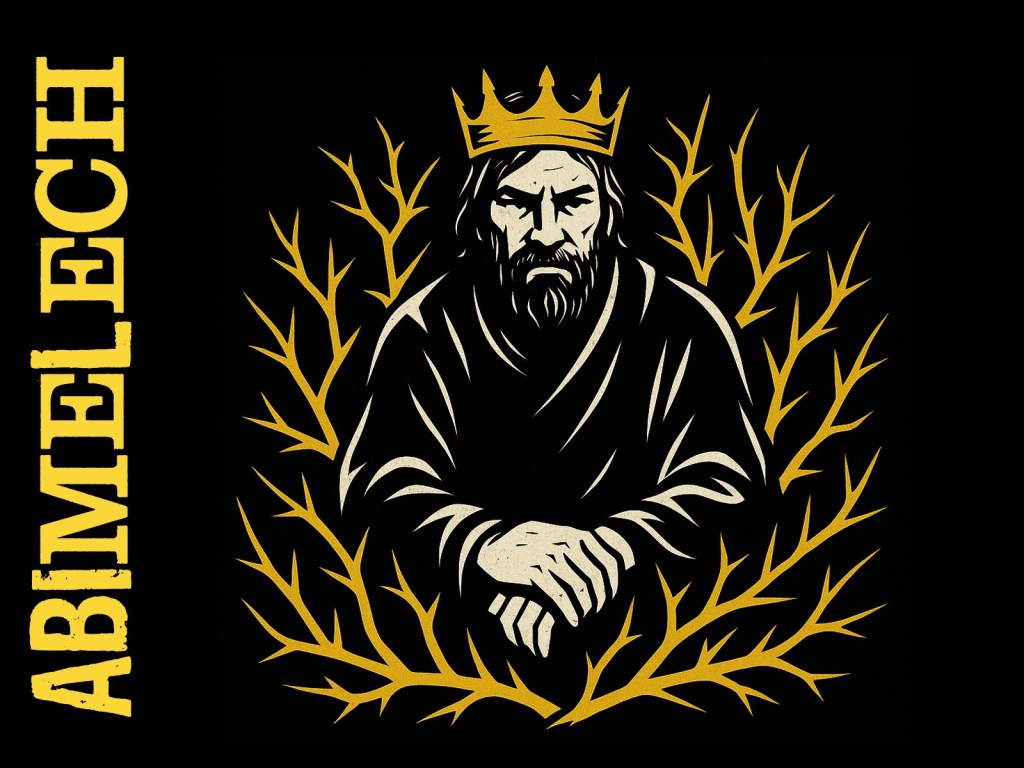
Gideon, or Jerub-Baal was an unlikely judge, and God used him to deliver the people of Israel from foreign oppression. But his story did not end well. His newfound fame went to his head, and Gideon became a bit of a tyrant. After the famous, miraculous battle with torches and trumpets, he led the people into idolatry and destruction.
Before we get into the next character in Judges 9, I want to go back to Genesis for a minute, with some reminders of the early events of the story of the first man and woman. God placed them in a garden, full of trees—trees that were pleasing to the sight and good for food. They were given charge over those trees, with explicit instructions NOT to eat from the tree of the knowledge of good and evil. The serpent, a created crafty creature, came to Eve with a proposal. As things happened, they did not rule over the serpent, as they should have, but they followed its advice. It deceived them, and Adam and Eve both took the fruit. Because of their actions, God says to the serpent that it will be cursed above all wild animals. God would put enmity between the serpent and the woman and between their offspring…HER offspring will crush the serpent’s head, and the serpent will strike his heel. Raising children will now be difficult for the woman,[1] and working the ground will be difficult for the man: it will produce thorns and thistles. Fast forward…
God meets Abraham under a great Oak tree, and invites Abraham and Sarah to be the parents of a new people—who will be a blessing to the world. God meets Moses in a burning bush. And at a mountain in the wilderness, God invites the descendants of Jacob to be his representatives in the world. There is a future hope of flourishing, living in the land of Promise, where later texts envision every person being able to sit under his vine and fig tree in a time of peace.[2]
The serpent shows up repeatedly throughout the Biblical stories that follow—as a character that sows division between humans, working to bring humans back to darkness and disorder, trying to get people to rule with their OWN wisdom, instead of God’s.[3] The serpent didn’t want to live under God’s authority, and it continually entices humans to want to be kings of their own! Humans must recover their ability to rule over the beasts, and this will only happen through the one who will strike the serpent, as foretold in Genesis 3. Keep these images in your mind as we look at the next chapter in Judges. We pick up the story at the end of chapter 8.
29 Jerub-Baal son of Joash went back home to live. 30 He had seventy sons of his own, for he had many wives. 31 His concubine, who lived in Shechem, also bore him a son, whom he named Abimelech. 32 Gideon son of Joash died at a good old age and was buried in the tomb of his father Joash in Ophrah of the Abiezrites. 33 No sooner had Gideon died than the Israelites again prostituted themselves to the Baals. They set up Baal-Berith as their god 34 and did not remember the Lord their God, who had rescued them from the hands of all their enemies on every side. 35 They also failed to show any loyalty to the family of Jerub-Baal (that is, Gideon) in spite of all the good things he had done for them. Judges 8:29-34
I don’t have to tell you—you know by now that this is the vicious cycle—repeating itself throughout the book of Judges. The failure of the people is two-fold: They do not REMEMBER the Lord their God—which isn’t just a head thing. ‘Remembering’ God means to honor, obey and worship God, and to live in faithfulness to him.[4] Also—these people do not show loyalty to Gideon’s family—honoring him as God’s chosen leader. This will show up even more so as we witness who wants to take over.
Abimelech son of Jerub-Baal went to his mother’s brothers in Shechem and said to them and to all his mother’s clan, 2 “Ask all the citizens of Shechem, ‘Which is better for you: to have all seventy of Jerub-Baal’s sons rule over you, or just one man?’ Remember, I am your flesh and blood.” 3 When the brothers repeated all this to the citizens of Shechem, they were inclined to follow Abimelech, for they said, “He is related to us.” 4 They gave him seventy shekelsof silver from the temple of Baal-Berith, and Abimelech used it to hire reckless scoundrels, who became his followers. 5 He went to his father’s home in Ophrah and on one stone murdered his seventy brothers, the sons of Jerub-Baal. But Jotham, the youngest son of Jerub-Baal, escaped by hiding. Judges 9:1-5
Gideon had many sons with many wives, but Abimelech is a son of one of Gideon’s concubines. In the ancient culture, only the sons of the primary wives would be granted special rights, unless the father specifically named them as heirs.[5] Abimelech is feeling left out. Maybe some things came out at his dad’s funeral—that’s normal, right? He may not have been included in the will, so to speak. Perhaps he was hoping for a bit more participation in the leadership. Abimelech may have even renamed himself[6]—as his name means, ‘my father is king.’ Whatever he is brooding about, he takes his complaint to his mom’s side—and asks his uncles to speak to the lords of Shechem on his behalf—the men who make the decisions for the city.[7] Gideon had not written out a succession plan. Were all seventy of the siblings supposed to rule over the people—divvy it up—make it work? Abimelech proposes that it should be just one—him! The men of Shechem sympathize with him and also want a piece of the pie. Hiring empty, reckless men—mercenaries who operate outside of the law—[8] they round up the seventy sons, and Abimelech kills all of his half-brothers on one stone—which makes you think of some kind of sacrifice[9]—perhaps to Baal? Only one son escapes.
Previously, his father Gideon had REFUSED the people’s offer to be king. In chapter 8, we read, The Israelites said to Gideon, “Rule over us—you, your son and your grandson—because you have saved us from the hand of Midian.” 23 But Gideon told them, “I will not rule over you, nor will my son rule over you. The Lord will rule over you.” Judges 8:22-23
Gideon refused their offer, but Abimelech is a part of Gideon’s household. He believes that the offer should still stand, and that it should apply to him![10] And the people seem to agree.
6 Then all the citizens of Shechem and Beth Millo gathered beside the great tree at the pillar in Shechem to crown Abimelech king. Judges 9:6
The people gather beside the great Oak of the Pillar for the momentous occasion. This is a sacred tree—possibly connected to Baal. The location heightens the religious significance of the event.[11] Abimelech is now supported by those who are connected to Baal—where his father had started so long ago. The apple doesn’t fall far from the tree.[12] But that also makes this play for kingship a conflict now—between Baal and Yahweh.[13] Subsequently, Jotham, the son who had escaped the massacre of his brothers, becomes a prophet to address the situation.[14] He climbs up to Mount Gerizim, the mountain where the people renewed their covenant with God when entering the Promised Land—where both Moses and Joshua spoke to the people.[15] And he is going to tell a fable.
A fable is where the characters are non-humans who have human abilities, feelings, habits, and the moral before the finish spells out the meaning of the plot.[16] In Aesop’s fables, the characters are usually animals. In Old Testament fables, plants are personified.[17] In Babylonian literature, there is the story of the Tamarisk and the Palm, where two trees debate their usefulness for the royal court.[18] There is also a fable: “The Lebanese Thistle and the Cedar, found in 2 Kings.” Jotham will also use trees to illustrate a point.
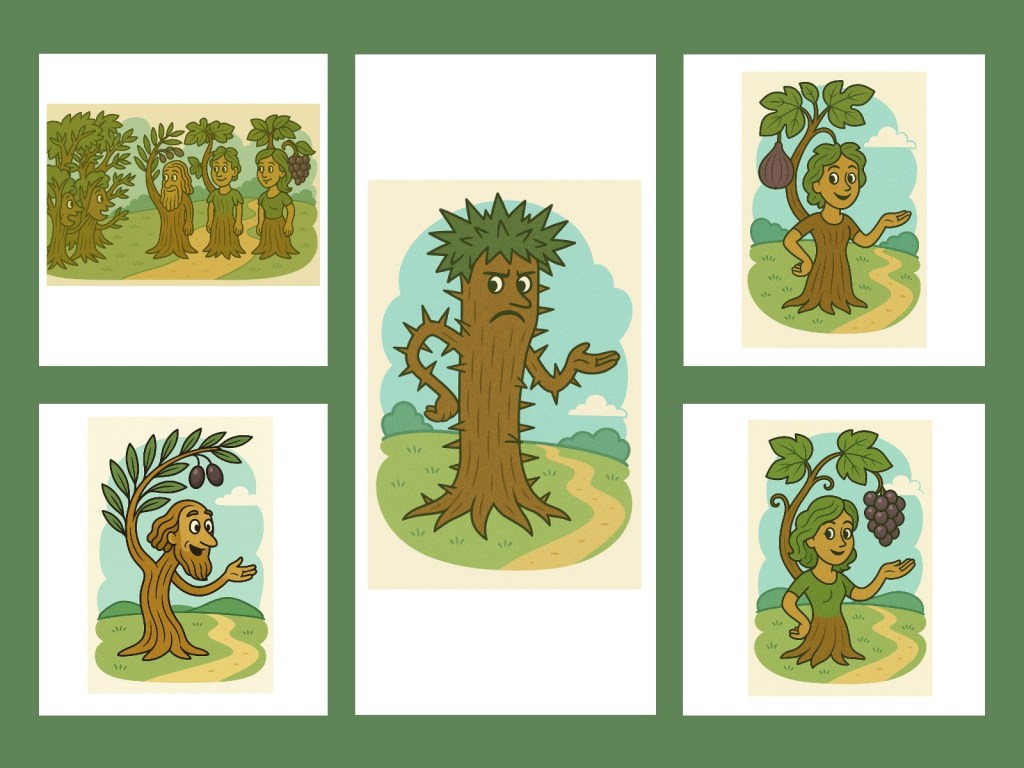
When Jotham was told about this, he climbed up on the top of Mount Gerizim and shouted to them, “Listen to me, citizens of Shechem, so that God may listen to you. One day the trees went out to anoint a king for themselves. They said to the olive tree, ‘Be our king.’ But the olive tree answered, ‘Should I give up my oil, by which both gods and humans are honored, to hold sway over the trees?’ Next, the trees said to the fig tree, ‘Come and be our king.’ But the fig tree replied, ‘Should I give up my fruit, so good and sweet, to hold sway over the trees?’ Then the trees said to the vine, ‘Come and be our king.’ But the vine answered, ‘Should I give up my wine, which cheers both gods and humans, to hold sway over the trees?’ Finally all the trees said to the thornbush, ‘Come and be our king.’ The thornbush said to the trees, ‘If you really want to anoint me king over you, come and take refuge in my shade; but if not, then let fire come out of the thornbush and consume the cedars of Lebanon!’ Judges 9:7-15
The trees want to anoint a king over themselves. This is already an issue, because GOD is supposed to be their king, their ruler, their judge! When the men of Shechem accept Abimelech’s offer to be their king and then murder Gideon’s sons, they are rising in revolt against God.[19] It is a rebellion that hearkens back to the rebellion in the garden in Genesis.
In the Bible, the word etz means tree. It has a large range of meaning—a vine, a bush, a log, a piece of firewood, or even a staff.[20] It includes the famous tree of life. The trees that gather in this fable include vines and brambles.[21] Some trees in this parable have symbolic meaning. Let’s lay the background. Olives were very important in ancient Israelite life. Olive oil was used for anointing, and as remedies for various ailments. Zechariah later uses two olive trees to represent temple and kingdom.
The wood of the olive tree is valuable as well. It is a tree that symbolizes blessing and strength.[22] The fig tree was sometimes planted in the corners of vineyards. It provides good shade, and its fruit could be dried and made into cakes. The fig tree later became a symbol of Israel. Noah planted a vineyard in Genesis, after coming out of the ark.
The vine was the first cultivated plant in Israel, and there were also luxurious grapes in the Promised Land.[23] Together the vine and the fig tree symbolized national and individual security[24], prosperity and peace, and a picture of the future Messiah’s kingdom.[25]
It’s interesting that the other trees do not ask the cedar to be their king. Cedars were considered some of the most majestic trees of the ancient Levant, and many kingdoms and kings were represented by the cedar in Scripture,[26] like Assyria, Babylon, and Israelite kings Joash and Zedekiah. And why isn’t the oak tree or terebinth tree asked to be their ruler? These trees were also known for their strength and ability to endure harsh conditions. Think of God meeting Abraham[27] or even Gideon under a terebinth.[28]
Those are trees that would be associated with power, longevity and spiritual significance. Being a leader over other trees is not in the nature of the olive tree, the fig tree, or the vine. They have other benefits! They provide oil, fruit, and wine,[29] things that are useful to people.[30] Those trees are not interested in ‘holding sway’ over the other trees—that verb ‘holding sway’ has a sense of being unstable[31], and can even suggest drunken staggering.[32] The olive, fig and vine are servants of the people, with no self-interest at heart. The olive would rather honor others than be narcissistically anointed with its own oil.[33] These trees simply wanted to function as God intended them to function—as fruit-bearing trees.[34]
Next, the trees approach the thornbush. This is an interesting picture. In the last chapter, Gideon had threatened and then threshed[35] or beat the men of Succoth with thorns and briers,[36] before moving on to the next town and killing all the men of that city. The thornbush in this fable is a symbol of wilderness and chaos.[37] It offers refuge as king, or retribution if it is denied the throne. An ancient king was known to provide protection and benefits[38], a defense from those who would attack them.[39] The thornbush could metaphorically offer both shade and protection by using its thorns as a defense.

The word for this thornbush in the Hebrew is found in only a couple of places in the Old Testament. It is defined by some as a bramble, or buckthorn.[40] That plant does have thorns, and some fruit clusters, but this type of bush does not seem to fit this story. It doesn’t grow very tall, about 4 feet, it doesn’t provide shade, nor does it combust easily,[41] producing more of a smoky fire.[42]
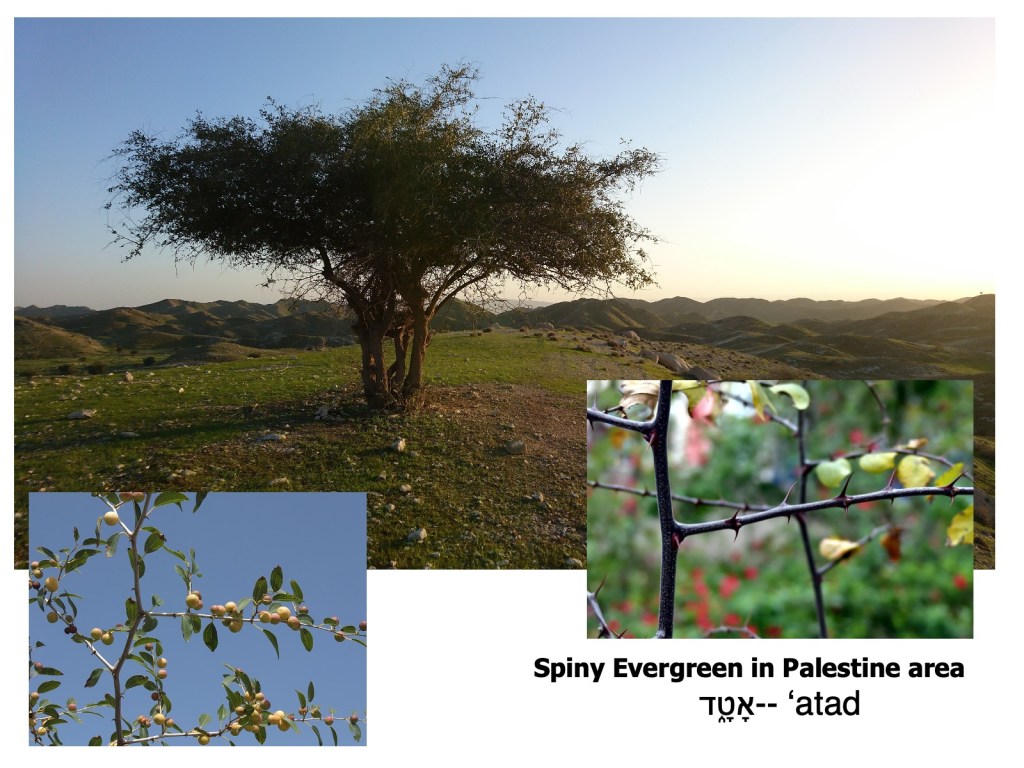
A professor of botany at the Hebrew University, and another Israeli botanist, among others[43] both identify this tree instead, as a type of evergreen[44] that can grow 15-30 feet. It is a spiny tree, and produces yellowish fruits, edible, but with a slightly bitter taste…a poor relative of the olive, fig and vine mentioned in the parable.[45] It is a common tree in Israel and Palestine.[46] And I think it is a better representation of Abimelech! On the outside it looks good—it stands tall, it offers shade, it provides fruit—an alternative to the fig tree or olive in times of need.[47] It even has some healing remedies.[48] But it doesn’t have the same characteristics of an olive tree, a fig tree, or a vine.
Jesus later aptly states the timeless truth: “You will know them by their fruits. Grapes are not gathered from thorn bushes, nor figs from thistles. A good tree bears good fruit, but the bad tree bears bad fruit.[49] In his fable, Gideon’s remaining son, Jotham, correctly captures the caricature of Abimelech as a toxic thornbush.
THE THORNBUSH KING BRINGS RUIN
Remember this! While the people may want a king at this time in the Judges, Jotham portrays it as negative, and self-destructive.[50] Israel will not be delivered by a political institution, but only in a wholehearted return to Yahweh![51] Jotham goes on talking, and I’ll have only a few comments here and there:
16 Have you acted honorably and in good faith by making Abimelech king? Have you been fair to Jerub-Baal and his family? Have you treated him as he deserves? 17 Remember that my father fought for you and risked his life to rescue you from the hand of Midian. 18 But today you have revolted against my father’s family. You have murdered his seventy sons on a single stone and have made Abimelech, the son of his female slave, king over the citizens of Shechem because he is related to you. 19 So have you acted honorably and in good faith toward Jerub-Baal and his family today? If you have, may Abimelech be your joy, and may you be his, too! 20 But if you have not, let fire come out from Abimelech and consume you, the citizens of Shechem and Beth Millo, and let fire come out from you, the citizens of Shechem and Beth Millo, and consume Abimelech!” 21 Then Jotham fled, escaping to Beer, and he lived there because he was afraid of his brother Abimelech. Judges 9:21
Abimelech will rule the people as king. But he is never officially recorded as one. Even the narrator of Judges refuses to dignify him with the title.[52] He is not a judge, either, in case you were wondering. Because we’re in the book of Judges, we might think that God will raise up another judge to free the people from Abimelech’s internal rule of oppression[53]—but God does not show mercy in this story. GOD is the ultimate judge and deliverer![54] He gives the people the kind of king they deserve,[55] and God stirs up bad blood among the people to bring justice. The ending is not a good one.
22 After Abimelech had governed Israel three years, 23 God stirred up animosity between Abimelech and the citizens of Shechem so that they acted treacherously against Abimelech. 24 God did this in order that the crime against Jerub-Baal’s seventy sons, the shedding of their blood, might be avenged on their brother Abimelech and on the citizens of Shechem, who had helped him murder his brothers. 25 In opposition to him these citizens of Shechem set men on the hilltops to ambush and rob everyone who passed by, and this was reported to Abimelech. 26 Now Gaal son of Ebed moved with his clan into Shechem, and its citizens put their confidence in him. 27 After they had gone out into the fields and gathered the grapes and trodden them, they held a festival in the temple of their god. While they were eating and drinking, they cursed Abimelech.
Notice that there will be no cry for help to YAHWEH from the people of God. They are completely immersed in their pagan worship.[56]
Then Gaal son of Ebed said, “Who is Abimelech, and why should we Shechemites be subject to him? Isn’t he Jerub-Baal’s son, and isn’t Zebul his deputy? Serve the family of Hamor, Shechem’s father! Why should we serve Abimelech? If only this people were under my command! Then I would get rid of him. I would say to Abimelech, ‘Call out your whole army!’” When Zebul the governor of the city heard what Gaal son of Ebed said, he was very angry. 31 Under cover he sent messengers to Abimelech, saying, “Gaal son of Ebed and his clan have come to Shechem and are stirring up the city against you. 32 Now then, during the night you and your men should come and lie in wait in the fields. 33 In the morning at sunrise, advance against the city. When Gaal and his men come out against you, seize the opportunity to attack them.” So Abimelech and all his troops set out by night and took up concealed positions near Shechem in four companies. 35 Now Gaal son of Ebed had gone out and was standing at the entrance of the city gate just as Abimelech and his troops came out from their hiding place. 36 When Gaal saw them, he said to Zebul, “Look, people are coming down from the tops of the mountains!” Zebul replied, “You mistake the shadows of the mountains for men.” 37 But Gaal spoke up again: “Look, people are coming down from the central hill, and a company is coming from the direction of the diviners’ tree.” Judges 9:28-37
Another sacred tree! A terebinth—a sacred spot to practice divination or seek a word from the gods.[57] And this tree is near the city of Shechem—the city where Abimelech’s mother is from—the people who have crowned him as king.
Quick pause: It was at Shechem where Abraham built an altar to God under a terebinth.[58] It was in Shechem where Jacob erected an altar on the land he purchased from Shechem’s father,[59] and where he later buried the foreign gods at THE terebinth in Shechem,[60] part of a sacred grove? Possibly the same tree as in this text in Judges![61] Shechem later became the first capital of the Northern kingdom of Israel. In the time of the Judges, it was a temple fortress, with large standing stones near the entrance—one of them may have been a stone that Joshua erected when the people entered the Promised Land.[62] It was in this vicinity that Abimelech had been crowned.
It was a Canaanite temple at this time, surrounded by sacred gardens, and dedicated to the Canaanite god El.[63] Archaeologists have discovered this temple, and it the largest Canaanite structure found in Israel.[64] It was in this temple that the banquet was held, where the men were eating and drinking and criticizing Abimelech, and came up with the plan to rebel against him.
38 Then Zebul said to him, “Where is your big talk now, you who said, ‘Who is Abimelech that we should be subject to him?’ Aren’t these the men you ridiculed? Go out and fight them!” 39 So Gaal led out the citizens of Shechem and fought Abimelech. 40 Abimelech chased him all the way to the entrance of the gate, and many were killed as they fled. 41 Then Abimelech stayed in Arumah, and Zebul drove Gaal and his clan out of Shechem. 42 The next day the people of Shechem went out to the fields, and this was reported to Abimelech. 43 So he took his men, divided them into three companies and set an ambush in the fields. When he saw the people coming out of the city, he rose to attack them. 44 Abimelech and the companies with him rushed forward to a position at the entrance of the city gate. Then two companies attacked those in the fields and struck them down. 45 All that day Abimelech pressed his attack against the city until he had captured it and killed its people. Then he destroyed the city and scattered salt over it.
In case you’re wondering, salt could make the land infertile, or could be just a ritual act like a curse on the site.[65]
46 On hearing this, the citizens in the tower of Shechem went into the stronghold of the temple of El-Berith. 47 When Abimelech heard that they had assembled there, 48 he and all his men went up Mount Zalmon. He took an ax and cut off some branches, which he lifted to his shoulders. He ordered the men with him, “Quick! Do what you have seen me do!” 49 So all the men cut branches and followed Abimelech. They piled them against the stronghold and set it on fire with the people still inside. So all the people in the tower of Shechem, about a thousand men and women, also died. Judges 9:38-49
As Jotham had predicted in the fable, fire had burst forth from the king and consumed the cedars of Lebanon. All of his rivals have been eliminated.[66] But Abimelech is not finished.
PICS
50 Next Abimelech went to Thebez and besieged it and captured it. 51 Inside the city, however, was a strong tower, to which all the men and women—all the people of the city—had fled. They had locked themselves in and climbed up on the tower roof. 52 Abimelech went to the tower and attacked it. But as he approached the entrance to the tower to set it on fire, 53 a woman dropped an upper millstone on his head and cracked his skull. 54 Hurriedly he called to his armor-bearer, “Draw your sword and kill me, so that they can’t say, ‘A woman killed him.’” So his servant ran him through, and he died. 55 When the Israelites saw that Abimelech was dead, they went home. Judges 9:50-55
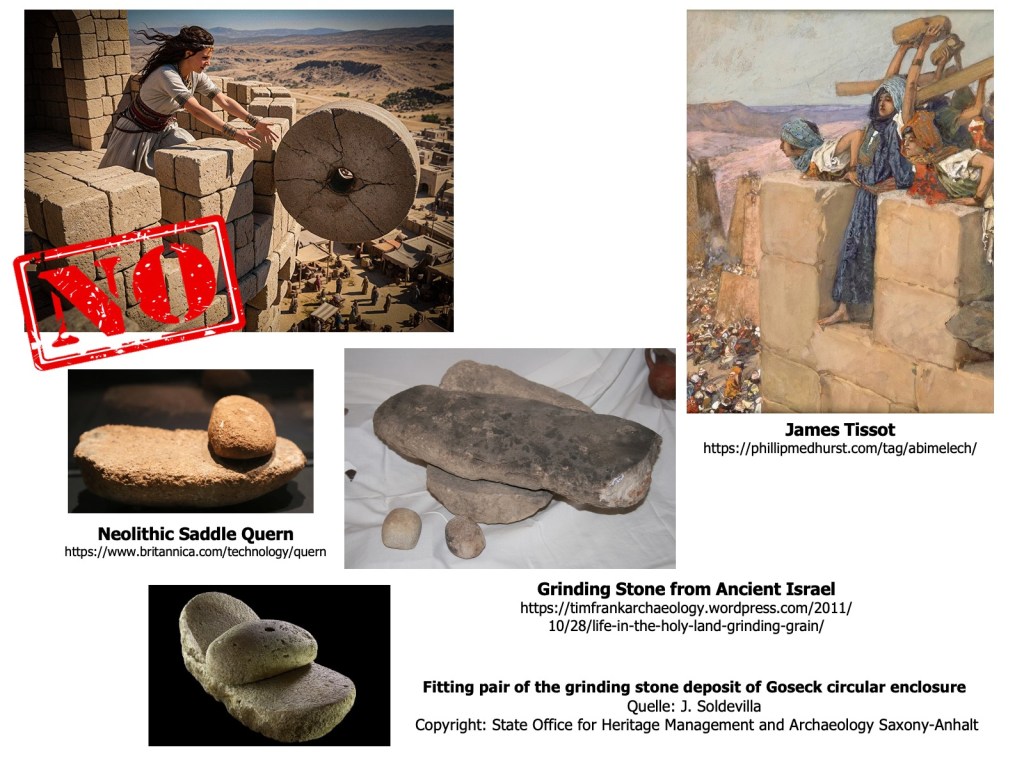
This tower in Thebez was in the center of the city, unlike the tower in Shechem which was probably on the city wall.[67] A millstone in the time of the Judges is not like the millstones you might be picturing. This type could not be brought up to a tower, or thrown, for that matter. The wheel mill didn’t come into use until 1,000 years AFTER the period of the Judges. The woman here would have used a different kind.[68] In that day, a quern, or two stones that rub together to de-husk and grind grain[69], could be used in a second floor or roof house[70], and a woman or servant could grind grain using a portable stone that weighed between 4-9 pounds,[71] a ‘riding grinder.’[72] The woman of Thebez would absolutely have been strong enough to throw THAT kind of upper millstone. Like Shamgar, Ehud, and Jael, she used an ordinary tool to achieve heroic results. Abimelech, the man who wanted to rule singlehandedly, and who killed his seventy brothers on one single stone, in the end is killed by one single woman, who drops a single stone upon his head.[73]
Dying at the hand of a woman in battle seems to be the greatest humiliation a warrior could suffer.[74] But even though his armor-bearer finishes him off, he’s still remembered as being killed by a woman, as recounted by Joab later, in 2 Samuel 11:21. Sisera was feminized in his defeat a couple of stories back,[75] and Abimelech suffers the same humiliation. It’s a devastating statement to his manhood. That, along with his lack of restraint, no list of a wife or a child, an heir, Abimelech is pictured as a total failure—as a man,[76] and as a leader. His story is framed on either side by two women: his mother, and this woman, who is unnamed, but praiseworthy. She kills a bully, much like how Jael acts boldly to kill a wicked general. [77] Abimelech, the thornbush king is killed by a woman dropping a millstone on him, crushing his skull, …an echo of the promise in Genesis that the serpent’s head will be crushed![78] Isn’t THAT an image! Keep that thought as our story in Judges concludes!
56 Thus God repaid the wickedness that Abimelech had done to his father by murdering his seventy brothers. 57 God also made the people of Shechem pay for all their wickedness. The curse of Jotham son of Jerub-Baal came on them. Judges 9:56
Abimelech had a choice—to trust God’s wisdom, or to do what was right in his OWN eyes—something that the people of Judges end up doing repeatedly as the book goes on. Abimelech turns out to be more of an aspiring king rather than a delivering judge.[79] He is self-serving, murderous, and even his own people turn against him.
THE THORNBUSH KING BRINGS RUIN
This wicked king ends up being much like a serpent in this story—if we think back to Genesis. Abimelech is an image of the thorns and thistles of the curse, he sows division, he wants to be a king on his own, and doesn’t want to live under God’s authority!
The writer of Psalm 58 expresses the frustration that the people in some of these stories must have felt. “The wicked spread lies—they are like venomous snakes that cannot be stopped![80] O God, break their teeth! Tear out their fangs! Let their arrows fall short! Before they produce thorns like a bramble bush,[81] or a thorn tree—(it’s the same kind of tree as we’ve seen in Judges—and the only other time in Scripture where it is used) Before they produce thorns—the wicked will be swept away. Then people will say, “Surely the righteous still are rewarded; surely there is a God who JUDGES the earth.”
This is an ongoing story, is it not? The things that we face as part of the curse: the serpent that continues to wreak havoc in our lives. It is frustrating, maddening, soul-sickening at times! But the true Son of Man—will strike the serpent once and for all.
In the time of the Judges, the leaders in Shechem must choose their king. Over a thousand years later, the leaders of the people of Israel must also make a choice, as Pilate asks them, ‘what shall I do with the one you call king of the Jews?’ They cry out for Jesus to be crucified. He is struck with a whip with little pieces of bones and metal, much like bramble bushes. He is crowned with a crown of thorns. Another thornbush king? Maybe you’ve figured out where this is going, but I got so excited about this when I discovered it. The thornbush tree that is named in Judges 9 is technically called: Ziziphus spina-Christi. There is one of these trees in Israel that is said to be between 1500-2000 years old.[82]

The interesting thing about this tree—the same one mentioned in Judges 9—is that when it is younger, the branches are fairly pliable and if you take it and bend the branches, you can make a crown of thorns. This thorn tree is believed by many to have been used to make the crown of thorns that went on Jesus’ head. Jesus stands in stark contrast to Abimelech. One would rule with force and brutality and would be crushed—by a woman. The other would be crowned with thorns—and the cross was his throne and Jesus, the seed of the woman, would be the one who would crush the serpent’s head.
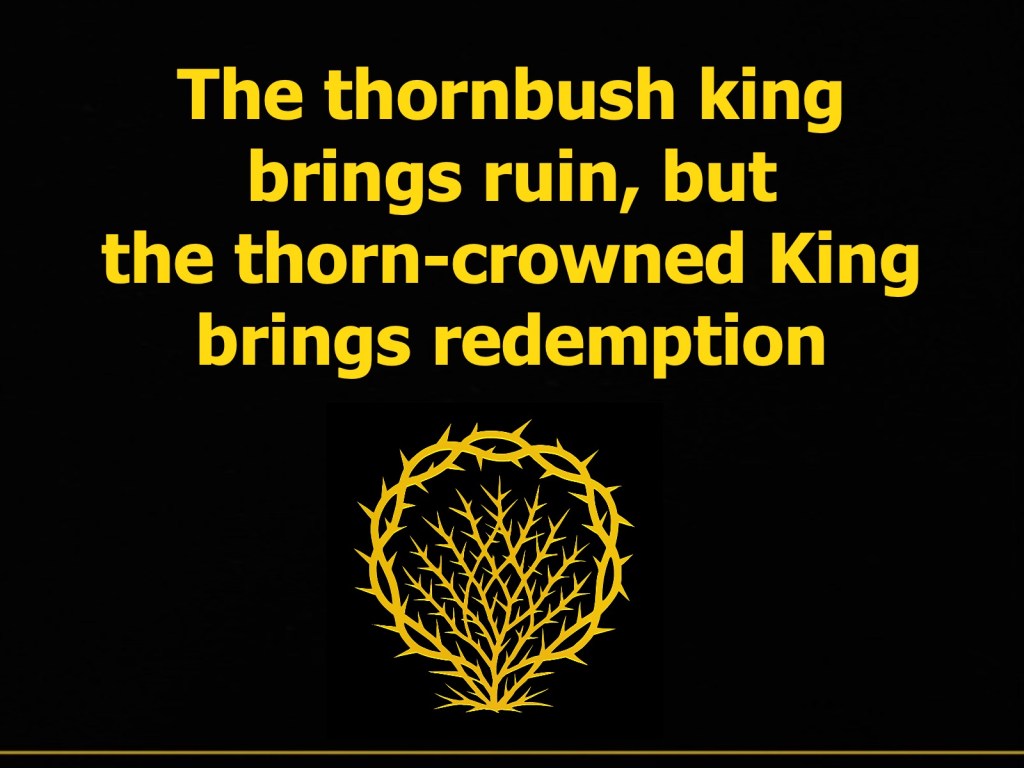
As in the fable of Jotham, there are those who would look to other trees to find their king—yes, the olive tree is majestic and provides oil for anointing and healing, but Jesus is our anointed one, and our healer. As Gentiles, we are grafted into the olive tree of Israel.[83] The fig tree most often represents Israel, but Jesus is the true Israelite—the one who brings real fruitfulness and blessing. The vine provides wine that gladdens the heart, but Jesus IS the vine[84], and he is the drink offering—His blood poured out for the forgiveness of sins. The thornbush invited the other trees to take refuge in his shade, but we stand in the shadow of the cross—the tree where our Savior surrendered himself to the beast and he calls his followers to live in the same way—resisting the urge to use the ways of the serpent—and trust in the power of God.[85] “He himself bore our sins” in his body on the cross, so that we might die to sins and live for righteousness; “by his wounds you have been healed,[86]” writes Peter.
THE THORN-CROWNED KING BRINGS REDEMPTION
The garden of Eden had trees of beauty and life, and one of the pictures of the Promised Land, was the image where everyone would sit under their own Vines and Fig trees. Even George Washington had an affinity for this image, and one of his hopes for this country long ago was that everyone would be able to have their own Vines and Fig trees.[87] The use of the “vine and fig tree” metaphor also brings up images of an anticipated alternative community to come,[88] where there is peace, freedom from fear,
and an eternity in the presence of our long-awaited King! Revelation is a picture of hope for the future—in a place that transcends the garden of Eden, a place of healing and abundance, where Jesus, the Lamb who was crucified by the beast, has won complete victory!
There are thornbush kings who still rule today: those who offer hope and promise, and peace, who promise shade—but will bring fire. Surely, we can see it in political or celebrity “saviors” who promise identity, security, or belonging—but exploit and divide.
We can see it in movements that elevate human glory while scorning humility, truth, or repentance. Those things might be easy to point out and point fingers at, but there are also more subtle ways that this mindset shows up. The way of the thornbush is when charisma is mistaken for calling. It grasps for position or control rather than serving in humility, promises quick solutions or easy comfort but burns those who follow. The thornbush is evident when control, flattery, or dependence replaces genuine care; when so called brothers and sisters in Christ kill each other with their words.
The ways of the thornbush take root INSIDE—long before they reign OUTSIDE—and so, it’s important to search our own hearts, too. -Do we have a pride that insists on being right? Is there a bitterness that is keeping us bound? Is fear ruling our decisions? is avoiding conflict or pain more important than following the truth? How about the subtle idolatry of ease, pleasure, or safety that keeps us from obedience? And what kind of fruit are WE bearing? When faith becomes about image, performance, or influence rather than surrender? When we use God’s name to build our own kingdom instead of His? Where have we traded fruit for thorns?
Like Adam and Eve, we have the choice as to which kind of kingdom we will be a part of, and which kind of actions to put into practice—actions that obey God and follow his idea of flourishing, or actions that will hurt others and will eventually kill us. There are only two alternatives. If we reject the lordship of Jesus, we will be ruled by chaos.
THE THORNBUSH KING BRINGS RUIN, BUT THE THORN-CROWNED KING BRINGS REDEMPTION
We look to the thorn-crowned king: the one who has taken all the bad choices that we have made—and the evil done against him. He took on our sin and shame and carried it to the cross—swallowing death—and by the power of God becoming alive again, where he reigns at the right hand of God the Father, interceding for us as a true High Priest! A living connection always produces something living. and as we are connected to Jesus—as we root ourselves in him—through prayer, trust, obedience, and meditation on Scripture, his Spirit bears good fruit in us—patience, self-control, joy, peace. What kinds of trees will we be—for God—and to each other? Let’s pray about that:
PRAYER: Lord Jesus, You are the True Vine, and we are your branches. Apart from You, we can do nothing—but in You, our lives can bear fruit that lasts. Root us deeply in Your love.
Let Your Spirit flow through us like living sap, nourishing every thought, every word, every choice. Where our hearts have wandered, draw us back. Where we’ve tried to grow on our own, graft us again into You. Burn what is useless in us and make us fruitful. Teach us to choose what is good and life-giving—to turn from selfishness, pride, and fear, and to walk in obedience and trust. Prune what hinders, Lord, even when it hurts, so that the life of Your Kingdom may flourish in us. Reign over every part of us—our desires, our decisions, our days. Be our King, our center, our first love.
May Your beauty be seen in our actions, Your wisdom in our choices, Your grace in our relationships. Let the fruit of Your Spirit—love, joy, peace, patience, kindness, goodness, faithfulness, gentleness, and self-control—grow freely within us. May our lives bring glory to You, the true and rightful King of every heart. Amen.
Bibliography
Block, Daniel I. Judges, Ruth, Nashville: B&H Publishing Group, 1999.
Boda, Mark J., Mary L. Conway, Daniel I. Block, general editor; Judges, Exegetical Commentary on the Old Testament, Grand Rapids: Zondervan Academic, 2022.
Brown, F; S. Driver, and C. Briggs, The Brown-Driver-Briggs Hebrew and English Lexicon, Peabody: Hendrickson Publishers, 2010.
Butler, Trent C., Word Biblical Commentary: Judges, Grand Rapids: Zondervan, 2009.
Frolov, Serge, Judges, Grand Rapids: William B. Eerdmans Publishing Company, 2013.
Inrig, Gary, Hearts of Iron, Feet of Clay, Chicago: Moody Bible Institute, 1979.
King, Philip J., Lawrence E. Stager, Life in Biblical Israel, Louisville: Westminster John Knox Press, 2001.
Soggin, J. Alberto, Judges, Philadelphia: The Westminster Press, 1981.
Smit, Laura A. and Stephen E. Fowl, Brazos Theological Commentary on the Bible: Judges and Ruth, Grand Rapids: Brazos Press, 2018.
Matthews, Victor H., Judges & Ruth, Cambridge: Cambridge University Press, 2004.
McCann, J. Clinton, Judges, Louisville: John Knox Press, 2002.
Pietersma, Albert, Benjamin G. Wright, A New English Translation of the Septuagint and the Other Greek Translations, New York: Oxford University Press, 2007.
Wilcock, Michael, editor, J.A. Motyer, The Message of Judges: Revised Edition, Downers Grove: Illinois, 1992, 2021.
Articles
Althann, Robert, “Psalm 58:10 in the light of Ebla”, Biblica, 1983, volume 64, issue 1, 122-124.
Angel, Hayyim, “The positive and negative traits of Gideon: as reflected in his sons Jotham and Abimelech”, Jewish Bible Quarterly, 34 no 3 Jul-Sep 2006, 159-167.
Brueggemann, Walter, ‘Vine and fig tree’: a case study in imagination and criticism, The Catholic Biblical Quarterly, Apr 1981, 188-204.
Carman, Jon-Michael, “Abimelech the manly man?- Judges 9.1-57 and the performance of hegemonic masculinity”, Journal for the Study of the Old Testament, 2019, 301-316.
Dafni, Amots; Levy, Shay; and Lev, Efraim, “The ethnobotany of Christ’s Thorn Jujube (Ziziphus spina-christi) in Israel,” Journal of ethnobiology and ethnomedicine vol. 1 8. 28 Sep. 2005.
Dreisbach, Daniel L., “The ‘vine and fig tree’ in George Washington’s letters: reflections on a biblical motif in the literature of the American founding era”, Anglican and Episcopal History, Sep 2007, volume 76, issue 3, 299-326.
Endris, Vince, “Yahweh versus Baal: a narrative-critical reading of the Gideon/Abimelech narrative”, Journal for the Study of the Old Testament, 33 no 2 Dec 2008, 173-195.
Haddox, Susan E, “The Lord is with you Mighty Warrior-Gideon’s Masculinity”, Eastern Great Lakes Biblical Society & Midwest Region Society of Biblical Literature, Vol. XXX (2010), 70-87.
Herr, Denise Dick, and Mary Petrina Boyd. “A Watermelon Named Abimelech,” Biblical Archaeology Review 28.1 (2002): 34–37, 62.
Irwin, Brian B., “Not just any king- Abimelech, the northern monarchy, and the final form of Judges “, Journal of Biblical Literature 131 no. 3, 2012, 443-454.
Janzen, J Gerald, “A certain woman in the rhetoric of Judges 9”, Journal for the Study of the Old Testament, Jun 1987, 33-37.
Janzen, David, “Gideon’s House-a Proposal for reading Jotham’s Fable”, The Catholic Biblical Quarterly, 74, 2012, 465-475.
Klotz, John William, “The vine, the fig tree, and the olive: a study in biblical symbolism”, Concordia Journal, Nov 1980, 256-260.
Koszarek, Tomasz, “The Structure and Poetic Elements of Jotham’s Speech (Judg 9-7g-20)”, Studia Biblica Slovaca 16, 2/2024, 201-229.
Margulies, Zachary, “Aesop and Jotham’s Parable of the Trees (Judges 9-8-15)”, Vetus testamentum, 2019, 81-94.
Miglio, Adam E. “Imagery and analogy in Psalm 58:4-9”, Vetus testamentum, 2015, volume 65, issue 1, 114-135.
Naʼaman, Nadav, “A hidden anti-Samaritan polemic in the story of Abimelech and Shechem (Judges 9)”, Biblische Zeitschrift, 2011, 1-20.
Roehrs, Walter R, “Sermon study on Judges 9:8-15: The fable of the bramble king”, Concordia Theological Monthly, 20 no 7 Jul 1949, 488-495.
S. Saura-Mas, S. Paula, J. G. Pausas, and F. Lloret, “Fuel loading and flammability in the Mediterranean Basin woody species with different postfire regenerative strategies”, International Journal of Wildland Fire 2010, 19, 783–794.
Stager, Lawrence E. “The Shechem Temple,” Biblical Archaeology Review 29.4 (2003): 26–29, 31, 33–35, 66, 68.
Tatu, Silviu, “Jotham’s fable and the crux interpretum in Judges IX”, Vetus testamentum, 2006, 105-124.
Wright, David, “Blown Away Like A Bramble: The Dynamics Of Analogy In Psalm 58”, Revue biblique, Apr 1996, volume 103, issue 2, 213-236.
Websites—accessed between October 13-17, 2025
Bible project: Where does the rebellious creature in Genesis 3 go after the garden?
Does God Punish Women with Pain in Childbirth?
https://bibleproject.com/videos/vocab-insight-ets-tree/
https://bibleproject.com/videos/chaos-dragon/
https://www.freebibleimages.org/illustrations/wcy-judges3/
https://orionmagazine.org/article/aesops-animals-fables-jo-wimpenny/
https://peiinvasives.com/common-buckthorn/
https://www.britannica.com/technology/quern
https://www.secret-israel.com/travel/the-2000-year-old-jujube-tree-a-symbol-of-ein-hatzeva/
Going Deeper Questions
—What’s a time when someone (maybe even you!) wanted to be “in charge” but it didn’t go quite as planned? What made it go wrong—or right?
Read Judges 8:33–35 and 9:1–6 (Roots of Rebellion)
—What similarities do you notice between the rebellion in Eden and the rebellion in Shechem? —Why do you think we humans keep trying to “rule on our own” rather than trust God’s authority? —Where are those same temptations visible in our culture—or in your own heart—today?
Read Judges 9:7-15 (The Fable of the Trees)
—Which of the trees in Jotham’s story—the olive, fig, vine, or thornbush—do you relate to most right now? Fruitful but reluctant, or thorny and defensive? —The olive, fig, and vine all said “No” to power so they could keep bearing fruit. What lesson is in that for us? —How do we discern the difference between servant leadership and thornbush ambition? —Why are we sometimes drawn to “thornbush kings” instead of fruit-bearing ones?
Read Judges 9:16-21 (Jotham’s warning)
—-Have you ever watched someone warn others about a bad decision — and been ignored? What happened? —Why do you think the people of Shechem chose Abimelech anyway, despite his violent rise to power? —Have you ever chosen something (or someone) because it felt familiar or easy, even though you knew it wasn’t right?
Read Judges 9:22-49 (When Thornbush Kings Rise)
—What does it mean that God stirred up animosity between Abimelech and the leaders of Shechem? (In the Hebrew, it says that God sent an evil spirit.) —Have you ever seen a conflict “blow up” because pride got in the way? What made it spiral instead of heal? —Why do you think the people turned on Abimelech so quickly? What changed? —How do you see Jotham’s warning from verses 19–20 (“Let fire come out…”) being fulfilled here?
Read Judges 9:50-57 (The Crown Collapses)
—What emotions do you feel at the end of this story—satisfaction, sadness, warning, hope? Why? —How does the way Abimelech dies (crushed by a stone from an unnamed woman) reveal God’s sense of poetic justice? —What is the significance of a nameless woman bringing down this powerful tyrant? What might that say about God’s justice and strength?
—Why is Abimelech so concerned about his reputation (“so they can’t say, ‘A woman killed him’”)? What does this reveal about his pride and his heart even at the moment of death? —Where in your life (or community) do you see God quietly “setting things right,” even after a long time of chaos?
Read John 19:1-6 (The True King and the Crown of Thorns)
—How does Jesus compare or contrast with Abimelech? —What kinds of things are hardest for you to resist—success, control, comfort, reputation, approval? —Jotham’s parable warned about “thornbush kings.” What kinds of thornbush kings are people still crowning today—in culture, leadership, or personal life? Why do you think we often prefer thornbush kings—quick fixes and visible strength—over God’s slower, deeper ways? —In Genesis 3, thorns first appear as part of the curse. What does it mean to you that Jesus willingly wore thorns—the symbol of the curse—to become our true King? —The thornbush in Jotham’s parable (Judges 9:14–15) is thought to be the Ziziphus spina-christi—the same kind of thorn used in Jesus’ crown. What does that connection suggest about how God weaves the story of Scripture together? —How does Christ’s thorn-crowned kingship transform our idea of power, sacrifice, and leadership?
The thornbush king brings ruin, but
The thorn-crowned King brings redemption
Personal Application and Practice
—Which King are you living under right now? Whose rule shapes your decisions: self or Savior? —What “thorns” have you allowed to grow in your heart—habits, fears, or ambitions—that are now wounding you or others? —What would it look like to live fully under Jesus’ rule of love and grace? How can His humility reshape the way you use your influence, words, or leadership this week? (Picture freedom, not control. Christ’s rule produces peace, not pressure) — How can you re-root yourself in Jesus the True Vine this week—through prayer, obedience, or service?
Prayer: Lord Jesus, You are the True Vine, and we are your branches. Apart from You, we can do nothing—but in You, our lives can bear fruit that lasts. Lord Jesus, be king over… (e.g., my decisions, my home, my words, my future). Amen.
[1] See this video from The Bible Project for a more in-depth conversation about this verse: https://www.youtube.com/watch?v=h_zIJt0Kpes
[2] 1 Kings 4:25; Micah 4:4; Zechariah 3:10; 2 Kings 18:31; Isaiah 36:16
[3] https://www.youtube.com/shorts/I5cEsO_tI3k
[4] Boda, Mark J., Mary L. Conway, Daniel I. Block, general editor; Judges, Exegetical Commentary on the Old Testament, Grand Rapids: Zondervan Academic, 2022, 422.
[5] Smit, Laura A. and Stephen E. Fowl, Brazos Theological Commentary on the Bible: Judges and Ruth, Grand Rapids: Brazos Press, 2018. 114.
[6] Boda, Conway, 428.
[7] Boda, Conway, 428.
[8] Boda, Conway, footnote 19, p429—Gregory Mobley, Chisholm references.
[9] Boda, Conway, 429.
[10] David Janzen, “Gideon’s House-a Proposal for reading Jotham’s Fable”, The Catholic Biblical Quarterly, 74, 2012, 465-475,472.
[11] Daniel I. Block, Judges, Ruth, Nashville: B&H Publishing Group, 1999, 313.
[12] Smit, Fowl, 113, 115.
[13] Smit, Fowl, 120.
[14] Boda, Conway, 431.
[15] Boda, Conway, 435.
[16] Silviu Tatu, “Jotham’s fable and the crux interpretum in Judges IX”, Vetus testamentum, 2006, 105-124, 108.
[17] Roehrs, Walter R, Sermon study on Judges 9vs8-15 The fable of the bramble king, 488.
[18] Silviu Tatu, 109.
[19] Walter R, Roehrs, “Sermon study on Judges 9:8-15: The fable of the bramble king”, Concordia Theological Monthly, 20 no 7 Jul 1949, 488-495, 490.
[20] https://bibleproject.com/videos/vocab-insight-ets-tree/
[21] F Brown, S. Driver, and C. Briggs, The Brown-Driver-Briggs Hebrew and English Lexicon, Peabody: Hendrickson Publishers, 2010, p781, #6086
[22] Klotz, John William, “The vine, the fig tree, and the olive: a study in biblical symbolism”, Concordia Journal, Nov 1980, 256-260, 260.
[23] Klotz, John William, “The vine, the fig tree, and the olive-a study in biblical symbolism”, Concordia Journal, Nov 1980, 256-260, 257.
[24] Daniel L. Dreisbach, “The ‘vine and fig tree’ in George Washington’s letters: reflections on a biblical motif in the literature of the American founding era”, Anglican and Episcopal History, Sep 2007, volume 76, issue 3, 299-326, 308.
[25] Klotz, 259.
[26] Ezekiel 31:3, Isaiah 2:13, Jeremiah 22:6, Zechariah 11:2, 2 Kings 14:9
[27] Genesis 18:1
[28] Judges 6:11
[29]David Janzen, “Gideon’s House-a Proposal for reading Jotham’s Fable”, The Catholic Biblical Quarterly, 74, 2012, 465-475, 470.
[30] Silviu Tatu, 108.
[31] Brown, F; S. Driver, and C. Briggs, The Brown-Driver-Briggs Hebrew and English Lexicon, Peabody: Hendrickson Publishers, 2010, p631 #5128
[32] Janzen, David, ‘Gideon’s House…”, 469.
[33] Daniel I. Block, Judges, Ruth, 318.
[34] Inrig, 167.
[35] Daniel I. Block, Judges, Ruth, 293.
[36] Judges 8: 7,18
[37] Smit, Fowl, 120.
[38] Lamentation 4:20 The Lord’s anointed, our very life breath, was caught in their traps. We thought that under his shadow we would live among the nations.
[39] Janzen, David, “Gideon’s House…”, 470.
[40] Daniel I. Block, Judges, Ruth, 318.
[41] Silviu Tatu, 117.
[42] S. Saura-Mas, S. Paula, J. G. Pausas, and F. Lloret, “Fuel loading and flammability in the Mediterranean Basin woody species with different postfire regenerative strategies”, International Journal of Wildland Fire 2010, 19, 783–794. doi:10.1071/WF09066_AC
[43] Tatu, Silviu 117
[44] Janzen, David, “Gideon’s House…” 469.
[45] http://www.flowersinisrael.com/Ziziphusspina-christi_page.htm
[46] Dafni, Amots, Shay Levy, and Efraim Lev “The ethnobotany of Christ’s Thorn Jujube (Ziziphus spina-christi) in Israel.” Journal of ethnobiology and ethnomedicine vol. 1 8. 28 Sep. 2005, 8. https://pmc.ncbi.nlm.nih.gov/articles/PMC1277088/
[47] Silviu Tatu, 121.
[48] Khedre, Ehsan Kh M et al. “Ziziphus spina-christi alleviates paracetamol-induced hepatorenal toxicity in rats through in vivo and computational approaches.” Scientific reports vol. 15,1 30163. 18 Aug. 2025. https://pmc.ncbi.nlm.nih.gov/articles/PMC12361524/
[49] Matthew 7:16-17
[50] Daniel I. Block, Judges, Ruth, 321.
[51] Daniel I. Block, Judges, Ruth, 321.
[52] Daniel I. Block, Judges, Ruth, 322.
[53] Boda, Conway, 440.
[54] Boda, Conway, 473.
[55] Daniel I. Block, Judges, Ruth, 335.
[56] Boda, Conway, 444.
[57] Daniel I. Block, Judges, Ruth, 329.
[58] Genesis 12:6
[59] Genesis 33:18-20.
[60] Genesis 35:4.
[61] Stager, Lawrence E. “The Shechem Temple,” Biblical Archaeology Review 29.4 (2003)- 26–29, 31, 33–35, 66, 68.
[62] Joshua 24:25-27
[63] Stager, Lawrence. https://library.biblicalarchaeology.org/article/the-shechem-temple/
[64] https://christianpublishinghouse.co/2024/05/30/exploring-the-ruins-of-ancient-shechem/
[65] Daniel I. Block, Judges, Ruth, 330. Deut. 29:23; Psalm 107:34; Jeremiah 17:6; Zephaniah 2:9
[66] Daniel I. Block, Judges, Ruth, 332.
[67] Boda, Conway, 470.
[68] https://library.biblicalarchaeology.org/images/bsba280103622ljpg/
[69] https://www.britannica.com/technology/quern
[70] Herr, Denise Dick, and Mary Petrina Boyd. “A Watermelon Named Abimelech,” Biblical Archaeology Review 28.1 (2002): 34–37, 62. https://library.biblicalarchaeology.org/article/a-watermelon-named-abimelech/
[71] Herr, Denise Dick, and Mary Petrina Boyd, 34–37, 62.
[72] Boda, Conway, 470—footnote 13—from Chisholm, Judges and Ruth, 322n59.
[73] Janzen, J Gerald, “A certain woman in the rhetoric of Judges 9”, Journal for the Study of the Old Testament, Jun 1987, 33-37, 35.
[74] Susan E Haddox, “The Lord is with you Mighty Warrior-Gideon’s Masculinity”, Eastern Great Lakes Biblical Society & Midwest Region Society of Biblical Literature, Vol. XXX (2010), 70-87, 74.
[75] Haddox, Susan, 74.
[76] Carman, Jon-Michael, 309.
[77] Based on remarks by Glenn Packiam on X, https://x.com/gpackiam/status/1903589445439504414
[78] Laura A. Smit, and Stephen E. Fowl, Brazos Theological Commentary on the Bible: Judges and Ruth, Grand Rapids: Brazos Press, 2018, 20.
[79] Carman, Jon-Michael, “Abimelech the manly man?- Judges 9.1-57 and the performance of hegemonic masculinity”, Journal for the Study of the Old Testament, 2019, 301-316, 306.
[80] Miglio, Adam E. “Imagery and analogy in Psalm 58:4-9”, Vetus testamentum, 2015, volume 65, issue 1, 114-135, 117.
[81] David Wright, “Blown Away Like A Bramble: The Dynamics Of Analogy In Psalm 58”,
Revue biblique, Apr 1996, volume 103, issue 2, 213-236, 230.
[82] https://www.secret-israel.com/travel/the-2000-year-old-jujube-tree-a-symbol-of-ein-hatzeva/
[83] Romans 11:17-24
[84] John 15:1-8
[85] https://bibleproject.com/videos/chaos-dragon/
[86] 1 Peter 2:24
[87] Dreisbach, Daniel L., “The ‘vine and fig tree’ in George Washington’s letters: reflections on a biblical motif in the literature of the American founding era”, Anglican and Episcopal History, Sep 2007, volume 76, issue 3, 299-326.
[88] Waler Brueggemann, ‘Vine and fig tree’: a case study in imagination and criticism, The Catholic Biblical Quarterly, Apr 1981, 188-204, 199.
 Preach it Sista