
I remember when I became a regular chaperone for band camp. It was exciting, fun, and something I enjoyed lending a hand in. Imagine my terror when the head chaperone was about to retire, and I was asked to take over! What? Be in charge of herding almost 200 kids for a week on a college campus? I just wanted to be a helper! No way! The other chaperones convinced me that I would be great. So, with major fear and trepidation, I agreed. Yes, it certainly had its challenges, but it turned out it was some of the most fun I’ve ever had! Plus, I got to be involved in something my kids were a part of, too!
Have you ever been talked into something you didn’t think you could do? Maybe it was signing up for a 5K, or leading a project at work, or being asked to do something that felt WAY out of your league. Remember that moment when you were thinking: Me? No way! That’s exactly where we’ll meet the judge in our story today: hiding out in the hills, hoping nobody notices him, and God shows up and calls him to do a task that he felt totally unprepared and unqualified to do. He was fearful, doubtful, and far from heroic. But here’s the twist: God loves to take people who feel small, weak, or afraid and use them for something big. Sometimes, he even reduces our strength, so that HIS strength shines through! This story will remind us that the real battle is between fear and faith.
After the last story, you might have some high hopes for the people of Israel. God has rescued them from the hands of their enemies again, and the stories are amazing! But nope…
The Israelites did evil in the eyes of the Lord, and for seven years he gave them into the hands of the Midianites. 2 Because the power of Midian was so oppressive, the Israelites prepared shelters for themselves in mountain clefts, caves and strongholds. 3 Whenever the Israelites planted their crops, the Midianites, Amalekites and other eastern peoples invaded the country. 4 They camped on the land and ruined the crops all the way to Gaza and did not spare a living thing for Israel, neither sheep nor cattle nor donkeys. 5 They came up with their livestock and their tents like swarms of locusts. It was impossible to count them or their camels; they invaded the land to ravage it. 6 Midian so impoverished the Israelites that they cried out to the Lord for help. Judges 6:1-6
You’re getting the idea now, right? This is the fourth time we’ve seen the vicious cycle! Things are pretty grim for the people of Israel. They continue to do evil, and God sends other people to oppress them. The Midianites and Amalekites are from the area East and Southeast of Canaan. The Midianites were distant relatives: people of Abraham by his second wife, Keturah. Moses married a Midianite woman and when he led the people out of Egypt he brought the people to that area. On Midianite soil, the people received the Torah![1] Sometime after that is when their relationship soured. The Amalekites are descendants of Esau.[2] Eglon had called the sons of Amalek to help him in his conquest of Jericho in the story of Ehud.[3]
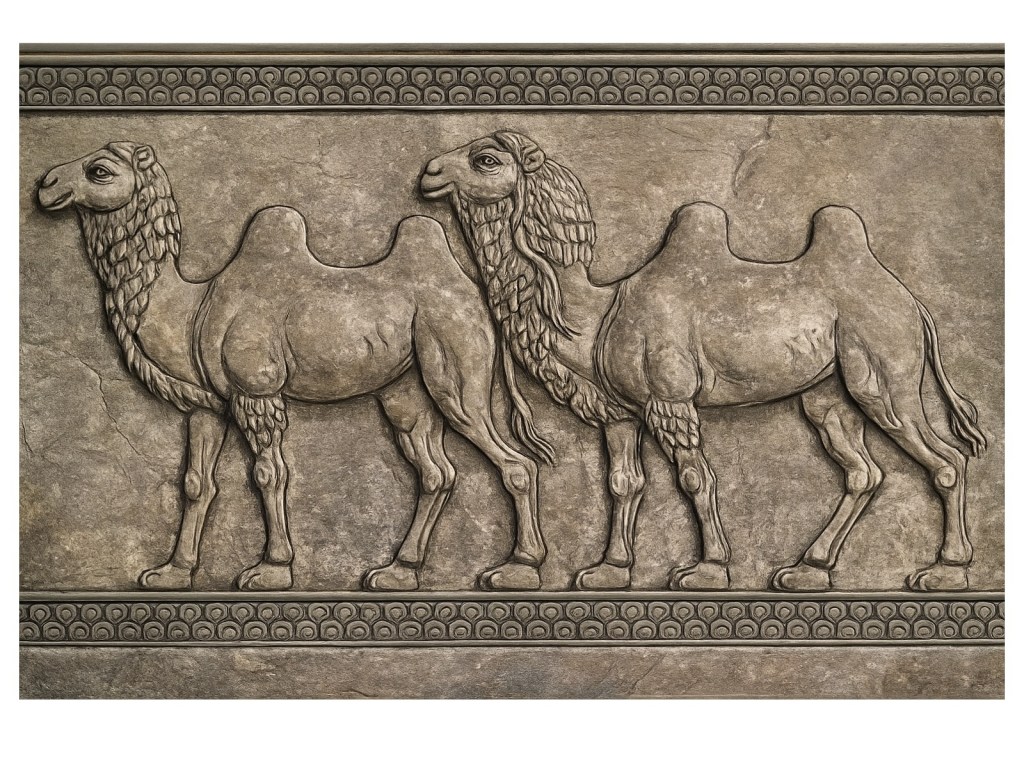
The Canaanites had iron chariots—modern technology. These people have camels![5] Camels can travel for three to four days, with a heavy load, and cover about 300 miles without food or water.[6] These enemy peoples would swoop through the land, taking everything they could, load it onto their camels and go back into the desert. Seven years of these raids—had demoralized the Israelites and left them without food and hiding in the hills. The people are once again at a loss. They cry out to God for help. Not to REPENT—but only to ask for help.
7 When the Israelites cried out to the Lord because of Midian, 8 he sent them a prophet, who said, “This is what the Lord, the God of Israel, says: I brought you up out of Egypt, out of the land of slavery. 9 I rescued you from the hand of the Egyptians. And I delivered you from the hand of all your oppressors; I drove them out before you and gave you their land. 10 I said to you, ‘I am the Lord your God; do not worship the gods of the Amorites, in whose land you live.’ But you have not listened to me.” Judges 6:7-10
The first two times that the people cried out, God sent them a deliverer, a judge. Othniel, then Ehud, who both had military victories. Then God sent a judge and a prophet—Deborah, who sent for Barak, and told him to go to war and God would be with him. Now, God sends a man, a prophet—with a message for Israel, BEFORE he sends someone to deliver them. The message: I brought you up, I delivered you, I gave many things to you—and YOU…you have not obeyed my instructions!
11 The angel of the Lord came and sat down under the oak in Ophrah that belonged to Joash the A’biez’rite, where his son Gideon was threshing wheat in a winepress to keep it from the Midianites. Judges 6:11
Gideon comes from the people of Manasseh—Joseph’s firstborn son. Manasseh was the firstborn, but Ephraim received the greater blessing, given by Jacob, who also was the younger brother and took the birthright blessing from his brother. Manasseh had seven sons, which all had clans associated with them by the time they arrived in the Promised Land. One of those sons had only daughters—fiver of them in fact! But all the daughters requested and received an inheritance of land! [7] From one of the other descendants of Manasseh came Abiezer, and from HIS line was born Gideon.
Gideon’s story is central to the meaning of Judges.[8] His story is a much larger one than what we’ve encountered so far! As the story goes, an angel—or messenger of God—sits down under an oak—or terebinth[9] where the worship of Baal and other Canaanite deities was often practiced.[10] Now, Abraham also worshipped under a great tree like this, but he made an altar to Yahweh,[11] not to another god. Still, we have to remember that these tribes—these people—still have a lot of different ideas about God. It doesn’t matter that their ancestors were in the wilderness and saw signs and wonders. THIS generation has come into the new land, they have dispersed into a HUGE new territory, and they have picked up, whether right or not, on the practices of the people around them. Trent Butler writes that “Gideon and his family would probably see themselves as faithful worshipers of Yahweh.”[12]
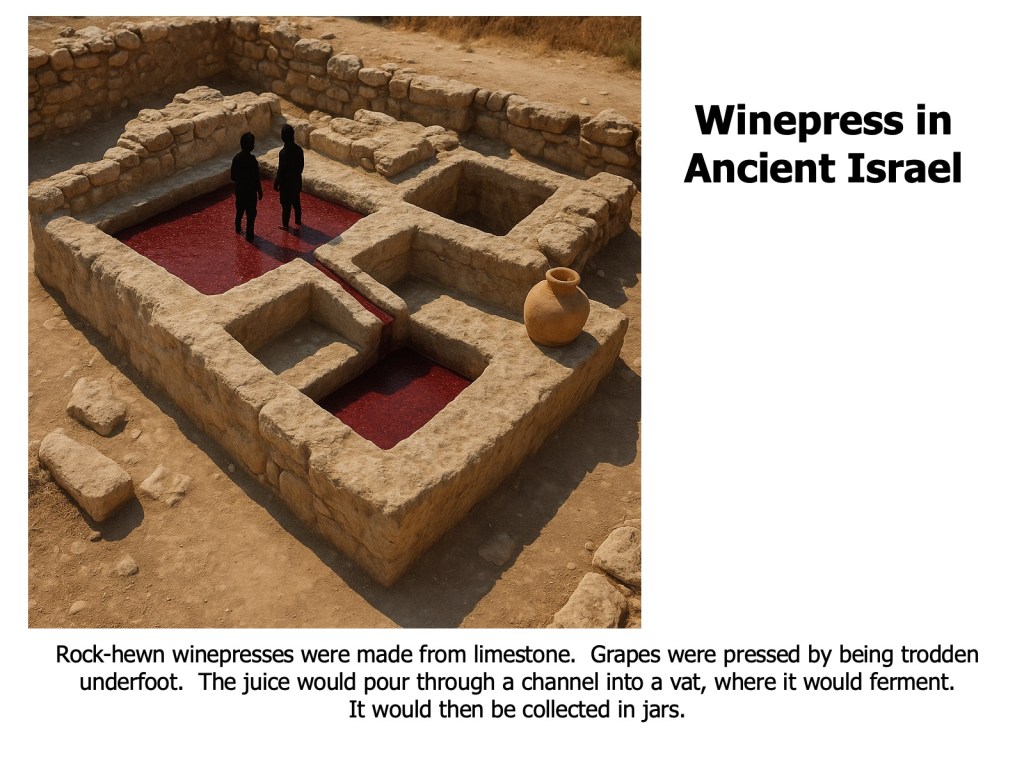
In this scene, Gideon is using a winepress to thresh and winnow the wheat. An ancient winepress was a depression in the ground, cut into the hillside. The limestone made excellent winepresses, because it cut easily and held liquid well.[13] Here’s a great 3-D model of an iron age winepress. https://www.biblewalks.com/winepresses/
The Midianites are coming in and ruining and stealing the crops of the Israelites. This has forced the people into the hillsides to try and eke out a living in any way they knew how. Rather than an open threshing floor, Gideon uses the winepress to hide and protect his wheat, so that his family doesn’t starve. The angel—or messenger—approaches Gideon. The NIV uses the word ‘angel’, but the Hebrew word could mean it was either a heavenly OR a human being sent from God.[14] This messenger doesn’t have wings, or a halo.[15] So, Gideon may easily have assumed that this is just someone passing by who has no idea about the current political and economic situation.[16] But it will turn out to be not just any messenger.
12 When the angel of the Lord appeared to Gideon, he said, “The Lord is with you, mighty warrior.” 13 “Pardon me, my lord,” Gideon replied, “but if the Lord is with us, why has all this happened to us? Where are all his wonders that our ancestors told us about when they said, ‘Did not the Lord bring us up out of Egypt?’ But now the Lord has abandoned us and given us into the hand of Midian.” Judges 6:12-13
The messenger calls Gideon a mighty warrior. It seems a bit ironic. Gideon may have looked around to see if the messenger was talking to someone else! If you look at the meaning of Gideon’s name now, it will often come up as ‘Mighty Warrior’—probably because of this text. Gideon and the people are facing a crisis that I think we can relate to. The question he asks is the thing standing in the way of Gideon’s acceptance of the mission. How can he give God undivided respect and loyalty if he can’t see God’s power and presence in the world around him?[17]
14 The Lord turned to him and said, “Go in the strength you have and save Israel out of Midian’s hand. Am I not sending you?” 15 “Pardon me, my lord,” Gideon replied, “but how can I save Israel? My clan is the weakest in Manasseh, and I am the least in my family.” 16 The Lord answered, “I will be with you, and you will strike down all the Midianites, leaving none alive.” 17 Gideon replied, “If now I have found favor in your eyes, give me a sign that it is really you talking to me. 18 Please do not go away until I come back and bring my offering and set it before you.” And the Lord said, “I will wait until you return.” 19 Gideon went inside, prepared a young goat, and from an ephah of flour he made bread without yeast. Putting the meat in a basket and its broth in a pot, he brought them out and offered them to him under the oak. 20 The angel of God said to him, “Take the meat and the unleavened bread, place them on this rock, and pour out the broth.” And Gideon did so. 21 Then the angel of the Lord touched the meat and the unleavened bread with the tip of the staff that was in his hand. Fire flared from the rock, consuming the meat and the bread. And the angel of the Lord disappeared. 22 When Gideon realized that it was the angel of the Lord, he exclaimed, “Alas, Sovereign Lord! I have seen the angel of the Lord face to face!” 23 But the Lord said to him, “Peace! Do not be afraid. You are not going to die.” 24 So Gideon built an altar to the Lord there and called it The Lord Is Peace. To this day it stands in Ophrah of the A’biez’rites. Judges 6:14-24
Gideon extends ancient hospitality to the messenger by making him a meal. It’s a meal, not a sacrifice, which may be an attempt by Gideon to decipher if this is an angel or a human—because angels don’t eat.[18] When the angel burns it all up, and disappears, he has his answer! It’s a sign of favor![19] And an encounter with the living God! He builds an altar to God, and then he is instructed to make a REAL sacrifice…
25 That same night the Lord said to him, “Take the second bull from your father’s herd, the one seven years old. Tear down your father’s altar to Baal and cut down the Asherah pole beside it. 26 Then build a proper kind ofaltar to the Lord your God on the top of this height. Using the wood of the Asherah pole that you cut down, offer the second bull as a burnt offering.” 27 So Gideon took ten of his servants and did as the Lord told him. But because he was afraid of his family and the townspeople, he did it at night rather than in the daytime. Judges 6:25-27

Baal is not really a name, but a title—like “Lord.” And he is considered lord of the storm, and the ruler of the pantheon associated with the gods of Canaan.[21] Asherah is a fertility goddess, who was Baal’s mother,[22] and is associated with fertility, even with the crops of the land. These are public, prominent monuments that won’t be easily taken down! it is not enough that Gideon recognizes God; the rest of Israel should too.[23] Gideon needs to make a public declaration. But it’s an act bordering on terrorism. A seven-year-old bull was a prime breeding bull![24] It was probably a bull that was being raised up to be offered in worship to Baal.[25] To take that bull and offer it up is a line drawn in the sand. And by using the wood of the Asherah to make the fire, the Asherah in essence is being sacrificed to Yahweh,[26] too!
28 In the morning when the people of the town got up, there was Baal’s altar, demolished, with the Asherah pole beside it cut down and the second bull sacrificed on the newly built altar! 29 They asked each other, “Who did this?” When they carefully investigated, they were told, “Gideon son of Joash did it.” 30 The people of the town demanded of Joash, “Bring out your son. He must die, because he has broken down Baal’s altar and cut down the Asherah pole beside it.” 31 But Joash replied to the hostile crowd around him, “Are you going to plead Baal’s cause? Are you trying to save him? Whoever fights for him shall be put to death by morning! If Baal really is a god, he can defend himself when someone breaks down his altar.” 32 So because Gideon broke down Baal’s altar, they gave him the name Jerub-Baal that day, saying, “Let Baal contend with him.” Judges 6:28-32
Gideon’s name means: the one who cuts down[27], or cuts off.[28] Gideon is guilty of messing with the mixed religious practices of the village. But his dad defends his son and says …Baal should be able to defend himself! Nothing happens to him, so Gideon is saved, and the name, Jerubbaal can be taken as proof that Baal is powerless, and, side note: many scholars believe that Jerubbaal is actually Gideon’s birth name.[29] Gideon may have broken down the altar and pole and sacrificed to God, but he has more to do. And so does God. God had appeared to Gideon as a lone messenger, and now Gideon is testifying about God before a small group of people—tearing down idols so that Yahweh alone will be worshipped. But the larger body of Israel also needs to know that God is powerful and present![30] The battle is coming!
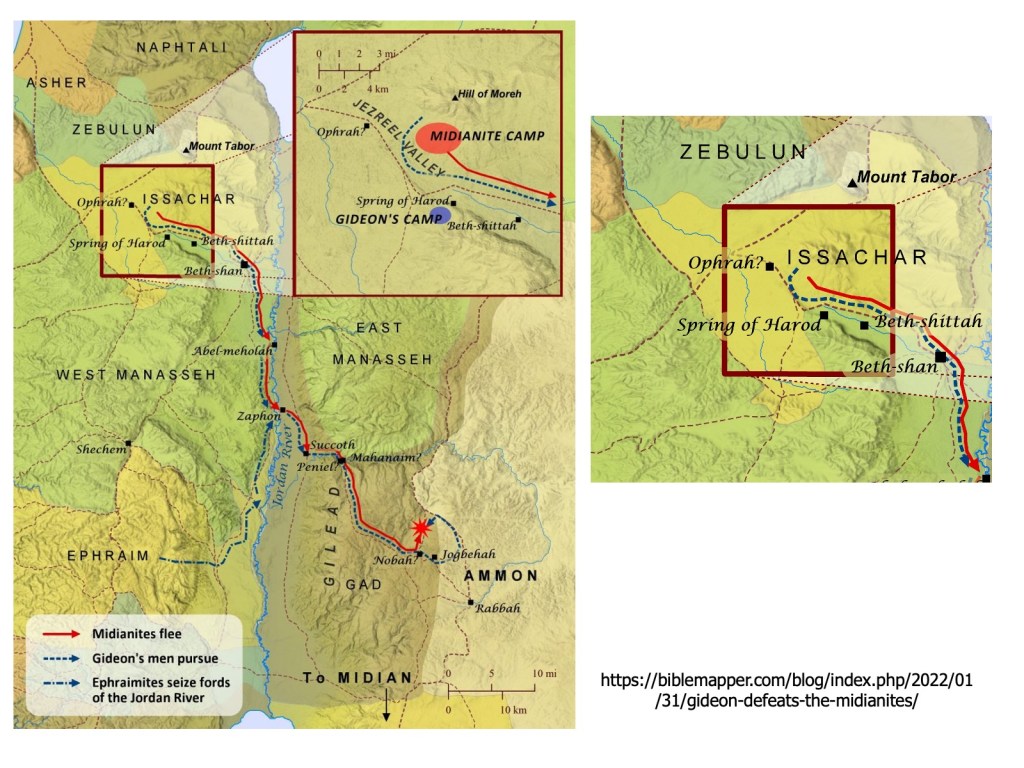
33 Now all the Midianites, Amalekites and other eastern peoples joined forces and crossed over the Jordan and camped in the Valley of Jezreel. 34 Then the Spirit of the Lord came on Gideon, and he blew a trumpet, summoning the Abiezrites to follow him. 35 He sent messengers throughout Manasseh, calling them to arms, and also into Asher, Zebulun and Naphtali, so that they too went up to meet them. Judges 6:33-35
The Spirit of God comes upon Gideon—a powerful move! But Gideon puts a pause in the process to test God:
36 Gideon said to God, “If you will save Israel by my hand as you have promised— 37 look, I will place a wool fleece on the threshing floor. If there is dew only on the fleece and all the ground is dry, then I will know that you will save Israel by my hand, as you said.” 38 And that is what happened. Gideon rose early the next day; he squeezed the fleece and wrung out the dew—a bowlful of water. 39 Then Gideon said to God, “Do not be angry with me. Let me make just one more request. Allow me one more test with the fleece, but this time make the fleece dry and let the ground be covered with dew.” 40 That night God did so. Only the fleece was dry; all the ground was covered with dew. Judges 6:36-40
The first time, Gideon needs reassurance. The second time, he knows he is being distrustful. He knows what God wants him to do, and still he asks for another sign. But God doesn’t criticize his request. He honors it and responds.[31] Why the dew? What’s so special about that sign? When the Israelites were in Egypt, they farmed using the Nile river and other irrigation techniques. But in this new land of Canaan, farming is not the same. God had promised them that the rain and the dew would come, as long as they obeyed the commands of God—to love him with all of their heart and soul, and not turn away and worship other gods.[32] The Canaanites believed that Baal provided the rain and dew.[33] But God said that HE was the one to provide it. Gideon’s first request is that the fleece would be damp, but not the threshing floor. The threshing floor would be stone, and any water would evaporate more quickly from the floor than the fleece—it’s a natural expectation. It’s the AMOUNT of water that should capture our attention—a bowlful![34] The next night, Gideon asks for the opposite—that the fleece be dry, and the ground be covered in dew. God demonstrates his presence and power by reversing the results![35] God and Baal cannot occupy the same throne.
Yahweh proves himself more powerful than Baal, and Gideon has his answer! It’s time for him to lead the army he has called, but what kind of army will there even be? Many of the soldiers may have had only farm elements, like the oxgoad Shamgar used. They may have had some training, but being prepared for war was not a given. There were instructions for war time troops given in Deuteronomy 20: If you just built a house, go home. If you planted a vineyard, if you’re engaged to be married, and if you’re afraid—go home.[36] God gives Gideon a little different plan of action on how to handle the group.
Early in the morning, Jerub-Baal (that is, Gideon) and all his men camped at the spring of Harod. The camp of Midian was north of them in the valley near the hill of Moreh. 2 The Lord said to Gideon, “You have too many men. I cannot deliver Midian into their hands, or Israel would boast against me, ‘My own strength has saved me.’ 3 Now announce to the army, ‘Anyone who trembles with fear may turn back and leave Mount Gilead.’” So twenty-two thousand men left, while ten thousand remained. 4 But the Lord said to Gideon, “There are still too many men. Take them down to the water, and I will thin them out for you there. If I say, ‘This one shall go with you,’ he shall go; but if I say, ‘This one shall not go with you,’ he shall not go.” 5 So Gideon took the men down to the water. There the Lord told him, “Separate those who lap the water with their tongues as a dog laps from those who kneel down to drink.” 6 Three hundred of them drank from cupped hands, lapping like dogs. All the rest got down on their knees to drink. 7 The Lord said to Gideon, “With the three hundred men that lapped I will save you and give the Midianites into your hands. Let all the others go home.” 8 So Gideon sent the rest of the Israelites home but kept the three hundred, who took over the provisions and trumpets of the others. Judges 7:1-7
The NIV says that the men went home, but the Hebrew says that they just went to their tents. In other words, they went back to the military camp, but they didn’t take part in the battle.[37]
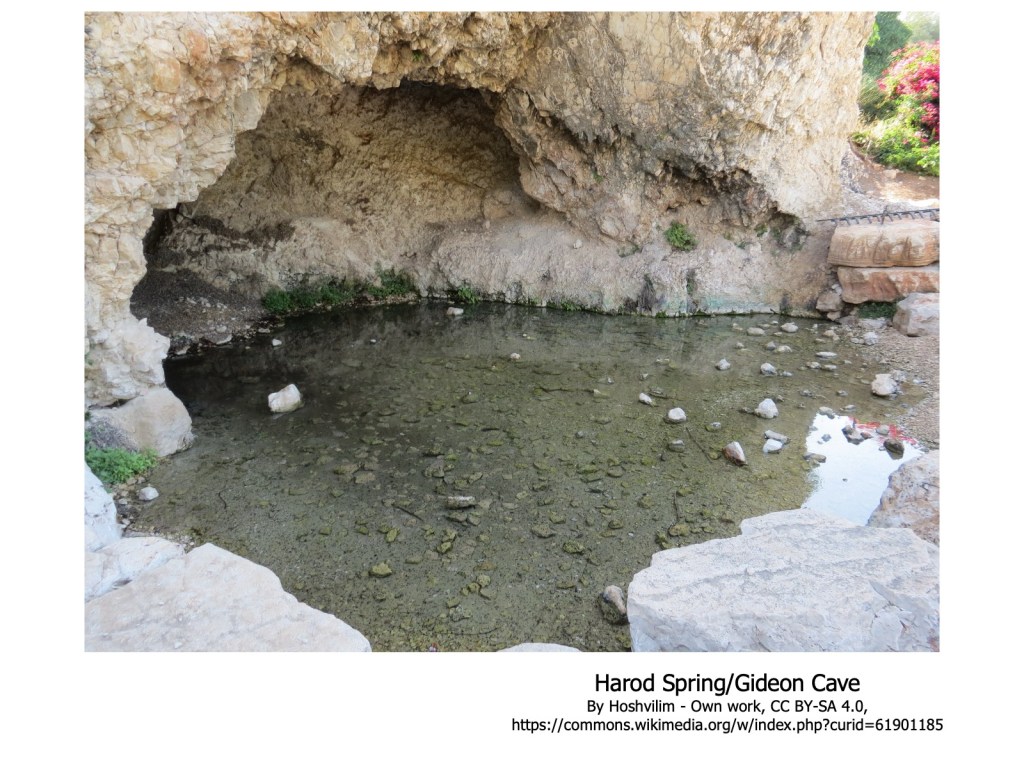
But why were the men who drank the water from cupped hands the ones allowed to stay? I’ve always wondered about this. In year’s past, I had heard from various pastors or sources that it was because those who ‘cup’ water are more alert to their surroundings. It makes sense on a military level, doesn’t it? But God wants to show his power through a small group in such an interesting way, and it doesn’t make sense that these were the best warriors. Otherwise, they could still credit the victory to their skills!
I ran across a commentary from a Jewish rabbi I follow who proposed something else entirely. Gideon initially says that anyone who is afraid can go back. That lines up with Deuteronomy’s instructions about war. The fear that many of these men faced, was that the enemy would come in and take their stuff—their house, their vineyard, their wives. And this is what was happening: their crops were already being confiscated—and their belongings were devastated. The people had become slaves to fear. God had reprimanded the people through the prophet at the beginning of this chapter—“It was I who brought you up from Egypt and brought you out from the house of 1slavery. I delivered you from the hands of the Egyptians and from the hands of all your oppressors. You shall not fear the gods of the Amorites—or the gods of Canaan.
But the people ARE bowing down to other gods. They ARE afraid of the surrounding nations with their powerful weapons. They are acting just like slaves again. And what do slaves do? They bow in complete obedience, to a master they have no business serving. Those who worship idols are accustomed to pray—by kneeling before the idols. This POSTURE of kneeling is nothing unusual to them.[38] The second of the 10 commandments is, ‘Do not make idols and do not bow down to them.’[39] The 300 men that do not bend the knee at Harod’s spring, the men who lift the water with cupped hands, THEY still have dignity. THEY don’t bow so easily,[40] to fear, or to another god. Only God knows their hearts, but these may be men who haven’t bowed down to worship other gods like many of the Israelites have been doing. And God will use THEM to defeat the enemy. It doesn’t make military sense. It makes spiritual sense.
Now the camp of Midian lay below him in the valley. 9 During that night the Lord said to Gideon, “Get up, go down against the camp, because I am going to give it into your hands. 10 If you are afraid to attack, go down to the camp with your servant Purah[41] 11 and listen to what they are saying. Afterward, you will be encouraged to attack the camp.” So he and Purah his servant went down to the outposts of the camp. 12 The Midianites, the Amalekites and all the other eastern peoples had settled in the valley, thick as locusts. Their camels could no more be counted than the sand on the seashore. Judges 7:8-12
In the story of Deborah and Barak, the problem was technology—the chariots of iron. In this scene, the problem is a numerical one.[42] There are SO MANY warriors! Gideon is told to go down to the camp and have a listen, so that he will be encouraged to go into battle. So, he goes.
13 Gideon arrived just as a man was telling a friend his dream. “I had a dream,” he was saying. “A round loaf of barley bread came tumbling into the Midianite camp. It struck the tent with such force that the tent overturned and collapsed.” 14 His friend responded, “This can be nothing other than the sword of Gideon son of Joash, the Israelite. God has given the Midianites and the whole camp into his hands.” 15 When Gideon heard the dream and its interpretation, he bowed down and worshiped. Judges 7:13-15a
Hearing from God directly didn’t convince Gideon; the test with the fleece didn’t totally convince Gideon; but hearing from a Midianite soldier? NOW he is convinced?[43] Yes, that, and his friend’s interpretation. Because the dream meant this: the barley loaf represents sedentary, agricultural Israel, the tent represents the nomadic culture of the people of the East.[44] The tiny loaf somehow knocks over the tent, it tips over and collapses. The loaf is Gideon! Gideon is convinced now that God is going to use him, and this small army, as small and insignificant as it may seem. And then, Gideon worships God.
Fear looks at the Battle, but Faith looks at God
GOD has called Gideon to this moment. It is no longer about how many people are on the opposing side. Gideon will do what he has been called to do. He is gaining momentum, just like the loaf of bread. He trusts God completely at this point. He will be the mighty warrior that God has called him to be!
He returned to the camp of Israel and called out, “Get up! The Lord has given the Midianite camp into your hands.” 16 Dividing the three hundred men into three companies, he placed trumpets and empty jars in the hands of all of them, with torches inside. 17 “Watch me,” he told them. “Follow my lead. When I get to the edge of the camp, do exactly as I do. 18 When I and all who are with me blow our trumpets, then from all around the camp blow yours and shout, ‘For the Lord and for Gideon.’” 19 Gideon and the hundred men with him reached the edge of the camp at the beginning of the middle watch, just after they had changed the guard. They blew their trumpets and broke the jars that were in their hands. 20 The three companies blew the trumpets and smashed the jars. Grasping the torches in their left hands and holding in their right hands the trumpets they were to blow, they shouted, “A sword for the Lord and for Gideon!” 21 While each man held his position around the camp, all the Midianites ran, crying out as they fled. Judges 7:15-b21
Gideon’s men are holding a torch in a pitcher in one hand, and a trumpet in the other. There are no hands left—to defend themselves or attack the enemy. They must COMPLETELY trust in God’s promises and not in their own strength![45] Their cry is a ploy—”a sword for the Lord and for Gideon?”—they HAVE no sword in their hands![46] And as God so often does, he uses ordinary things to give his people victory.
22 When the three hundred trumpets sounded, the Lord caused the men throughout the camp to turn on each other with their swords. The army fled to Beth Shittah toward Zererah as far as the border of Abel Meholah near Tabbath. 23 Israelites from Naphtali, Asher and all Manasseh were called out, and they pursued the Midianites. 24 Gideon sent messengers throughout the hill country of Ephraim, saying, “Come down against the Midianites and seize the waters of the Jordan ahead of them as far as Beth Barah.”So all the men of Ephraim were called out and they seized the waters of the Jordan as far as Beth Barah. 25 They also captured two of the Midianite leaders, Oreb and Zeeb. They killed Oreb at the rock of Oreb, and Zeeb at the winepress of Zeeb. They pursued the Midianites and brought the heads of Oreb and Zeeb to Gideon, who was by the Jordan. Judges 7:22-25
Ironically, the scene ends at a rock and a winepress—which are the same types of places where this account began.[47]
There are a lot of things about Gideon in this story that are commendable: He is called mighty warrior by the messenger from God, and Gideon is humble in his response. He responds to the sign from the messenger with an expression of worship. He destroys the pagan cult items in his town even though he knows it will make everyone upset. The Spirit of God comes over him to prepare him for battle. He obeys God and reduces his troops, even when it seems ludicrous with the numbers of enemy soldiers they will face.[48] In this narrative, Gideon appears to be a kind of Moses—a hesitant deliverer who is raised up by God to deliver Israel.[49] However, this is a turning point in the story of the judges.[50] From this time on, things will go downhill. While Gideon may seem to be doing good here, in the next part he will not! A tiny glimpse of that is seen in his battle cry: For the Lord and for Gideon! Gideon seems to be trying to claim some of the fame.[51] He wants to share the spotlight with God.[52] Not a good sign. It’s all about who gets the credit for delivering Israel. Gideon will end up showing the best and the worse of the judges.[53] We’ll get to that later. But for now, we can rejoice in what God is doing! As he has done so often before, God intervenes on Israel’s behalf—in spite of what they deserve.[54] GOD is the main character of the story, not Gideon!
You know, lately, I have caught myself so many times looking at the battles around me: some of my relationships, the bills, the workload. How about you? Are you caught up in seeing a battle? What things are looming on the horizon for you? Maybe it’s a financial struggle, a health crisis, a broken relationship—something that feels bigger than you can handle. Maybe you are struggling with your identity or value. Our students can face the constant comparison of themselves to their peers, Those in the workplace may feel small in comparison with others’ achievements or success. Parents may feel inadequate to raise their kids in today’s culture. Choosing to be faithful to God in this world is a battle of faithfulness: when you see the social media posts, or struggle with the approval of others. Maybe you have a desire for material goods that bring comfort, or are tempted to compromise your values to fit in, or get that promotion.
Maybe you are just overwhelmed with the never-ending news cycle that sounds the alarm, and the politics that threaten to pull people further and further apart. The threat of defeat is asserted and assumed in so many areas. What is going on in YOUR life right now?
Maybe you’ve been asking the same questions as Gideon: Where is God in all of the things that are going on in the world? Where is his power and presence? Where are the miracles, the promises? Why does it look like God has forsaken us? We read these stories in Judges and think that times were much more exciting back then![55] Sure, God worked for THEM! But that may have been how Gideon felt, too—hearing about the stories of what God had done for his people in the past… For him, the stories of Othniel, Ehud, Deborah, Barak, and Jael were old! It’s easy to get caught up in all of the things that threaten defeat, and the battles we face—that are REAL—and need our attention. But where are our eyes focused? On the battle—or on God?
Fear looks at the Battle, but Faith looks at God
We look at ourselves and see our flaws and failings. God looks at us and sees our possibilities, through his transforming presence![56] The main theme in this story is not the vicious cycle, and it’s not the deliverance that God provides, as miraculous as it may be. This story is about Gideon’s struggle to believe God’s promise.[57] He finally had to decide to believe, because God had said it.[58] Not because of all the signs, not because he experienced immediate victory—he had to take action first! He had to move from fear to faith![59] And he is included in the great line-up of faith in Hebrews 11. That same writer of Hebrews encourages the church by saying: Keep loving one another as brothers and sisters. Don’t forget to show hospitality. Remember those who are mistreated. Honor marriage. Keep your lives free from the love of money. Be content with what you have. Why? Because God said, “I will never leave you or forsake you. So we say with confidence, “The Lord is my helper; I will not be afraid. What can mere mortals do to me? So imitate the faith of the leaders who speak the word of God to you. Jesus Christ is the same yesterday and today and forever! (paraphrased from Hebrews 13:1-8)
Let’s choose faithfulness—this week—and keep our eyes on Jesus—the one who has already won the battle! To his disciples he says: “In this world you WILL have trouble. But take heart! I have overcome the world.”[60] So, WILL YOU do the things that God has called you to do this week? Will you trust God’s Promise that he is WITH us? Will you stand in courage and fight the battle? As people of faith, we are regularly called to have courage and a proper confidence in God. In this final prayer, I’m going to ask you to lift your arms above your head and reach for what God could drop to you.
Prayer: Lord of Hosts, You are the God who called Gideon when he felt weak and afraid, and You are the same God who calls us today. When we feel weak and afraid, remind us that You are with us. Give us courage for the battles we face. When doubts whisper and fear surrounds us, let us hear Your voice of truth. Strengthen our hearts to trust in You. Teach us to walk in obedience, even when Your ways seem unexpected. We believe the victory comes not by our power, but by Your hand. Mighty God, go before us and fight for us. Give us courage to face the battles of today and tomorrow. Make us bold in faith and steadfast in hope. Give us confidence that you go before us, Mighty Warrior. In You, we have the victory. In Jesus’ name, we pray. Amen.
Bibliography
- Block, Daniel I. Judges, Ruth, Nashville: B&H Publishing Group, 1999.
- Boda, Mark J., Mary L. Conway, Daniel I. Block, general editor; Judges, Exegetical Commentary on the Old Testament, Grand Rapids: Zondervan Academic, 2022.
- Butler, Trent C., Word Biblical Commentary: Judges, Grand Rapids: Zondervan, 2009.
- Frolov, Serge, Judges, Grand Rapids: William B. Eerdmans Publishing Company, 2013.
- Goldingay, John, Joshua, Judges & Ruth for Everyone, Louisville: Westminster John Knox Press, 2011.
- Inrig, Gary, Hearts of Iron, Feet of Clay, Chicago: Moody Bible Institute, 1979.
- Keller, Timothy; Judges for You; The Good Book Company, 2013.
- Soggin, J. Alberto, Judges, Philadelphia: The Westminster Press, 1981.
- Smit, Laura A. and Stephen E. Fowl, Brazos Theological Commentary on the Bible: Judges and Ruth, Grand Rapids: Brazos Press, 2018.
- Matthews, Victor H., Judges & Ruth, Cambridge: Cambridge University Press, 2004.
- McCann, J. Clinton, Judges, Louisville: John Knox Press, 2002.
Articles
- Beck, John A., “Gideon, dew, and the narrative-geographical shaping of Judges 6:33-40”, Bibliotheca sacra, 165 no 657 Jan-Mar 2008, 28-38.
- Block, Daniel I., “Will the Real Gideon Please Stand Up? Narrative Style and Intention in Judges 6-9”, Journal of the Evangelical Theological Society, 40 no 3 Sep 1997, 353-366.
- Claassens, L Juliana M. “The character of God in Judges 6-8: the Gideon narrative as theological and moral resource”, Horizons in Biblical Theology, 23 no 1 Jun 2001, 51-71.
- Derby, Josiah, “Gideon or Jerubaal”, Jewish Bible Quarterly, 31 no 3 Jul-Sep 2003, 181-185.
- Derby, Josiah, “Gideon and the Ephraimites”, Jewish Bible Quarterly, 30 no 2 Apr-Jun 2002, 118-120.
- Janzen, David, “Gideon’s house as the ʼṭd [Hebrew characters]: a proposal for reading Jotham’s fable”, The Catholic Biblical Quarterly, 74 no 3 Jul 2012, 465-475.
- Haddox, Susan E., ‘The Lord is with you, you mighty warrior’: the question of Gideon’s masculinity, Proceedings, 30 2010, 70-87.
- Murphy, Kelly J., “Laying out the fleece: reading Gideon’s requests with reception history”, Word & World, 37 no 3 Sum 2017, 241-251.
- Reid, Thomas G., “Judges 6-8:32: Gideon”, The Confessional Presbyterian, 17 2021, 61-80, 235.
- Roncace, Mark, “Josephus’ (real) portraits of Deborah and Gideon: A reading of Antiquities 5.198-232”, Journal for the Study of Judaism in the Persian, Hellenistic and Roman Period, 31 no 3 2000, 247-274.
- Scolnic, Benjamin Edidin, “I’ll Sit Here Until You Come Back: Gideon And The Patience Of God”, Jewish Bible Quarterly, 50 no 4 Oct-Dec 2022, 245-254.
- Tanner, J Paul, “The Gideon narrative as the focal point of Judges,” Bibliotheca sacra, 149 no 594 Apr-Jun 1992, 146-161.
- Yoder, Nathan Howard, “The descent into fear and ascent into trust of Judges 7vs9-15,” Lutheran Forum, Winter 2012, 15-18.
Going Deeper Questions
—Have you ever been talked into something you didn’t think you could do? How did it turn out?
Read Judges 6:1–6
—What do you notice about the way fear and oppression shape Israel’s life here?
—What are some circumstances or forces that leave people today feeling powerless or hiding?
Read Judges 6:11–16
—Why do you think God calls Gideon “mighty warrior” when he’s hiding in fear?
—What excuses does Gideon make, and how are they like our own doubts today?
—What might it look like to “go in the strength you have” instead of waiting until you feel ready?
Read Judges 6:19-24
—The angel directed Gideon to present the offering in a very specific way. What might
this teach us about obedience in the small details of faith?
—When fire consumed the offering, Gideon realized he was in the presence of God. Have you ever had a moment when God’s presence became suddenly real to you? What was it like?
Read Judges 6:25-32
—Why do you think Gideon acted at night instead of the daytime? How does that show
both faith and fear?
—What stands out to you about the reaction of the townspeople when they discovered
Baal’s altar had been torn down?
—Joash, Gideon’s father, surprisingly defends him against the crowd. Why is his response significant? What does this show about shifting loyalties or courage in leadership?
—In what ways might we face similar pressures today when we challenge cultural idols
or false securities (comfort, money, success, popularity)?
Read Judges 6:33-40
—Why do you think Gideon asked for a sign even after God had already promised to deliver Israel through him and he had already called the troops together?
—Have you ever asked God for reassurance when facing a big decision or step of faith? What did that look like for you?
—This story shows us that God has patience with our fears and questions. Instead of asking for signs today, how can we grow in confidence in God’s promises and guidance?
Read Judges 7:1-7
—Why would God say “you have too many men” when they were already outnumbered? What does that tell us about the way He works?
—The sermon noted how some men bowed at the water and others did not. Why do you think posture mattered in this moment? (think about slavery, idolatry, and dignity)
—Imagine you’re one of the 300. What emotions might you feel at this point—fear, excitement, trust? How would you encourage your fellow soldier next to you?
—When have you felt like God was “thinning out” your resources, relationships, or options so that you had to depend only on Him?
—How does this story challenge the way we measure strength, security, or “being ready”?
Read Judges 7:8-15
—Why do you think Gideon was convinced by the dream more than God’s direct promises?
—How does this show God’s kindness in meeting us in our doubts?
—What’s a moment where God confirmed His word to you in an unexpected way?
Read Judges 7:16-22
—What ordinary tools did God use here?
—Where in your life might God be asking you to trust Him without “a sword in your hand”?
Fear looks at the battle; faith looks at God.
—What idols, fears, or false securities might you need to lay down?
Hebrews 13:5–6 “God has said, “Never will I leave you; never will I forsake you.” So we say with confidence, “The Lord is my helper; I will not be afraid. What can mere mortals do to me?”
—What does God’s promise “I will be with you” mean in your life right now?
Prayer: Lord, You are our strength. Help us face our battles with faith, not fear. Go with us this week and make us courageous. Amen.
[1] Daniel I. Block, Judges, Ruth, Nashville: B&H Publishing Group, 1999, 252.
[2] Gen. 36:12, 16.
[3] Judges 3:12-13.
[4] https://anetoday.org/heide-peters-camels-ancient/
[5] PICS: https://biblearchaeology.org/research/contemporary-issues/3832-the-date-of-camel-domestication-in-the-ancient-near-east?highlight=WyJwIiwiJ3AiLCIncCciLCJ3aXNlbWFuIiwid2lzZW1hbidzIiwicCB3aXNlbWFuIl0=
[6] Gary Inrig, Hearts of Iron, Feet of Clay, Chicago: Moody Bible Institute, 1979, 86.
[7] Joshua 17:1-6.
[8] Laura A. Smit, and Stephen E. Fowl, Brazos Theological Commentary on the Bible: Judges and Ruth, Grand Rapids: Brazos Press, 2018, 23.
[9] Tent C. Butler, Word Biblical Commentary: Judges, Grand Rapids: Zondervan, 2009, 201.
[10] Mark J. Boda, Mary L. Conway, Daniel I. Block, general editor; Judges, Exegetical Commentary on the Old Testament, Grand Rapids: Zondervan Academic, 2022, 317.
[11] Genesis 12:6
[12] Boda, Conway, 320, footnotes 16.
[13] https://www.facebook.com/KingJamesBibleDictionary/posts/bible-word-of-the-day-winepresswinepress-from-the-scanty-notices-contained-in-th/1280631464062328/
[14] Boda, Conway, 317, footnote 4.
[15] Gary Inrig, 89.
[16] Boda, Conway, 319.
[17] Based on John A. Beck., “Gideon, dew, and the narrative-geographical shaping of Judges 6:33-40”, Bibliotheca sacra, 165 no 657 Jan-Mar 2008, 28-38, 32.
[18] Butler, 203.
[19] Reid, Thomas G, Judges 6-8-Gideon, 65.
[20] https://www.learnreligions.com/asherah-in-the-bible-6824125
[21] https://raymondusrex.wordpress.com/2016/08/20/the-gods-and-goddesses-of-canaan/
[22] https://www.learnreligions.com/asherah-in-the-bible-6824125
[23] Claassens, L Juliana M, “The character of God in Judges 6-8: the Gideon narrative as theological and moral resource”, Horizons in Biblical Theology, 23 no 1 Jun 2001, 51-71, 59.
[24] Butler, 205.
[25] Reid, Thomas G., “Judges 6-8:32: Gideon”, The Confessional Presbyterian, 17 2021, 61-80, 235, 67.
[26] Butler, 205.
[27] Josiah Derby, Derby, Josiah, “Gideon or Jerubaal”, Jewish Bible Quarterly, 31 no 3 Jul-Sep 2003, 181-185, 183.
[28] https://www.abarim-publications.com/Meaning/Gideon.html
[29] Josiah Derby, 184.
[30] Based on Beck, 33.
[31] Boda, Conway, 352.
[32] Deuteronomy 11:10-17
[33] Beck, 36.
[34] Based on Beck, 37.
[35] Based on Beck, 38.
[36] Deuteronomy 20:5-9
[37] Trent C. Butler, 213.
[38] Attributed to Raschi-a Jewish commentator from the Middle Ages. https://hermeneutics.stackexchange.com/questions/21143/who-laps-and-who-kneels-judges-75
[39] Deuteronomy 5:8-9
[40] From Rabbi David Fohrman, https://members.alephbeta.org/playlist/divine-justice-against-human-evil
[41] Purah here is a name, but it is also similar to the word Purah, which is a winepress, or lower vat of a winepress, found in Isaiah 63:3 https://biblehub.com/hebrew/6333.htm
[42] Butler, 213.
[43] Butler, 214.
[44] Nathan Howard Yoder, “The descent into fear and ascent into trust of Judges 7vs9-15,” Lutheran Forum, Winter 2012, 15-18, 17.
[45] Based on Boda, Conway, 365.
[46] Boda, Conway, 366.
[47] Based on Butler, 216.
[48] Based on some of Daniel I. Block, “Will the Real Gideon Please Stand Up? Narrative Style and Intention in Judges 6-9”, Journal of the Evangelical Theological Society, 40 no 3 Sep 1997, 353-366, 356-357.
[49] Butler, 200.
[50] Boda, Conway, 295.
[51] Boda, Conway, 366.
[52] Claassens, 61.
[53] Butler, 192.
[54] Block, Will the Real Gideon…365.
[55] Based on Gary Inrig, 90.
[56] Gary Inrig, 90.
[57] Paul J. Tanner, “The Gideon narrative as the focal point of Judges,” Bibliotheca sacra, 149 no 594 Apr-Jun 1992, 146-161, 157.
[58] Tanner, J. Paul, 159.
[59] Paul J. Tanner, 160.
[60] John 16:33
 Preach it Sista