
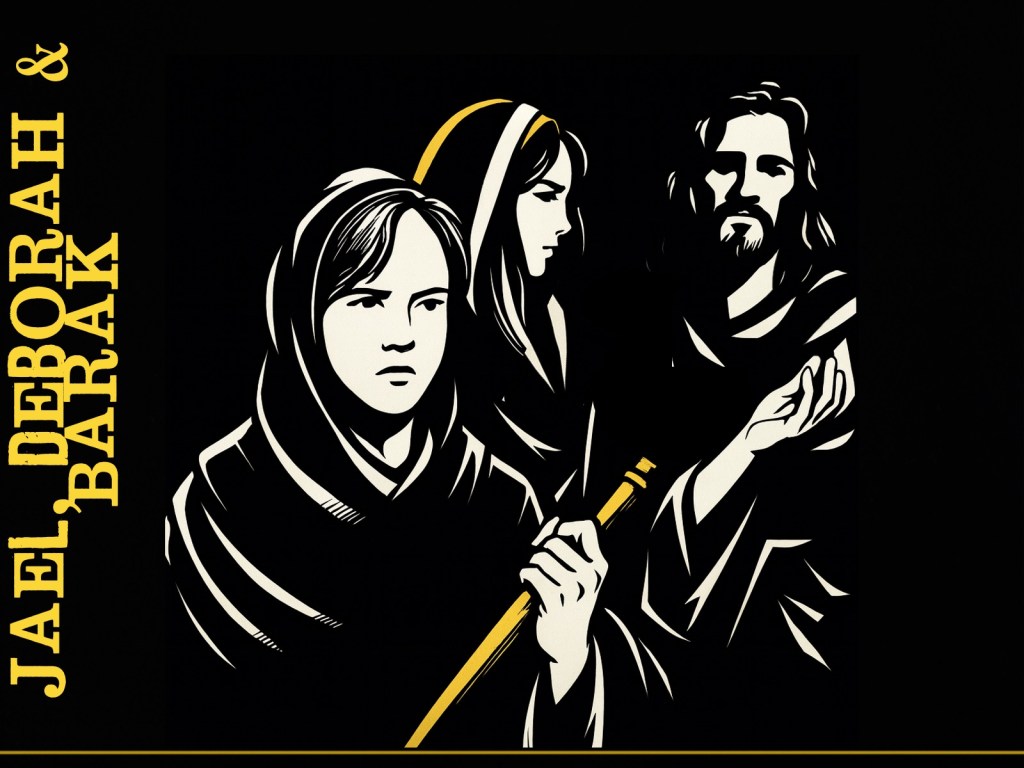
My name is Brenda, but there are a few variations that certain people call me. Bren, Brenny, and “Bee” are some of the nicknames I have. I have also been mistaken—many times actually!—for a Deb or Deborah! It’s uncanny. And whether it’s just a dyslexia of the letters or not, I do feel a certain affinity to one of our characters today. Someone said there are three kinds of people in the world—those who WATCH what is happening; those who MAKE things happen; and those who SCRATCH their heads and ASK, “Hey, what’s happening?”[1] We have all three of them in our story today. There is no one clear person that emerges as the leading character.[2] They are ALL unlikely heroes!
John Goldingay writes about the three judges we’ve already looked at—who seem to have no place in the structure of responsibility and power. The story of Othniel, referred to as a younger brother, tackling a possible case of eldest-ism; and then Ehud—with a handicap—a case of able-ism; Shamgar—a Canaanite—a swipe at racism; and now the character of Deborah, which quells the idea of sexism. God uses the young, the disabled, the foreign—and yes, even women.[3]
We’re going to look at Chapter 4 today, and a few sections from chapter 5. Judges 4 and 5 present a story—and a song about the same incident—a battle narrative! No other unit in the Book of Judges has had more scholarly discussion! Yikes! The story highlights some of the heroic roles played by women, which can sometimes turn into feminist commentary.[4] We’ll not overemphasize that in these texts, but there IS a lot to point out, as the narrator and the song writer tell their stories. The song in chapter 5, is a completely different genre than the story. It is creative and uses poetic license to tell it.[5] It is part song, part poem, part ballad—[6] kind of like the Ballad of Davy Crockett tune that we used at our church in the song before the sermon. It is entertaining, informing, and inspiring![7] It uses an archaic style of Hebrew[8]—older than the other chapters around it!
Chapter four and five tell different aspects of the story. GOD’S participation…and ISRAEL’S participation are portrayed differently.[9] So, how is God’s purpose achieved in the world? How do men and women play a part in that?[10] There is a lot of death in these stories in Judges! But in the end, the story and the song is really about how God provides salvation for his people! He is orchestrating the events, the strategies, and ultimately gets the victory![11]
Again the Israelites did evil in the eyes of the Lord, now that Ehud was dead. 2 So the Lord sold them into the hands of Jabin king of Canaan, who reigned in Hazor. Sisera, the commander of his army, was based in Harosheth Haggoyim. 3 Because he had nine hundred chariots fitted with iron and had cruelly oppressed the Israelites for twenty years, they cried to the Lord for help. Judges 4:1-3
We’re back to the vicious cycle in the book of Judges again: Israel turns away from Yahweh and worships other gods. God gives the people over to a foreign aggressor. The finally repent and cry out to God for help, and God brings deliverance through a judge. There is a time of peace, but soon the cycle starts all over, with a new oppressor and a new deliverer.[12]

Israel’s enemies come from all directions in the book of Judges![13] So far we’ve looked at Othniel, Ehud and Shamgar, which you can see on the map. The city of Hazor is a hard one to pin down, and there is a lot of debate about it. But the main character here is Jabin.[14] Jabin is the oppressor. Jabin is not just king of Hazor, he is king of Canaan![15] Canaan was a bunch of small independent kingdoms at this time.[16] Jabin is so strong, and his realm is so large, that he does not need to go into battle.[17] Sisera may have been a mercenary, hired by Jabin, to lead his forces in an attack against Israel.[18] Sisera lives in a town that is the western edge of the battle scene.[19] He’s got the manpower of the king behind him! Nine hundred chariots of iron! Whether that is literal or written as an epic exaggeration[20], it is a hefty force of military power! It might not sound like much in our day and age, but it was the latest in military technology back then! [21] The chariots were probably not made entirely of iron, but they may have just had iron bands on their wheels or were strengthened with iron.[22] An iron chariot could cut through foot-soldiers like a hot knife through butter,[23] writes Tim Keller. And for some reason, this new technology is what causes the people to be distressed—not their own actions, not the absence of a leader —but these new-fangled chariots.[24] True, the Israelites have NO chariots, but doesn’t it matter that God used Ehud’s single blade to rescue them before, or Shamgar used only an oxgoad? These chariots are just too much? Really? Israel may have been outmanned, outgunned, and outpositioned,[25]but none of that is an issue for God!
God delivers His people through unlikely servants
That is what we are going to discover today in our story!
Now Deborah, a prophet, the wife of Lappidoth, was leading Israel at that time. 5 She held court under the Palm of Deborah between Ramah and Bethel in the hill country of Ephraim, and the Israelites went up to her to have their disputes decided. Judges 4:4-5
Deborah is the wife of Lappidoth. His name means ‘torch’ or ‘flashes.’[26] Her name means “bee.”[27] And there is a sting in her words,[28] and a flash in her eye.[29] She is a prophet—a spokesperson for God![30] She is the first prophet since the time of Miriam and Moses.[31] Her title places her…in the company of other women with this title: Miriam[32], Huldah[33], Noadiah[34], Isaiah’s wife[35]… and Anna[36] in the New Testament. Deborah judges Israel. She holds an office that is usually held by men. Even though the term ‘Judge’ is central to this book, Deborah is the ONLY judge who is represented as being involved in activities that fit this category.[37] She COULD be compared to Joan of Arc![38] …and yet, she doesn’t go before the troops into battle.[39] She isn’t a military leader, or portrayed as physically powerful, like many of the other judges are.[40] What she DOES do, is communicate God’s message to the people. She sits somewhere in the hill country, a central location, where the nation can come to her to settle disputes—and not personal disputes, but NATIONAL issues![41] Her role seems to be more of a priestly role, as a mediator between God and the people. Deborah…is a multi-faceted leader.[42] She is both prophet and judge, an exceptional woman, and yet…she is not really the heroine of the story.[43] If anything, Deborah, or ‘bee’, is a torch lady,[44] a light that shines in the dark days of the judges.[45] In the song of chapter 5, Deobrah is hailed as a mother in Israel, expressing God’s protective care over his people in a stressful time.[46] It reads:
“In the days of Shamgar son of Anath, in the days of Jael, the highways were abandoned; travelers took to winding paths. 7 Villagers in Israel would not fight; they held back until I, Deborah, arose, until I arose, a mother in Israel. Judges 5:6-7
Male prophets were sometimes referred to as “father.”[47] But this is more than just a maternal image. The “wise woman” was a role in ancient Israel—women who spoke with authority…and provided counsel, inspiration and leadership.[48] As a prophet of God, she represented a ray of light and hope—a spokesperson for God.[49] She faithfully fulfills her functions.[50] Remember, she was qualified to—and held the office of judge BEFORE this battle[51] that is coming! The people come to her because they want a word from God—[52] What should they do about their oppression THIS time?
6 She sent for Barak son of Abinoam from Kedesh in Naphtali and said to him, “The Lord, the God of Israel, commands you: ‘Go, take with you ten thousand men of Naphtali and Zebulun and lead them up to Mount Tabor. 7 I will lead Sisera, the commander of Jabin’s army, with his chariots and his troops to the Kishon River and give him into your hands.’” Judges 4:6-7
Barak’s name means lightning.[53] Bee, the woman of flashes, and Barak—lightning. Hm. They may be somewhat similar—but also very different![54]
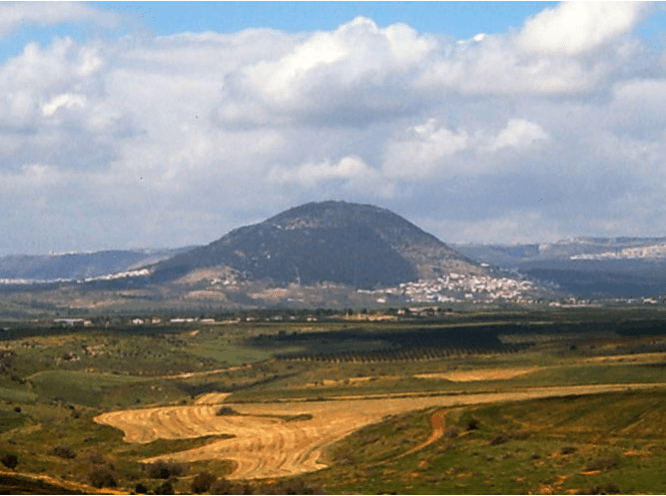
Licensed under CC BY-SA 3.0.
https://commons.wikimedia.org/wiki/File:Mount_Tabor4.jpg
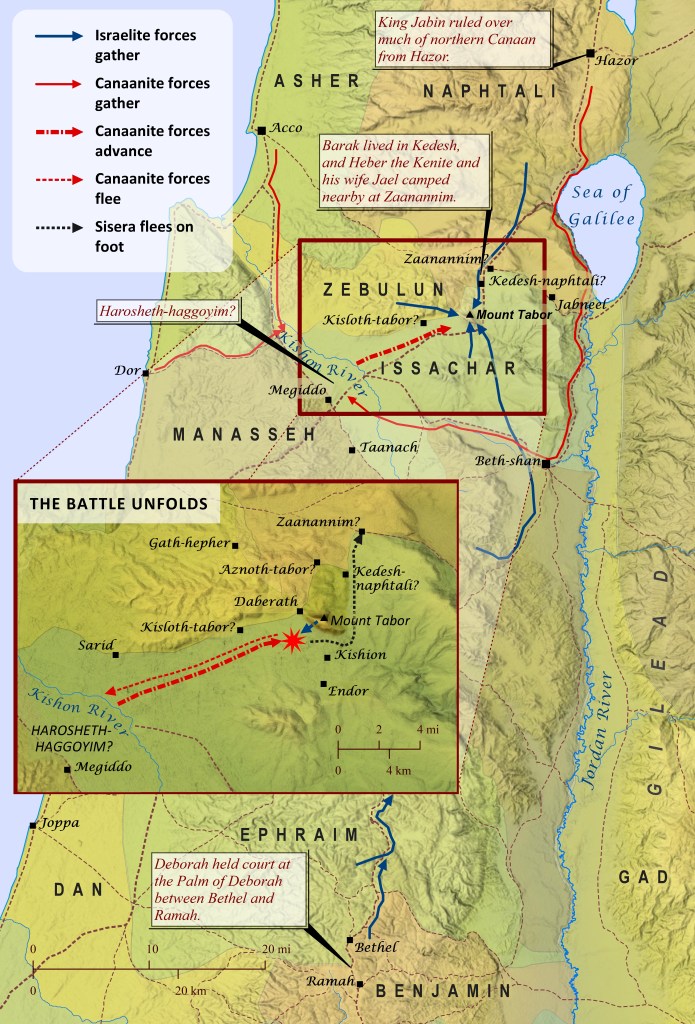
He lives very close to Jabin, the oppressor of the people. Mount Tabor was at the corner of the Jezreel Valley, and was one of the most important crossroads in the region.[55] Barak is a leader, but he is not portrayed as seeking God[56]—or as a judge, rather, God calls Barak—like he calls Moses. He has a strategy, and a promise—GOD will give the victory![57] It’s a sure thing! But Barak isn’t so sure: He hesitates. There’s a good amount of fear involved.[58] He weighs the odds—and doesn’t want to endanger himself without a guarantee.[59]
Barak said to her, “If you go with me, I will go; but if you don’t go with me, I won’t go.” 9 “Certainly I will go with you,” said Deborah. “But because of the course you are taking, the honor will not be yours, for the Lord will deliver Sisera into the hands of a woman.” So Deborah went with Barak to Kedesh. 10 There Barak summoned Zebulun and Naphtali, and ten thousand men went up under his command. Deborah also went up with him. Judges 4:8-10
Barak has good reason to be insecure—Jabin has nine hundred chariots![60] And only the tribes of Zebulun and Naphtali are to be summoned to battle—where in the stories before, ALL the ‘sons of Israel’ have joined in.[61] This is a little different story than the one of Othniel, or even Ehud. And Barak’s response is not ranked up there, either! He is reluctant, even cowardly, in his request for Deborah to go with him.[62] Barak ‘summons’ the tribes, or ‘cries out’ to them in verse 10—He cries out—not to GOD, but to the men.[63] and only 10,000 will appear. Barak wants Deborah the prophet to go with him—he wants the physical reassurance of God’s presence, but he doesn’t ask God directly—he wants HER to do it! If he IS recognizing Deborah’s prophetic authority—taking her into battle is a bit of a superstitious attempt to manipulate Yahweh’s presence with him. But this seems more like a challenge—he is unwilling to recognize her message as a word from God unless she risks herself to defend it.[64] Deborah’s response is a demonstration of trust in God—she will go! But it comes at a cost to his honor[65]: God will give Sisera into the hands of a woman. At this point, the reader may think that the woman will be Deborah. Not so fast! We’ll learn more in a moment.
Now Heber the Kenite had left the other Kenites, the descendants of Hobab, Moses’ brother-in-law, and pitched his tent by the great tree in Zaanannim near Kedesh. 12 When they told Sisera that Barak son of Abinoam had gone up to Mount Tabor, 13 Sisera summoned from Harosheth Haggoyim to the Kishon River all his men and his nine hundred chariots fitted with iron. Judges 4:11-13
Heber is a Kenite, possibly connected to the Kenizzites, like Caleb, in chapter one. The Kenites were said to be a nomadic or semi-nomadic tribe of coppersmiths,[66] craftsmen of weapons.[67] Possible descendants of Cain, and also connected to the father-in-law of Moses.[68] They were a non-Israelite community,[69] or had separated themselves from their Israelite connections.[70] Heber may have found work as a smith in Jabin’s army. With all the iron chariots, it was probably a profitable venture![71] And Heber has now parked his tents close to where BARAK’S troops were located, which invites some tension into our story.[72] But both Heber and Sisera are tools in Yahweh’s hand.[73]
14 Then Deborah said to Barak, “Go! This is the day the Lord has given Sisera into your hands. Has not the Lord gone ahead of you?” So Barak went down Mount Tabor, with ten thousand men following him. 15 At Barak’s advance, the Lord routed Sisera and all his chariots and army by the sword, and Sisera got down from his chariot and fled on foot. 16 Barak pursued the chariots and army as far as Harosheth Haggoyim, and all Sisera’s troops fell by the sword; not a man was left. Judges 4:14-16
Deborah does not lead the army herself. But she assumes the role of commander in chief.[74] She instructs Barak to do what God has commanded. “Go!” Barak obeys. God’s ‘lightning weapon’ goes forth.[75] And the battle is won!
God delivers His people through unlikely servants
But it is GOD who does the action here—This is a holy war.[76] The LORD routed Sisera and his army! HE is the divine warrior.[77] How did he do it? Chapter five’s poem gives us a clue:
Kishon was usually a dried-up creek bed. But in the middle of the dry season, a storm came through the area. The rain turned the ground to mud, and the chariots bogged down.[78] The Canaanite god, Ba’al, the storm God, was thought to live in the North, But it is Yahweh, not Ba’al, who reigns supreme![79] (Incidentally, the brook of Kishon is also where Elijah kills the prophets of Baal much later.[80]) The poem goes on to highlight some of the scenes of battle—and again, the listeners would be entranced with the language in Hebrew: The hooves of the horses hammered—thundered, and the galloping, the galloping of the stallions! All the word choices were intentionally designed to make the listener experience the ferocity and chaos of the battle, hearing the sounds in their head. It’s a cosmic battle![81] But the battle…is not actually the high point of the story.[82] It’s not about who wins the battle, but who gets the credit?[83] In comes the mystery woman we have been waiting for. The final scene is an ironic twist to the story:[84]
17 Sisera, meanwhile, fled on foot to the tent of Jael, the wife of Heber the Kenite, because there was an alliance between Jabin king of Hazor and the family of Heber the Kenite. 18 Jael went out to meet Sisera and said to him, “Come, my lord, come right in. Don’t be afraid.” So he entered her tent, and she covered him with a blanket. 19 “I’m thirsty,” he said. “Please give me some water.” She opened a skin of milk, gave him a drink, and covered him up. 20 “Stand in the doorway of the tent,” he told her. “If someone comes by and asks you, ‘Is anyone in there?’ say ‘No.’” Judges 4:17-20
When a warrior approaches a tent in wartime, we NORMALLY fear for the woman—bracing ourselves for a violent rape.[85] But Jael controls the events in this scene![86] She acts like an independent woman.[87] Now, women had their own tents—separate from their husbands,[88] but it was usually the HUSBAND who offered hospitality.[89] Sisera should have gone to Heber’s tent. His actions dishonor Heber,[90] and place him at risk of an adultery charge. But Sisera also is on the run, and he’s trying to hide.[91] And Heber is nowhere in sight. Jael goes out to meet Sisera, she invites him in…In Hebrew, she uses the word ‘sur’—turn aside! which is a close alliteration with his name—Sisera, sur! Sur![92] (And by the way, alliteration—is all through these two chapters…because the listeners would HEAR the story first and foremost, not read it!)[93] Sisera comes in, and Jael covers him with a rug…which could be a thick sheep or goat skin—enough to muffle any noise.[94] But she is in a predicament. Her husband is not there. Her husband has an alliance with the Canaanites, but …she could face consequences from the Israelites by harboring him.[95] She has to think fast. She invites Sisera in—possibly to the more private area of her tent.[96] There is an element of mothering here—she almost turns Sisera into a little child, tucking him into bed for the night and hiding him from any monsters who might threaten him.[97] She gives him protection, rest, and milk…[98] which was known to induce sleep. She dopes him and dupes him![99]
Sisera on the other hand, lies in the bed and acts like a general. First, he asks her for a drink. That is improper etiquette. He has already asked for hospitality and received it and should not ask for something more. Doing so…implies that his needs have not been met, and that is insulting. When Jael gives him milk, it may be a one-upmanship of that ancient hospitality—instead of the basics, she gives him much more. He also orders her to stand guard and to lie to anyone who comes by.[100] Again, he is questioning the intentions of the hostess to protect her guest.[101] He tells her to tell anyone else that no one is in the tent—and in the end, he will turn out to be a nobody.[102] He stopped being a man from the moment he entered the tent—he has no more chariots, no more army, and he gives himself up into the hands of a woman…as a vulnerable child.[103] She does not obey orders very well.[104]
But Jael, Heber’s wife, picked up a tent peg and a hammer and went quietly to him while he lay fast asleep, exhausted. She drove the peg through his temple into the ground, and he died. Judges 1:21
Jael takes the only weapon she has available—a tent peg and hammer. Jael DRIVES the peg—that verb is found only three times in the Bible—the other two were in Joshua and Judges…in the story of Achsah and Caleb—do you remember that one? The word was used to describe Achsah’s decisive “dismounting” from her donkey as she prepares to request springs of water from her father, Caleb. Here, it describes the tent peg that goes into the ground. Two different scenes, but in each of them, this action brings victory.[105] It even parallels with our story last week: what Ehud’s dagger had been to Eglon, Jael’s tent peg was to Sisera.[106] Here, the female penetrates the male with her weapon,[107] and his life drains from him.[108] Jael’s actions are similar to Shamgar with his oxgoad.[109] They are as commendable as those of Ehud.[110] In fact, she outdoes him![111]
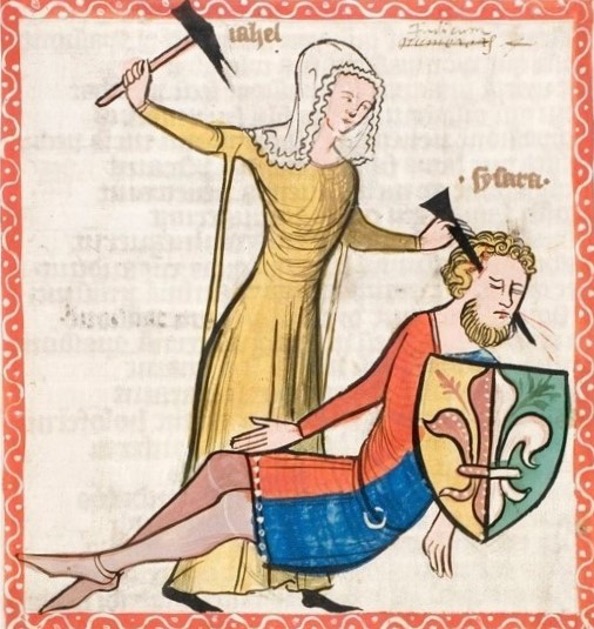
If people say, “The Bible is all about men—there are no strong women in it.” Well, I guess this speaks for itself. So, is Jael a heroine or a villain? It depends on your point of view. Barak is shamed and is robbed of the glory of victory. As far as Heber, Jael’s husband, goes, she has not been very supportive, she offered hospitality on his behalf, violated ancient hospitality rules, and lulled their guest into a place where she could murder him! It is the ultimate treachery![112] But Jael breaks with convention and with her family’s loyalties to come to the aid of YAHWEH’S people![113] Her husband has an alliance to Canaan, but she breaks those commitments—to save Israel.[114] Like Rahab, Jael is an outsider—living in her own house—when political events are thrust upon them. Different people enter their domain—2 spies in one story, and a general in the other—and they have to decide where their loyalties lay.[115] Tivka Frymer-Kensy writes: Both Rahab and Jael may violate ancient rules of ethics and hospitality[116], but they also abandon the Canaanites and act for God and Israel.[117]
And, interestingly, there are intertextual connections with Jael and other women of the Bible: Marg Mowczko makes interesting connections[118] withGenesis 3:15, where God says, “I will put hostility between you and the woman, and between your offspring and her offspring.[119] Her offspring will strike your head, and you will strike his heel.”
And she also connects Jael with Mary, the Mother of Jesus…where in Luke 1 it says, “Blessed are you among women!” In this story about Jael it is said, “Most blessed of women be Jael!” Deborah and Barak sing a victory song—and Mary sings the Magnificat! Both Jael and Mary were chosen by God to defeat God’s Enemy and to establish justice and righteousness. Jael definitely took the more violent path! In an ancient society of war, she murders her invited guest,[120] while Mary defeated the enemy through peaceful, though risky, obedience. Marg writes: Jael defies the …stereotypes of gentle mother and passive victim, and inverts them. She was treacherous and violent with Sisera, yet she is praised. More than that, God used her. The Lord DID hand Sisera over to a woman, just as Deborah prophesied.[121]
God delivers His people through unlikely servants
The song in Judges 5 is attributed to Deborah.[122] Even her name ‘Deborah’ is linked to the Hebrew word “dibberah,” meaning “she spoke.” Her Weapon is the Word—and her interpretation of the battle is a prophetic word,[123] in keeping with her office. In Judges 5, the song, this scene with Jael is written about this way:
“Most blessed of women be Jael, the wife of Heber the Kenite, most blessed of tent-dwelling women. He asked for water, and she gave him milk; in a bowl fit for nobles she brought him curdled milk. 26 Her hand reached for the tent peg, her right hand for the workman’s hammer. She struck Sisera, she crushed his head, she shattered and pierced his temple. 27 At her feet he sank, he fell; there he lay. At her feet he sank, he fell; where he sank, there he fell—dead. Judges 5:24 -27
In the story, in Judges 4, Sisera was pictured as sleeping. In the song, he is erect and sinks to his knees and falls as she stands over him. Poetic license. Tikva Frymer-Kensky notes again that it is a savage grotesquery of childbirth-rather than being delivered to life SISERA is delivered to death and Israel is delivered to life![124] In Exodus, the female saviors nurture and preserve life—here, Jael kills. And yet, she too, becomes one of the mothers of Israel.[125] And so, Sisera has been conquered.
22 Just then Barak came by in pursuit of Sisera, and Jael went out to meet him. “Come,” she said, “I will show you the man you’re looking for.” So he went in with her, and there lay Sisera with the tent peg through his temple—dead. Judges 4:22
Just like Jael invited Sisera in, she now stands at the door inviting Barak to enter.[126] He doesn’t die, but he does end up being emasculated.[127] He expects to finish off Sisera, but instead, he is already dead. Sisera was deprived of his life, and Barak is deprived of the honor of taking him out.[128] In the story, the initiative and power of female participants is deliberately highlighted, and the male characters are humiliated. In the song, it minimizes the role of Barak, but it doesn’t humiliate him.[129] Even so, Daniel Block notes: Just like the guards after king Eglon was discovered, Barak is made to look like a buffoon.[130] This story highlights the most unexpected of heroines.[131] But there’s another woman in the story: Sisera’s mom. We get to see her point of view in the song in chapter 5.
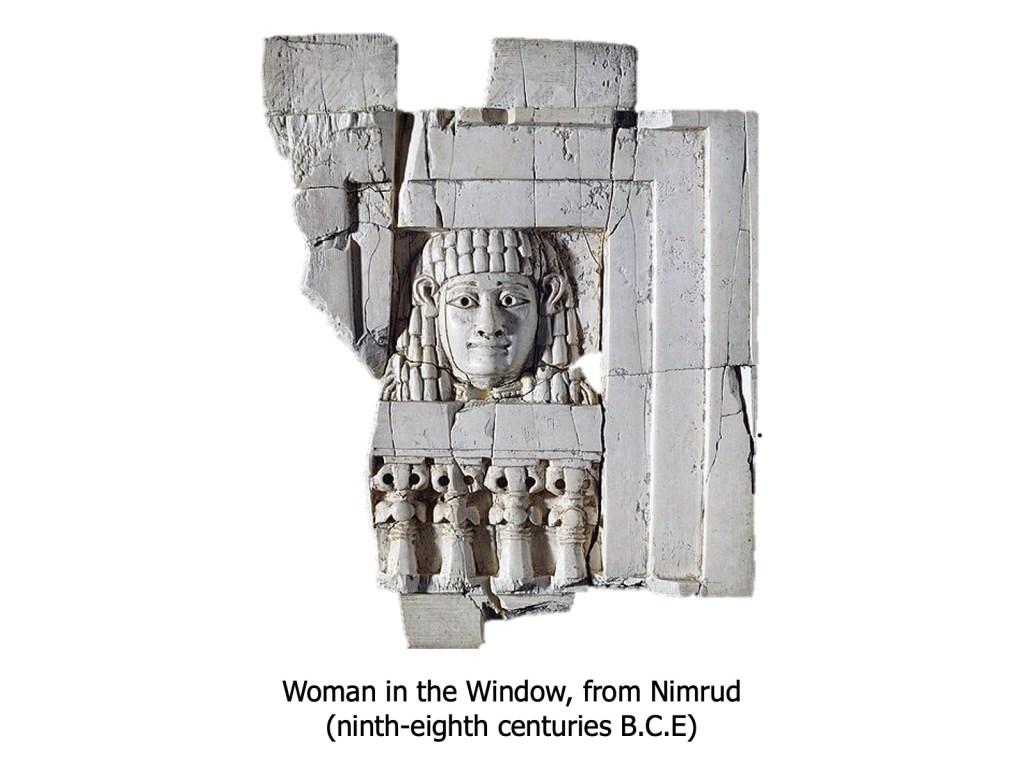
Through the window peered Sisera’s mother; behind the lattice she cried out, ‘Why is his chariot so long in coming? Why is the clatter of his chariots delayed?’ 29 The wisest of her ladies answer her; indeed, she keeps saying to herself, 30 ‘Are they not finding and dividing the spoils: a woman or two for each man, colorful garments as plunder for Sisera, colorful garments embroidered, highly embroidered garments for my neck— all this as plunder?’ Judges 5:28-30
Sisera’s mom, like all women did back then, is gazing out the window, waiting and wondering while her son is at war. Should we feel sorry for her? Yes, it’s another perspective in the story[133], but if her son DID come home, he would be coming home with the spoils of war, taken from the Israelites! And even Sisera’s mom envisions him coming back with women as loot—a wench, two wenches… This woman is not concerned about other women—they are prizes of war![134] They are wombs to be possessed![135]
Deborah..is portrayed as a “mother in Israel” —someone who was caring, respected and selfless, while Sisera’s mother is depicted as a selfish woman who imagines the riches he will bring home, and the women who will be violated in the aftermath of war.[136] In the perfect twist, instead of going home to his birth mother, Sisera comes to the home of his death mother, Jael. His mother thinks of women only as booty—2 girls for each man—instead—two girls have finished him off.[137]
Deborah and Jael both play motherly roles in these texts, but in ways that extend beyond traditional childbearing and childrearing, speaking and acting for God in order to impact areas usually controlled by men. They play a role at the national level![138] And they prepare the way for other women who God will use to usher in his kingdom.[139]
We’ll close the story with the last verses from chapter 4 and from chapter 5: 23 On that day God subdued Jabin king of Canaan before the Israelites. 24 And the hand of the Israelites pressed harder and harder against Jabin king of Canaan until they destroyed him. Judges 4:23-24 “So may all your enemies perish, Lord! But may all who love you be like the sun when it rises in its strength.” Then the land had peace forty years. Judges 5:31
The love for God mentioned here should be more than just an emotional response to the victory…It involves obeying, fearing, walking, serving, and observing…something that the Israelites have really failed to do in these chapters.[140] Judges 4 and 5 tells the story and the song of a battle scene.
God delivers His people through unlikely servants
Deborah shows us that God raises up women and men alike when they are willing to listen and obey. Barak’s hesitation highlights human weakness, and yet God still works through imperfect obedience. Jael, an outsider of Israel, became the instrument of God’s victory with a simple tent peg. God likes to upset our expectations and our prejudices.[141] When God calls, we must respond—even it seems to run counter to convention.[142] Deborah and Jael get the highest accolades…Barak plays second fiddle to Deborah, and Sisera falls to Jael,[143] and God’s people are called to sing praises to Yahweh, who triumphs over their enemies![144] The glory ultimately goes to HIM!
Is there even a singular hero in this story? There are lots of duos: Jabin and Sisera, Deborah and Barak,[145] or even Sisera and Jael, or Jael and Barak. But “In the end, this is not really a story about any of them. This is a story about GOD, who is the real hero.”[146] HIS power is greater than human strength or military might. GOD’S power is what secures victory!
God delivers His people through unlikely servants so that He alone receives the glory!
These stories in Judges remind us that even though we may live in times of darkness, in the end, Yahweh wins.[147] God hears the cries of his people, and he raises up people for battle, too, even if they seem weak and inconsequential by the world’s standards. Those who participate in the battle are not necessarily the strongest or smartest, but they do have a relationship with God—and they love him.[148] In God’s work, there are no spectators—He calls His people to step up with faith, courage, and willingness. God’s kingdom advances through participation. We win life’s battles not by our own strategies but by trusting in the Lord’s strength. We can have the confidence to put ourselves in his service whatever the odds or the cost.[149] In Judges 4-5, both story and song offer praise to God, something very rare in the book of Judges! The song is also reminiscent of the song of Moses and Miriam in Exodus 14-15, AND the Song of Mary in Luke 1…an expression of praise to God, who works on behalf of his people to see his kingdom realized on earth as it is in heaven.[150]
PRAYER: Lord God, You are the One who fights for Your people. When the odds are against us, when the chariots of this world seem too strong, remind us that the battle belongs to You. We confess the pull of lust, greed, pride and dishonesty. The same cycles that pulled the people of Israel away from you are on the doorsteps of our hearts, too. The fear of failure, fear of rejection, and fear of stepping into Your calling is very real. Too often we are tempted to stay passive rather than engage Your mission in this world. Heavenly Father, forgive us when we shrink back, when we sit among the “sheepfolds” instead of joining the battle. Stir our hearts to rise up and serve You willingly. Thank You for using Deborah, Barak, and even Jael to show us that You work through ordinary, unlikely servants. Holy Spirit, teach us to step forward in faith, even when we feel hesitant. Raise us up, Lord—give us the courage to join in your work of justice—as we work out our relationships, as we encounter abuse, as we face the pressure to compromise to the world’s standards, and confronting conflict with grace and truth. May all the victories in our lives, great and small, point back to Your power and Your glory. And like Deborah’s song, may our lips always sing of Your deliverance. We pray this in the strong name of Jesus, the One who gives us victory! Amen.
Bibliography
- Boda, Mark J., Mary L. Conway, Daniel I. Block, general editor; Judges, Exegetical Commentary on the Old Testament, Grand Rapids: Zondervan Academic, 2022.
- Butler, Trent C., Word Biblical Commentary: Judges, Grand Rapids: Zondervan, 2009.
- Frolov, Serge, Judges, Grand Rapids: William B. Eerdmans Publishing Company, 2013.
- Goldingay, John, Joshua, Judges & Ruth for Everyone, Louisville: Westminster John Knox Press, 2011.
- Inrig, Gary, Hearts of Iron, Feet of Clay, Chicago: Moody Bible Institute, 1979.
- Keller, Timothy; Judges for You; The Good Book Company, 2013.
- Soggin, J. Alberto, Judges, Philadelphia: The Westminster Press, 1981.
- Smit, Laura A. and Stephen E. Fowl, Brazos Theological Commentary on the Bible: Judges and Ruth, Grand Rapids: Brazos Press, 2018.
- Matthews, Victor H., Judges & Ruth, Cambridge: Cambridge University Press, 2004.
- McCann, J. Clinton, Judges, Louisville: John Knox Press, 2002.
Articles
- Backfish, Elizabeth H. P., “The function of alliteration in the prosaic and poetic accounts of the Deborah cycle”, Journal for the Study of the Old Testament, 44 no 4 Jun 2020, p551-562.
- Bae, Hee-Sook, “Reconsidering Barak’s Response In Judges 4”, Biblica, 98 no 4 2017, 504-519.
- Blessing, Carol, Judge, Prophet, Mother: Learning from Deborah, Daughters of Sarah, 21 no 1 Wint 1995, 34-37.
- Fewell, Danna Nolan and David M. Gunn, “Controlling Perspectives: Women, Men, and the Authority of Violence in Judges 4 and 5,” Journal of the American Academy of Religion 58, no.3 (Fall 1990).
- Goldingay, John, “Motherhood, Machismo, and the Purpose of Yahweh in Judges 4-5”, Anvil, 12 no 1 1995, 21-33.
- Graybill, Rhiannon, “Day of the Woman: Judges 4-5 as Slasher and Rape Revenge”, Journal of Religion and Popular Culture, 30 no 3 Fall 2018, 193-205.
- Haddox, Susan E., “Gendering violence and violating gender in Judges 4-5,” Conversations with the Biblical World, 33 2013, 67-81.
- Järlemyr, Sara, “A Tale of Cross-Dressers, Mothers, and Murderers: Gender and Power in Judges 4 and 5”, Svensk exegetisk årsbok, 81 2016, 49-62.
- Jenei, Péter, “Strategies of Stranger Inclusion in the Narrative Traditions of Joshua–Judges: The Cases of Rahab’s household, the Kenites and the Gibeonites”, Old Testament Essays (New Series), 32 no 1 2019, 127-154.
- Mayfield, Tyler D., “The accounts of Deborah (Judges 4-5) in recent research’’, Currents in Biblical Research, 7 no 3 Jun 2009, 306-335.
- Mondriaan, Marlene E., “Who were the Kenites?”, Old Testament Essays (New Series), 24 no 2 2011, 414-430.
- Sterman, Judy Taubes, “Themes in the Deboarh narrative (Judges 4-5)”, Jewish Bible Quarterly, 39 no 1 Jan-Mar 2011, 15-24.
- van der Merwe, Natashia C., “An Alternative Ideology Relating to Difference as Hidden Polemic in the Book of Judges: Judges 4-5 as an Illustration”, Old Testament Essays (New Series), 22 no 3 2009, 677-694.
- Vermeulen, Karolien, “Hands, Heads, and Feet: Body Parts as Poetic Device in Judges 4-5”, Journal of Biblical Literature, 136 no 4 2017, 801-819.
- Wright, Jacob L., “Deborah’s war memorial: the composition of Judges 4-5 and the politics of war commemoration,” Zeitschrift für die alttestamentliche Wissenschaft, 123 no 4 2011, 516-534.
- Zucker, David J., Reiss, Moshe, “Subverting sexuality: manly women; womanly men in Judges 4–5, Biblical Theology Bulletin, 45 no 1 Feb 2015, 32-37.
Websites:
https://armstronginstitute.org/236-sisera-v-deborah-evidence-for-the-biblical-account
Going Deeper Questions
- What is the meaning of your name, or what “nicknames” have people given you, and do they reveal anything about you?
- What’s a time you felt unlikely or unqualified, yet were called to step up?
Judges 4 is a story account, and Judges 5 is a song, a poem, a ballad. We’ll cover all of chapter four and some of chapter 5 side by side in this study.
Read Judges 4:1–5, and Judges 5:6-7
Again the Israelites did evil in the eyes of the Lord, now that Ehud was dead. 2 So the Lord sold them into the hands of Jabin king of Canaan, who reigned in Hazor. Sisera, the commander of his army, was based in Harosheth Haggoyim. 3 Because he had nine hundred chariots fitted with iron and had cruelly oppressed the Israelites for twenty years, they cried to the Lord for help. Now Deborah, a prophet, the wife of Lappidoth, was leading Israel at that time. 5 She held court under the Palm of Deborah between Ramah and Bethel in the hill country of Ephraim, and the Israelites went up to her to have their disputes decided. “In the days of Shamgar son of Anath, in the days of Jael, the highways were abandoned; travelers took to winding paths. 7 Villagers in Israel would not fight; they held back until I, Deborah, arose, until I arose, a mother in Israel.”
Discussion
- What do you notice about the cycle Israel falls into again (vv. 1–3)?
- Deborah’s name comes from the Hebrew word which means ‘bee.’ In Jewish tradition, the bee symbolizes diligence, industriousness, and the sweetness of honey, but also can be seen as a reminder to stay humble. The root of Deborah is close to the root word that means “to speak”, or “word”, which also connects to her role as prophet. Psalm 19:10 states, “How sweet are your words to my taste, sweeter than honey, even than honey from the honeycomb”.
- Deborah was a prophet before the battle episode in these chapters. She is in the company of other women with this title: Miriam (Exodus 15:20), Huldah (2 Kings 22:14), Noadiah (Nehemiah 6:14), Isaiah’s wife (Isaiah 8:3), and Anna (Luke 2:36). Why do you think God chose Deborah, a prophet and a woman, to lead here?
- What strikes you about Deborah being called a “mother in Israel”?
Read Judges 4:6-10
6 She sent for Barak son of Abinoam from Kedesh in Naphtali and said to him, “The Lord, the God of Israel, commands you: ‘Go, take with you ten thousand men of Naphtali and Zebulun and lead them up to Mount Tabor. 7 I will lead Sisera, the commander of Jabin’s army, with his chariots and his troops to the Kishon River and give him into your hands.’” Barak said to her, “If you go with me, I will go; but if you don’t go with me, I won’t go.” 9 “Certainly I will go with you,” said Deborah. “But because of the course you are taking, the honor will not be yours, for the Lord will deliver Sisera into the hands of a woman.” So Deborah went with Barak to Kedesh. 10 There Barak summoned Zebulun and Naphtali, and ten thousand men went up under his command. Deborah also went up with him.
- What might Barak be hesitant to go, even with God’s clear promise? (See 4:3)
- What do Deborah’s actions teach us about leadership and listening to God?
- Have you ever needed someone to “go with you” in faith?
- Some tribes fought, others stayed home (v10). What does this say about the fracturing in Israel at this time?
Read Judges 4:11–16 and Judges 5:4-5; 21-22
Now Heber the Kenite had left the other Kenites, the descendants of Hobab, Moses’ brother-in-law, and pitched his tent by the great tree in Zaanannim near Kedesh. 12 When they told Sisera that Barak son of Abinoam had gone up to Mount Tabor, 13 Sisera summoned from Harosheth Haggoyim to the Kishon River all his men and his nine hundred chariots fitted with iron. 14 Then Deborah said to Barak, “Go! This is the day the Lord has given Sisera into your hands. Has not the Lord gone ahead of you?” So Barak went down Mount Tabor, with ten thousand men following him. 15 At Barak’s advance, the Lord routed Sisera and all his chariots and army by the sword, and Sisera got down from his chariot and fled on foot. 16 Barak pursued the chariots and army as far as Harosheth Haggoyim, and all Sisera’s troops fell by the sword; not a man was left. When you, Lord, went out from Seir, when you marched from the land of Edom, the earth shook, the heavens poured, the clouds poured down water. The mountains quaked before the Lord, the One of Sinai, before the Lord, the God of Israel…
The river Kishon swept them away, the age-old river, the river Kishon. March on, my soul; be strong! 22 Then thundered the horses’ hooves—galloping, galloping go his mighty steeds.
Discussion
- How does do these verses explain how God defeated Sisera’s army?
- Why is it significant that Baal was supposed to be the storm-god, yet Yahweh sent the storm?
- What does Deborah’s bold command in v. 14 show us about trusting God?
- What do we learn about God’s role in battle (v. 15) and how he participates with people?
- What risks did Jael take, and what does that say about courage?
- How might God be calling you to act with unexpected courage today?
Read Judges 4:17-22 and Judges 5:24-27
17 Sisera, meanwhile, fled on foot to the tent of Jael, the wife of Heber the Kenite, because there was an alliance between Jabin king of Hazor and the family of Heber the Kenite. 18 Jael went out to meet Sisera and said to him, “Come, my lord, come right in. Don’t be afraid.” So he entered her tent, and she covered him with a blanket. 19 “I’m thirsty,” he said. “Please give me some water.” She opened a skin of milk, gave him a drink, and covered him up. 20 “Stand in the doorway of the tent,” he told her. “If someone comes by and asks you, ‘Is anyone in there?’ say ‘No.’” But Jael, Heber’s wife, picked up a tent peg and a hammer and went quietly to him while he lay fast asleep, exhausted. She drove the peg through his temple into the ground, and he died. 22 Just then Barak came by in pursuit of Sisera, and Jael went out to meet him. “Come,” she said, “I will show you the man you’re looking for.” So he went in with her, and there lay Sisera with the tent peg through his temple—dead.
24 “Most blessed of women be Jael, the wife of Heber the Kenite, most blessed of tent-dwelling women. 25 He asked for water, and she gave him milk; in a bowl fit for nobles she brought him curdled milk. 26 Her hand reached for the tent peg, her right hand for the workman’s hammer. She struck Sisera, she crushed his head, she shattered and pierced his temple. 27 At her feet he sank, he fell; there he lay. At her feet he sank, he fell; where he sank, there he fell—dead.
Discussion
- How is Jael’s action both shocking and courageous?
- Leaders note: What Ehud’s dagger had been to Eglon, Jael’s tent peg was to Sisera. Jael’s actions are similar to Shamgar with his oxgoad, they are as commendable as those of Ehud.
- Jael is called “most blessed of women.” What do you think about that description?
- Leaders Note: “Blessed are you among women” is what Elizabeth exclaims to Mary when she comes to visit in Luke 1:42.
- Her actions are reminiscent of Genesis 3:15, “I will put hostility between you and the woman, and between your offspring and her offspring.Her offspring will strike your head, and you will strike his heel.”
- Why do you think the victory came through a woman rather than Barak?
- Jael was not an Israelite. She is an “outsider.” What does her boldness teach us about God using unexpected people?
Leaders Note: Like RAHAB, Jael is an outsider, and may violate ancient rules of ethics and hospitality, but they also both abandon the Canaanites and act for God and Israel. living in her own house—when political events are thrust upon them.
- What emotions do you imagine Barak felt when Jael showed him Sisera already dead? Relief? Frustration? Regret? Vindication? Why?
- In what ways might Barak’s partial obedience (needing Deborah to go with him) have shaped the outcome of who received the honor? How does that speak to us about trust in God’s Word?
Read Judges 5:28–30 — Sisera’s Mother
28 “Through the window peered Sisera’s mother; behind the lattice she cried out,
‘Why is his chariot so long in coming? Why is the clatter of his chariots delayed?’
29 The wisest of her ladies answer her; indeed, she keeps saying to herself, 30 ‘Are they not finding and dividing the spoils: a woman or two for each man, colorful garments as plunder for Sisera, colorful garments embroidered, highly embroidered garments for my neck—all this as plunder?’
Discussion
- Why do you think the song of Deborah includes this disturbing glimpse into Sisera’s household? What stands out to you about how Deborah portrays Sisera’s mother?
- What emotions do you think Sisera’s mother is experiencing?
- How do the imagined words of Sisera’s mother and her ladies reveal their worldview and values? What modern parallels can you think of where people celebrate or excuse things that God sees as wicked?
- How does Sisera’s mother’s view of women contrast with Deborah and Jael? (vs30)
- How does this scene deepen your understanding of the justice of God? Does it stir any tension in you between God’s mercy and God’s judgment?
Read Judges 4:23-24 and 5:31
23 On that day God subdued Jabin king of Canaan before the Israelites. 24 And the hand of the Israelites pressed harder and harder against Jabin king of Canaan until they destroyed him.
“So may all your enemies perish, Lord! But may all who love you be like the sun
when it rises in its strength.” Then the land had peace forty years.
Discussion
- What is the significance of the text saying “God subdued Jabin” rather than crediting Deborah, Barak, or Jael directly? How does this shape our view of human effort versus divine action?
- What does it mean for those who love God to be “like the sun when it rises in its strength”? How might this image inspire you in your faith and witness?
- Why do you think Deborah ends the song with the theme of peace (forty years of rest)? What does this suggest about the ultimate goal of God’s victories?
- Where do you long to see God bring both victory over evil and lasting peace in your life, your community, or the world?
- Why do you think Deborah and Barak responded to victory with a song rather than just a simple announcement of success? What does this show about the role of worship in remembering God’s work?
God delivers His people through unlikely servants so that He alone receives the glory!
- In the song, Deborah, Barak, Israel’s leaders, and even the stars and rivers participate in the song. What might that suggest about the scope of worship? Why are worship and thanksgiving important after God’s victory?
- How does singing or creative expression help us experience God differently than prose or straight teaching? How does praising God in community strengthen faith differently than private prayer or reading Scripture alone?
- Deborah’s song highlights both the victories of the faithful and the shame of those who stayed behind (5:16–17, 23). What does this tell us about worship as both encouragement and challenge?
- Love for God (5:31) is not just an emotional response to victory…it involves obeying, fearing, walking, serving, and observing…something that the Israelites have really failed to do in these chapters. What can we do to prevent the vicious cycles like they experienced from happening to us?
- What victories can you already thank God for today?
Prayer:
Lord, You are the One who fights for Your people. When the odds are against us, remind us that the battle belongs to You. Give us courage to step forward in faith, to trust You with our battles, and to give You all the glory when victory comes. Amen.
[1] Gary Inrig, Hearts of Iron, Feet of Clay, Chicago: Moody Bible Institute, 1979, 55.
[2] Boda, Mark J., Mary L. Conway, Daniel I. Block, general editor; Judges, Exegetical Commentary on the Old Testament, Grand Rapids: Zondervan Academic, 2022, 241.
[3] Goldingay, John, “Motherhood, Machismo, and the Purpose of Yahweh in Judges 4-5”, Anvil, 12 no 1 1995, 21-33, 23.
[4] Block, 185.
[5] Daniel Block, 177.
[6] Block, 213.
[7] Block, 216.
[8] Block, 215.
[9] Block, 182.
[10] John Goldingay, Motherhood, Machismo, and the Purpose of Yahweh in Judges 4-5, 21.
[11] Based on Block, 186.
[12] Frolov, Serge, Judges, Grand Rapids: William B. Eerdmans Publishing Company, 2013, 17.
[13] Boda, Conway, 242.
[14] Based on Block, 189.
[15] Butler, Trent C., Word Biblical Commentary: Judges, Grand Rapids: Zondervan, 2009, 88.
[16] Boda, Conway, 247.
[17] Butler, 84.
[18] Block, 189.
[19] Butler, 89.
[20] Block, 190.
[21] Inrig, 58.
[22] Boda, Conway, 248.
[23] Keller, Timothy; Judges for You; The Good Book Company, 2013, 56.
[24] Butler, 86, noting Schneider’s words.
[25] Inrig, 58.
[26] John Goldingay, “Motherhood, Machismo, and the Purpose of Yahweh in Judges 4-5”, Anvil, 12 no 1 1995, 21-33 23.
[27] Block, 192.
[28] Goldingay, John, Joshua, Judges & Ruth for Everyone, Louisville: Westminster John Knox Press, 2011, 100.
[29] Goldingay, article, 23.
[30] Block, 192.
[31] Goldingay, 101.
[32] Exodus 15:20
[33] 2 Kings 22:14
[34] Nehemiah 6:14
[35] Isaiah 8:3
[36] Luke 2:36
[37] Boda, Conway, 174.
[38] Block, 193.
[39] Block, 194.
[40] Boda, Conway, 255.
[41] Block, 195-196.
[42] Blessing, Carol, Judge, Prophet, Mother-Learning from Deborah, 34.
[43] Butler, 91.
[44] Tikva Frymer-Kensky, Reading the Women of the Bible: A New Interpretation of their stories, New York: Shocken Books, 2002, 46.
[45] Block, 193.
[46] Block, 226.
[47] 2 Kings 2:12; 6:21; 13:14.
[48] Boda, Conway, 279-280.
[49] Block, 246.
[50] Butler, 109.
[51] Butler, 93.
[52] Boda, Conway…the people of Israel went up to her for the purpose of judgment…decision, or prophetic word.
[53] Block, 198.
[54] Goldingay, Motherhood, 26.
[55] Block, 198-199.
[56] Butler, 95.
[57] Based on Block, 199.
[58] Bae, Hee-Sook, Reconsidering Barak’s Response In Judges 4, 509.
[59] Butler, 95.
[60] Tivka Frymer-Kensy, 48.
[61] Butler, 97.
[62] Boda, Conway, 256.
[63] Butler, 99.
[64] Smit, Fowl, 79.
[65] Boda, Conway, 257.
[66] Mondriaan, Marlene E., “Who were the Kenites?”, Old Testament Essays, 24 no 2 2011, 414-430, 416.
[67] Mondriaan, 417.
[68] Mondriaan, 419.
[69] Mondriaan, 421.
[70] Boda, Conway, 258.
[71] Smit, Fowl, 76.
[72] Boda, Conway, 258.
[73] Smit, Fowl, 76.
[74] Butler, 102.
[75] Smit, Fowl, 77.
[76] Butler, 102.
[77] Block, 204.
[78] Inrig, 66.
[79] Boda, Conway, 278.
[80] https://www.bibleodyssey.org/dictionary/kishon/
[81] Elizabeth Backfish, 560.
[82] Butler, Trent C., Word Biblical Commentary: Judges, Grand Rapids: Zondervan, 2009, 103.
[83] Butler, 109.
[84] Matthews, Victor H., Judges & Ruth, Cambridge: Cambridge University Press, 2004, 65.
[85] Tikva Frymer-Kensky, 56.
[86] Block, 206.
[87] Goldingay, Motherhood, 30.
[88] Butler, 104.
[89] Butler, 104, citing Brensinger.
[90] Matthews, 69.
[91] Matthews, 70.
[92] Backfish, Elizabeth H. P., “The function of alliteration in the prosaic and poetic accounts of the Deborah cycle”, 554.
[93] Elizabeth Backfish, 561.
[94] Block, 206.
[95] Matthews, 71.
[96] Matthews, 72, from J.A. Soggin, Judges, 1987, 67.
[97] Butler, 106, citing Olson.
[98] Butler, 106, citing Bal.
[99] Block, 207, footnote 263—Burney, Boling comments.
[100] Butler, 106.
[101] Matthews, 73.
[102] Block, 207.
[103] Danna Nolan Fewell and David M. Gunn, “Controlling Perspectives: Women, Men, and the Authority of Violence in Judges 4 and 5,” Journal of the American Academy of Religion 58, no.3 (Fall 1990), 393.
[104] Butler, 106.
[105] https://biblehub.com/hebrew/6795.htm
[106] Block, 208—same verb!
[107] Tikva Frymer-Kensky, 56.
[108] Boda, Conway, 270.
[109] Hee-Sook Bae, 515.
[110] Boda, Conway, 275.
[111] Contra Exum, “The Centre Cannot Hold,”, 416, who states, “Jael gives Sisera refuge and then kills him, reflectin and outdoing Ehud’s grotesque murder of Eglon.”
[112] Block, 209.
[113] Block, 245.
[114] Butler, 101.
[115] Tikva Frymer-Kensky, 57.
[116] Butler, 108.
[117] Tikva Frymer-Kensky, 57.
[118] https://margmowczko.com/jael-type-mary-jesus-cross/
[119] Also in Smit, Fowl, 74.
[120] https://margmowczko.com/jael-judges-4/
[121] https://margmowczko.com/jael-judges-5/#_ftn7
[122] Block, 214.
[123] Block, 215.
[124] Tikva Frymer-Kensky, 52.
[125] https://jwa.org/encyclopedia/article/jael-bible
[126] Boda, Conway, 275.
[127] Boda, Conway, 276.
[128] Butler, 107.
[129] Block, 183.
[130] Block, 208, footnote, 279.
[131] Butler, 85.
[132] https://commons.wikimedia.org/wiki/File:Carved_ivory_depicting_a_woman_at_a_window.jpg
[133] Smit,, Fowl, 85.
[134] Block, 242-243.
[135] Haddox, Susan E, Gendering Violence and Violating Gender, 72.
[136] Boda, Conway, 285.
[137] Tikva Frymer-Kensky, 52.
[138] Boda, Conway, 288.
[139] Boda, Conway, 289.
[140] Boda, Conway, 285.
[141] Carol Blessing, 36.
[142] Block, 246.
[143] Block, 217.
[144] Block, 218.
[145] Smit, Fowl, 85.
[146] Block, 210.
[147] Boda, Conway, 292.
[148] Boda, Conway, 292.
[149] Keller, 64.
[150] Boda, Conway, 290.
 Preach it Sista


