
Are there any lefties out there? Wait…wait! I’m not talking politics! I’m actually talking about Left-handed people! Most people use their right hands, to be sure—but according to experts, roughly 12% of the world is left-handed.[1] And a lefty is 23% more likely to be a MAN than a woman! Only 1% of the population is ambidextrous, having the ability to use either hand with the same degree of ease. I have a friend who is a lefty who plays bass guitar, and another who plays the drums. And yes, the instrument and the set-up have to change COMPLETELY for them to be able to play!
There is a town in West Virgina called—‘Left Hand’! It has a small population of 390 people. And it was named—not for left-handed people, but for the Creek that runs nearby, called, Lefthand Run Creek.[2]
When I went to Guatemala—I was told never to shake someone’s hand with my left hand. It was considered offensive, because the left hand is the hand used for hygiene purposes—after going to the bathroom. That is part of the humor of our story today.
Potty humor is always funny. Just ask my grandkids. The audience who heard this tale would have found it hilarious, too. It’s unexpected, inappropriate.[3] Laughter is a tool—that would help keep the people’s sanity in times of oppression. The satire, puns, and irony are found all throughout this story. Our unlikely hero in the book of Judges today was a lefty. When no one else was left—Ehud was the right man for the job
When I was a child, I was an avid reader—and an avid Bible reader to top it off! My parents were thrilled that I was reading the Bible—and who wouldn’t be? But the Bible is NOT a G-rated book, and I found myself enthralled by the stories that were racy, or horrific, or just plain strange! Today’s story in the book of Judges long ranks as one of my favorites, although I’m not sure why. When I was in my twenties, I taught a fourth grade Sunday school class. I used this story in the curriculum…I don’t remember what the point was, but I do remember the kid’s mouths hanging open after we went through it. I’m not sure what the parents thought when their kids came home that day, though. Are you ready for this one? Let’s go!
Now the sons of Israel again did evil in the sight of the LORD. So the LORD strengthened Eglon the king of Moab against Israel, because they had done evil in the sight of the LORD. 13 And he gathered to himself the sons of Ammon and Amalek; and he went and defeated Israel, and they possessed the city of the palm trees. 14 The sons of Israel served Eglon the king of Moab eighteen years. Judges 3:12-14
In Jewish tradition, Eglon’s grandfather is Balak——another previous king of Moab who is part of the story in Numbers 22-24. You may be more familiar with the strange incident with Balaam and his talking donkey. King Balak desperately wants to put a curse on Israel, but the Lord speaks through Balaam the prophet and gives a blessing to them instead.
This is part of the prophecy to Balak: A star shall come forth from Jacob, A scepter shall rise from Israel, And shall crush through the forehead of Moab, and tear down all the sons of Sheth. “Edom shall be a possession, Seir, its enemies, also will be a possession, While Israel performs valiantly. “One from Jacob shall have dominion, And will destroy the remnant from the city.” Numbers 22:17b-19
More about that later. Tuck it away for now. In the time of the judges, Eglon has gained strength, from God, the text says, to come against Israel, because they were doing evil. He goes to war and possesses the city of the palm trees.

The City of Palms—is none other than Jericho. You may remember that the city was destroyed in the time of Joshua. Well, the outside walls came down, but years later, they built over the ruins. Archaeologists have discovered layers and layers of buildings and amazing finds in the mounds around this area. There have been digs in the last 5 years that have uncovered a Moabite palace in Jericho, and a potsherd discovered just this year with letters matching the dialect used during the time of king Eglon.[4]

There was a middle building that was identified as a large residence or villa associated with Eglon of Moab in the 14th century BC, measuring about 14.5 meters by 12 meters and being the sole occupied area at the previously destroyed city.[5] One of these pictures is a model that was built of Eglon’s palace. Cool stuff!
But when the sons of Israel cried to the LORD, the LORD raised up a deliverer for them, Ehud the son of Gera, the Benjamite, a left-handed man. And the sons of Israel sent tribute BY him to Eglon the king of Moab. Judges 3:15
Ehud was a Benjamite. A Benjamite, literally means, “A son of the right hand.”[6] There’s some irony for you. Many Benjamites were said to be left-handed. Judges 20:16 says that there were 700 of them—trained to sling a stone at a hair and not miss. So, Ehud was probably not, as the translations have it, “a man left-handed.” Rather, he was one of a breed of men—schooled in the use of the left hand for war.[7] The Septuagint, the Greek translation of the Old Testament, says that Ehud was ambidextrous.[8] Being a southpaw was handy in battle. Left-handed troops were skilled in the clash of blade opposite blade—and shield opposite shield. A typical right hander would have problems attacking a walled city. Your right side would be exposed to the wall if you were charging the gate. If you are right-handed, you would hold a shield with the left arm, and it couldn’t be used to fend off stones, darts or anything else hurtled at you. Because a left-handed man would use a shield on the right arm, which would protect them from anything coming from the wall. Nice, huh? Ehud is a man who is able to fight with his left hand—a skill which will help him immensely in this story.
The people of Israel are under the rule of King Eglon. As part of their capitulation to his rule, they have to send a tribute to him regularly. Ehud—is part of the group sent as an emissary to the king…maybe to guard the treasure on the journey.[9] But Ehud has something up his sleeve that others may not be aware of.
16 Ehud made himself a sword[10]which had two edges, a cubit in length, and he bound it on his right thigh under his cloak. 17 He presented the tribute to Eglon king of Moab. Now Eglon was a very fat man. Judges 3:15b-17 **image of ancient Canaanite sword and dagger (https://armstronginstitute.org/247-ehud-v-eglon-evidence-for-the-biblical-account)
The narrator draws our attention—to Eglon and his body fat.[11] He is introduced, not in terms of royal respect, but with a description of his “fatness”.[12] This isn’t body shaming, or criticism. It is a statement meant to show the extent of the king’s wickedness.
Psalm 73 says: I was envious of the arrogant as I saw the prosperity of the wicked. For there are no pains in their death, and their body is fat. Psalm 73:3-4 NASB
You may remember the story of Daniel. He and his friends were in good health in captivity, and the text says: At the end of ten days their appearance seemed better and they were fatter than all the youths who had been eating the king’s choice food. Daniel 1:15 NASB
This king is fat—because he lives off the tribute paid to him by the Israelites. So, while there are MANY different depictions of the King, what we do know is that Eglon is very pleasingly plump. He is healthy. He is ‘meaty.’[13] Probably a little more than he should be. He’s big enough that it merits mention. The word ‘fat’ that is used in this story, is the same kind as the fat from an animal—that was to be used in the offerings that were presented to the Lord.[14] This is a bit of dark humor, making Eglon a perfect creature for sacrifice.[15] Even his name means, ‘calf-like’,[16] along with the term ‘round’.[17] Ehud may have brought an offering from the people to king Eglon, but instead, the king will become the offering. “Dear King Eglon, says Ehud, “I made a sword for you.” The words have a different meaning for the reader than they do for Eglon.[18]
18 It came about when he had finished presenting the tribute, that he sent away the people who had carried the tribute. 19 But he himself turned back from the idols which were at Gilgal, and said, “I have a secret message for you, O king.” And he said, “Keep silence.” And all who attended him left him. Judges 3:18-19
Ehud may have had a moment here. He had an idea, but maybe he wasn’t sure if he could execute his plan. After bringing the tribute—with a GROUP of people, however many it took to carry the loot, he dismisses them, and they all go on their way back from the palace. But when he gets to Gilgal, he turns back.
Joshua 4:19 places Gilgal on the eastern edge of Jericho.[19] It was either the camp Gilgal, or the place where the people had crossed the Jordan coming into the Promised land, where they had laid out stones as a memorial. It’s not far on the map, anyway you look at it.[20]
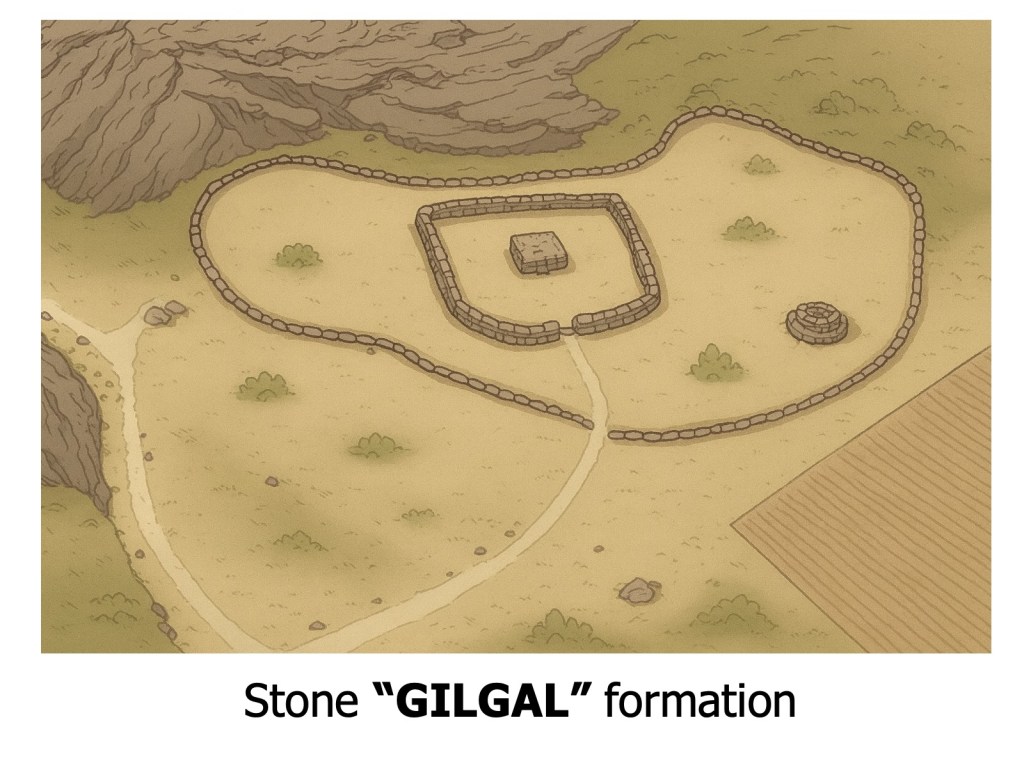
A Gilgal formation may have been Egyptian style, and some kind of assembly point for ritual celebrations. There were IDOLS set up there—graven images— one of the reasons the people are in trouble with God in the first place! Ehud gets to that point—to Gilgal, and turns around. Maybe he had a moment of resolve—to do the thing he had intended to do. Meanwhile, Eglon is sitting in his cool roof chamber. The Septuagint says it is Eglon’s upper summer chamber.[21] Summer homes were popular for kings, and Jericho was a nice vacation spot, and a great place to rule over the people of Israel.[22]
The King may have SEEN Ehud turn around, as he sat in his “cool room” on the roof. Maybe Ehud called out to the king that he had a secret message for him. Eglon must have felt that he was in little danger from one “unarmed” Israelite, and he let him back into the palace and met him—away from his security forces.[23] Ehud has already been checked for weapons. Besides, the king has got his security right outside the door. A secret message is a tantalizing thing, especially for a king in those parts.[24] A word from God? Eglon can’t pass it up.
Ehud is using a pun—a play on words.[25] Yes, he has a secret word or thing—he wants to show him—and it’s not a singing telegram—it’s a weapon hidden under his clothing. The sword he made has two edges. In the Hebrew—it has ‘two mouths’—a sly slam on the oversized king.[26] And…it is a tool with which to deliver the word of God.[27]
20 Ehud came to him while he was sitting alone in his cool roof chamber. And Ehud said, “I have a message from God for you.” And he arose from his seat. 21 Ehud stretched out his left hand, took the sword from his right thigh and thrust it into his belly. 22 The handle also went in after the blade, and the fat closed over the blade, for he did not draw the sword out of his belly; and the refuse came out. Judges 3:20-22
Eglon stands to receive the word of the Lord. Appropriate, is it not? Ehud’s dagger fits the belly perfectly.[28] The sword goes in, and the excrement comes out. And the smell? Well, it’s the worst. It’s also a statement of uncleanness.
Baruch Halpern, a professor of Jewish studies, and a leader of archaeological digs[29], says that the upper chamber, or ‘cool room’, should be translated as a ‘room over the beams’.
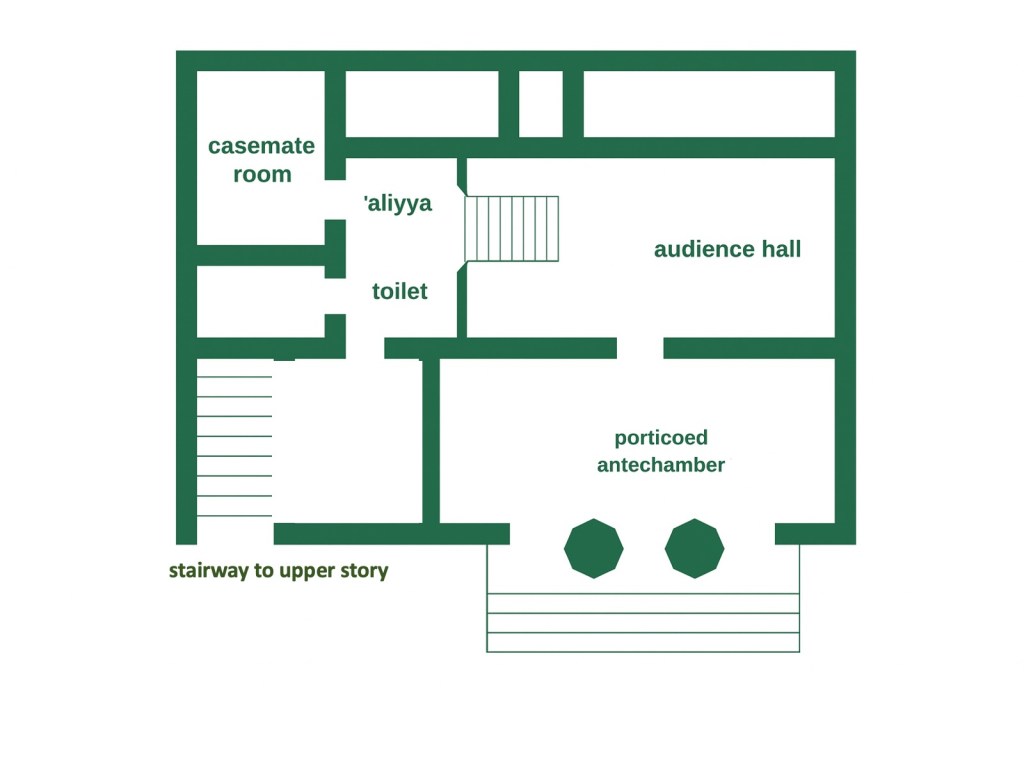
In a typical palace like this, there was a throne room or public audience hall, with a tall two-story ceiling. Then there was an upper chamber, at the level of the windows.[30]
This was the king’s private room, This room has a throne—and a ‘throne’—if you know what I mean. It is an inner toilet room. For the Israelites, toilets had to be ‘outside the camp’,[31] not in the place where God would walk. It’s another way that the Moabites were seen as unclean, and why they needed to be removed from the land.[32] Once in this small room, it was a simple matter to kill Eglon.[33] The king invites Ehud up to conduct his business—and ends up getting a hidden knife in the gut. But now there’s a problem. Ehud needs to get out of there without the guards realizing what has happened.
23 Then Ehud went out into the vestibule and shut the doors of the roof chamber behind him, and lockedthem.When he had gone out, his servants came and looked, and behold, the doors of the roof chamber were locked; and they said, “He is only relieving himself in the cool room.” 25 They waited until they became anxious; but behold, he did not open the doors of the roof chamber. Therefore they took the key and opened them, and behold, their master had fallen to the floor dead. Judges 3:23-25
If Ehud had tried to escape out the window, it would have aroused suspicions immediately. So, how did he do it? It’s the first locked-room murder mystery![34]
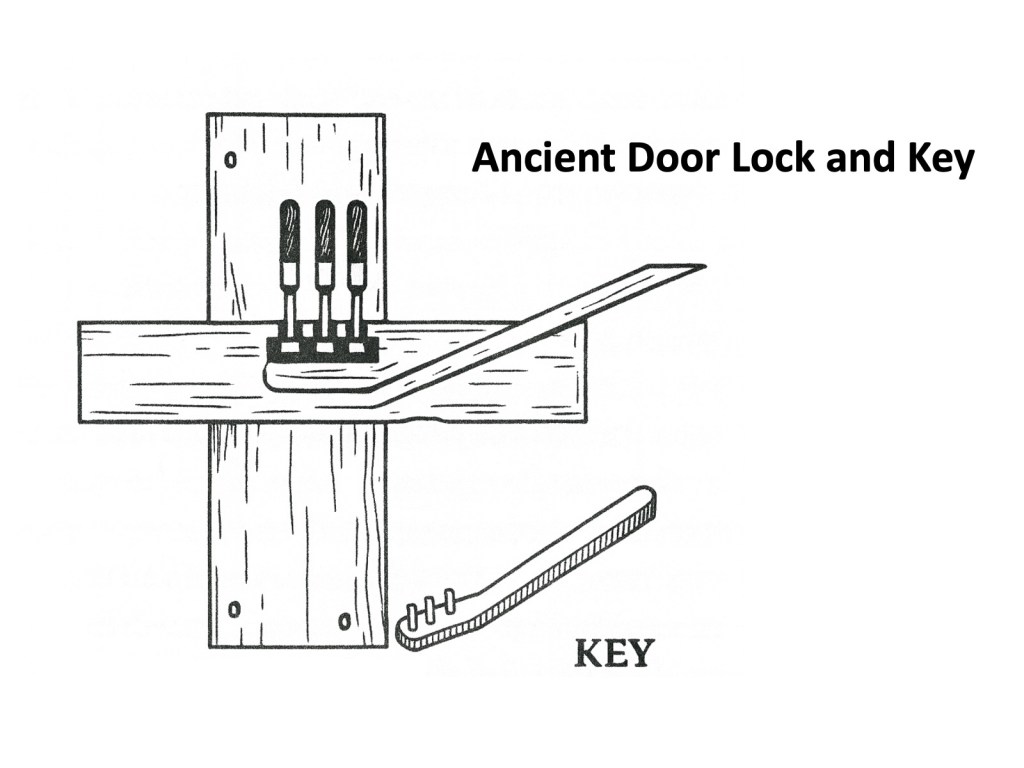
In antiquity, locks were placed on the inside of a chamber.[35] It’s possible—that by putting his hand through the keyhole, Ehud could have slid the bolt of the tumbler lock into place from outside[36] the door, but there was still a risk of someone catching him.
According to professor Halpern, there’s another way Ehud could have escaped. The upper chamber has a toilet…Second story indoor plumbing! The king’s ‘deposits’ fall through into a room below the beams. Janitors enter that area through a side door from the private audience hall in order to clean up after the king.[37] Ehud locks the door, and CAUTIOUSLY swings down through the floor to the level below. He comes from the janitor’s door into the public audience chamber and then goes through the portico, in full view of the guards, exiting through the palace courtyard and back home. After a time, the king does not appear. The guards investigate. But the door is locked. He must be doing his business! They can smell it! So they wait. And they wait. The text says, they wait until they become anxious.
Finally, the servants would have had to fetch the key to unlock the doors.[38] Keys were large and carried on the shoulder! The guards waited a long time…then they had to find the key. There may have been a few of them! To find the right one and open the door would have taken enough time for Ehud to get away before they discover the body. The irony and humor would have been evident to early Israelites: All that remains of Eglon, the fattened calf, is a corpse and a pile of feces.[39] Wait. I’m getting a notification that a news report is coming in. Hot off the press! Here’s the latest from our news studio:
Here are the headlines from the Canaan times: ‘Monarch Murdered by Left-Handed Killer.’ Eglon, the well-fed king of Moab, died today after a knife attack by an Israelite terrorist.[40] First reports indicate that a man named Ehud, a SOUTHPAW from Israel came to deliver the goods to the pudgy prince, and said he had a hidden message for the king. The kings gut reaction was to rise from his throne, but Ehud had something up his sleeve. Turns out he was packing heat, and King Eglon was caught with HIS pants down. Out of left field, Ehud drove home his point. As they say, “No guts, no gory!” His guards were not privy to the scenario, and erroneously assumed that the king was answering the call of nature. In lieu of leaving through the main door, Ehud went to the powder room and slipped through the cracks. We’ll give you the lowdown if any other developments come out.
Now Ehud escaped while they were delaying, and he passed by the idols and escaped to Seirah. 27 It came about when he had arrived, that he blew the trumpet in the hill country of Ephraim; and the sons of Israel went down with him from the hill country, and he was in front of them. 28 He said to them, “Pursue them, for the LORD has given your enemies the Moabites into your hands.” So they went down after him and seizedthe fords of the Jordan opposite Moab, and did not allow anyone to cross. 29 They struck down at that time about ten thousand Moabites, all ROBUST and valiant men; and no one escaped. 30 So Moab was subdued that day under the hand of Israel. And the land was undisturbed for eighty years. Judges 3:26-30
Notice—just as King Eglon was fat, the Moabites are also represented as robust—or fat and strong. And THAT is the story of how Ehud rescued Israel from the Moabite king. As they launch the attack, for the first time, Ehud expresses a theological perspective—YAHWEH has rescued his people![41] Here is a structure of the story, according to Laura Smit[42], which I found helpful:
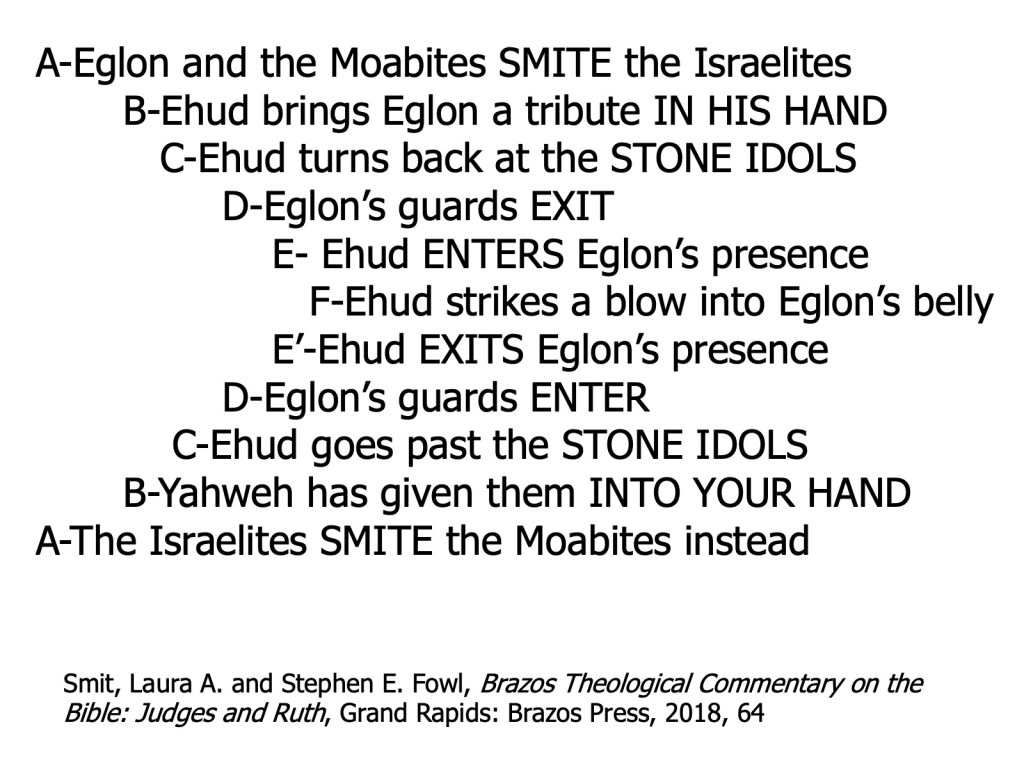
It helps frame the story quite well, don’t you think? This enGROSSing tale is about a left-handed liberator and a fat king…and it is also about God’s people who have lost their way. [43] This story is really about the ‘left-handed’ ways of God both to judge AND to deliver Israel.”[44] God does not take pleasure in suffering, and he is not sadistic.
Evil people suffer consequences consistent with their wrongdoing. Eglon brought uncleanness and shame into Israel, so he is shamed and made unclean.[45] We’ll come back to wrap up this story in a moment.
But there’s a tiny little story at the end of this one about a much-overlooked judge. It’s the SHORTEST report of a judge in the book—a little tag to the Ehud story, perhaps?
After him came Shamgar the son of Anath, who struck down six hundred Philistines with an oxgoad; and he also saved Israel. Judges 3:31
Shamgar is mentioned in this little verse here, and then again as part of the song of Deborah. But it’s not much. Shamgar may be a Hurrian or Canaanite—[46]

Anath was the name of one of the three great Canaanite goddesses.[47] Son of Anath—was a name used by the ‘Habiru’ mercenaries employed by the Egyptians in the twelfth to tenth centuries BCE. They took on the name of the Canaanite goddess of war to mark their ferocity in battle…[48] Shamgar may have been devoted to the service of Anath,[49] who was added to this list of judges simply because he defeats Israel’s enemies.[50] His weapon—was an “oxgoad.” An oxgoad was an “ox prodder” of sorts, a sharp instrument mounted on the end of a fairly long pole – long enough so that the plowman could jab his oxen in the backside to goad them on so that they would plow faster. At the other end of the oxgoad a scraper was attached, which the plowman could use to scrape off dirt or mud that has stuck to the plow. It may have just been what Shamgar had available to him.[51] It’s unconventional, for sure. And so is God in these stories. In these dark days, the tools God uses are crude.[52] Othniel—was a Kenizzite, the son-in-law of a famous generation. Ehud—used a left-handed DAGGER to offer up feast of fat. Shamgar—has NO tribal connections, and uses an OX GOAD—a strange weapon.[53] but each of them delivered Israel,[54] and through them, God brings rest from war.[55]
The Bible has violent stories. But our society has our own weird fairy tales and songs that are gruesome: Hansel and Gretel, Rock-a-bye-Baby, Ring around the Rosy. The vulgar humor in the story of Ehud is a tool in itself—giving a way for people who are suffering under cruel oppressors to have a laugh, to revel in the downfall of those who oppose God. And if these kings thought that they were given the upper hand over Israel because God was on THEIR side, they had another thing coming. [56] The writers were actually doing serious work. It may be tempting to avoid this kind of stuff, but that would eliminate most of the stories in the Bible—we go from the garden of Eden to a brother killing his own brother. Noah’s ark is troubling because almost everyone dies, and even Jesus dies by crucifixion, even though the end of the story and the resurrection may seem to take the edge off. We live in a world that is familiar with violence and terrorism. We’ve seen it a lot in recent days. And God is not surprised by it, nor does it keep him from being able to work. We tell these stories because we are reminded that God has promised to take unjust violence and bring about restoration, healing, and life. It’s part of our faith![57] He is sensitive to his people’s groaning and he often rescues—in spite of his people and their poor leaders.[58]
Now, it’s one thing to tell a story, and it’s another thing to wrestle with what the takeaway is from something like this. Let me give it a try. Two things I want to highlight. Ehud used a double-edged sword to bring down the enemy of God. The Psalmist uses that imagery of a sword in Psalm 149 to say—’Let Israel sing God’s praise—for he takes delight in his people and crowns the humble with victory.’ It goes on:
May the praise of God be in their mouths, and a double-edged sword in their hands—to inflict vengeance on the nations and punishment on the peoples, to bind their kings with fetters, their nobles with shackles of iron, to carry out the sentence written against them—this is the glory of all his faithful people. Psalm 149:6-9 NIV
Now, that sounds quite violent. And in its day, it was. The edge of a sword was likened to a mouth because it devoured the flesh of the one it attacks.[59] And if you remember, the word for ‘double-edged ‘ means literally, a ‘sword of mouths’. Ehud’s sword had two edges—a double edged—or double mouthed sword. It was a tool with which to deliver the word of God.[60] This same metaphor of a double-edged sword[61] is used again in the NEW Testament—in the book of Hebrews:
For the word of God is alive and active. Sharper than any DOUBLE-EDGED sword, it penetrates even to dividing soul and spirit, joints and marrow; it judges the thoughts and attitudes of the heart. Nothing in all creation is hidden from God’s sight. Everything is uncovered and laid bare before the eyes of him to whom we must give account. Hebrews 4:12-13
A double-edged sword—became a metaphor—for the Word of God.[62] The Word of God, Jesus, cuts both ways: it judges the heart. For the non-believer, it reveals guilt and condemnation, while for the believer, it offers redemption and healing. The apostle Paul urges believers to take up the Sword of the Spirit, to stand against the schemes of the devil, because our struggle is not against flesh and blood—it is against the powers of darkness, the spiritual forces of evil.[63] A physical sword—is not going to do any good against spiritual entities.
As followers of Jesus, we have to be alert, sober minded, and develop new and shrewd and resourceful ways to do battle with the one who roams around seeking to destroy us. Ehud gained skills at being left-handed. How are YOU sharpening your skills of prayer and studying and using Scripture to win the battle for your heart in this world?
An important question to consider after this message. Like Ehud, may we be the RIGHT people to stand for what is holy and good and true, even if no one else is left.
And yes, even the oxgoad used by Shamgar has a metaphor in Scripture: Ecclesiastes 12:11 says “The words of the wise are like goads, their collected sayings like firmly embedded nails—given by one Shepherd.” Our Good Shepherd uses the Word to prick our consciences, drive us to repentance—and direct us to Christ for salvation.[64]
In Revelation, it is written that Jesus has a double-edged sword—that comes out of his mouth for judgment.[65] In the end, God will have his victory. He will overcome all thrones, all dominions, all powers and positions.
I’ve got one more thing I want to consider, Because I found it absolutely fascinating. Like this story in Judges, the Jews had other folklore and traditions that were told and written down. They are not in our Bibles, but give us a window into how they were interpreting these texts. In the late Jewish Aramaic translation of the Hebrew Bible, there is an interesting passage in Ruth. Again, it’s not in our English Bibles, but it is an interpretative tradition, and I think it’s worth sharing. In the Targum of Ruth, chapter one, it says—”Elimelech, the husband of Naomi, died, and she was left a widow and her two sons orphans. They transgressed the decree of the Memra of the Lord, and they took for themselves foreign wives from the house of MOAB. The name of one was Orpah, and the name of the second was Ruth, the daughter of Eglon, the king of Moab. Ruth 1:3-4 Targum[66] In OTHER rabbinic texts and folklore, it tells that, ‘Ruth was the daughter of the son of Eglon, who was the son of the son of Balak the King of Moab.’[67] So, whether daughter or granddaughter, or further down the line, in some way, Ruth—is said to be a descendant of Eglon.[68] In the Talmud, a record of rabbinic teachings, it also says—that Ruth descended from Balak[69]—who is the grandfather of Eglon, which I mentioned at the beginning. So, there’s something to this idea. The rabbis taught that–because of the sacrifices that Balak offered,[70] and because Eglon honored God by rising from his throne, a descendant would come that would sit upon the throne of God.[71]
And regardless of whether or not Ruth descends from Eglon, it is interesting, isn’t it, that Ehud is from the tribe of Benjamin, where Saul comes from[72]—and who is ultimately dethroned, but from a Moabite, Ruth, eventually comes David, the king whose descendant is Jesus. God definitely has the last laugh. May God work in our stories, too—to bring about good from evil and to bring true justice in the battle against evil, so that one day we will live in His peace—forever!
Prayer: O God, most Holy—may we always and forever be your faithful people. We thank you for the gift of spiritual mothers and fathers, who have followed your ways and passed down your Word from generation to generation. Your Spirit has spoken in the world in every time and place, in ancient cities and distant lands, in technology and business, in modern languages, through the church, and through Scripture. You, God, have never been without a witness. By the power of your Word, uphold us and make us strong against our sworn enemies—the devil, the worldly systems, and our own flesh—so that we may not go down to defeat in the spiritual struggle, but may firmly resist our enemies until we finally win the complete victory. Destroy the devil’s work and every conspiracy against you, God, until your kingdom is so complete and perfect—that in it you are all in all. For the kingdom and the power and the glory are yours forever. Amen.
Bibliography
Bell, Rob, What is the Bible?, San Francisco: Harper One, 2017.
Block, Daniel I. Judges, Ruth, Nashville: B&H Publishing Group, 1999.
Boda, Mark J., Mary L. Conway, Daniel I. Block, general editor; Judges, Exegetical Commentary on the Old Testament, Grand Rapids: Zondervan Academic, 2022.
Butler, Trent C., Word Biblical Commentary: Judges, Grand Rapids: Zondervan, 2009.
Frolov, Serge, Judges, Grand Rapids: William B. Eerdmans Publishing Company, 2013.
Inrig, Gary, Hearts of Iron, Feet of Clay, Chicago: Moody Bible Institute, 1979.
King, Philip J., Lawrence E. Stager, Life in Biblical Israel, Louisville: Westminster John Knox Press, 2001.
Soggin, J. Alberto, Judges, Philadelphia: The Westminster Press, 1981.
Smit, Laura A. and Stephen E. Fowl, Brazos Theological Commentary on the Bible: Judges and Ruth, Grand Rapids: Brazos Press, 2018.
Matthews, Victor H., Judges & Ruth, Cambridge: Cambridge University Press, 2004.
McCann, J. Clinton, Judges, Louisville: John Knox Press, 2002.
Pietersma, Albert, Benjamin G. Wright, A New English Translation of the Septuagint and the Other Greek Translations, New York: Oxford University Press, 2007.
Wilcock, Michael, editor, J.A. Motyer, The Message of Judges: Revised Edition, Downers Grove: Illinois, 1992, 2021.
Articles
Ausloos, Hans, “The Story of Ehud and Eglon in Judges 3:12-30: A Literary Pearl as a Theological Stumbling Block”, Old Testament Essays (New Series), 30 no 2 2017, 225-239.
Chalcraft, David J., “Ehud, Stigma, and the Management of Spoiled Identity: A Sociological Retelling of Judges 3:12-30”, Postscripts, 11 no 2 2020, 201-236.
Chisholm, Robert B. Jr., “What’s wrong with this picture?: stylistic variation as a rhetorical technique in Judges”, Journal for the Study of the Old Testament, 34 no 2 Dec 2009, 171-182.
Christianson, Eric S., A fistful of shekels: scrutinizing Ehud’s entertaining violence (Judges 3:12-30), Biblical Interpretation, 11 no 1 2003, 53-78.
Halpern, Baruch. “The Assassination of Eglon,” Bible Review 4.6 (1988): 33–36, 38–41, 44.
Jull, Tom A., “MQRH in Judges 3: A Scatological Reading”, Journal for the Study of the Old Testament, 23 no 81 Dec 1998, 63-75.
Miles, Johnny E. ‘Who are you calling ‘stupid”?: ethnocentric humour and identity construct in the colonial discourse of Judges 3.12-30”, The Bible & Critical Theory, 4 no 1 Feb 2008, 1-16.
Selms, Adrianus van, Judge Shamgar, Vetus testamentum, 14 no 3 Jul 1964, 294-309.
Schroeder, Ryan D., “Eglon’s Fat and Ehud’s Oracle: A Reconsideration of Humour in Judges 3.12-30”; Journal for the Study of the Old Testament, 46 no 4 Jun 2022, 460-479.
Shupak, Nili, “New light on Shamgar ben ‘Anath”, Biblica, 70 no 4 1989, 517-525.
Smith, Mark S, “’Midrash’ in the Book of Judges: The Cases of Judges 3:31 and 6:7-10”, The Catholic Biblical Quarterly, 78 no 2 Apr 2016, 256-271.
Websites
https://en.wikipedia.org/wiki/Left_Hand,_West_Virginia
https://www.jpost.com/archaeology/article-860616
https://armstronginstitute.org/247-ehud-v-eglon-evidence-for-the-biblical-account
Going Deeper Questions
Icebreaker
- Hold up your hand: are you a lefty, righty, or ambidextrous? Share a “left-handed life hack” or a time your difference became an advantage.
- If this sermon were a movie, what would the title be? (Bonus points for a pun.)
Read Judges 3:12–30
- What patterns in Judges show up again in verses 12-15?
- “The LORD strengthened Eglon” (3:12). In what ways can God use ungodly rulers to discipline His people without endorsing their evil?
- Why does the narrator tell us Ehud is a Benjamite (“son of the right hand”) yet left-handed? What layers of irony are at work?
- What does the author highlight about Eglon in verse 17, and why?
(Eglon’s name mean’s ‘calf-like’ along with the term ‘round’, making him a perfect ‘sacrifice.’)
I was envious of the arrogant as I saw the prosperity of the wicked.
For there are no pains in their death, and their body is fat. Psalm 73:3-4 NASB
At the end of ten days their appearance seemed better and they were fatter than all the youths who had been eating the king’s choice food. Daniel 1:15 NASB
- Where do you see providence plus planning in Ehud’s actions?
- The story uses bathroom humor. When is humor faithful (exposing idols, relieving the oppressed) and when is it cruel? How do we tell the difference?
- How can laughter be an act of resistance for oppressed people?
- Ehud uses deception and violence. What makes his act a deliverance rather than mere assassination? What guardrails help us read narratives without making them mandates?
- Ehud “turned back at the idols” (3:19, 26). What idols do you pass every week that tempt you to keep walking instead of turning back in obedience?
- Where do we see God’s mercy in this story (hint: 3:15, 3:28–30)? What does 80 years of rest say about God’s heart?
Shamgar Spotlight
Read Judges 3:31
- With only an oxgoad, Shamgar “also saved Israel.” What does this say about God’s willingness to use ordinary tools and marginal people?
(Shamgar may have been a Canaanite)
- A double mouthed sword in Ehud’s story meant—it has ‘two mouths’. A double-edged sword later became a metaphor—for the Word of God.
Read Hebrews 4:12–13.
- How does God’s word “cut both ways” for believer and unbeliever?
- Compare Psalm 149:6–9 with Ephesians 6:10–18. What changes from physical to spiritual warfare under the new covenant?
- Where has Scripture recently “cut” you—convicting or healing?
Read Ecclesiastes 12:11: The words of the wise are like goads, their collected sayings like firmly embedded nails—given by one Shepherd.
- How can the words of the wise function as “goads” for us this week?
- “When no one else was left, Ehud was the right man.” Describe a moment you felt unlikely but available. What “left-handed” gift might God be shaping in you?
Big Story Thread
- Jewish tradition ties Ruth to Eglon/Balak as a descendant. What might this reversal (Moabite line leading to David → Jesus) show about God’s redemptive creativity?
- Where have you seen God bring good from a family line or personal past that looked irredeemable?
Application & Practice
- Identify one “left-handed skill” (prayer rhythm, Scripture habit, quiet act of service) you’ll train this week. What’s your specific plan (when/where/how)?
- What oppressive “Moab” (habit/system/lie) do you sense the Spirit targeting in your life? What would it look like to “seize the fords” and cut off its retreat?
Final Reflection
- Pray Psalm 139:23, asking the Lord to search, reveal, and lead.
Search me, God, and know my heart; test me and know my anxious thoughts.
See if there is any offensive way in me, and lead me in the way everlasting. Amen.
[1] https://leftyfretz.com/how-many-people-are-left-handed/
[2] https://en.wikipedia.org/wiki/Left_Hand,_West_Virginia
[3] Schroeder, R. D. (2022). Eglon’s Fat and Ehud’s Oracle: A Reconsideration of Humour in Judges 3.12–30. Journal for the Study of the Old Testament, 46(4), 460-479. https://doi.org/10.1177/03090892211061177 (Original work published 2022)
[4] https://www.jpost.com/archaeology/article-860616
[5] religions-14-00796-v2, 13. In file. (Garstang 1948, pp. 177–80). (See Figure 9 below)
[6] Trent C. Butler., Word Biblical Commentary: Judges, Grand Rapids: Zondervan, 2009, 70.
[7] Baruch Halpurn, https://library.biblicalarchaeology.org/article/the-assassination-of-eglon/
Halpern, Baruch. “The Assassination of Eglon,” Bible Review 4.6 (1988): 33–36, 38–41, 44.
[8] Philip E. Satterthwaite, “Judges,” in A New English Translation of the Septuagint and the Other Greek Translations Traditionally Included under That Title, ed. Albert Pietersma and Benjamin G. Wright (New York: Oxford University Press, 2007), 204 translates the Greek word as “ambidextrous.”
[9] Based on Smit, Fowl, 68.
[10] https://armstronginstitute.org/247-ehud-v-eglon-evidence-for-the-biblical-account
[11] Butler, 70.
[12] Butler, 59.
[13] Ausloos, Hans, 230.
[14] Butler, 71. Gen 4:4, Lev 8:25, and many others)
[15] Butler, 70.
[16] https://armstronginstitute.org/247-ehud-v-eglon-evidence-for-the-biblical-account
[17] Daniel I. Block, Judges, Ruth, Nashville: B&H Publishing Group, 1999, 158.
[18] Ausloos, Hans, The Story of Ehud and Eglon in Judges 3, 229.
[19] Now the people came up from the Jordan on the tenth of the first month and camped at Gilgal On The Eastern Edge Of Jericho. Joshua 4:19
[20] This 6th century AD floor mosaic is a map of the Holy Land https://crossroadsbible.net/2020/12/24/joshuas-memorial-at-gilgal/
[21] Accordance, 3:20
[22] https://armstronginstitute.org/247-ehud-v-eglon-evidence-for-the-biblical-account
[23] https://bible.org/seriespage/4-ehuds-gut-reaction-or-no-guts-no-gory-judges-35-31
[24] Sasson, 577.
[25] Schroeder, R. D. (2022). Eglon’s Fat and Ehud’s Oracle: A Reconsideration of Humour in Judges 3.12–30. Journal for the Study of the Old Testament, 46(4), 460-479, 469. https://doi.org/10.1177/03090892211061177
[26] Smit, Laura A. and Stephen E. Fowl, Brazos Theological Commentary on the Bible: Judges and Ruth, Grand Rapids: Brazos Press, 2018, 65.
[27] Eric S. Christianson, “A Fistful of Shekels: Scrutinizing Ehud’s Entertaining Violence (Judges 3:12-30),” Biblical Interpretation: A Journal of Contemporary Approaches 11, no.1, 2003, 53-78, 53.
[28] Trent Butler, 71.
[29] https://en.wikipedia.org/wiki/Baruch_Halpern
[30] Baruch Halpern, “The Assassination of Eglon, The First Locked-room Murder Mystery”, Bible Review, 1988, 33-44.
[31] Deuteronomy 23:12-14.
[32] Smits, Fowl, 69.
[33] Victor H. Matthews Judges & Ruth, Cambridge: Cambridge University Press, 2004, 61.
[34] Baruch Halpern.
[35] Sasson, 583.
[36] Philip J. King and Lawrence E. Stager, Life in Biblical Israel, Louisville: Westminster John Knox Press, 2001, 33.
[37] Baruch Halpern, The Assassination of Eglon, The First Locked-room Murder Mystery.
[38] Philip J. King and Lawrence E. Stager, Life in Biblical Israel, Louisville: Westminster John Knox Press, 2001, 33.
[39] Block, 168.
[40] Michael Wilcock, editor, J.A. Motyer, The Message of Judges: Revised Edition, Downers Grove: Illinois, 1992, 2021, 25.
[41] Block, 170.
[42] Smit, Fowl, Judges and Ruth, 64.
[43] Rob Bell, What is the Bible?, San Francisco: Harper One, 2017, 70. ‘And the Fat Closed in Over the Sword’
Yes, it’s about a left-handed liberator and a fat king, but it’s also about a tribe that has lost its way. It’s about the failure of violence to actually solve anything.
[44] Butler, 75, quoting D.T. Olson, Judges, NIB, Vol. 2, Nashville: Abingdon, 19988, 721-888, 772.
[45] Smit, Fowl, Judges and Ruth, 39.
[46] Matthews, 63.
[47] Butler, 74.
[48] Matthews, 62.
[49] Block, 173.
[50] Matthews, 63.
[51] https://bible.org/seriespage/4-ehuds-gut-reaction-or-no-guts-no-gory-judges-35-31
[52] Block, 171.
[53] Butler, 774-5.
[54] Butler, 74.
[55] Butler, 75.
[56] Based on and rewritten from Schroeder, Ryan D., 474.
[57] Adapted from https://gospelproject.lifeway.com/are-bible-stories-too-violent-for-children/
[58] Block, 175.
[59] Fowl, 71.
[60] Eric S. Christianson, “A Fistful of Shekels: Scrutinizing Ehud’s Entertaining Violence (Judges 3:12-30),” Biblical Interpretation: A Journal of Contemporary Approaches 11, no.1, 2003, 53-78, 53.
[61] *It’s the same word in the Septuagint of Judges 3 as it is in Hebrews 4: δίστομον
[62] Hebrews 4:12-13.
[63] Ephesians 6:10-18
[64] https://www.gotquestions.org/oxgoad-Bible.html
[65] Revelation 1:16
[66] http://targuman.org/targum-ruth/targum-ruth-in-english/
[67] b. Hor. 10b “R. Jose son of R. Hanina said: Ruth was the daughter of the son of Eglon who was the son of the son of Balak the King of Moab.” See also b. San. 102b. b. Sotah 47a, and b. Naz. 23a. and (Naz 24b-granddaughter of Eglon)
[68] https://www.surfsideminyan.com/parsha-halacha.html?post_id=1424591
[69] https://www.chabad.org/library/article_cdo/aid/644180/jewish/What-was-Ruths-ancestry.htm#footnote1a644180
[70] https://www.chabad.org/library/article_cdo/aid/644180/jewish/What-was-Ruths-ancestry.htm#footnote1a644180
[71] Ruth Rabba 2, in .A.J. Rosenberg, ed. Judges: A New Translation: Translation of Text, Rashi and Commentary, trans. Avrohom Fishelis and Shmuel Fishelis, New York: Judaica, 1983, 23.
[72] Smit, Fowl, 72.
 Preach it Sista