
If you go to a Tim Hortons, especially in Canada, you can order a coffee: double-double. It means two shots of cream and two packs of sugar.[1] In the U.S. you can use the term, but it’s not as well-known, although Dunkin’ Donuts seems to know what I mean whenever I ask. It’s a FAVORITE when I’m on the road! Doublemint gum used to have the jingle: “Double your pleasure, Double your fun!” or “Two mints in One!” using twins as spokespersons for their product.[2]
Our story today has double trouble, AND double blessings! It’s the story of Othniel and Achsah, and a king who was double trouble! Yes, it’s kind of obscure. We are in the book of Judges, learning about the unlikely judges that God used to rescue his people. The Judges are a mix of men and women who are both successes and failures. God is going to test Israel in holy warfare, and in their relationships.[3]
Will they heed the warning of Joshua, when he said: If you…intermarry with them, so that you associate with them and they with you, know with certainty that the LORD your God will NOT continue to drive these nations out from before you; but they will be a snare and a trap to you, and a whip on your sides and thorns in your eyes, until you perish from off this good land which the LORD your God has given you. Joshua 23:12-13
We pick up our text in Judges chapter three today, beginning at verse one: Now these are the nations which the LORD left, TO TEST ISRAEL by them (that is, all who had not experienced any of the wars of Canaan; 2 only in order that the generations of the sons of Israel might be taught war, those who had not experienced it formerly). 3 These nations are: the five lords of the Philistines and all the Canaanites and the Sidonians and the Hivites who lived in Mount Lebanon, from Mount Baal-hermon as far as Lebo-hamath. 4 They were FOR TESTING ISRAEL, to find out if they would obey the commandments of the LORD, which He had commanded their fathers through Moses. 5 The sons of Israel lived among the Canaanites, the Hittites, the Amorites, the Perizzites, the Hivites, and the Jebusites; 6 and they took their daughters for themselves as wives, and gave their own daughters to their sons, and served their gods. Judges 3:1-6
Ah… the people fail the two tests miserably, in failing to drive out the other nations, and as they settle down and form alliances with their marriages to the people who live there. These are the two great sins of Israel in the book of Judges: Idolatry and Intermarriage with the Canaanites.[4]

If we go back to the Genesis narrative, we see that Adam and Eve are named as God’s image, or representatives. Their priestly role is to “guard” and “keep” the garden. Adam and Eve have ‘rest’ in the land of Eden—they live in a right relationship with God, with each other, and with creation. God is always the lover, and the Bridegroom of his people, and desires an intimate, holy relationship them—of reciprocal love.
After the fall of Adam and Eve into sin, there is a disruption of their relationships and their vocation. They are alienated from God, from each other, and from the land. Adam and Eve experienced double consequences: their relationship with the land was going to be difficult—thorns and thistles will block their way to flourishing…and their relationships with each other will be strained—Husbands will now tend to dominate their wives, and the woman will now have hardship and sorrow in child-rearing. The promise, however, is that one of Eve’s descendants will crush the serpent’s head and break the curse.[5]
In later chapters, God covenants with Abraham, with a promise of a new land, and descendants. It is a promise to RESTORE the relationship with God that was broken. The covenant at Sinai in the wilderness is another step in God’s desire for intimacy with his people. The promise of the land of Canaan is that it will be a place where Yahweh will dwell among his people again—a foretaste of the new creation.[6] For us, Jesus is the one who dwelt among us—he tabernacled among us—and after his ascension, is the High Priest in heaven that guarantees our rest in the true promised land—in the age to come.[7] In Judges, the people of Israel are NOT finding rest in the Promised land, because they are not worshipping rightly. There is no mention of the tabernacle or communal worship. They are NOT living as holy people in a holy land.[8] The vicious cycle is going to start here (see last week’s post)
The story of Othniel—is short and sweet in the tales of the Judges. Someone wrote, ‘it tells us everything and tells us nothing.”[9] If you’re looking for heroic action or entertainment, you won’t find it here,[10] writes Trent Butler.
But the story actually begins back in chapter one. Even though the people of Israel are said to have failed in their marriage relationships—marrying those who worship other gods, and those outside of God’s people—Othniel…does not. And so, we’ll look at both Othniel AND Achsah today. Let’s go back to chapter one:
Afterward the sons of Judah went down to fight against the Canaanites living in the hill country and in the Negev and in the lowland. 10 So Judah went against the Canaanites who lived in Hebron (now the name of Hebron formerly was Kiriath-arba); and they struck Sheshai and Ahiman and Talmai. Then from there he went against the inhabitants of Debir (now the name of Debir formerly was Kiriath-sepher). 12 And Caleb said, “The one who attacks Kiriath-sepher and captures it, I will even give him my daughter Achsah for a wife.” 13 Othniel the son of Kenaz, Caleb’s younger brother, captured it; so he gave him his daughter Achsah for a wife. 14 Then it came about when she came to him, that she persuaded him to ask her father for a field. Then she alighted from her donkey, and Caleb said to her, “What do you want?” 15 She said to him, “Give me a blessing, since you have given me the land of the Negev, give me also springs of water.” So Caleb gave her the upper springs and the lower springs. The descendants of the Kenite, Moses’ father-in-law, went up from the city of palms with the sons of Judah, to the wilderness of Judah which is in the south of Arad; and they went and lived with the people. Judges 1:9-16
This seems like an odd story to find in the middle of all of the accounts about battles, especially since it was already told in the book of Joshua.[11] But there are elements that we should pause to consider. Caleb…was one of the twelve spies that went to check out Canaan, and only he and Joshua were the two that believed that God would give the land into their hands. The other spies doubted, and didn’t want to fight the giants, and they died in the desert. When they get to Gilgal, Caleb goes to Joshua and reminds him—that Moses promised him an inheritance of land, and he asks for the hill country.
In that account we read: 13 Then Joshua blessed Caleb son of Jephunneh and gave him Hebron as his inheritance. 14 So Hebron has belonged to Caleb son of Jephunneh the Kenizzite ever since, because he followed the Lord, the God of Israel, wholeheartedly. Joshua 14:13-14
Caleb is a Kenizzite. He was not an Israelite—from the descendants of Jacob, but he is faithful to Yahweh and is rewarded for it—by getting a piece of the Promised Land. Caleb…is NOT biologically a descendent of Abraham, but IS a member of the covenant community affiliated with Judah.[12] We’ll get to that in a little bit.
At this point, Caleb’s daughter is eligible for marriage. A bride price was typically given by the ancient bridegroom to the bride’s father, because the daughter would no longer be contributing to her parent’s household.[13] (Like when Jacob worked for seven years for each of Laban’s daughters.)[14] In this instance, Caleb uses his daughter as bait, in order to gain more territory.[15] Achsah is a pawn—she is a trophy, and her father uses her to get the men to rise up for battle.[16] In effect, he WAIVES the bride-price in order to ensure the tribe’s victory.[17] And Othniel wins the battle and the fair maiden.
Othniel is Caleb’s nephew, and yes, marriage in families looked differently than they do today. But also consider that men had wives AND concubines in those days. Caleb’s first wife, Azubah, died, and then he married Ephrath.[18] He also bore sons by Jerioth, Ephah, and Maacah,[19] his concubines.
Coming from the wandering era in the desert, where the tribes were semi-nomadic, into the conquest of Canaan, with the acquisition of land, the family and sociopolitical spheres were changing. In the time period of the Judges, there was no central administration and no standing army,[20] and there was a shift from TRIBAL identity to LOCAL families and clans.[21] The HOUSEHOLD was becoming its own unit, taking up farming, raising animals, and producing everything it needed to survive. It became its own economic unit and would be made up of a new couple and any hired help. Villages would have been mapped out according to households, that depended on each other and lived from harvest to harvest.[22] It was going to look different for Achsah than it had in her father’s household, which had Caleb as the center, multiple women and children, perhaps twenty to fifty people![23]
As a woman, Achsah is offered in the context of war and was expected to submit[24] —it’s just the way things are! But she is going to subvert the narrative.[25] Her loyalties have been transferred to the household of her new husband.[26] The text says next that Achsah urges Othniel to ask her father for a field. The Septuagint and Vulgate say that Othniel urges HER to ask her father. Other scholars say that the Hebrew verb and syntax leaves out Othniel completely, and when she arrived, she asked her father.[27] OR, it may be that Othniel asked for the field, and got it, and it wasn’t enough, and Achsah goes back to her dad to ask for more.[28]
Land, for Israel, is not just soil to be worked, or simply a place in which to live, but is understood as God’s blessing. It is not to be sold or lost.[29] Land is God’s BLESSING! In the scene, Achsah is asking for not just a dowry, from her father, but a birthright.[30] The dowry a woman brings from her father’s house would belong only to the children of that woman. It does not belong to ANY other member of the woman’s family or to the husband’s family (including the husband).[31] Achsah wants something for HERSELF. She wants something for HER future in this Promised Land.
Caleb got his land through the victory of Othniel, her new husband, and she wants something, too! And her request is given at the optimum time—right after victory in battle has been achieved.[32]
Now, when Achsah gets to her father, the text says, ‘she alighted from her donkey’—The Septuagint says that she murmured and cried out; or that she screamed…she made a noise… One scholar saw similarities between this verb and an Akkadian word, which means that she did something very unladylike[33], and her dad said, ‘what is wrong with you?’.[34] That verse was translated very interestingly in the New English Bible back in the day. If you want a chuckle, check out the questions at the bottom, and I’ll include it there for your reading and study pleasure.
According to the Hebrew version, though, Achsah decisively gets down from the donkey with a request for her father’s favor. Her action suggests that their business is not complete.[35] As a daughter, she could not be considered the legal heiress to her father’s property.[36] But any inheritance, any dowry should include land AND water, and she COMPLAINS that the land that was given to her and her husband is dry—like a desert. And it is.
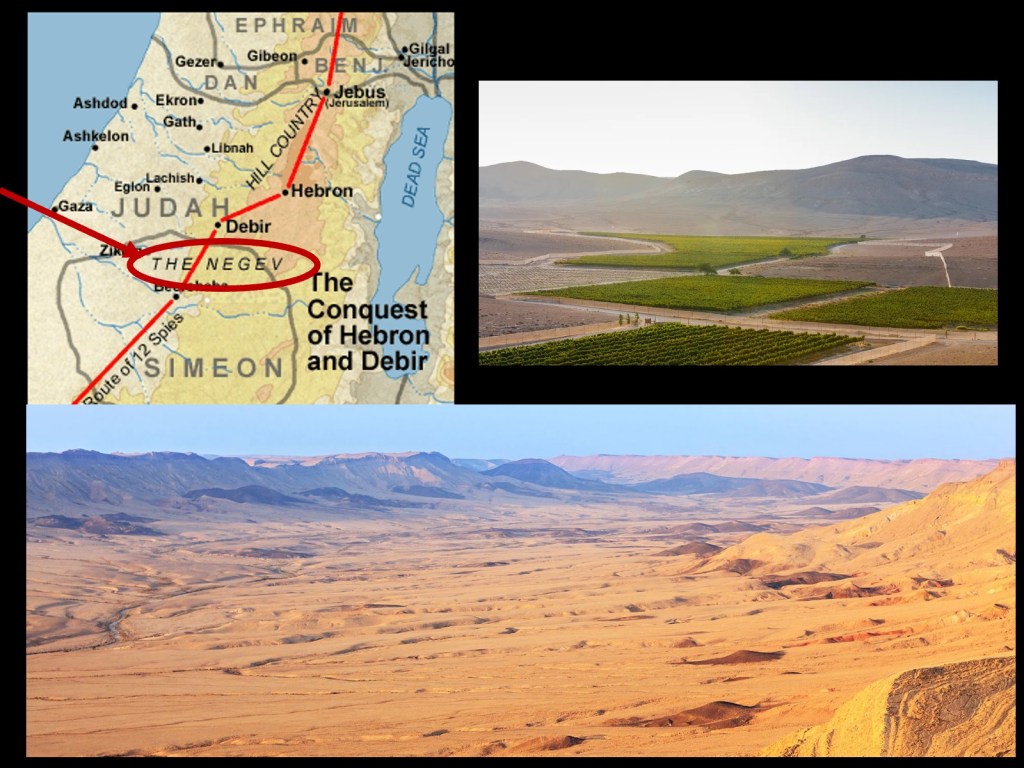
The Negev is a hot, dry region in the southern part of Israel that has very little rainfall. After the entrance into the Promised Land, that region was allotted to Judah and Simeon.[37] It was a little bit like the Wild West, with the undeveloped landscape, and isolated outposts that developed. Land like that needs water to be able to farm.[38] Achsah points out the disparity to her father, which shames him and provokes a guilt reaction.[39] She’s a plucky girl.[40] Give me a blessing! Give ME a blessing—she asks for herself! And so, her descent from the donkey leads to exultation—and blessing.[41]
Her father gives her what she asks—and she receives it in double measure. Caleb gives her not one spring, but two! A DOUBLE BLESSING!
Achsah and Caleb got a Double Blessing!
In Judges, there is a theme of undoing the double consequences on Adam and Eve after the Fall, focusing on a right relationship with the land, AND on right relationships between men and women.[42] Achsah fulfills the role of helpmeet, who intercedes with her Father, and gets good land with springs of water. Othniel—does not dominate his wife, but will use his power to conquer the powers of evil instead.[43] This story in the book of Judges starts out well.
But as Judges unfolds, there will be MANY stories about women—more than is typical in other biblical books, and women are treated less and less well as the narratives progress.[44] Achsah gets on her donkey in a quest to ask for land and water from her father. At the end of Judges, another woman is placed on a donkey—dead from abuse—and is dismembered and distributed throughout Israel, piece by piece.[45] An example of brilliant, though gruesome framework by the author!
The double blessing is part of Achsah and Othniel’s story, but the people of Israel are asking for trouble in how they live and respond to God. This is the pattern throughout the book of Judges: They forget God. They forget the covenant. They forget to keep God’s commands.[46]
Sometime after Othniel and Achsah get married: The sons of Israel did what was evil in the sight of the LORD, and forgot the LORD their God and served the Ba’als and the Asheroth. 8 Then the anger of the LORD was kindled against Israel, so that He sold them into the hands of Cushan-rishathaim king of Mesopotamia; and the sons of Israel served Cushan-rishathaim eight years. Judges 3:7-8
The violence, abuse in society, and anarchy[47] all point to the need for a king —but they the right kind of king.[48] In this case, the wrong kind of king comes in—sent from God. The king of Mesopotamia, or King of Aram Naharaim in the Hebrew, is also translated as “Aram of the TWO RIVERS,” which is the upper part of Mesopotamia, dominated by the Tigris and Euphrates Rivers. That area is now Syria and Lebanon.[49]
Achsah…was GOOD. She asked for and received two springs of water-a double blessing. God’s people—are acting BADLY. They’re asking for trouble, and they receive it in the form of a king—Cushan-Rishathaim—(Koo’-shan-rish-a-time). Can you say that? His name is a pejorative—not something you want to name your children,[50] in case you were considering it. Cushan Rishathaim can be interpreted as Cushan of double wickedness,[51] or Cushan the Doubly Wicked.[52] This guy is DOUBLE TROUBLE for the Israelites.[53] The “Doubly Wicked One” has taken possession of the land that was set apart for God’s people because they have FORGOTTEN him.[54] And so, the people spend eight years serving a wicked king.
9 When the sons of Israel cried to the LORD, the LORD raised up a deliverer for the sons of Israel to deliver them, OTHNIEL the son of Kenaz, Caleb’s younger brother. 10 The Spirit of the LORD came upon him, and he judged Israel. When he went out to war, the LORD gave Cushan-rishathaim king of Mesopotamia into his hand, so that he prevailed over Cushan-rishathaim. Judges 3:9-10
Othniel—husband of Achsah, nephew of Caleb, becomes the agent of God’s judicial action on behalf of Israel.[55] He “judges” Israel, though what that means is not defined.[56] But he is the first and the best judge. “His ARM prevailed”[57] over the doubly wicked king.
It’s interesting that the Spirit of God comes on Othniel. It’s something that happens in many of the stories of the judges that follow. It does NOT mean that God endorses EVERYTHING that the judges do.[58] If you remember, God came upon Balaam[59], a foreign prophet and diviner, and he also came upon Saul.[60] But God is king—king of his people—king of the earth—and he can use ANYONE to bring about his purpose.
Othniel is a God-appointed deliverer who judges Israel, and who wins a battle with a doubly wicked king of a far-distant land.[61] He is the ideal judge, obedient and successful. He accomplishes his task through the power of the Spirit of Yahweh that comes upon him, so there is no need for further preparation, encouragement, or rebuke.[62] Although Othniel’s story seems short—and a bit hum-drum, he takes on a king who has more territory and more power than ANY of the other enemies that later judges will take on.[63]
Othniel and Achsah are a model couple. Othniel uses his power to dominate the powers of evil[64], the king of double trouble., rather than falling into the post-fall paradigm of dominating his wife. Achsah is a faithful helpmeet, who intercedes with her father on behalf of the man she has married[65], and is given a double blessing of living water.
Then the land had rest forty years. And Othniel the son of Kenaz died. Judges 3:11
Othniel was a part of the tribe of Judah.[66] His name means: Lion of God.[67] His exemplary role at the beginning of Judges points forward to the rise of David
as a Judahite leader over all the tribes of Israel.[68] And he also points to the One—who came from the Davidic line to defeat the enemy and initiate God’s kingdom on earth as it is in heaven[69] —Jesus!—another lion of God—the lion of Judah—a greater JUDGE and a greater SAVIOR!
Last week we read about the angel of the Lord who appeared at GILGAL—and reminded the people that he had brought them out of Egypt, and he called out their sin; and the people wept and sacrificed to the Lord.[70] Some scholars believe that the angel of the Lord there—is God Himself, who appears in other places in the Old Testament,[71] as well, and that here, it may even refer to the pre-incarnate Jesus.
Laura Smit notes that: Judah is chosen to lead the people of Israel and take the land, but it is Jesus, the Lion of Judah who eventually completes and fulfills the terms of Judah’s election—in this instance, by insisting on purity in the land, and in the future, in his incarnation, by being lifted up on the cross, raised from the dead on the third day and raised to the right hand of the Father in his ascension. When Jesus comes again, he will fulfill the terms of Judah’s election by going before His people into the REST that is prepared for them in the heavenly kingdom.[72]
The people of Israel did not get their rest in the land. But there is a rest waiting for us as people of God, that we need to keep our eyes on. The writer of Hebrews says: For if Joshua had given them rest, God would not have spoken later about another day. 9 There remains, then, a Sabbath-rest for the people of God; 10 for anyone who enters God’s rest also rests from their works, just as God did from his. 11 Let us, therefore, make every effort to enter that rest, so that no one will perish by following their example of disobedience. 12 For the word of God is alive and active. Sharper than any double-edged sword, it penetrates even to dividing soul and spirit, joints and marrow; it judges the thoughts and attitudes of the heart. 13 Nothing in all creation is hidden from God’s sight. Everything is uncovered and laid bare before the eyes of him to whom we must give account. Hebrews 4:8-13
We were created by God, with a purpose and a promise. The PURPOSE of good relationships with God, with each other, and with creation—and the PROMISE of forever in the presence of our God, and King! Will we fulfill our roles rightly, or will we turn aside to the worship of other things?
Are you asking for trouble or blessing from God?
See, we have the opportunity to choose. We can turn aside to other gods: like money, power, reputation, sex, and even self or social media, and let our relationships slide. It would give us a dose of double trouble—which we have seen in every generation, as people turn away from God. OR…we can do what is right and good and combat the evil that is prevalent all around us—and ask God for his double blessings: on our worship, on our land, and in our relationships—our marriages, our families, our friendships. We can ask for a spiritual inheritance, a deeper understanding of God’s Word, and a more profound experience of God’s grace.
When Jesus preached in the synagogue in Nazareth in his hometown, He used the words of Isaiah 61. Here’s a portion of it:
The Spirit of the Sovereign Lord is on me, because the Lord has anointed me to proclaim good news to the poor. He has sent me to bind up the brokenhearted, to proclaim freedom for the captives and release from darkness for the prisoners, 2 to proclaim the year of the Lord’s favor and the day of vengeance of our God, to comfort all who mourn, 3 and provide for those who grieve in Zion—to bestow on them a crown of beauty instead of ashes, the oil of joy instead of mourning, and a garment of praise instead of a spirit of despair. They will be called oaks of righteousness, a planting of the Lord for the display of his splendor. 4 They will rebuild the ancient ruins and restore the places long devastated; they will renew the ruined cities that have been devastated for generations. 5 Strangers will shepherd your flocks; foreigners will work your fields and vineyards. 6 And you will be called priests of the Lord, you will be named ministers of our God. You will feed on the wealth of nations, and in their riches you will boast. 7 Instead of your shame you will receive a double portion, and instead of disgrace you will rejoice in your inheritance. And so you will inherit a double portion in your land, and everlasting joy will be yours. Isaiah 61:1-7
The double portion is what went to the firstborn. A double portion[73]—a double blessing—is what Elisha asked for from Elijah.[74] A double blessing is what God gave to Hannah because he loved her.[75] God gave Job TWICE as much as he had before all of his troubles.[76] In our story, Othniel and Achsah received a double blessing. In Revelation, however, the judgement against Babylon will be a double JUDGMENT—based on evil deeds.[77]
Now, let me ask you again: Are you asking for trouble or blessing from God?
Take a moment to ponder where your heart is. WHAT are you seeking after? And WHO are you seeking it from? Are you looking for satisfaction…power?… wealth?… revenge?…popularity? …more stuff? WHERE are the places that you are going—to be fulfilled? The people of Israel sought after the wrong thing time and time again—and ended up being oppressed—enslaved—and subject to the consequences of turning away from God. Are you heading down that road in the things you keep going after? Is it time to make a change—to turn around—to seek after God?
Now let me ask you: Are there deserts or trouble in your life where you need a BLESSING? Places where you need life? Healing? Hope? Is there a thirst, a craving, a hunger in your soul? Has something come in that has stolen your joy, your hope, your connection with God?
JESUS—is the one who is named as the firstborn son over all creation. He is the heir of all things—The one who was sent to proclaim the good news—freedom, praise, release from darkness, comfort for those who mourn, to restore the devastation that has come from generational sins, to replace shame with joy. HE is the one with the ability to grant us BLESSING! HE is the one who brings life! WHAT is it that you would ask him for? WHAT is the desire of your heart?
I pray—that we will ask for a double blessing from God—the blessing of knowing him, and through that to know who we are—Sons and Daughters of the living God!
PRAYER
Blessed are You, Eternal One, our God, Sovereign of the world, who has given us a Torah of truth—and planted in our midst eternal life. Blessed are You, Eternal One, who gives the Word to your people. Heavenly Father, we thank You for Your grace and provision in our lives. We humbly ask that you bless our work, our relationships, and our spirits with your favor. Holy Spirit, give us the strength to invite blessing rather than trouble in our lives. Forgive our sins, and lead us once again on the path to everlasting life. Guide us to be a blessing to others, too, and may your steadfast love and peace fill our hearts and our homes. May we follow Jesus, the Lion of Judah, with all of our hearts, minds, and strength as we live into what it means to be children of God. Amen.
Bibliography
Books
Boda, Mark J., Mary L. Conway, Daniel I. Block, general editor; Judges, Exegetical Commentary on the Old Testament, Grand Rapids: Zondervan Academic, 2022.
Butler, Trent C., Word Biblical Commentary: Judges, Grand Rapids: Zondervan, 2009.
Frolov, Serge, Judges, Grand Rapids: William B. Eerdmans Publishing Company, 2013.
Inrig, Gary, Hearts of Iron, Feet of Clay, Chicago: Moody Bible Institute, 1979.
Soggin, J. Alberto, Judges, Philadelphia: The Westminster Press, 1981.
Smit, Laura A. and Stephen E. Fowl, Brazos Theological Commentary on the Bible: Judges and Ruth, Grand Rapids: Brazos Press, 2018.
Matthews, Victor H., Judges & Ruth, Cambridge: Cambridge University Press, 2004.
McCann, J. Clinton, Judges, Louisville: John Knox Press, 2002.
Articles
Begg, Christopher T., “Israel’s first judge according to Josephus”, NTT, 60 no 4 Nov 2006, 329-336.
Brockhaus, Monika, “Achsah: who ever saw her was angry with his wife. Achsah in the Bible and Bavli Temurah 16a”, Lectio Difficilior, 2 2011, 1-12.
Fleishman, Joseph, “A daughter’s demand and a father’s compliance: the legal background to Achsah’s claim and Caleb’s agreement (Joshua 15,16-19; Judges 1,12-15)”, Zeitschrift für die alttestamentliche Wissenschaft, 118 no 3 2006, 354-373.
McKinlay, Judith, “Meeting Achsah on Achsah’s land”, The Bible & Critical Theory, Oct 2009.
Mosca, Paul G., “Who seduced whom: a note on Joshua 15:18; Judges 1:14”, The Catholic Biblical Quarterly, 46 no 1 Jan 1984, 18-22.
Ratner, Tsila, “Playing Fathers’ Games: The story of Achsah, daughter of Caleb, and the princess’s blank sheet”, Journal of Modern Jewish Studies, 3 no 2 Jul 2004, 147-161.
Szpek, Heidi M., “Achsah’s story: a metaphor for societal transition”, Andrews University Seminary Studies, 40 no 2 Aut 2002, 245-256.
Tobolowsky, Andrew, “Othniel, David, Solomon: Additional Evidence of the Late Development of Normative Tribal Concepts in the South”, Zeitschrift für die alttestamentliche Wissenschaft, 131 no 2 2019, 207-219.
Websites:
https://www.foodrepublic.com/1326520/what-does-double-double-mean-coffee-tim-hortons/
https://en.wikipedia.org/wiki/Doublemint
https://www.gotquestions.org/Negev-in-the-Bible.html
Going Deeper Questions
The post started with comments about coffee (double-double) and Doublemint gum. What’s something you like “doubled” (extra cream, extra scoops, extra blessings)?
Read Judges 1:8-15
Then the sons of Judah fought against Jerusalem and captured it and struck it with the edge of the sword and set the city on fire. 9 Afterward the sons of Judah went down to fight against the Canaanites living in the hill country and in the Negev and in the lowland. 10 So Judah went against the Canaanites who lived in Hebron (now the name of Hebron formerly was Kiriath-arba); and they struck Sheshai and Ahiman and Talmai.
11 Then from there he went against the inhabitants of Debir (now the name of Debir formerly was Kiriath-sepher). 12 And Caleb said, “The one who attacks Kiriath-sepher and captures it, I will even give him my daughter Achsah for a wife.” 13 Othniel the son of Kenaz, Caleb’s younger brother, captured it; so he gave him his daughter Achsah for a wife. 14 Then it came about when she came to him, that she persuaded him to ask her father for a field. Then she alighted from her donkey, and Caleb said to her, “What do you want?” 15 She said to him, “Give me a blessing, since you have given me the land of the Negev, give me also springs of water.” So Caleb gave her the upper springs and the lower springs.
-Who are Othniel and Achsah, and how are they connected to Caleb?
-What was Caleb’s challenge and reward for capturing Kiriath-Sepher?
-Why might Caleb have offered his daughter in marriage as the reward for military victory?
-What did Achsah ask her father for after her marriage, and what was his response?
-How does Achsah’s bold request demonstrate faith, initiative, or wisdom?
-If you were in Achsah’s place, what would you have asked Caleb for?
When Achsah got off her donkey to ask her father for a blessing, the Septuagint (Greek translation of the Hebrew Scriptures) says that she murmured and cried out; she screamed. One scholar saw similarities with an Akkadian word, and it got translated like this in the New English Bible:
When she [Achsah] came to him, he [Othniel] incited her to ask her father for a piece of land. As she sat on the ass, she broke wind, and Caleb said, ‘What did you mean by that?’ Judges 1:14 NEB
So, what did Achsah do? Did she break wind? Did she make a noise? Did she cry? Probably not. She probably dismounted her donkey in order to talk to her father.[78]
Achsah asked her father boldly for springs of water—something essential for life—and received a double blessing.
What keeps us from asking God boldly for what we need?
How does Achsah’s request challenge our understanding of prayer and inheritance?
In your spiritual journey, what feels like “land without water” right now, and how might God want to refresh that place?
If you could “get off your donkey” this week and boldly ask for something, what would it be?
Read Judges 3:7-11
The sons of Israel did what was evil in the sight of the Lord, and forgot the Lord their God and served the Baals and the Asheroth. 8 Then the anger of the Lord was kindled against Israel, so that He sold them into the hands of Cushan-rishathaim king of Mesopotamia; and the sons of Israel served Cushan-rishathaim eight years.
9 When the sons of Israel cried to the Lord, the Lord raised up a deliverer for the sons of Israel to deliver them, Othniel the son of Kenaz, Caleb’s younger brother. 10 The Spirit of the Lord came upon him, and he judged Israel. When he went out to war, the Lord gave Cushan-rishathaim king of Mesopotamia into his hand, so that [l]he prevailed over Cushan-rishathaim. 11 Then the land had rest forty years. And Othniel the son of Kenaz died.
What happens to Israel when they forget God and serve the Baals and Asheroth?
Cushan-Rishathaim’s name means “Doubly Wicked.” What do you think the writer of Judges wants us to understand by highlighting the king’s wickedness?
How long did Israel serve under his oppression?
How would you feel living under a king known as “the Doubly Wicked One”? What words come to mind?
If you had to give a funny nickname to something annoying in your life (traffic, chores, technology), what would you call it?
How does God use this foreign oppressor as part of testing and disciplining His people?
Where do you see “double trouble” patterns in today’s culture?
In what subtle ways might we “ask for trouble” today — not by words, but by choices or habits?
Think of a time when you felt you were in “double trouble.” How did God meet you in that season? Has God ever used trouble to get your attention or draw you back to Him?
What encouragement can we take from the fact that God raised up a deliverer (Othniel) even when His people had turned away?
What does this passage teach us about God’s sovereignty—even over wicked rulers?
Israel did evil in the eyes of the Lord so that God sold them into slavery. But when they cried out to God He acted on their behalf. Was there ever a time when you cried to God and He acted on your behalf?
Othniel’s name means ‘lion of God.’ Why might God choose to begin the book of Judges with a leader like that?
(If your name had an animal in it, what would it be? (“Brenda the Brave Badger,” “Mike the Mighty Moose,” etc.)
How does his quiet, faithful leadership compare to what we usually expect from a “hero” figure?
Othniel was empowered by the Spirit of God to deliver Israel. Have you experienced the Spirit’s power giving you courage or strength in a situation where you felt weak?
What does it mean for us today to follow God with “wholehearted” devotion, like Caleb and Othniel did?
Othniel’s victory and leadership points forward to King David, and even further into the future, as it points to Jesus. In Revelation 5:5, Jesus is called the “Lion of Judah.”
“…behold, the Lion that is from the tribe of Judah, the Root of David, has overcome so as to open the book and its seven seals.”
What comes to mind when you picture Jesus as the Lion of Judah? Strong? Fierce? Protector? Something else?
What battles (personal, relational, or spiritual) in your life right now do you need to trust Jesus, the Lion of Judah to fight on your behalf?
How can remembering God’s ultimate victory over evil kings and powers (through Christ) give us courage in facing present challenges?
Like Othniel, are there places where God is calling you to courageously step up in obedience, even if it looks risky?
Read Hebrews 4:8-16
For if Joshua had given them rest, God would not have spoken later about another day. 9 There remains, then, a Sabbath-rest for the people of God; 10 for anyone who enters God’s rest also rests from their works, just as God did from his. 11 Let us, therefore, make every effort to enter that rest, so that no one will perish by following their example of disobedience.
12 For the word of God is alive and active. Sharper than any double-edged sword, it penetrates even to dividing soul and spirit, joints and marrow; it judges the thoughts and attitudes of the heart. 13 Nothing in all creation is hidden from God’s sight. Everything is uncovered and laid bare before the eyes of him to whom we must give account.
Therefore, since we have a great high priest who has ascended into heaven, Jesus the Son of God, let us hold firmly to the faith we profess. 15 For we do not have a high priest who is unable to empathize with our weaknesses, but we have one who has been tempted in every way, just as we are—yet he did not sin. 16 Let us then approach God’s throne of grace with confidence, so that we may receive mercy and find grace to help us in our time of need.
According to Hebrews 4:8-9, what kind of rest remains for the people of God?
How is this rest different from the land inheritance that Joshua gave to Israel?
What role does God’s Word play, according to verses 12–13?
How does the “rest” described here point forward to Jesus’ completed work and our eternal inheritance?
Where in your life do you feel restless or burdened, and how might God be calling you into His Sabbath-rest?
In the book of Judges, Israel repeatedly “forgot the Lord” and fell into idolatry.
What does forgetting God look like in our world today — and in your personal life?
How can spiritual practices (Scripture, prayer, Sabbath, community) help guard against forgetfulness?
How can we discern whether we are asking God for blessing or simply seeking after things that will lead us into trouble?
Final Thoughts
Name one “trouble” in your life where you need God’s rest.
Name one “blessing” you want to ask boldly from God.
[1] https://www.foodrepublic.com/1326520/what-does-double-double-mean-coffee-tim-hortons/
[2] https://en.wikipedia.org/wiki/Doublemint
[3] Butler, 60.
[4] Smit, Laura A. and Stephen E. Fowl, Brazos Theological Commentary on the Bible: Judges and Ruth, Grand Rapids: Brazos Press, 2018, 16.
[5] Smit, 17.
[6] Smit, 13.
[7] Based on Smit, 14-15.
[8] Based on Smit, 15.
[9] Mark J. Boda, Mary L. Conway, Daniel I. Block, general editor; Judges, Exegetical Commentary on the Old Testament, Grand Rapids: Zondervan Academic, 2022, citing A. Graeme Auld, p189.
[10] Based on Butler, 56.
[11] Smit, 57.
[12] Laura A. Smit, and Stephen E. Fowl, Brazos Theological Commentary on the Bible: Judges and Ruth, Grand Rapids: Brazos Press, 2018, 28.
[13] Heidi M. Szpek, Achsah’s story-a metaphor for societal transition, Andrews University Seminary Studies, 40 no 2 Aut 2002, 245-256, 247.
[14] Genesis 29:18-30.
[15] Tsila Ratner, Playing Fathers’ Games-The story of Achsah, daughter of Caleb, and the princess’s blank sheet, Journal of Modern Jewish Studies, 3 no 2 Jul 2004, 147-161, 149.
[16] Judith McKinlay, Meeting Achsah on Achsah’s land, The Bible & Critical Theory, Oct 2009, 39.2
[17] Serge Frolov, Judges, Grand Rapids: William B. Eerdmans Publishing Company, 2013, 49.
[18] 1 Chronicles 2:18-20.
[19] 1 Chronicles 2:46-48.
[20] Mark J. Boda, Mary L. Conway, Daniel I. Block, general editor; Judges, Exegetical Commentary on the Old Testament, Grand Rapids: Zondervan Academic, 2022, 52.
[21] Boda, Conway, 52.
[22] Matthews, 14, 16.
[23] Heidi Szpek, 254.
[24] Tsila Ratner, “Playing Fathers’ Games-The story of Achsah, daughter of Caleb, and the princess’s blank sheet”, Journal of Modern Jewish Studies, 3 no 2 Jul 2004, 147-161, 150.
[25] Tsila Ratner, 150.
[26] Victor H. Matthews, Judges & Ruth, Cambridge: Cambridge University Press, 2004. 41.
[27] Paul G. Mosca, 21.
[28] Heidi M. Szpek, Achsah’s story-a metaphor for societal transition, Andrews University Seminary Studies, 40 no 2 Aut 2002, 245-256, 245.
[29] Judith McKinley, 39.3
[30] Tsila Ratner, 150.
[31] Joseph Fleishman, “A daughter’s demand and a father’s compliance-the legal background to Achsah’s claim and Caleb’s agreement”, Zeitschrift für die alttestamentliche Wissenschaft, 118 no 3 2006, 354-373, 368.
[32] Paul G. Mosca, Who seduced whom-a note on Joshua 15vs18; Judges 1vs14, The Catholic Biblical Quarterly, 46 no 1 Jan 1984, 18-22, 22.
[33] Dr. Stephen D. Cook, https://stephencook.com.au/2018/05/19/the-bibles-one-and-only-fart-joke-maybe/ article in file.
[34] Joseh Fleishman, 370.
[35] Victor H. Matthews Judges & Ruth, Cambridge: Cambridge University Press, 2004, 40.
[36] Joseph Fleishman, 372.
[37] https://www.gotquestions.org/Negev-in-the-Bible.html
[39] Matthews, 41.
[40] Judith, McKinlay, “Meeting Achsah on Achsah’s land”, The Bible & Critical Theory, Oct 2009, 39.1
[41] https://biblehub.com/hebrew/6795.htm
[42] Smit, 58.
[43] Based on Smit, 20.
[44] Based on Smit, 57-58.
[45] Judith McKinlay, 39.5
[46] Butler, 63.
[47] Boda, Conway, 70.
[48] Boda, Conway, 71.
[49] Boda, Conway, 191.
[50] Butler, 68.
[51] Boda, Conway, 191.
[52] Butler, 64.
[53] Butler, 68.
[54] Smit, 60.
[55] Smit, 62.
[56] Butler, 67.
[57] Serge Frolov, Judges, Grand Rapids: William B. Eerdmans Publishing Company, 2013, 103.
[58] Smit, 62.
[59] Numbers 24:2
[60] 1 Samuel 11:6
[61] Based on Butler, 65.
[62] Boda, Conway, 191.
[63] Frolov, 103.
[64] Laura A. Smit, and Stephen E. Fowl, Brazos Theological Commentary on the Bible: Judges and Ruth, Grand Rapids: Brazos Press, 2018, 20.
[65] Laura A. Smit, and Stephen E. Fowl, Brazos Theological Commentary on the Bible: Judges and Ruth, Grand Rapids: Brazos Press, 2018, 20.
[66] Smit, Fowl, 28.
[67] https://www.biblicalcyclopedia.com/O/othniel.html#:~:text=Oth’niel%20(Heb.,the%20International%20Standard%20Bible%20Encyclopedia.
[68] Smit, 54.
[69] Boda, Conway, 199.
[70] Judges 2:1
[71] Smit, 29.
[72] Smit, 30.
[73] https://www.gotquestions.org/double-portion.html
[74] 2 Kings 2:9
[75] 1 Samuel 1:5
[76] Job 42:10
[77] Revelation 18:6
[78] Claude Mariottini, Emeritus Professor of Old Testament, Northern Baptist Seminary, https://claudemariottini.com/2016/07/20/what-did-achsah-do/
 Preach it Sista