
I’m starting a new series this Fall on the book of Judges. I can’t recall a pastor ever covering these stories before, but it’s something I’ve had a desire to preach through for well over a decade now. I’m hoping I can keep up with this blog as we go!
I’m especially grateful to The Well Community Church in California, because I saw their graphics a few months ago and wrote to their creative team, and they gave permission to use their pictures free of charge! Very much appreciated! (Graphics created by Kham Ornta)
Our society has categories for different generations: Boomers, Gen X-ers, Millennials, Gen Z. There are more of them, but these are the most well-known. Each generation could say that the world is going downhill, I suppose, but we DO live in an era where ‘do your own thing’ is entrenched in the mindset. The nightly news media has reports that are unsettling, with murders, robberies, dissension, and rumors of war. To use a word that became popular in 2020—these times are UNPRECEDENTED! But are they really? Terrible things were happening in the time of the Old Testament, too. There is a phrase in the book of Judges that says: “everyone did what was right in his own eyes.” It doesn’t sound all that different than what we hear about, read, and are experiencing today!
The book of Judges is a literary masterpiece—written with violence, irony, uncouth acts, and comic relief, writes Trent Butler.[1] It appears in the Jewish writings known as the Prophets, and more specifically, in the category of the former Prophets.[2] Unlike movie genres, like horror films, or action films, it’s hard to pin down the genre of Judges.
Some have called them ‘hero legends’[3] but they are only heroes in the way we might think of legends like Billy the Kid, Jessie James, and Wild Bill Hickock, who were part of an era where flaunting the law gave them hero status in some circles.[4] Judges could be seen as a historical book, with events and times and places.[5] It contains a lot of narrative—stories—or it could be seen as a conquest account,[6] an extension of the attacks and victories of Israel after Joshua.[7]
But the book of Judges is not just a set of entertaining stories. This collection has stories of people who are just like us—people with a God-given potential for Greatness,
AND an awesome Capacity for Catastrophe, writes Gary Inrig.[8] When the judges trusted God, they made a positive influence in their world. But even the so called ‘heroes’ in these stories experienced and even caused spiritual catastrophe.[9] Their lives are lessons for us, even today.
If anything, the book’s biggest literary structure is the cycles[10] that are repeated. (I really like this chart based on the idea from Kirk E. Miller[11])
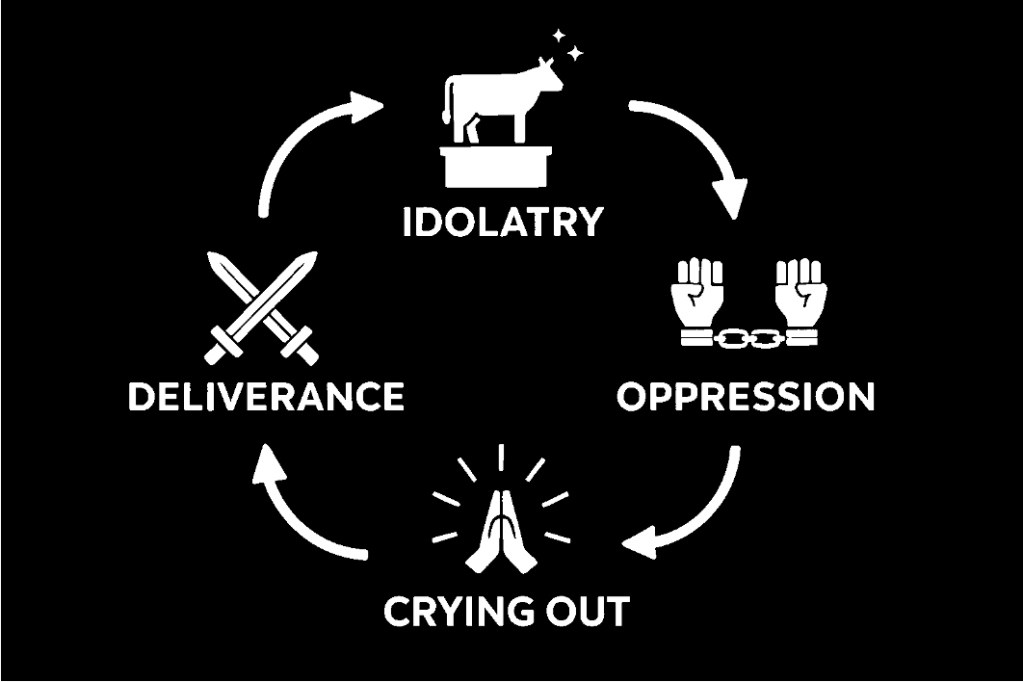
Israel turns away from Yahweh and worships other gods, falling into idolatry. God leaves the people to the mercy of a foreign aggressor. After a period of oppression, they repent and cry out to God for help. God brings deliverance through a judge and defeats the oppressor. There is a time of peace, but after the judge’s death, the cycle begins again, with a new oppressor and a new deliverer.[12] It’s a vicious cycle. This cycle helps us understand the overall context.
From Judges 1-21 covers a span of about 300-350 years! 350 years ago, colonial America had just begun! The events happen sometime after the people enter the Promised Land,[13] and the rise of the monarchy in Israel. The shift is from tribes to a kingdom. We’ll cover sections of chapters one and two today, as the setup for the stories that are to come. Joshua and Judges are right next to each other in the Biblical canon, but they are MILES apart in what they show of Israel’s obedience to God.
Joshua is a book of conquest, while Judges is a story of defeat. Josphua is a book of faith, Judges of unbelief. In Joshua the people say, ‘we will not forget the Lord.’ In Judges—the people forget the Lord. It shows what happens after generations of people give in to temptation and fail to follow God’s ideals for living.[14] We’ve seen this in our own churches and denominations—where the parent’s faith does not take root in the next generation, and the children and grandchildren are apathetic towards God.[15]
Here’s the text from Judges 1: Now it came about after the death of Joshua that the sons of Israelinquired of the LORD, saying, “Who shall go up first for us against the Canaanites, to fight against them?” The LORD said, “Judah shall go up; behold, I have given the land into his hand.” Judges 1:1-2
After Joshua’s death, you would expect that an INDIVIDUAL would rise up, but a single tribe is listed—Judah.[16] The tribe of Judah is going to prepare the way for David,[17] far into the future.
Then Judah said to Simeon his brother, “Come up with me into the territory allotted me, that we may fight against the Canaanites; and I in turn will go with you into the territory allotted you.” So Simeon went with him. Judah went up, and the LORD gave the Canaanites and the Perizzites into their hands, and they defeated ten thousand men at Bezek. They found Adoni-bezek in Bezek and fought against him, and they defeated the Canaanites and the Perizzites. Judges 1:3-5 (Adoni-bezek is the first KING mentioned in the book of Judges.[18])
But Adoni-bezek fled; and they pursued him and caught him and cut off his thumbs and big toes. Adoni-bezek said, “Seventy kings with their thumbs and their big toes cut off used to gather up scraps under my table; as I have done, so God has repaid me.” So they brought him to Jerusalem and he died there. Judges 1:6-7
Then the sons of Judah fought against Jerusalem and captured it and struck it with the edge of the sword and set the city on fire. Afterward the sons of Judah went down to fight against the Canaanites living in the hill country and in the Negev and in the lowland. So Judah went against the Canaanites who lived in Hebron (now the name of Hebron formerly was Kiriath-arba); and they struck Sheshai and Ahiman and Talmai. Judges 1:8-10
Sheshai, Ahiman and Talmai are three leaders,[19] sons of Anak, the Nephilim[20], legendary giants. These are the descendants of the people that the first group of spies were afraid to go up against when they brought their report back about the Promised Land. Judah went against them. The text says they ‘STRUCK’ them, and some versions say ‘SMITE’, or ‘SMOTE’ them—but here—it means that they beat them—they defeated them—and made them powerless. They didn’t kill them because they show up again. When skipping down a little bit:
Then Judah went with Simeon his brother, and they struck the Canaanites living in Zephath, and utterly destroyed it. So the name of the city was called Hormah. And Judah took Gaza with its territory and Ashkelon with its territory and Ekron with its territory. Now the LORD was with Judah, and they took possession of the hill country; but they could not drive out the inhabitants of the valley because they had iron chariots. Then they gave Hebron to Caleb, as Moses had promised; and he drove out from there the three sons of Anak. Judges 1:17-20
These are the same three sons of Anak—Sheshai, Ahiman and Talmai, then, who were expelled from the area.
Let me review the topography of the land. The land of Israel is naturally divided into zones that run North and South. There is the coastal plain, which was the highway of commerce and conquest. There is the Central hill country which has mountainous, rugged terrain, with a belt of smaller rolling hills, called the Shephelah. The Jordan valley—has the lowest elevation in the world[21], with the Sea of Galilee, which flows into the Dead Sea. And finally, the Transjordanian Plateau, which is East of the Jordan. These factors helped determine where people lived, what crops could be grown where, and what land was good for cattle, etc. No place on earth has as much variety as this land!
Gaza, Ashkelon, and Ekron were three of the five major Philistine cities near the coast. Those cities had not yet been conquered by Joshua. The tribe of Judah—had the opportunity to complete the task given to Joshua and conquer the land that remained. But they quit.[22] For some reason they chose NOT to face the people in the valley. Iron chariots were chariots strengthened with iron fittings or iron-shod wheels, and were a cutting-edge military technology of the time, and a symbol of power.[23]
Although Judah did not finish the job, it was the tribe that had the most going for it, especially according to Judges. The other tribes—the Northern Tribes—the house of Joseph—did not fare so well. Let me highlight portions of what comes next:
But the sons of Benjamin did not drive out the Jebusites who lived in Jerusalem…Judges 1:21
But Manasseh did not take possession of Beth-shean and its villages, or Taanach and its villages, or the inhabitants of Dor and its villages, or the inhabitants of Ibleam and its villages, or the inhabitants of Megiddo and its villages; so the Canaanites persisted in living in that land. Judges 1:27
Ephraim did not drive out the Canaanites who were living in Gezer; so the Canaanites lived in Gezer among them. Judges 1:29
Zebulun did not drive out the inhabitants of Kitron, or the inhabitants of Nahalol…Judges 1:30a
Asher did not drive out the inhabitants of Acco, or the inhabitants of Sidon, or of Ahlab, or of Achzib, or of Helbah, or of Aphik, or of Rehob. Judges 1:31a
Naphtali did not drive out the inhabitants of Beth-shemesh, or the nhabitants of Beth-anath, but lived among the Canaanites, the inhabitants of the land…Judges 1:33
Are you seeing a pattern here? The mentions of these specific tribes also set up an anti-Northern premise and promotes Davidic interests later.[24] These tribes failed to remove the Canaanites in the land…not because they could not, but because they WOULD NOT![25] And not only did they not remove them…but here’s another pattern:
When Israel became strong…they put the Canaanites to forced labor…The Canaanites lived among them and became subject to forced labor…The inhabitants of Beth-shemesh and Beth-anath became forced labor…The Amorites…became forced labor…Judges 1:28, 30, 33, 35.
The Northern tribes did not drive out the inhabitants of the land—they coexisted.[26] AND they used the people for slave labor. Their materialism and greed did them in. Having a guaranteed supply of free labor outweighed all other considerations.[27] Their forefathers and mothers came out of slavery, and in their new land, they enslaved the people living there. THERE’S a generational cycle that should NOT have been repeated! From here, the people begin to adopt the practices of the Canaanites, worship their gods, intermarry with their people, and for all practical purposes, they BECOME Canaanites![28] Chapter One is all about the political and military disobedience of Israel, and the leadership role of JUDAH.[29] It’s the set up for what is to come.
I will digress for just a moment to talk about the sticky subject of the extermination of the Canaanites and what that means. I read something recently by Laura Smit that I’m really intrigued by, and I’ll try to explain her take as briefly as I can.
In Genesis 22, Abraham is commanded by God to sacrifice his son Isaac, but at the last minute, God provides a lamb, and Isaac is spared. God has the right to demand the life, and yet, in the moment, God teaches Abraham that he is NOT like the gods of the nations. He DOESN’T desire that people sacrifice their children.[30] The command was not a trick. It was a serious command, and God truly does have the right of life and death over all those we love. But God chooses to be the one to pay what is due to Him, rather than having us pay, showing us a deeper lesson about his nature.[31] In the Passover, God still claims all firstborn sons, but they are to be redeemed with the blood of the Passover lamb.[32] Now, consider that God has every right to require the destruction of the Canaanites, regardless of how awful that sounds.[33] Scripture rightly tells us that we ALL deserve to die and that God is well within His rights to kill any one of us.[34] God is the source of life, and he does not exist on the same scale of being that we do.[35] So, basically, we cannot know what the final destiny of the Canaanite people would be—had the tribes attempted to do what they were asked. All we know is that God’s people failed in their obedience and are held responsible for it. Short answer. Hard topic.
Chapter Two. This chapter is going to give us the framework, the reasoning behind everything that drives the stories of the judges. It’s going to repeat elements from Joshua 24 to reinforce the reason—for Israel’s lack of success.[36]
Now the angel of the LORD came up from Gilgal to Bochim. And he said, “I brought you up out of Egypt and led you into the land which I have sworn to your fathers; and I said, ‘I will never break My covenant with you, and as for you, you shall make no covenant with the inhabitants of this land; you shall tear down their altars.’ But you have not obeyed Me; what is this you have done? 3 “Therefore I also said, ‘I will not drive them out before you; but they will become as thorns in your sides and their gods will be a snare to you.’” When the angel of the LORD spoke these words to all the sons of Israel, the people lifted up their voices and wept. So they named that place BOchim; and there they sacrificed to the LORD. Judges 2:1-5
A messenger of God appears at Gilgal. The people trekked out of Egypt, did their miserable loop in the desert for many years, and finally arrived at the Jordan river, where they would enter the land of Canaan. Gilgal is the place where Israel first camped after crossing the Jordan River into the Promised land,[37] using twelve stones to represent the twelve tribes, which were placed as a lasting memorial.[38] This angel, or messenger in Judges 2, moves from Gilgal, a place of worship, to Bochim, a place of weeping.[39] The message is meant to jog Israel’s memory. God’s promise—going all the way back to Abraham, was that he would bring his people out of Egypt and into the Promised Land—and he HAS! Israel has become HIS people, and in their relationship with Yahweh—their obligation is to respond in love to him—to serve him alone as their God. But they have not listened—they have not obeyed.[40] Same word in the Hebrew! To listen—to obey. The people hear the message—They recognize their wrongdoing—and they weep. Now, they APPEAR to be sorry, as they stand convicted, but are they sad because they got caught and are about to get punished? or are they truly sorry and will do what God is asking?[41] That is the question that will be answered as Judges plays out. This scene is one of the few mentions of appropriate worship in the book of Judges, and from here on out, corporate worship is absent.[42] The lack of right worship will create a vacuum that will be filled by other worship.[43]
The writer now goes back to a scene from Joshua 24, almost word for word, but in slightly different order.[44] This is not about chronological order—it’s about setting the stage.[45]
When Joshua had dismissed the people, the sons of Israel went each to his inheritance to possess the land. The people served the LORD all the days of Joshua, and all the days of the elders who survived Joshua, who had seen all the great work of the LORD which He had done for Israel. Then Joshua the son of Nun, the servant of the LORD, died at the age of one hundred and ten. And they buried him in the territory of his inheritance in Timnath-heres, in the hill country of Ephraim, north of Mount Gaash. All that generation also were gathered to their fathers; and there arose another generation after them who did not know the LORD, nor yet the work which He had done for Israel. Judges 2:6-10
Joshua’s generation had seen the great acts of God in bringing them into the Promised Land. The next generation has not.[46] The downward spiral for the rest of the book of Judges begins here, and will characterize all the vicious cycles that follow.[47] Pay attention to the wording and the repetition.
Then the sons of Israel did evil in the sight of the LORD and served the Ba’als, and they forsook the LORD, the God of their fathers, who had brought them out of the land of Egypt, and followed other gods from among the gods of the peoples who were around them, and bowed themselves down to them; thus they provoked the LORD to anger. So they forsook the LORD and served Ba’al and the Ashtaroth. The anger of the LORD burned against Israel, and He gave them into the hands of plunderers who plundered them; andHe sold them into the hands of their enemies around them, so that they could no longer stand before their enemies. Wherever they went, the hand of the LORD was against them for evil, as the LORD had spoken and as the LORD had sworn to them, so that they were severely distressed. Then the LORD raised up judges who delivered them from the hands of those who plundered them. 17 Yet they did not listen to their judges, for they played the harlot after other gods and bowed themselves down to them. They turned aside quickly from the way in which their fathers had walked in obeying the commandments of the LORD; they did not do as their fathers. 18 When the LORD raised up judges for them, the LORD was with the judge and delivered them from the hand of their enemies all the days of the judge; for the LORD was moved to pity by their groaning because of those who oppressed and afflicted them. 19 But it came about when the judge died, that they would turn back and act more corruptly than their fathers, in following other gods to serve them and bow down to them; they did not abandon their practices or their stubborn ways. 20 So the anger of the LORD burned against Israel, and He said, “Because this nation has transgressed My covenant which I commanded their fathers and has not listened to My voice, 21 I also will no longer drive out before them any of the nations which Joshua left when he died, 22 in order to test Israel by them, whether they will keep the way of the LORD to walk in it as their fathers did, or not.” So the LORD allowed those nations to remain, not driving them out quickly; and He did not give them into the hand of Joshua. Judges 2:11-23
These last verses highlight that cycle that we’ll continue to see throughout the book. Israel turns away from Yahweh and worships other gods, falling into idolatry. Yahweh’s anger burns against them—literally, his nose becomes hot![48] God gives them into the hands of oppressors. The people repent and cry out for help. God brings deliverance through a judge and defeats the oppressor, but after a time, the vicious cycle begins again.
We can appreciate these writings in Judges—as an honest look at the history of Israel—their faults exposed, but also God’s CHARACTER revealed. The stories collected are what give them their identity as special people under Yahweh.[49]

Maybe you’ve been connecting some of the dots in your own world with this portrayal of Israel’s history. What cycles have you experienced in your own faith journey? Would YOU dare write down your failure and foibles, as well as your victories? Our world experiences many cycles: weather cycles and generational cycles—and we experience this in our own lives: The vicious cycle of weight loss and gain, the relapse of the alcoholic, negative thoughts that feed off each other and bring us into a spiral. Generations that fail to learn from the past are doomed to repeat history.
Who are the people of God? Does that designation come from our fathers and mothers, or from OUR faithfulness?[50] We see the experiences of different generations in the Bible—In Genesis, the stories of Abraham, Isaac, Jacob, and Jacob’s children—the struggles involved in the transfer of faith from one generation to the next.[51] We see the disobedient generation in the wilderness that left Egypt and refused to enter the land and then died in the wilderness. We read about the generation who experienced a relationship with God, and received his covenant promises at Mount Sinai. Then the people of Israel fail to complete the mission that God gave them through Joshua, and because of their disobedience, God will not carry out his promises.[52] The Prophets later—point toward a future age of repentance, and then we read about the generations of those who turn in faith and expectancy: Mary, Elizabeth, Zacharias, Simeon, and Anna.[53] The passing of the faith from one generation to another is evident in Paul’s correspondence with Timothy, too.[54] The saying is true: “God has no grandchildren.” Each generation MUST have a personal encounter with the living God![55]
What kind of generation will WE be known as? Not Gen X or Boomer, or Millennials, but what kind of spiritual legacy will we pass on? What past cycles will we break? Patterns of abuse, control, addiction?
Only God can break the vicious cycles in our worlds
The Judges are a mix of successes and failures. There are men and women who lived by faith in God in difficult times, and many of them are listed in Hebrews 11 as heroes of faith.[56] Like all of us, though, the judges are prone to wander.[57] “Prone to wander, Lord, I feel it—prone to leave the God I love.” Maybe by looking at where the people of Israel failed, we can guard against that in our own lives,[58] in our own families, and in our church. Rebellion against God IS our story, too, and the stories in Judges will bring us to that realization.[59] Yet, God is gracious—he pursues his people and invites them to seek after him, no matter how far we have strayed.[60] Jesus ushers in a new age of relationship with God, through the work of the Holy Spirit. As followers of Jesus, we align ourselves with God’s standards, and not the standards of this world. We are not simply to survive in this world, but to SHINE in it—to reflect the glory of Jesus, bearing witness to him.[61]
THIS is our goal, taken from the words of the apostle Paul: Do all things without grumbling or disputing; so that you will prove yourselves to be blameless and innocent, children of God above reproach in the midst of a crooked and perverse generation, among whom you appear as lights in the world, holding fast the word of life…Philippians 2:14-16a
The people of Israel were guaranteed the Promised Land…a gift, a new space, a place in which to worship God. They came into the land, but they did not enter into their rest in the way that God had established for them. They did not worship him with their whole hearts, minds, and bodies.[62] Jesus is preparing a place for US in his Father’s house, a place of union with and as His body.[63] We want to live well, to worship rightly, and to be united with Christ through the work of the Holy Spirit.[64] Let’s pray that our study in Judges will help us to do that.
PRAYER
God our Creator, we thank you for the blessings we share this day. For all of those who have gone before us, people strong and brave, willing to put their lives on the line for the causes they believe in. Give us the courage to step out in faith for that which is true and right. We give you thanks for our families, friends, and the church, who provide us with food and drink for our journey. We pray for those who are hungry and tired, hopeless and wandering, finding no place to rest.[65]
God, you are faithful from generation to generation. You were a faithful God to our spiritual fathers and mothers: Abraham and Sarah, Isaac and Rebecca, and to Jacob and his children. As you have led us in the past, so guide us now and always. Help us to face the future with confidence, knowing that you have guided and led your people through the ages past.
Let the light of faith shine in all that we do, so that the one who is from everlasting to everlasting, yet who was born among us and lived with us may continue to inspire the thoughts of our hearts and the actions of our lives.[66] Jesus, we praise you.
Holy Spirit, help us and our future generations remain strong in your strength so that we may not go down to defeat in the spiritual struggle, but may firmly resist our enemies until we win the complete victory. Above all else we worship you…tune our hearts to sing your praise…Amen.
Going Deeper Questions
-How many of the judges can you name for memory?
–Read Hebrews 11:32-24. How many judges are in there? Are you surprised by any in that list? (You might be as we go through the series!)
On Sunday we covered portions of Judges 1-2. You can read all of that now, or just use the sections highlighted below with questions.
Read Judges 1:21, 27-33
-What are the patterns you notice?
-Why do you think that is significant?
-How do you think the presence of the Canaanites among the Israelites affected their religious and societal life?
-What generation are you a part of? (The Greatest Generation, Silent Generation, Boomer, Gen x, Millennial (or Gen Y), Gen Z.)
-What changes have you seen from your generation to the next?
In technology, morality, political persuasions, church involvement and patterns…
Read Joshua 2:6-10
-Why do you think the people followed God while Joshua and the elders were alive, but then turned away after they died?
-Have you seen any similar comparisons in your lifetime? (Kids who grow up in Christian families and follow God while their parents are around. People who follow God around their believing friends, but not alone or around their unbelieving friends?)
Read Judges 2:11-23
These verses represent the overall pattern of the entire book of Judges. It’s the vicious cycle that gets repeated over and over again.
-What cycles have you experienced in your own faith journey?
-Would YOU dare write down your failure and foibles, as well as your victories?
-Are there negative patterns in your life that need to be rooted out and changed? (Abuse, addiction, control, eating habits, negative thoughts, how you spend your leisure time?)
Only God can break the vicious cycles in our worlds
-Generations that fail to learn from the past are doomed to repeat history. We each need to have our own encounter with the living God and allow him to work in our hearts to redeem us, change us, and help us to be children of God, shining his light in our generation. (See Philippians 2:14-16a)
Prayer: Merciful God, help us to live faithfully in response to your call. Set us free from a past that we cannot change; open to us a future in which we can be changed; and give us grace to grow more and more in your likeness and image; through Jesus Christ, the light of the world.
**The Bible Project has a great overview video about the Book of Judges that you can watch here: https://bibleproject.com/videos/judges/
—
Bibliography
Boda, Mark J., Mary L. Conway, Daniel I. Block, general editor; Judges, Exegetical Commentary on the Old Testament, Grand Rapids: Zondervan Academic, 2022.
Butler, Trent C., Word Biblical Commentary: Judges, Grand Rapids: Zondervan, 2009.
Frolov, Serge, Judges, Grand Rapids: William B. Eerdmans Publishing Company, 2013.
Inrig, Gary, Hearts of Iron, Feet of Clay, Chicago: Moody Bible Institute, 1979.
Soggin, J. Alberto, Judges, Philadelphia: The Westminster Press, 1981.
Smit, Laura A. and Stephen E. Fowl, Brazos Theological Commentary on the Bible: Judges and Ruth, Grand Rapids: Brazos Press, 2018.
Matthews, Victor H., Judges & Ruth, Cambridge: Cambridge University Press, 2004.
McCann, J. Clinton, Judges, Louisville: John Knox Press, 2002,
Articles
Mosca, Paul G., Who seduced whom- a note on Joshua 15vs18, Judges 1vs14
The Catholic Biblical Quarterly, 46 no 1 Jan 1984, p18-22.
O’Doherty, Eamonn, Literary problem of Judges 1:1-3:6, The Catholic Biblical Quarterly, 18 no 1 Jan 1956, 1-7.
Williams, Jay G., The structure of Judges 2:6-16:31, Journal for the Study of the Old Testament, 16 no 49 Feb 1991, 77-86.
Mullen, E Theodore, Judges 1:1-36: the Deuteronomistic reintroduction of the Book of Judges, Harvard Theological Review, 77 no 1 Jan 1984, 33-54.
Websites
https://www.youtube.com/watch?v=JV8bhWJncsk (Jason Salmon)
https://www.ignitermedia.com/creator/editor/d2kqhvfax7x00208e1y0
FOOTNOTES
[1] Butler, lxxi.
[2] Mark J. Boda, Mary L. Conway, Daniel I. Block, general editor; Judges, Exegetical Commentary on the Old Testament, Grand Rapids: Zondervan Academic, 2022, 39.
[3] Serge Frolov, Judges, Grand Rapids: William B. Eerdmans Publishing Company, 2013, 7.
[4] Based on Victor H. Matthews, Judges & Ruth, Cambridge: Cambridge University Press, 2004, 12.
[5] Laura A. Smit, and Stephen E. Fowl, Brazos Theological Commentary on the Bible: Judges and Ruth, Grand Rapids: Brazos Press, 2018, 8.
[6] Frolov, 38.
[7] Based on Frolov, 44.
[8] Gary Inrig, Heart of Iron, Feet of Clay—in title of book
[9] Inrig, 7.
[10] Frolov, 28.
[11] Pic by Kirk E. Miller https://kirkmillerblog.com/2022/02/05/the-judges-cycle/
[12] Frolov, 17.
[13] Boda, Conway, 50.
[14] Inrig, 11-12.
[15] Based on Inrig, 22.
[16] Butler, 19.
[17] Butler, 24.
[18] Butler, 21.
[19] Deuteronomy 1:28; 9:2, Numbers 13:28, 33.
[20] Numbers 13:33
[21] https://en.wikipedia.org/wiki/Jordan_Valley
[22] Butler, 26.
[24] Based on Frolov, 62.
[25] Frolov, 64.
[26] Butler, 33.
[27] Frolov, 64.
[28] Frolov, 79.
[29] Butler, 49.
[30] Smit, 31.
[31] Smit, 32.
[32] Smit, 31.
[33] Smits, 32.
[34] Smit, 35.
[35] Smit, 36.
[36] Butler, 38.
[37] Butler, 39.
[38] https://leewoof.org/2014/02/01/what-is-the-meaning-and-significance-of-gilgal-in-the-bible/
[39] Butler, 40.
[40] Based on Butler, 40-41.
[41] Butler, 41.
[42] Smit, 41.
[43] Smit, 42.
[44] Butler, 38.
[45] Butler, 42.
[46] Based on Boda, Conway, 168.
[47] Boda, Conway, 167.
[48] Boda, Conway, 183.
[49] Based on Butler, 58.
[50] Based on Butler, 34.
[51] Boda, Conway, 194.
[52] Based on Butler, 42.
[53] Boda, Conway, 195.
[54] Boda, Conway, 195.
[55] Boda, Conway, 195.
[56] Inrig, 12.
[57] Smit, 11.
[58] Gary Inrig, 12.
[59] Smit, 22.
[60] Boda, Conway, 196.
[61] Gary Inrig, Hearts of Iron, Feet of Clay, Chicago: Moody Bible Institute, 1979, 6.
[62] Based on Smit, 15.
[63] Smit, 15.
[64] Based on Smit, 15.
[65] From The Worship Sourcebook, 415.
[66] From The Worship Sourcebook, 396.
 Preach it Sista