
Have you ever encountered something unexpected?
It’s said that long-time actress and comedienne Gracie Allen once received a small, live alligator as a gag. Not knowing what to do with it, Gracie placed it in the bathtub and then left for an appointment. When she returned home, she found this note from her maid: “Dear Miss Allen: Sorry, but I have quit. I don’t work in houses where there is an alligator. I’d a’ told you this when I took on, but I never thought it would come up. THAT would be quite the surprise!
According to some sources, Jesus has shown up in surprising places in our world, too. Jesus’ FACE…has been said to show up: On a tree stump, on a frying pan, in a coffee cup, on a potato chip, and even on toast![1] And now…you could buy a toaster and get Jesus’ face EVERY day!
Now, that’s not the kind of presence that we’re looking for, is it? But it is undeniable that Jesus shows up in unexpected ways. After the resurrection, Jesus showed up on the road to Emmaus to two disciples, who didn’t recognize him right away. It wasn’t until after lengthy conversations, and a meal together that they figured it out—as he gave thanks and broke the bread.[2] ‘Did not our hearts burn within us?’, they later said. It’s the pattern of God to show up in places that we least expect.[3]
GOD… showed up for Abraham and Sarah in their old age, for Jacob in a wrestling match, for Moses in a bush, for Samuel in the middle of the night, for Ruth in a foreign country, for Esther in an involuntary beauty contest, for Elijah in a whisper, for Zacchaeus in a tree. Mary Magdalene looked for him in a tomb but found him standing behind her.[4]
Kevin Thompson writes that:
—Israel expected blessing through birth-order, but God chose the second son. When choosing a king he came to the youngest. When choosing disciples, he came to the least qualified.
—They expected God would protect the strong, but His law protected the widows, the fatherless, and the alien.
—They expected the Messiah in Jerusalem, but he was born in Bethlehem.
They expected that he would come from the religious elite, but he came from a young woman.
—They expected he would praise the Pharisees and chastise the sinners, but he chastised the Pharisees and loved the sinners.
—They expected he would take up the crown, but he took up a Cross.[5]
Jesus is a surprising, startling character in the world he lived in, too. He is often portrayed as a gentle man, maybe with a little glow around him, hanging around children, smiling, healing people, and doing nice things. But Jesus—did things that were considered quite scandalous in his time—by his peers, by his disciples, by the religious institution, and by the government. We may have lost some of that in translation. Jesus—is inspiring and provocative! He challenges the status-quo! He’s not conventional in anything he does. He had habits that were offensive and bad behaviors that were criticized. Jesus did things that were often completely unexpected, and he showed up in unpredictable ways.
God shows up in unexpected places
We’re going to look at the first verses in Mark chapter one. Mark is a beautiful Gospel that shocks. It is a brilliant, unsettling piece of literature, full of twists, turns, and surprises.[6] It’s a compelling story of salvation.[7] In Jesus Christ, God HIMSELF—invades a hostile cosmos to liberate it from its satanic oppression.[8]
In Mark 1 we read: The beginning of the gospel of Jesus Christ, the Son of God. Mark 1:1 NASB
Those who are hearing this gospel for the first time are hearing it after the destruction of the Temple in A.D. 70. Some of these people may have been around during Jesus’ ministry and know A BIT about the story. They may have heard of his death and resurrection. Some of them may have been a part of the first community of Christians, while some may be hearing these stories for the FIRST time.
We have a lot in common with these folks. We may have heard some or maybe ALL the stories about Jesus’ life that were written down in the Bible. We may be SO familiar with them, that perhaps it’s good for us to go back and re-read, discuss, and get into some things that we may have glossed over, isunderstood, or never took the time to study over the years.
What IS the Gospel of Jesus Christ?
Gospel is important language. In the ancient world, it draws upon expressions of the good news that appear in texts like Isaiah 52:7:
How lovely on the mountains are the feet of him who brings good news, Who announces peace and brings good news of happiness, Who announces salvation, and says to Zion, “Your God reigns!” Isaiah 52:7 NASB
Good news—is when God is reigning on his throne, and everything is as it SHOULD be! To the people of Israel, the good news proclaimed would mean that the God of Israel has returned to restore his people, to rid the land of Romans and pagans, to purify the temple, and to bring flourishing to the land! These kinds of things symbolize salvation—good news!
Mark says that this is THE beginning of the good news! Right away, the phrase ‘the beginning’, should connect us with Israel’s STORY, begun all the way in Genesis 1:1—’In the beginning’. This isn’t a NEW story—it’s the continuation of the story of Israel.[9] This is a breath of fresh air! It is not just a nice little add-on that—will bring us the peace, safety, and security we long for in life.
As Christians, we may have seen the Gospel—the good news—as a lawn mower, going back and forth across the same patch of ground at 4-miles-per hour. But the gospel is not safe or mundane. It’s exhilarating and even a little dangerous! I read an article by a pastor who suggested that it’s less like a lawnmower, and more like a motorcycle ride![10] It’s the open road, the wind in your hair, and twists and turns! It’s risky, yes, and dangerous: and so is boating, bungee jumping, and flying—[11]and—being a follower of Jesus! We’re going to go with THAT idea.
C.S. Lewis once wrote: “If you want a religion to make you feel really comfortable, I certainly don’t recommend Christianity.”[12] And neither would Mark. The beginning of Mark’s gospel sums up the whole of his narrative about Jesus Christ, the Son of God who confronts and defeats SATAN! …and inaugurates God’s kingdom, beginning the work of restoring God’s creation![13]
This is THRILLING news! But the good news that Mark writes about is not coming from the place that everyone was expecting! Let’s start again:
The beginning of the gospel of Jesus Christ, the Son of God. As it is written in Isaiah the prophet: “Behold, I send my messenger ahead of you, who will prepare your way; the voice of one crying in the wilderness, ‘make ready the way of the Lord, make his paths straight.’” Mark 1:1-3 NASB
This is actually NOT a passage directly from Isaiah. In fact, some manuscripts read, “it is written… in the prophets.” Mark uses a combination of three passages: from Exodus, Malachi and Isaiah, drawing on multiple ideas to connect them into one idea—and flood the people’s minds with familiar stories and reminders from the pages of Scripture. The Exodus connection reminds the people of the exodus from Egypt. In Malachi, the messenger is coming as a response to the sins of the people—God is weary—of the way the priests and people are impure—and is coming to cleanse and purify the nation. In Isaiah 40, the people had been in exile, and God is promising that he has forgiven them, and that God himself will travel on the road—God is preparing a way in the wilderness. He is right behind the messenger—ready to bring his people out of exile, to bring comfort…and judgment. He is ready to do some amazing things in their midst—and preparation comes in the form of repentance, not in a rebellion against the Romans.
So, at this time: John the Baptist appeared in the wilderness preaching a baptism of repentance for the forgiveness of sins. And all the country of Judea was going out to him, and all the people of Jerusalem; and they were being baptized by him in the Jordan River, confessing their sins. Mark 1:4-5 NASB
The crowds are coming from the surrounding area of Judea. John may be out in this area because this is where the Essenes were gathered. His father Zechariah was a priest in the temple, and the corruption there may have made him leave Jerusalem to live in the desert nearby this community that read and studied the Old Testament literature, discussing and praying—and waiting for God to bring salvation to the people. They believe that God will build a house—household—a community of people—an eschatological TEMPLE that is coming,[14] along with a kingdom established in the line of David. So, John MAY have been a part of the Essenes, but at the very least, he knew these people, because they were camped out in the wilderness in the same area.
Mark says that ALL the country of Judea and ALL the people of Jerusalem are coming out. It’s an exaggeration[15]—meant to show you that there are enough people coming out that it is making a statement. People are experiencing a move of God! They are tired of the corruption in the temple system, and they want to be part of a community that is going to set their lives right with God—for the restoration of the nation—and for the forgiveness of their sins. Salvation for Israel means that the whole nation needs to be restored to God. These baptisms are not just individual baptisms—this is part of a corporate MOVEMENT, as they wait for God to arrive on the scene!
It’s remarkable—that people are going out into the WILDERNESS to be baptized. JERUSALEM is where God lives! The TEMPLE is his dwelling place. The temple is where you encounter God! THAT is where forgiveness of sins happens! This is a critique of the temple, but also, a sign that God is doing something UNEXPECTED.
Even here: God shows up in unexpected places
Understand, the wilderness isn’t just a desert and lots of sand. It is a theological term. The people associate wilderness with Moses and the Exodus. The wilderness—is where the Israelites first became a people, moving from Egypt, towards the Promised Land. They encounter God in the wilderness and are provided for by God in the wilderness!
The desert also represents CHAOS. Just as God creates the earth out of chaos, God creates a people from what was chaos; bringing them to the Promised Land, to a place of security and rest.[16] John is calling people out to the desert, out to the WILDERNESS—to encounter God, to have a NEW Exodus! John is getting people ready to leave behind ‘Egypt’—by entering the water—and waking up to God’s reality.[17]
Mark compares John to an Old Testament character—Elijah—One who also was God’s messenger. He writes that: John was clothed with camel’s hair and wore a leather belt around his waist, and his diet was locusts and wild honey. And he was preaching, and saying, “after me one is coming who is mightier than I, and I am not fit to stoop down and untie the thong of his sandals. I baptized you with water; but he will baptize you with the Holy Spirit.” In those days Jesus came from Nazareth in Galilee and was baptized by John in the Jordan. Mark 1:6-9 NASB
Here are a couple of pictures of the Jordan River.
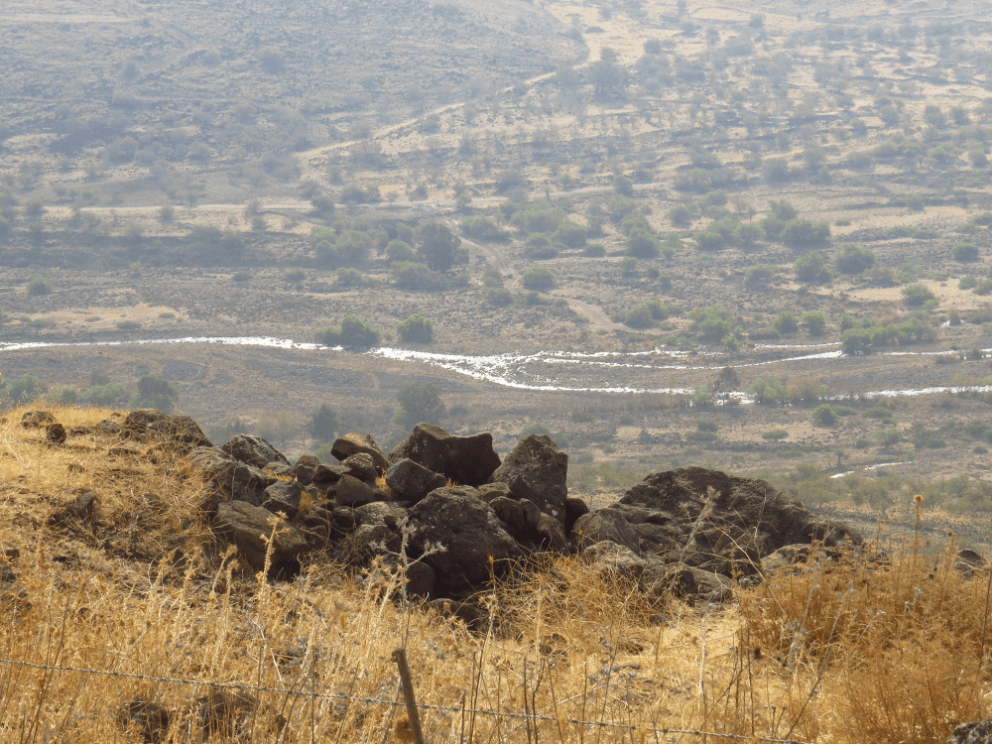

This place is significant. It was where the people crossed with Joshua when they come from the wilderness into the land of promise. Jesus may also be coming out to the desert—to identify with the righteous remnant that is preparing for God’s coming, that is ready for a move of God! He is being obedient to the call, and God is going to define him in this moment.
Immediately coming up out of the water, he saw the heavens opening, and the Spirit like a dove descending upon him; and a voice came out of the heavens: “you are my beloved Son, in you I am well-pleased.” Mark 1:9-11
Mark begins and ends his gospel with the revelation that God is no longer working in the Temple—using the SAME word to do so. In the Greek text here, the heavens don’t just open…they are TORN open at the beginning of his ministry; and God announces that this is his beloved Son. At the END of Jesus’ ministry, when he is on the cross, he utters a loud cry and breathes his last…and the curtain of the TEMPLE was TORN in two, from top to bottom.[18] It is revealed that God is not in the Holy of Holies—no, Jesus is on the cross!
The beginning of the good news of Jesus Christ is the beginning of something unexpected. It’s the beginning—like Genesis—of God working his redemption for creation. The Spirit descends on him like a dove, like the Spirit of God was hovering, or fluttering[19] above the water at the start of creation.
The Spirit descends upon Jesus, and then: Immediately the Spirit IMPELLED him to go out into the wilderness. And he was in the wilderness forty days being tempted by Satan; and he was with the wild beasts, and the angels were ministering to him. Mark 1:12-13 NASB
Jesus is THRUST into the wilderness for forty days: another reminder of the wilderness wanderings, AND…of Elijah’s 40 days in the wilderness traveling to Mt. Horeb, where an angel ministered to him, too.
I have to take a minute to talk about the wild beasts—wild animals—Why does Mark mention THEM in the wilderness? David Wenkel[20] makes an astute observation. Do you remember the creation narrative in Genesis? God created people…to multiply, fill and subdue the earth. Adam and Eve failed in their responsibility to creation—when they failed to subdue the serpent and instead, took their orders from a created creature. In Isaiah, it is noted multiple times that humanity has failed in that continued mandate, and especially, the people of Israel that God has called out. In Isaiah, wild beasts are pictured as having taken over and controlling the land. Wild goats dance on the foundations of cities (Isa 13:21) and hyenas cry in its towers (13:22), and they have taken over what was formerly the place where princes and royalty would reign. Israel’s failure to provide acceptable dominion of wild beasts—anticipates the need for a new humanity that WILL fulfill God’s designs.[21]
Charles Gieschen[22] sees the connection between Isaiah and Mark’s text here, when God declares: Behold, I am doing a new thing; now it springs forth, do you not perceive it? I will make a way in the wilderness and rivers in the desert. The wild beasts will honor me, the jackals and the ostriches, for I give water in the wilderness, rivers in the desert, to give drink to my chosen people, the people whom I formed for myself that they might declare my praise. Isaiah 43:19-21
Adam had failed to subdue—and is sent into the wilderness, outside the garden. Here, the Spirit impels Jesus into the wilderness where he is with the wild beasts…as God’s Son. Jesus is the new Adam—who will emerge from the wilderness, to announce God’s kingdom.
Now after John had been taken into custody, Jesus came into Galilee, preaching the gospel of God, and saying, “the time is fulfilled, and the kingdom of God is at hand; repent and believe in the gospel.” Mark 1:12-15
Jesus is the agent of God’s kingdom, coming as the second Adam, that will get things moving on the path of setting things right again. The good news—is that God has taken up rulership among his people—and he’s doing it THROUGH Jesus.
John’s arrest—is a foreshadowing of what will happen to the rest of the disciples, too…it puts a shadow on the gospel message. What does it mean to be a disciple? You get killed. Jesus will call people to a radical transformation by going the way of the cross—THAT’S unexpected. But while being a part of God’s kingdom means death, it also means resurrection. Jesus came to forgive us of our sin, but his mission was also to introduce us to the passion of living![23] Last week we celebrated that God raised Jesus from the dead. It was a bright spot in the season—joyful and loud! But maybe today you still feel stranded in the wilderness.
Let’s be reminded that: God shows up in unexpected places
We really don’t expect LIFE to come from the wilderness, do we? We WANT God’s kingdom to arrive, but we expect it to come a different way. But a voice is STILL calling in the wilderness. There is never a moment in which God is not at work. He is always at work, always revealing Himself, always doing more than we can imagine,[24] in the places we least expect. Now, Jesus’ face—is probably not going to show up in YOUR tree stump or burnt toast, but he WILL show up in unexpected places in your life.
He may show up: In the Silence
When we stop talking and start listening, God often shows up and takes us off guard. “We need to find God, and He cannot be found in noise and restlessness,” Mother Teresa once said. “God is the friend of silence.”
God may show up: In the Waiting
God often exists in between where we are—and where we want to go. In the in-between times, when we feel stuck between promises and provision—that’s when God is preparing us for what comes next. Isaiah said, “Those that WAIT on the Lord shall renew their strength.” [25]
God shows up: In our Disappointments
When things aren’t going well, we can STILL experience the movement of God in our lives. Perhaps our dis-appointments are really appointments with God—who works behind the scenes to refine us, shape us, and use our circumstances to bring us to a place of flourishing and life!
God even shows up: In our Failings
When we hit a wall, when we sin, we can turn to God and open ourselves up to God’s grace and forgiveness, that is readily available if we ask. Repentance puts us on the way to experiencing God’s presence.[26]
God shows up in unexpected places.
God can use your greatest heartache. He can work through your greatest trial. He can reveal himself –through your deepest pain. God can use the sorrows of life to change us. He is working through our inconveniences, our interruptions, and our setbacks. God shows up in the encouragement and prayers of others. He shows up in the pages of Scripture—He shows up in the little joys and in the big moments of celebration, too. Perhaps God is asking us to see him today where we didn’t expect. Are you willing to be surprised at where God shows up?
Being a follower of Jesus—is to participate in the reality that Jesus is king! We are invited to be a part of his kingdom—a unique community, and we participate in it by doing what glorifies God, with radically new practices that confronts our patterns of living.[27] In this community, God dwells among his people. God is WITH us. God’s presence is WITH us in the wilderness—not in a pillar of cloud and fire, but by his Spirit. Because of Jesus, the heavens have been opened, the curtains have been pulled back, and we are standing in the presence of a different reality.[28]
Let’s pray for God to open our eyes to his presence, even in our wilderness.
Prayer
Gracious Father, you prepare the way in the wilderness—so that we can find Jesus. Your voice in the wilderness calls us, and yet it’s very difficult for us to hear sometimes. Jesus, you speak of suffering and dying, and of the way to the cross and it conflicts with our ideas about power and success and life. The cross is unexpected to us. And yet, time and time again you remind us that you meet us in the wilderness, with the desire to bring us hope, and life to the full!
Holy Spirit, seal our hearts again with the presence and purpose of Jesus—the one whose death brings life—even through a cross. Meet us in our grief, our pain, our disappointments, and our longings, and may we see your hand at work in all of it. Open our ears and speak to us today…by peace or persuasion, assurance or confirmation.[29] Prepare the way in our deserts for the life-giving entrance of Jesus. And through his brokenness make us whole. Amen.
Bibliography
- Alexander, T. Desmond & David W. Baker, eds., Dictionary of the Old Testament: Pentateuch; Downers Grove: InterVarsity Press, 2003.
- Gombis, Timothy G., Tremper Longman III & Scot McKnight, general editors; The Story of God Bible Commentary: Mark; Grand Rapids: Zondervan Academic, 2021.
- Hooker, Morna, A Commentary on the Gospel According to St. Mark; Peabody: Hendrickson, 1991.
- Juel, Donald, Messiah and Temple: The Trial of Jesus in the Gospel of Mark; Missoula: Scholars Press, 1973
- Wright, N.T. Mark for Everyone; Louisville: Westminster John Knox Press, 2001, 2004.
Articles
- Gieschen, Charles A., “Why was Jesus with the wild beasts (Mark 1:13)?”; Concordia Theological Quarterly, 73 no 1 Jan 2009, p 77-80.
- Wenkel, David, “Wild Beasts in the Prophecy of Isaiah”; Journal of Theological Interpretation, September 1, 2011, 251-264.
Websites/Articles online
- https://www.sermonillustrations.com/a-z/u/unexpected.htm
- https://www.theguardian.com/world/gallery/2011/jul/21/jesus-food-sightings
- https://www.kevinathompson.com/god-shows-unexpected-places/
- https://sarasmusings.wordpress.com/2023/07/01/finding-god-in-unexpected-places/
- Joe Iovino, Born to be Mild?, June 20, 2011, https://joeiovino.com/2011/06/20/born-to-be-mild-sermon-text/
- https://www.columbiadailyherald.com/story/opinion/columns/2016/06/15/what-do-motorcycles-have-to/25677305007/
- https://bredenhof.ca/2020/08/18/motorcycle-evangelism/
- https://insider.catalystleader.com/read/4-places-to-encounter-jesus-that-may-surprise-you
Going Deeper Questions
—Have you ever encountered something that is out of place from where you expected it?
—Where do you expect to find God at work?
Read Mark 1:1-5
—Mark begins with a theologically rich statement about the person of Jesus Christ. What is good news to you? What is the good news about Jesus?
What kinds of things are you hoping for in Jesus? In the kingdom of God? In being a part of the church, as followers of Jesus?
—You can read the passages that Mark is combining in Mark 1:1-3 in Exodus 23:20; Malachi 3:1, Isaiah 40:3.
Read Mark 1:6-15
—John the Baptist is to be seen as an Elijah figure who prepares the way for the Lord, and who eats and wears similar things to Elijah.
—What is strange about people coming to the wilderness to be baptized, rather than going to the Temple? What does it tell you about what the people were reminded of? —hoping for?
—What might you have expected to happen after Jesus is baptized and God announces that he is pleased with him? How often do you experience difficult situations after exciting milestones? It’s easy to associate God with comfort and peace and lack of trouble. But God leads his people, and Jesus, into the desert intentionally.
—The wilderness is a theological place—where God meets with his people and provides for them. What wilderness are you experiencing right now? How can you open yourself up to the possibility that God is working, even in your struggles and disappointments?
God shows up in unexpected places
–Compare Mark 1:10-11, and Mark 15:33-39. What do you notice:
-in the conversations between God and Jesus
-in how Jesus is identified in both passages and by whom
-what is torn/opened (1:10 and 15:38 use the same word for that)
—How will you keep your eyes and ears open this week to be more aware of God’s presence in your life?
[1] https://www.theguardian.com/world/gallery/2011/jul/21/jesus-food-sightings
[2] Luke 24.
[3] https://www.kevinathompson.com/god-shows-unexpected-places/
[4] https://sarasmusings.wordpress.com/2023/07/01/finding-god-in-unexpected-places/
[5] https://www.kevinathompson.com/god-shows-unexpected-places/
[6] Huizenga, 22.
[7] Huizenga, 8.
[8] Huizenga, 41,42.
[9] Augustine, Ireneaus, and Origen saw in this allusion a unifying element between the gospel of Jesus Christ and the story of Israel’s Scriptures. (Thomas C. Oden and Christopher A. Hall [eds.], Ancient Christian Commentary on Mark [Downers Grove, IL: IVP, 1998], 2).
[10] Joe Iovino, Born to be Mild?, June 20, 2011 article. https://joeiovino.com/2011/06/20/born-to-be-mild-sermon-text/
[11] https://www.columbiadailyherald.com/story/opinion/columns/2016/06/15/what-do-motorcycles-have-to/25677305007/
[12] https://bredenhof.ca/2020/08/18/motorcycle-evangelism/
[13] Gombis, Timothy G., Tremper Longman III & Scot McKnight, general editors; The Story of God Bible Commentary: Mark; Grand Rapids: Zondervan Academic, 2021, 22.
[14] Donald Juel, Messiah and Temple: The Trial of Jesus in the Gospel of Mark, Missoula: Scholars Press, 1973, 174-175.
[15] Morna Hooker, A Commentary on the Gospel According to St. Mark Peabody: Hendrickson, 1991, 37.
[16] T. Desmond Alexander & David W. Baker, eds., Dictionary of the Old Testament: Pentateuch, Downers Grove: InterVarsity Press, 2003, 897.
[17] Based on N.T. Wright, Mark for Everyone, Louisville: Westminster John Knox Press, 2001, 2004, 2.
[18] Mark 15:37-38
[19] T. Desmond Alexander & David W. Baker, eds., Dictionary of the Old Testament: Pentateuch, Downers Grove: InterVarsity Press, 2003, 135.
[20] David Wenkel, “Wild Beasts in the Prophecy of Isaiah”, Journal of Theological Interpretation, September 1, 2011, 251-264.
[21] Wenkel, 258.
[22] Charles A Gieschen, “Why was Jesus with the wild beasts (Mark 1:13)?”, Concordia Theological Quarterly, 73 no 1 Jan 2009, p 77-80 (79).
[23] Joe Iovino, 4.
[24] https://www.kevinathompson.com/god-shows-unexpected-places/
[25] https://insider.catalystleader.com/read/4-places-to-encounter-jesus-that-may-surprise-you
[26] https://sarasmusings.wordpress.com/2023/07/01/finding-god-in-unexpected-places/
[27] Based on Timothy G. Gombis, Tremper Longman III & Scot McKnight, general editors, The Story of God Bible Commentary: Mark; Grand Rapids: Zondervan Academic, 2021, 25.
[28] Based on N.T. Wright, Mark for Everyone, 5.
[29] Arthur A.R. Nelson, A Book of Prayers.
 Preach it Sista