
-Brenda DeVries 12-4-23
Do you like the smell of baking bread? I live fairly close to a local bakery, and if I walk by in the morning, a wonderful dose of smells wafts from the doors when they are baking bread, cinnamon rolls, donuts and cake…mmm! I don’t really bake much, and I don’t make bread. I’ve made homemade rolls a couple of times, and they were amazing! But it takes some time and work to bake. I DO like to grab a bagel with my husband on the weekends. There’s something about that time—being able to sit across from each other and eat—but also, to have deeper conversations. The table is where we have shared fellowship.
All over the world, people of all cultures gather to share food. Some on the floor, some on chairs and some in living rooms. The church shares together in the celebration of communion around a table. And speaking of bread, churches use sourdough breads, pita loaves, rice cakes, muffins, challah, flatbread and unleavened wafers. Some churches use the same grape juice we do, but others celebrate communion with wine, some red and some white. All over the world, the church gathers around one table. Being around a table is a part of community.
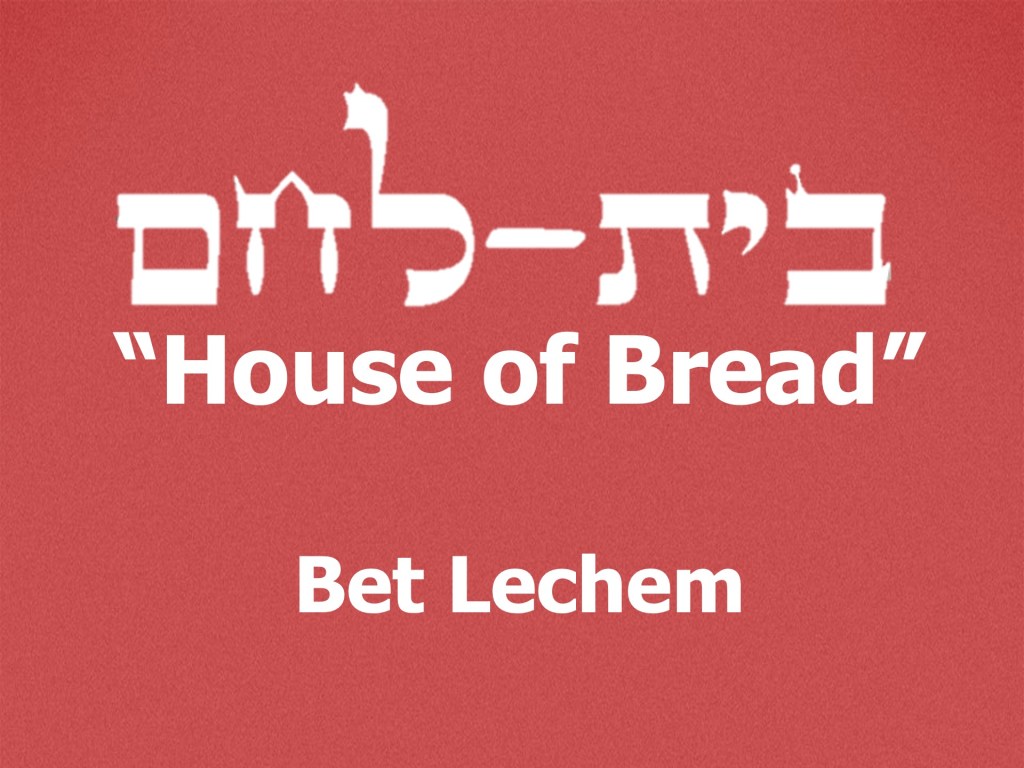
Bethlehem is a familiar town in the Christmas story. Bethlehem means, ‘House of Bread’ Bet—house, Lehem—Bread. The first mention of Bethlehem is found in Genesis. It happens after Jacob gets his name change to Israel, and is traveling—after he has meet up with his brother Esau, and after he has built an altar at Bethel.
Then they journeyed on from Bethel; but when there was still some distance to go to Ephrath, Rachel began to give birth and she suffered severe difficulties in her labor. 17 And when she was suffering severe difficulties in her labor, the midwife said to her, “Do not fear, for you have another son!” 18 And it came about, as her soul was departing (for she died),
that she named him Ben-oni; but his father called him Benjamin. 19 So Rachel died and was buried on the way to Ephrath (that is, Bethlehem). 20 And Jacob set up a memorial stone over her grave; that is the memorial stone of Rachel’s grave to this day. 21 Then Israel journeyed on and pitched his tent beyond the tower of Eder. Genesis 35:16-21 NASB
Bethlehem and Ephrath are mentioned together here, and though they may have started as separate towns, they were associated together by Micah1 …which we’ll see in a few minutes! Ephraim was Rachel’s grandson—Joseph’s son, and Ephraim’s inheritance was later Bethlehem, and the area of Ephrath, if that helps you make a connection.
Moving on. In the book of Judges, there’s a bizarre story that also has to do with Bethlehem. It was a story I strongly resisted doing any work on before, because it is a complicated and gory text. I’ll summarize it briefly here, because I think there’s relevance, in relation to redemption, which we’ll discover as we go along. If you haven’t heard the story before—prepare yourself. It’s a doozy. (You can read it for yourself in Judges 19, if you prefer.)
A Levite takes a concubine from Bethlehem. The term ‘concubine’ in this context refers to a second wife, with no dowry , and lower status.2 But the woman runs back to her father’s house—for whatever reason, and the man goes to Bethlehem to retrieve her. What ensues in this story is horrific. The woman’s father tries to prolong the Levite’s departure, and they spend many nights at a table, eating and drinking together. Each night the father says—stay another night—eat, drink, and let your heart be merry! But after four days of eating, drinking, negotiating? –the man takes his woman and heads out. In between Bethlehem and Judah, in the hill country of Ephraim, they find a place to spend the night. An old man offers them hospitality, which includes safe lodging and a meal. They receive bread and wine, and the host feeds and cares for their donkeys, and even washes their feet. Good guy, right? But in the night, Benjamites from the nearby city of Gibeah come pounding on the door and ask for the host to send his guest –the Levite—out to them. The old man at this point, is carelessly willing—to disregard the care and protection of the weak and helpless.3 The story progresses with a cheapened view of sexuality, and of people and life. At first, the old man refuses to comply, then—he offers his own daughter to the men, which THEY refuse, and finally, the concubine of the Levite is just thrown out the door and offered to the mob of men—worthless fellows—says the text-making their hearts merry.4 The old man and the Levite protect themselves at the expense of the woman who is of little value—she is unnamed, and she is cast out. After a long night of abuse, this poor woman winds up dead on the doorstep. The Levite goes outside, sees her on the doorstep, tells her to get up, checks her pulse, realizes she is dead, picks her up, puts her on his donkey, and takes her home. Then he takes a knife, cuts her into twelve pieces, and sends her throughout all Israel with a note: “Has such a thing ever happened like this in Israel? Consider this! Take counsel. Speak out!”
Why would you tell this story in Advent? (There’s a good reason, I promise!) This is a narrative that ends in tragedy and casts a shadow on Bethlehem in Scripture. The Gibeonites, the Ephraimite host, the Levites, and later the Israelites all stand under the judgment of the text. The Levite, of a priestly lineage, has no regard for what is right in this story. He calls out the evil deed, but he himself was partly to blame for the atrocities committed and is, by all appearances, cold and calloused towards his bride, as he takes her body and breaks it into pieces.
The beginning of the chapter hints at the reason WHY things were so bad at this time in Israel’s history. Notice carefully: Now it came about in those days, when there was no king in Israel, that there was a certain Levite staying in the remote part of the hill country of Ephraim, who took a concubine for himself from Bethlehem in Judah. Judges 19:1 NASB
Contrast that text with the NEXT book of the Bible, and the opening lines there:
Now it came about in the days when the judges governed, that there was a famine in the land. And a certain man of Bethlehem in Judah-went to sojourn in the land of Moab with his wife and his two sons. Ruth 1:1 NASB
In RUTH’S story, we find the Bethlehem that we want, and the hospitality that we wish for. Famine drives the family to Moab—because there was no bread in the “house of bread”—Bethlehem. Unlike the story of the unnamed Levite and his concubine in Judges, ALL of the characters in this story are named5: Elimelech, Naomi, Mahlon and Chilion, Orpah and Ruth… and then…Boaz. Boaz generously leaves food in the field for Ruth to glean. At mealtime, he offers her bread, and she dips it in the vinegar—or sour wine—until she was satisfied—and there was even some left over.6 Fellowship around a table—with bread and wine. She later proposes, and he accepts, and they are married. From the line of Boaz and Ruth comes Obed, who has Jesse, who has David…king David, that is. And although Bethlehem still has a shadow over it: (because of the incident in Judges, and for other things: later the prophet HOSEA announces that because of the sin of the princes of Judah: Gibeah, Ramah, and Benjamin, God is going to send them off to Assyria.)7 The same route that Jacob had taken to Bethlehem in the past, now will become the path that the attacking armies will use to enter Jerusalem. Even though there is a cloud over the people of Bethlehem because of what HAS been, there is also the hint of hope. Through Micah the prophet, God says,
But as for you, Bethlehem Ephrathah, too little to be among the clans of Judah, from you One will come forth for Me to be ruler in Israel. His times of coming forth are from long ago, from the days of eternity. Micah 5:2 NASB
And this, we know, to be a future reference to Jesus—who is born—in Bethlehem—
A descendant of Ruth and Boaz—people of GOOD character and hospitality—A man who shared his bread with those who didn’t have any, and invited the foreigner, the poor, and the widow around his table. Bethlehem: the place with a terrible history AND a future hope.
And now the most familiar text of the Christmas season:
Now in those days a decree went out from Caesar Augustus, that a census be taken of all the inhabited earth. 2This was the first census taken while Quirinius was governor of Syria. 3 And everyone was on his way to register for the census, each to his own city. 4 Joseph also went up from Galilee, from the city of Nazareth, to Judea, to the city of David which is called Bethlehem, because he was of the house and family of David, 5 in order to register along with Mary, who was engaged to him, and was with child. 6 While they were there, the days were completed for her to give birth. 7 And she gave birth to her firstborn son; and she wrapped Him in cloths, and laid Him in a manger, because there was no room for them in the guest room. Luke 2:1-7 NASB
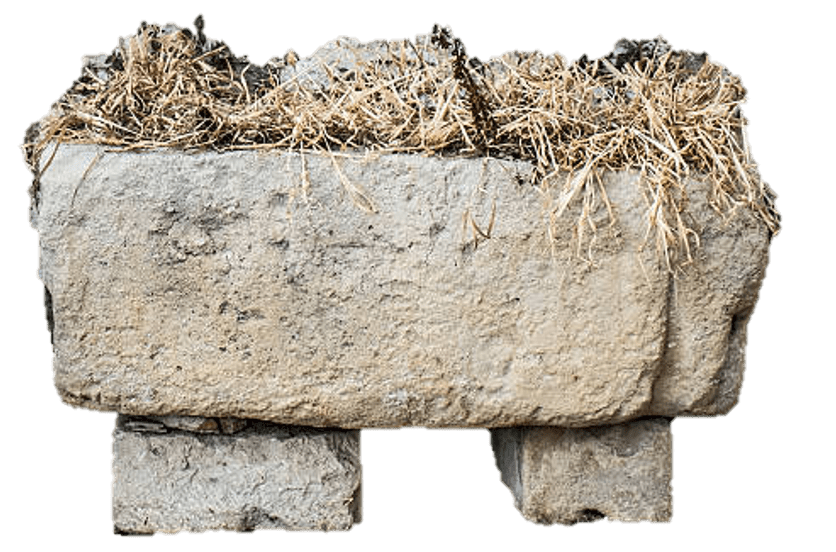
Bethlehem is where Joseph is from, and it’s possible that Mary was too.8 It’s the place where Jesus is born. The hospitality of Bethlehem is questionable here. The houses were full of people coming for the census, and it appears that no one was willing to give up their spot for a baby to be born. But all of that is part of a bigger picture. Because where Jesus IS laid after he is born—is in a feedbox. Jesus is laid in a box where animals, who were often used as food themselves, came to eat. Bethlehem—house of bread—truly becomes the house of bread, because within its walls is born the one who was the Bread of Life.
The apostle John writes that Jesus—’was in the beginning with God. All things came into being through Him, and apart from Him nothing came into being that has come into being. In Him was life…9 And so, we realize that Jesus is the Tree of Life that brings life from the beginning in Genesis. He provided the daily manna that came down from heaven in the wilderness. He sustained the widow and Elijah with bread. After Jesus had put on human flesh and was born among us, He grew up and increased in wisdom and stature and in favor with God and man.10 He broke the bread and fed the thousands. He shared the Word of God and fed the souls of many more. And when it was time, he was crushed, broken, and put in the grave—like an oven—
to cook. From his life comes life. He is the Lord’s Supper, and the Marriage Supper of the Lamb.
Jesus said, “I am the Bread—living Bread!—who came down out of heaven. Anyone who eats this Bread will live—and forever! The Bread that I present to the world so that it can eat and live is myself, this flesh-and-blood self.”11
The body of Jesus is broken for us.
The story of the woman and the Levite in Judges is not any more or less horrific than the one we know about Jesus—and there are parallels there, that we would do well to notice.
-The Levite in Judges went to Bethlehem to call back his bride. Jesus came to Bethlehem to call and claim his bride, too.
-The Levite was from a tribe that would have given him the right to be a priest, but he was not worthy of that title. Jesus was not from a priestly lineage, but he earned the right to become the ultimate high priest.
-The Levite went to Bethlehem to retrieve his wife, but when push came to shove, he protected himself at her expense—and threw her out to the mob. The murderous mob comes to call at Jesus’ door, too, and rather than throwing his bride out to them, he will sacrifice himself for her sake. HIS body will be the one torn and pierced.
-The unnamed woman died on the doorstep, outside the house, and was then cut into pieces and distributed to the twelve tribes. Jesus will die outside the doors of the city, and his body will be broken and given for all twelve tribes of Israel, and for the world!
–Unlike that Levite who once surrendered his concubine to death, Jesus, the Bridegroom, will wrench HIS bride from the grasp of death. Once upon a time, a murder cast a shadow over their future, but through Jesus, Bethlehem—house of bread—becomes the place of redemption. Jesus gives his own body to be broken, and he invites the marginalized, the stranger, and the unnamed ones to his table, in the greatest act of hospitality the world has ever known. The body of Jesus is broken for us.
His call to the church, now, is to practice the hospitality that he models. In the early church, Paul writes that the early believers:
…were continually devoting themselves to the apostles’ teaching and to fellowship, to the breaking of bread and to prayer. Acts 2:42 NASB
Table fellowship ranked right alongside listening to the apostle’s teaching, to fellowship and prayer. Many of you probably have plans to sit down and eat dinner with family members or friends on Christmas Day, or sometime during this month, but the church is part of God’s family—together. We may have different family experience, different occupations, different hobbies, different political views, and different sports teams that we sheer for, but Jesus’s broken body is what brings us together as the now body of Christ. The community that began in Jerusalem met often around a table. They celebrated Jesus’ life and death and resurrection with potluck meals, a little wine and some fellowship. Like that first Church community two thousand years ago, we hold table fellowship as a mark of the church. As the ‘body and bride of Christ’, we join in this shared meal, and become united by the bread we eat.
It’s easy to overlook spending time together around a table. When our whole family gets to sit around the table and talk and laugh and pass the bread, it bonds us in a different way. As a family of God, when we break bread together, face to face, we’re participating in something extraordinary. Especially when we can share our concerns and our joys; when we can talk about what Jesus is doing in us; and when we can be encouragers, and honest with our lives. In this life we are fellow table guests, on the way to the same great feast. Perhaps, during this holiday season, you can practice that hospitality with a face-to-face get together with someone from your church, whether it be opening up your house for one meal, sitting down for dessert with someone to get to know them better, or going out for a bagel and coffee.
Jesus told us that people would come from east and west, north and south to sit at table with him. And they do. When the church eats together, we proclaim that we are a part of something unique—Jesus’ globe-spanning body. The Holy Spirit is moving and working all over the world, from Africa to Europe, and from Asia to the Americas. We rejoice together in the feast Christ has prepared. Yes, we notice that the world right now suffers from the horrible atrocities—just like the woman in the story in Judges. Women and children, men and families are treated as discardable human beings—used as pawns in a bigger scheme. The wars in ALL corners of the world demonstrate that, and especially what we see in Israel right now. Modern day Bethlehem—has cancelled traditional festivities, parades and gifts, and no tree will be lit this Christmas…but, the Light of the World can still be found there, as the churches still plant to gather—to pray and collect offerings for Gaza. One Palestinian pastor says that ‘when he sits with his children on Christmas Day, tree lit with windows closed, he will tell them the story of a baby in a manger who died on a cross. And he will emphasize that the Resurrection illustrates that Jesus’ suffering brought hope to all who believe in him…and that is the hope they hold out to Gaza.’12
In Gaza, many churches and homes have been destroyed, and one Christian says,
“We see death everywhere. We smell death everywhere. But in the midst of sadness, pain, and heartbreak, we look at the face of Jesus Christ…Love is the most effective weapon for peace.”13 The body of Christ is still broken and given for us. It is still nourishment for our souls, and for us as people. And even though Bethlehem suffers in these tumultuous times, Jesus holds out his broken body for them, too, and offers his presence—Emmanuel.
But just as Jesus warned some people about what they were hoping to get from him,
we need to have caution, too. Some in the crowds just wanted signs. Some of them were looking to Jesus only as a means of filling their bellies with food. They wanted Him—only for what he could DO for them. It’s easy to get caught up in that mentality. We can get wrapped up in wanting stuff—especially at Christmas. We can do things in our relationships that compromise God’s best, because we ache to be wanted, to be loved. We can sell out in our morals, our financial dealings, and our work ethic, because of what we fancy or crave. Jesus knows our motives for coming to him, and we shouldn’t take that lightly. Jesus was born as our Savior—the one who will save us from our SIN! He’s the one who offers himself, so that we can start to live a different way; so that we can put our feet on the paths of life! When we seek HIM first, he promises that the other stuff will follow in the end. The Bread of Life came at a price, and though it is offered freely, it cannot be taken without consideration.
The smell of fresh baked bread is a good one, isn’t it? Even better than the smell of bread, though, is the scent that rises to heaven when unity and fellowship are evident among Christ’s people. Jesus, the Bread of Life, offers us himself this Christmas—in his presence, and at his table. The way that we delight in fresh bread is the same way we must desire the True Bread. Jesus said, ‘Do not work for food that spoils. Work for food that lasts forever. That is the food the Son of Man will give you.’ Jesus, the Bread of Life, born in Bethlehem, offers us a piece of himself. He has come to redeem what was broken, and to turn bad stories into reclaimed ones. His love is more fulfilling, more satisfying, and more sacrificial than any love you will ever know. The body of Jesus was broken for us.
Prayer: Heavenly Father, in Jesus, you provide us with the bread of life, and we are here—because we want to have fellowship with you. We confess that we too often ask you to bless what we do rather than seeking to do what you bless. We have often come to you for our own wants and pleasures, and discovered they were only husks for our souls. Have mercy on us, Lord, and forgive us.
Jesus, when we are in the presence of your table, we are reminded of the way you reveal yourself—in the experience of a shared meal. We are humbled by your hospitality, as you offer yourself for the world. We are indebted to you, as you gave up your body in our place, and did not throw us out to be devoured and destroyed by the evil one. We cry out at the empty and barren places in our world, in our homes, and in our relationships today. We are in desperate need of your nourishment and life for our souls.
Holy Spirit, transform us into a community that hungers for your Word and thirsts for your presence. As we gather around your table, may the broken body of Jesus fill us with wonder and awe as we remember his mysterious and marvelous love. God, take us, bless us, break us, and give us, too—so that by your power, our homes and tables will be places of feasting and fellowship, transformed by your grace. Amen.
- Tremper Longman III, The Story of God Commentary: Genesis, Grand Rapids: Zondervan, 2016, 443. ↩︎
- Victor H. Matthews, Judges & Ruth, Cambridge: Cambridge University Press, 2004, 181. ↩︎
- Arthur E. Cundall and Leon Morris; Judges and Ruth, TOTC, Downers Grove: InterVarsity Press, 1968, 2008, 189. ↩︎
- Judges 19:22 ↩︎
- Gaiser, Frederick J.; “Which Bethlehem?: A tale of two cities”; Word & World, 33 no 4 Fall 2013, 349-356, 354. ↩︎
- Ruth 2:14 ↩︎
- Hosea 5:8-9 ↩︎
- Craig S. Keener, The IVP Bible Background Commentary: New Testament, Second Edition; Downers Grove: IVP Academic, 2014, 185. ↩︎
- John 1:2-4a ↩︎
- Luke 2:52 ↩︎
- John 6:51 MSG ↩︎
- Christianity Today ↩︎
- Christianity Today ↩︎
Going Deeper Questions
-What is your favorite food to eat with friends?
-If you have an interest, you can read Judges 19:1-30, for the story of the Levite and his concubine. For sure, consider the parallels from Judges 19:1 and Ruth 1:1 above.
-What are the similarities? What are the differences? What strikes you about these two stories, if you know them in full?
-In Ruth’s story, Boaz is the hospitable host who offers her bread and wine and fellowship at a table. From their marriage comes Obed, who has Jesse, who has king David. And from David’s line comes Jesus, who was also born in Bethlehem.
Read Luke 2:1-7
-Are there any new things you notice when you read the text again?
-The word manger is also translated as feeding trough.
Jesus says, “I am the Bread, living Bread, who came down out of heaven. Anyone who eats this Bread will live—and forever! The Bread that I present to the world so that it can eat and live is myself, this flesh-and-blood self.” John 6:51 MSG *You can read John 6:26-51 for a fuller scope of the story.
The body of Jesus is broken for us.
-What is broken in you that needs to be made whole? Pray and ask God to redeem and restore your story. He’s in the business of healing and redemption!
Table fellowship ranked right alongside listening to the apostle’s teaching, to fellowship and prayer. (Acts 2:42-47)
-What do you do now that most resembles that kind of community?
-What will you do from here to help relationships to deepen?
Pray for Bethlehem today, and all of the Middle East, as they experience the effects of war. Confess the ways in which you come to Jesus only to get something. Ask the Holy Spirit to give you an awareness and willingness to participate in table fellowship more intentionally.
 Preach it Sista